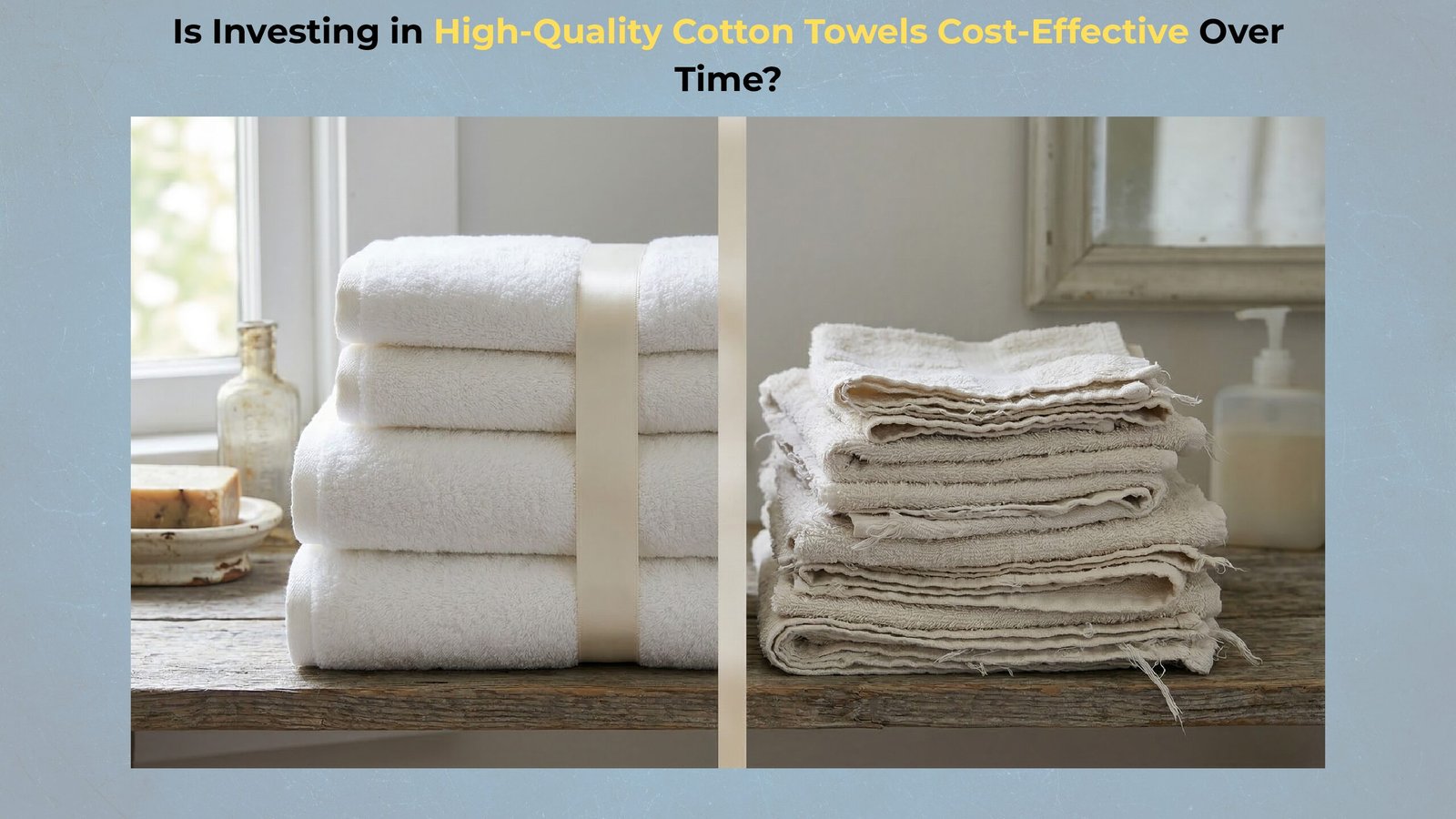
Is Investing in High-Quality Cotton Towels Cost-Effective Over Time?
An Engineering Guide to Total Cost of Ownership (TCO) and Textile Procurement ROI.
Yes, investing in high-quality cotton towels is considered cost-effective over time. Although they have a higher initial purchase price, their superior durability, longevity, and sustained performance mean they do not need to be replaced as frequently as lower-quality alternatives.
Task Fulfillment Statement
This guide audits the financial and technical variables of premium cotton to verify why higher initial acquisition capital results in lower long-term household expenditures.
Establishing a distinction between “Sticker Price” and “Total Cost of Ownership (TCO)” is essential for managing critical cotton towel durability factors. Non-optimized inventory triggers unplanned household costs through frequent replacement cycles and rapid performance degradation.
Why Does High-Quality Cotton Towel Cost-Effectiveness Matter for Long-Term Budgeting?
High-quality cotton towel cost-effectiveness directly influences long-term budgeting by reducing the annual frequency of replacement cycles and minimizing the waste generated by premature fiber failure.
A 10-year lifespan textile provides superior fiscal stability compared to a 12-month utility alternative. Unit price is an insufficient metric for evaluating textile value because it ignores the technical endurance required for a decade of use.
What Are the Hidden Costs of Low-Durability Towels?
High-quality cotton towel cost-effectiveness exposes the hidden costs of budget linens, such as excessive lint-trap mass loss and the rapid thinning that leads to total wicking failure.
The “Death by Lint” phenomenon demonstrates that every gram of lint captured in a dryer represents physical mass lost from a low-tenacity towel. Replacing a $5 towel annually results in higher cumulative costs and higher landfill impact than a single $40 investment over a decade. Low-tenacity carded fibers induce rapid mass loss, which compromises high-quality cotton towel cost-effectiveness.
How Does Sensory ROI Enhance High-Quality Cotton Towel Cost-Effectiveness?
High-quality cotton towel cost-effectiveness includes a sensory return on investment (ROI) because premium fibers maintain their epidermal smoothness and “luxury feel” throughout the entire amortization period.
Value back for every dollar spent extends beyond durability to dermatological comfort and skin barrier protection. Budget towels often acquire a “scratchy” hand-feel after just 10 cycles due to fiber calcification, effectively ending their “comfort life” long before their structural failure. These sensory returns depend entirely on the technical standards and fiber morphology described in our towel material guide.
What Technical Standards Define High-Quality Cotton Towel Cost-Effectiveness?
Technical standards define high-quality cotton towel cost-effectiveness by establishing measurable benchmarks for fiber staple length, tensile strength, and perimeter reinforcement.
Why Is Extra-Long Staple (ELS) Fiber the Baseline for High-Quality Cotton Towel Cost-Effectiveness?
High-quality cotton towel cost-effectiveness originates with Extra-Long Staple (ELS) fibers because longer cotton strands (> 34mm) create a “Strong Rope” yarn architecture with significantly fewer ends to fray or pill.
Utilizing the “Strong Rope” analogy reveals that longer strands provide more overlapping anchoring points, increasing the yarn’s breaking strength. ELS fibers like Egyptian Giza or American Pima exhibit 30% higher tensile strength per ASTM D5034 testing compared to Upland varieties. The Uniformity Index—the HVI measure of fiber length consistency—ensures yarn stability throughout the lifecycle.
How Does Construction Quality Drive High-Quality Cotton Towel Cost-Effectiveness?
High-quality cotton towel cost-effectiveness persists through heavy-duty use when the textile utilizes double-needle lockstitching and high SPI (stitches per inch) to prevent longitudinal hem unravelling.
The anti-fray standard mandates 12-14 SPI to balance seam strength with fabric flexibility. Perimeter failure is the #1 cause of towel disposal; a towel with a perfect pile but a failed hem is functionally decommissioned. Double-needle lockstitching isolates thread breaks, which secures high-quality cotton towel cost-effectiveness.
Analyzing the “Cost-Per-Use” Math of High-Quality Cotton Towel Cost-Effectiveness
High-quality cotton towel cost-effectiveness is mathematically validated by calculating the Cost-Per-Use (CPU), which can be precisely modeled through a towel lifespan calculator to spread the initial acquisition capital across a larger number of laundry cycles.
Calculating the 5-Year Replacement Cycle
High-quality cotton towel cost-effectiveness delivers a 30% to 50% savings over a decade because the durability of premium fibers allows for a replacement cycle of 6 to 10 years. This duration serves as a core component of Egyptian cotton lifespan cost justification.
A $10 budget towel replaced annually results in a $50 expenditure over five years, whereas a $40 ELS towel replaced once every 6 years remains a $40 investment. The “cheapest” option results in a 25% higher annual expenditure compared to the premium alternative.
How to Compare Options for Optimal High-Quality Cotton Towel Cost-Effectiveness?
Comparing budget versus premium options for high-quality cotton towel cost-effectiveness requires weighing the unit price against the technical durability metrics to identify the inventory “sweet spot.”
| Category | Initial Price | Est. Lifespan | Cost-Per-Use (CPU) | Value Rank |
|---|---|---|---|---|
| Economy (Upland) | $5 – $10 | 1 Year | $0.030 | Low (Rapid Replacement) |
| Mid-Range (Turkish) | $15 – $25 | 3–5 Years | $0.010 | High (Turkish cotton long-term value) |
| Premium (Egyptian) | $30 – $60 | 6–10 Years | $0.008 | Highest (ELS Durability) |
How Do You Identify Diminishing Returns in High-Quality Cotton Towel Cost-Effectiveness?
High-quality cotton towel cost-effectiveness plateaus when price increases originate from “designer brand markup” rather than measurable improvements in fiber staple length or GSM density.
A price jump for Giza 45 cotton represents a technical quality markup, whereas a logo embroidery represents a non-functional aesthetic markup. For a deeper dive into the technical metrics, consider our audit of Egyptian cotton price vs. value. Linking selection to essential laundry protocols ensures the protection of the investment capital.
Which Laundry Protocols Maximize High-Quality Cotton Towel Cost-Effectiveness?
Maximizing high-quality cotton towel cost-effectiveness requires strict adherence to pH-neutral laundering and low-temperature drying to preserve cotton towel softness maintenance and prevent the molecular degradation of the cellulose fibers.
Utilizing the ISO 6330 laundering standard provides the necessary baseline for domestic care guidelines.
Why Must You Avoid Chemical Softeners to Preserve High-Quality Cotton Towel Cost-Effectiveness?
High-quality cotton towel cost-effectiveness fails prematurely when treated with chemical softeners because the hydrophobic silicone polymers coat and weaken the cellulose fibers.
Mandating the replacement of liquid softeners with white distilled vinegar (acetic acid) maintains natural absorbency. Silicone coatings block capillary channels and neutralize high-quality cotton towel cost-effectiveness.
How Do Low-Heat Drying Protocols Support High-Quality Cotton Towel Cost-Effectiveness?
High-quality cotton towel cost-effectiveness persists through more cycles when utilizing low-to-medium heat settings to prevent “hornification” and fiber brittleness.
The term Hornification refers to the irreversible loss of fiber swelling capacity caused by excessive thermal stress. Linking drying settings to performance recovery maintains the amortization cycle.
How to Restore Performance to Preserve High-Quality Cotton Towel Cost-Effectiveness?
Preserving high-quality cotton towel cost-effectiveness involves executing periodic chemical resets to strip away mineral deposits and detergent salts that inhibit wicking.
How Does Stripping Detergent Buildup Restore High-Quality Cotton Towel Cost-Effectiveness?
High-quality cotton towel cost-effectiveness recovers its original wicking velocity when laundered with sodium bicarbonate (baking soda) and vinegar to exfoliate the textile surface.
Running a hot cycle with half a cup of baking soda removes the invisible film that causes a “slippery” texture. This restoration protocol is the final technical step before the strategic audit.
Audit Your Strategy with the High-Quality Cotton Towel Cost-Effectiveness Checklist
Executing a technical audit of high-quality cotton towel cost-effectiveness empowers buyers to verify current inventory performance and validate future procurement decisions.