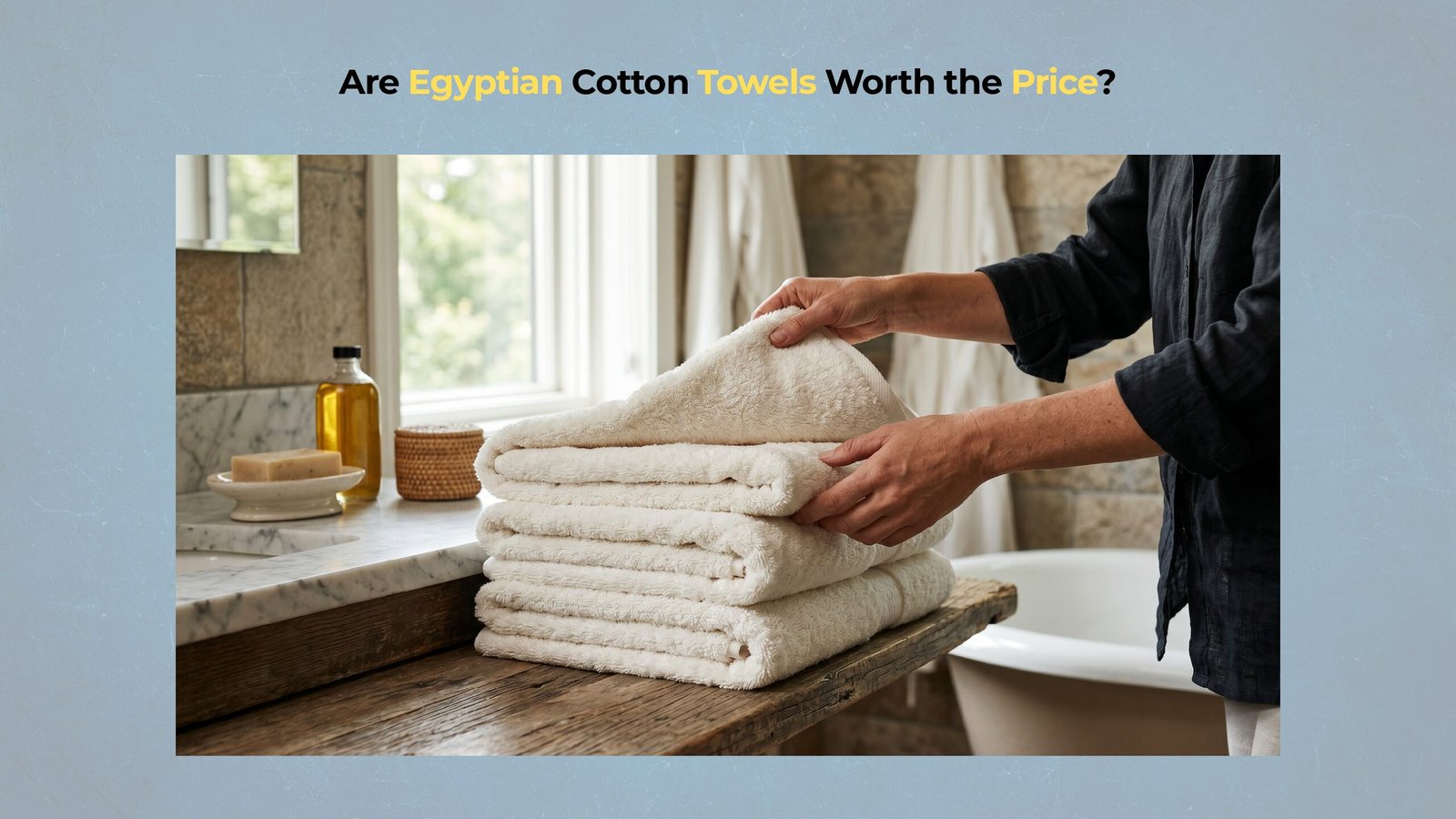
Technical Report: Textile ROI
Yes, Egyptian cotton towels are generally worth the price if you prioritize a low fiber protrusion index, high hydrophilic capacity, and an extended utility cycle. Constructed from extra-long staple (ELS) fibers, they provide high surface fiber density and maintain structural integrity by demonstrating slower tensile degradation compared to short-staple cotton.
The material-to-utility ratio of Giza-harvested cotton represents a significant departure from standard upland varieties. By utilizing a specific fiber geometry that maximizes moisture regain, these textiles minimize the frequency of replacement, effectively offsetting the higher initial procurement costs through superior mechanical performance and longevity. Integrating extra-long staple (ELS) fibers ensures that the textile maintains its tactile smoothness and structural durability throughout extensive industrial laundering cycles.
Assess Egyptian cotton towel value to justify the investment
Assessing Egyptian cotton towel value requires a comparison of the high initial entry cost against a significantly extended replacement cycle that outlasts mass-market alternatives. Research conducted by Cotton Incorporated highlights that hand-picked ELS fibers maintain their secondary cell wall structure better than machine-harvested upland varieties, which often suffer mechanical stress during ginning.
Mass-market alternatives typically rely on short-staple cotton that exhibits a high rate of fiber shedding during early laundering cycles. In contrast, the slower tensile degradation of ELS fibers ensures that the base weave remains dense even after fifty or more commercial wash cycles, preserving the original weight and functionality of the textile.
Why does Extra-Long Staple (ELS) drive Egyptian cotton towel value?
The value of Egyptian cotton towels is largely driven by the structural advantages of extra-long staple fibers, which create stronger and more continuous yarns. To understand this foundation, it is useful to explore how extra-long staple Egyptian cotton fibers improve durability and performance.
Durability correlates more strongly with fiber length and yarn construction than Grams per Square Meter (GSM) weight alone. While a high-GSM towel might appear dense, if constructed from short fibers, it will suffer from rapid “pilling” as the short ends migrate to the surface and detach, leading to a thin, non-absorbent base.
Identify performance properties that define Egyptian cotton towel value
Egyptian cotton is known for its high moisture retention capacity, which contributes to its plush feel and absorption strength. To connect this with real-world usability, it is useful to review what determines towel absorbency and how it affects performance. Reference the ASTM D4772 standard for surface water absorption to explain the hydrophilic capacity of ELS cotton.
The absorption mechanism relies on “moisture regain” and “lumen expansion” as scientific drivers of absorbency. As water enters the cotton fiber, the internal lumen expands to accommodate the liquid volume, a property that is significantly more pronounced in long-staple varieties due to their uniform cell structure.
Scientific Definition
Hygroscopy: The physical property of a fiber to attract and hold water molecules from the surrounding environment through either absorption or adsorption, critical for rapid skin-to-textile moisture transfer.
Compare Egyptian cotton towel value to Turkish and bamboo alternatives
However, increased density also leads to slower drying, which can impact usability in humid environments. Because of this trade-off, it is helpful to understand how quick-dry performance affects usability and drying efficiency.
Drying velocity represents a separate technical metric. While Egyptian cotton dominates in moisture retention capacity, Turkish cotton fibers are engineered for drying efficiency, making them more suitable for humid climates where bacterial growth in damp towels is a primary risk.
| Feature | Egyptian (ELS) | Turkish Cotton | Bamboo Blend |
|---|---|---|---|
| Tactile Profile | High Surface Fiber Density | Smooth / Flat | Silky |
| Moisture Absorption | Highest (ELS) | High | Medium |
| Drying Velocity | Slow (High Density) | Fast (Efficient) | Medium |
To objectively compare Egyptian cotton with other towel materials based on performance, durability, and cost, you can use a data-driven towel comparison template to evaluate real value.
Calculate the long-term ROI of Egyptian cotton towel value
Calculating the long-term ROI of Egyptian cotton towel value necessitates a cost-per-use formula that accounts for the softening of fibers as finishing agents are removed and cellulose structures relax during repeated washing.
Textile ROI Analysis
$CPW = \text{Price} / (\text{Washes Per Week} \times 52 \times \text{Years})$
If you want to calculate whether a premium towel delivers better long-term ROI based on your usage habits, you can use a towel lifespan calculator to estimate cost-per-use and replacement cycles. This helps visualize how the higher initial procurement costs of Giza-grade cotton are effectively offset by its mechanical performance and longevity.
Service life becomes the defining variable in the subject of sustainable consumption. Unlike standard towels that suffer from structural failure within 18 months, authentic Giza textiles maintain their tensile strength and pile integrity for significantly longer durations.
Preserve Egyptian cotton towel value through specific care protocols
Preserving Egyptian cotton towel value through specific care protocols ensures that the hydrophilic capacity remains unblocked by synthetic chemical residues. Cite Cotton Incorporated laundry science regarding the hydrophobic effect of liquid fabric softeners, which coat the ELS fibers in a waxy film that repels moisture.
Maintaining performance and preventing residue buildup requires proper washing and drying routines. To connect this with everyday care, it is useful to review what care instructions should be followed to preserve towel performance and longevity.
Avoid marketing pitfalls that diminish Egyptian cotton towel value
Avoiding marketing pitfalls that diminish Egyptian cotton towel value requires a critical audit of labels like “Egyptian-style,” which often mask inferior short-staple blends. Authentic ELS cotton is a premium commodity with a distinct market floor; any product priced significantly below this baseline is likely utilizing a blend or a non-certified upland variety.
| Marketing Red Flag | Hidden Structural Issue | Verified Value Indicator |
|---|---|---|
| “Egyptian-Style” | Short-staple / synthetic blend | “Certified 100% Egyptian” |
| Low GSM | Insufficient hydrophilic density | High density / ELS Yarn |
| Anomalous Low Price | Below ELS commodity floor | Premium market price tier |
Use this quality checklist to verify Egyptian cotton towel value
Using this quality checklist to verify Egyptian cotton towel value before buying facilitates a final audit of material origins and construction quality to ensure the investment is secure.
Is the cotton source certified as authentic 100% Giza or Egyptian cotton?
Does the weight (GSM) align with a high surface fiber density profile?
Are the hems reinforced or double-stitched to prevent ELS fiber fraying?
Is the towel verified as being free of synthetic “Silicon” softening coatings?
Does the product feature OEKO-TEX or GOTS safety certifications?
Frequently Asked Questions
Roughness is typically caused by detergent buildup or thermal degradation of cellulose fibers. Overusing detergent clogs the fiber lumen, while high heat drying makes ELS fibers brittle. Use a vinegar-based rinse to strip minerals and dry on medium heat to maintain tactile smoothness.
Not necessarily. While higher GSM increases total water holding capacity, it also significantly increases drying time. For most domestic users, a 600-700 GSM towel offers the best balance of hydrophilic capacity and drying velocity, whereas 900 GSM towels are better suited for hotel environments with industrial dryers.
Authentic Giza cotton will feature a trademarked logo from the Cotton Egypt Association. Additionally, true ELS towels maintain their density after washing and do not pill. Check for the premium market price tier; authentic Giza cotton is a high-cost commodity and rarely appears at budget prices.
No. Fabric softeners create a hydrophobic silicone coating on the ELS fibers. This prevents water from reaching the absorbent hydrophilic core, effectively ruining the towel’s performance. For softness, rely on the natural relaxation of the ELS cellulose structure during a medium-heat tumble dry.
Technical Disclaimer
The technical evaluations, fiber analysis, and ROI calculations presented in this document are provided for educational and informational purposes only. While every effort has been made to ensure accuracy based on ASTM D4772 standards and industry-standard textile research, individual product performance may vary significantly based on specific manufacturing processes, yarn twist levels, and user care protocols.
TowelDaily Research Wing maintains a position of absolute neutrality; references to specific fiber origins (e.g., Giza) or industry bodies (e.g., Cotton Incorporated) do not constitute a commercial endorsement. Users are advised to verify certification labels (OEKO-TEX, GOTS, Cotton Egypt Association) independently before making high-tier textile investments. This report does not constitute professional financial or material science advice.