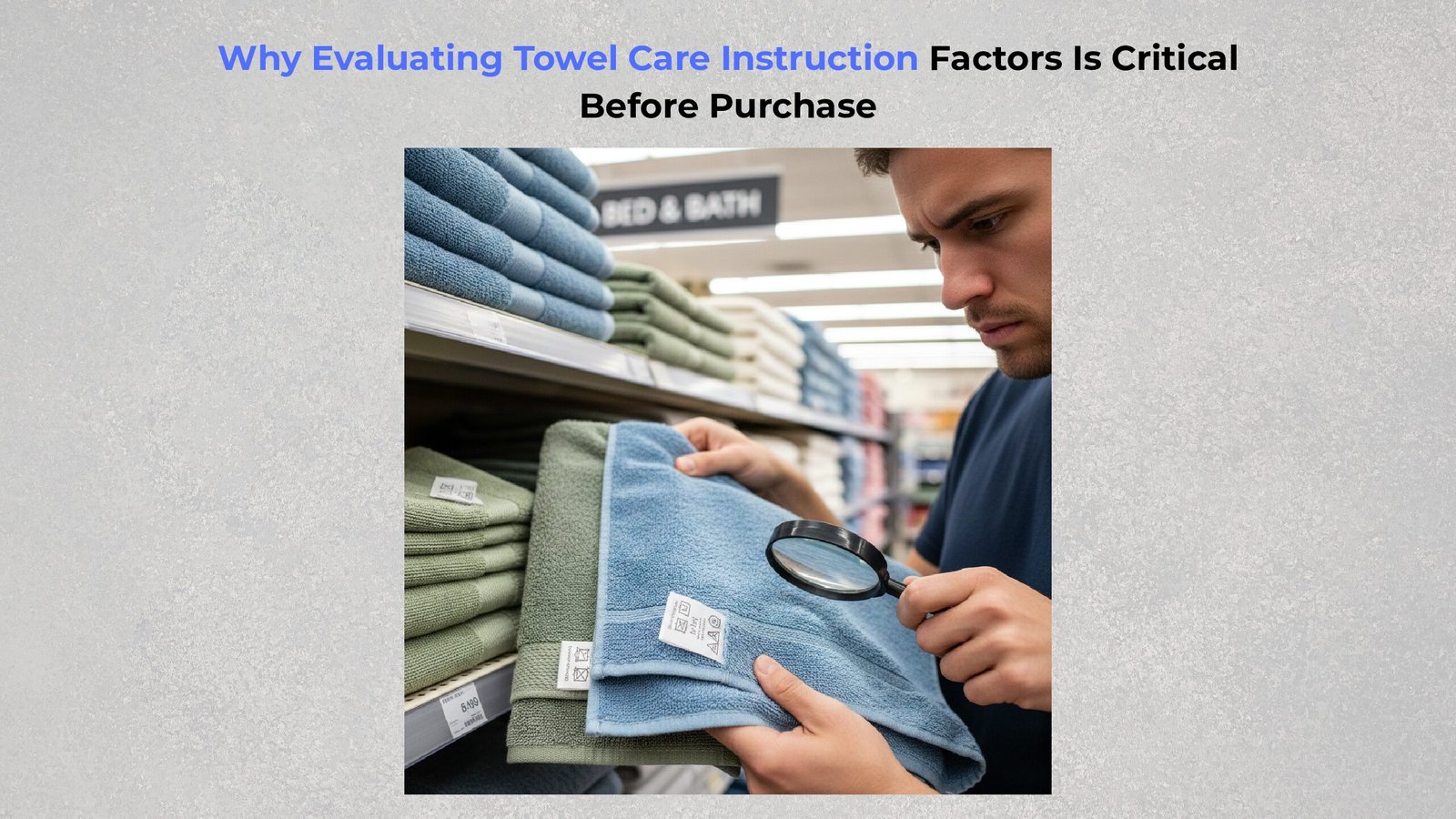
Why Evaluating Towel Care Instruction Factors Is Critical Before Purchase
An industrial maintenance framework for auditing fiber recovery, thermal thresholds, and biological safety.
EEvaluating Towel Care Instruction Factors is critical before purchase because the specified laundering temperature, chemical restrictions, and mechanical limits directly determine the textile’s long-term wicking performance and hygienic safety.
Before committing to a specific washing routine, it’s helpful to understand what are the 16 factors to consider before buying a towel, since maintenance directly affects durability, softness, absorbency, and long-term value. In the domain of facility management and high-performance home maintenance, care labels serve as the definitive “operating manual” for fiber health.
The Value Efficiency Formula
$$\frac{\text{Replacement Cost} + \text{Annual Utility Overhead}}{\text{Estimated Cycle Life}} = \text{Towel Care Instruction Factors Value Efficiency}$$
This objective calculation ensures that the true cost of a towel is measured by its maintainability, particularly regarding the biological risks and biofilm growth that occur when care limits are breached.
Why Analyzing Towel Care Instruction Factors Prevents Fiber Calcification and Biofilm Growth
Analyzing Towel Care Instruction Factors prevents fiber calcification and biofilm growth because adhering to technical laundering protocols ensures the total removal of organic lipids and detergent residues.
When towels lose their “thirsty” wicking ability or develop persistent musty odors, the root cause is rarely the age of the fabric, but rather a failure in environmental calibration. Without the correct thermal and chemical inputs, detergent molecules and hard water minerals bond to the yarn capillary surfaces, effectively “choking” the fibers.
Towel Care Instruction Factors Maintenance Risk Matrix
| Variable | Deviation Impact | Performance Result | Hygiene Risk |
|---|---|---|---|
| Temperature | Low (<40°C) | Poor oil emulsification | High Pathogen Retention |
| Chemicals | High pH / Softener | Fiber “glazing” | Total Wicking Failure |
| Agitation | Excessive | Longitudinal fraying | Structural Mass Loss |
Executing the Towel Care Instruction Factors Hygiene Audit
Executing the Towel Care Instruction Factors hygiene audit allows buyers and facility managers to identify failures in the laundering cycle that compromise the textile’s biological safety.
Standard industrial hygiene benchmarks require specific thermal thresholds (often >60°C) to achieve total neutralization of common household pathogens and skin flora. Quantitative observations in controlled environments indicate that washing below the specified thermal Towel Care Instruction Factors can result in a 40% higher microbial retention rate after the dry cycle.
Towel Care Instruction Factors Hygiene Audit Checklist
What Technical Standards and Symbols Define High-Performance Towel Care Instruction Factors
Technical standards and symbols define high-performance Towel Care Instruction Factors by providing universal, laboratory-verified benchmarks for maximum mechanical and thermal stress. To understand how these care standards correlate with overall fabric longevity, review our comprehensive [Textile Quality Guide].
How Standardized Care Symbols Validate the Technical Limits of Towel Care Instruction Factors
Standardized care symbols validate the technical limits of Towel Care Instruction Factors by defining the specific machine settings required to preserve fiber dimensions and tensile strength.
Repeated high-temperature drying can weaken fibers over time, making it important to explore how evaluating durability helps you choose a better towel before selecting maintenance-heavy options. The ISO 3758 standard provides a coded language for manufacturers to prevent such degradation.
Why Chemical Compatibility in Towel Care Instruction Factors Dictates Absorbency Retention
Chemical compatibility in Towel Care Instruction Factors dictates absorbency retention by restricting the use of surfactants and softeners that alter the fiber’s natural hydrophilicity.
Overusing detergent or softeners may affect moisture performance, so it’s useful to read why towel absorbency is important to consider before you buy when evaluating washing instructions. Chemical softeners utilize fatty acids that fill microscopic gaps, effectively “plugging” the towel core.
Towel Care Instruction Factors Symbol Logic Matrix
| Symbol | Technical Action | Impact on Fiber Integrity |
|---|---|---|
| Tub + Degree | Thermal Setting | Determines oil removal and sanitization |
| Triangle | Oxidative Limit | Protects molecular cellulose bonds |
| Iron (X) | Thermal Compression | Prevents “crushing” of the terry loop |
Calibrating Towel Care Instruction Factors for Specialized Environments and Fibers
Calibrating Towel Care Instruction Factors for specialized environments ensures that maintenance protocols align with the molecular vulnerabilities of the specific textile material. Different fibers respond differently to heat and detergents, which is why reviewing what makes towel material essential to evaluate before buying helps prevent damage from improper washing.
Adjusting Towel Care Instruction Factors for High-Turnover Hospitality Settings
Adjusting Towel Care Instruction Factors for high-turnover hospitality settings requires selecting textiles with high thermal stability that allow for aggressive sanitization cycles. Heavier, high-GSM towels may demand extended drying cycles, so understanding why towel weight is important to consider before you buy can help anticipate maintenance needs.
Why Delicate Towel Care Instruction Factors Are Essential for ELS and Bamboo Fibers
Delicate Towel Care Instruction Factors are essential for Extra-Long Staple (ELS) and bamboo fibers because these high-purity materials are susceptible to thermal degradation and fiber “baking.” Fabric softeners and improper drying cycles can reduce long-term plushness, which is why understanding why soft towels are worth considering before you buy helps you preserve comfort.
Fiber Selection Table
| Material | Max Wash | Chemical Restriction | Drying Protocol |
|---|---|---|---|
| Egyptian ELS | 60°C | No Chlorine | Low-Heat Tumble |
| Bamboo / Modal | 40°C | No Optical Brighteners | Air-Dry Preferred |
| Synthetic/Gym | 30°C | No Softener | Rapid Air Desiccation |
How to Implement Best Practices for Monitoring and Executing Towel Care Instruction Factors
Implementing best practices for monitoring and executing Towel Care Instruction Factors requires the periodic application of restorative rinses and strict adherence to mechanical load limits. Towels designed for faster evaporation typically require less drying time, which is why reviewing how quick-dry towels provide advantages worth considering may reduce overall laundry effort.
Using Acetic Acid Rinses to Restore Muted Towel Care Instruction Factors
Using acetic acid rinses to restore muted Towel Care Instruction Factors provides a chemical reset that neutralizes alkaline detergent buildup within the fiber loops.
Why Mechanical Agitation Limits Impact the Execution of Towel Care Instruction Factors
Mechanical agitation limits impact the execution of Towel Care Instruction Factors by ensuring the physical movement of the textile is sufficient to displace soil without shearing the fibers. Thicker towels often require longer drying times, which makes how towel thickness impacts its performance before you purchase it relevant when planning laundry routines.
Towel Care Instruction Factors Physical Execution Checklist
Final Summary: Operationalizing a High-ROI Towel Care Instruction Factors Strategy
Operationalizing a high-ROI Towel Care Instruction Factors strategy requires synthesizing the label’s technical limits with laundering throughput to determine true lifecycle value. Since improper washing can shorten a towel’s lifespan, it’s wise to explore why you should consider towel cost before buying to evaluate long-term value.
“Ultimately, a superior towel is defined not by its store-bought fluffiness, but by the precise care instructions and maintenance factors that preserve its utility for hundreds of wash cycles.”
Determining Financial Lifecycle Value via the Towel Care Instruction Factors ROI Formula
What Final Execution Steps Ensure a Successful Towel Care Instruction Factors Strategy
Following these final execution steps ensures a successful Towel Care Instruction Factors strategy that standardizes inventory hygiene and maximizes budget efficiency.
Master Technical Reference
| Quality Grade | Thermal Tolerance | Chemical Resistance | Performance |
|---|---|---|---|
| Grade A (Ind.) | 90°C | High (Bleach Safe) | 200+ cycles |
| Grade B (Res.) | 60°C | Moderate | 150 cycles |
| Grade C (Del.) | 30°C | Low (pH Neutral) | Early mass loss |