Textile Engineering Guide
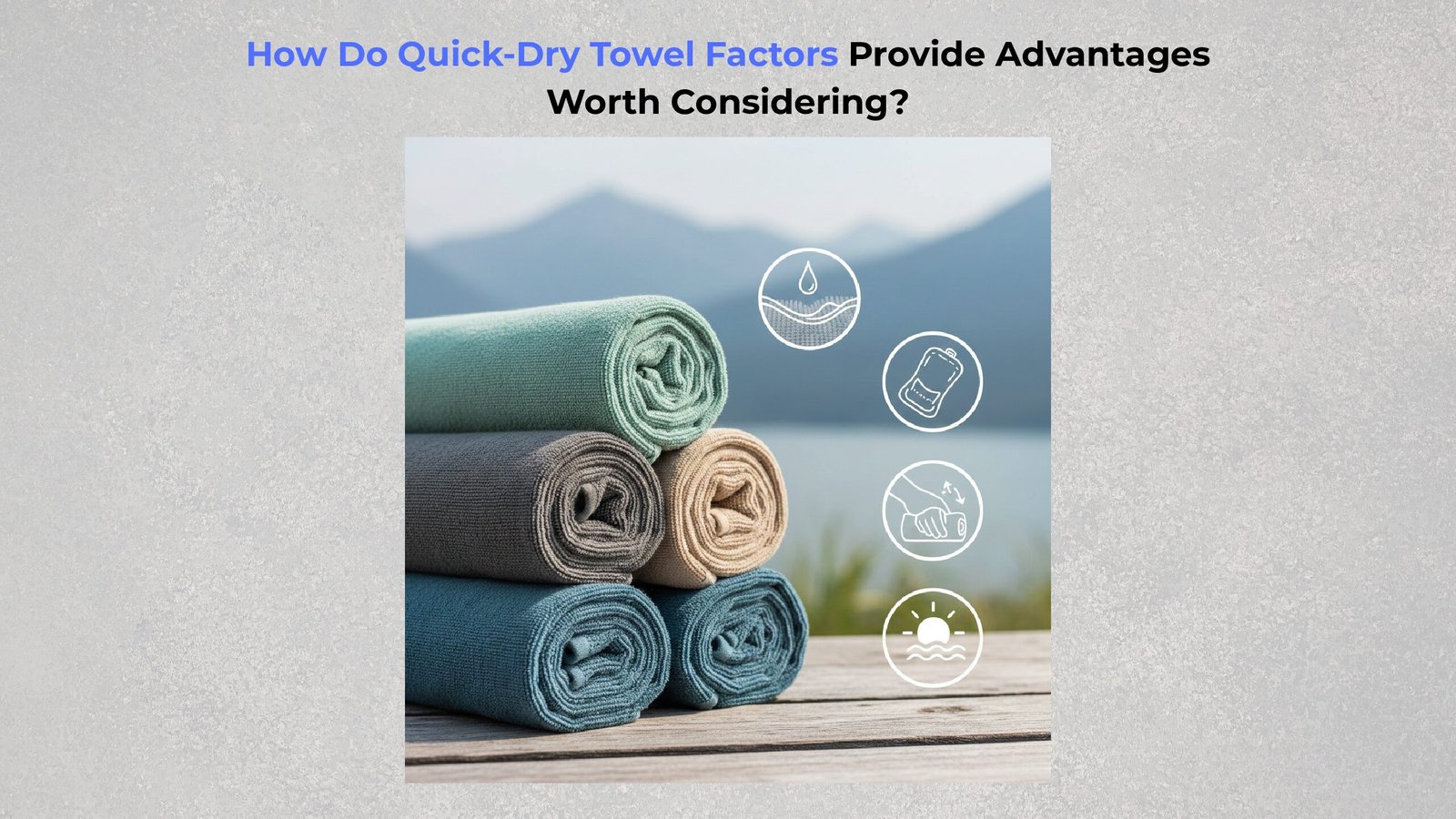
How Do Quick-Dry Towel Factors Provide Advantages Worth Considering?
By Abdikafar Tayib | Textile Research Specialist
Evaluating Quick-Dry Towel Factors is important to consider before buying because fiber hydrophilicity and weave porosity directly influence the textile’s evaporation rate, mitigating microbial colonization and optimizing laundering efficiency.
Before focusing specifically on drying speed, it’s helpful to understand what are the 16 factors to consider before buying a towel, since quick-dry performance depends on material, thickness, weight, and absorbency working together. When assessing commercial and residential linens, the discussion must pivot toward the mechanical physics of textile moisture release.
A textile’s structural architecture dictates how quickly trapped water escapes into the atmosphere. While heavy, dense fabrics are often marketed for their absorbent capacities, a towel’s primary job is not solely to absorb water, but to efficiently release it. Failing to execute this atmospheric transfer creates severe hygienic liabilities and costly operational bottlenecks.
Throughout this technical evaluation, we will demonstrate that rapid moisture release is not merely a convenience—it is a measurable operational efficiency. By the conclusion of this guide, we will calculate this efficiency using a strict cost-savings formula tying reduced dry time to annual utility rates, proving that structural textile choices have direct financial impacts.
Understanding the precise relationship between a fabric’s physical construction and its atmospheric vapor exchange reveals exactly how rapid moisture release mitigates biological and hygienic risks.
Why Quick-Dry Towel Factors Provide Significant Biological and Hygienic Advantages
Quick-Dry Towel Factors provide significant biological and hygienic advantages because rapid evaporation drastically reduces the duration of fiber dampness, inhibiting the primary catalyst for sour textile odors.
The physical drying speed of a textile is inherently linked to user pain points surrounding mildew accumulation and musty deterioration. Optimized Quick-Dry Towel Factors reduces fiber-dampness duration and neutralizes the primary catalyst for sour textile odors.
By minimizing the window in which fabric remains saturated, environments—from residential bathrooms to commercial locker rooms—are protected from biofilm generation.
Quick-Dry Towel Factors Hygiene Matrix
| Drying Rate | Estimated Dry-Time | Microbial Risk Profile | Advantage Gained |
|---|---|---|---|
| High-Efficiency | < 2.5 Hours | Minimal (Odor-Resistant) | High hygiene / Low maintenance |
| Standard-Utility | 4.0 – 6.0 Hours | Moderate (Requires Airflow) | Standard utility performance |
| Low-Velocity | > 8.0 Hours | High (Biofilm Prone) | Risk of persistent odor |
Executing the Quick-Dry Towel Factors Bio-Safety Audit
Executing the Quick-Dry Towel Factors bio-safety audit allows facility managers and homeowners to objectively measure a textile’s resistance to microbial colonization based on its moisture retention over time.
According to standard testing protocols defined by the American Association of Textile Chemists and Colorists (AATCC) regarding moisture management, textiles engineered for optimal evaporation should shed more than 80% of their saturated water weight within 2.5 hours in standard ambient conditions.
This rapid shedding is a crucial defensive mechanism. The familiar “sour” smell in a damp towel is technically the off-gassing of anaerobic bacteria. If a towel smells musty, it is not merely dirty; it is actively hosting a microbial colony facilitated by prolonged dampness.
Quick-Dry Towel Factors Bio-Safety Audit Checklist
Applying these measurable evaporation parameters directly informs our understanding of the required technical weave mechanics.
How Technical Weave Mechanics Create Functional Quick-Dry Towel Factors Advantages
Technical weave mechanics create functional Quick-Dry Towel Factors advantages by physically altering the textile’s surface area and porosity to maximize atmospheric airflow. To understand how these specific weaves withstand industrial laundering environments, review our comprehensive Textile Care Protocols.
How AATCC Standards Validate the Technical Advantages of Quick-Dry Towel Factors
AATCC standards validate the technical advantages of Quick-Dry Towel Factors by providing a universal, laboratory-controlled metric for evaluating moisture release over time.
Under the stringent parameters of the AATCC Test Method (Drying Time of Textiles: Moisture Analyzer Method), data demonstrates that properly engineered waffle-weave constructions frequently achieve up to a 50% faster evaporative rate compared to dense terry cloth. Standard terry loops inherently trap air inside the fabric core, creating a humid, insulating microclimate that stubbornly fights evaporation.
Thicker towels may feel plush but often retain more moisture, making it useful to explore how towel thickness impacts its performance before you purchase it when evaluating drying efficiency.
Conversely, highly porous weaves expose maximum fiber surface area directly to the ambient air. Utilizing testing protocols measures mechanical moisture release validates the energy-efficiency claims of Quick-Dry Towel Factors.
Why Capillary Engineering Provides Superior Wicking Advantages in Quick-Dry Towel Factors
Capillary engineering provides superior wicking advantages in Quick-Dry Towel Factors because optimizing yarn twist dictates both how fast water is absorbed and how easily it escapes.
Peer-reviewed capillary action studies published in the Textile Research Journal indicate that zero-twist or low-twist yarns can increase exposed fiber surface area by over 30%. This structural openness facilitates a significantly faster rate of both moisture uptake and atmospheric release.
High-twist yarns possess immense tensile strength but behave like tightly coiled ropes that actively lock water into their core. Low-twist yarns open the fiber bundles, sacrificing fractional tensile strength to harness extreme evaporative efficiency based on Capillary Action—the physical ability of a liquid to flow in narrow spaces without the assistance of external forces.
While rapid drying is convenient, it should not come at the expense of performance, which is why learning why towel absorbency is important to consider before you buy helps maintain balance between speed and effectiveness.
How High-Porosity Weaves Maximize the Airflow Advantages of Quick-Dry Towel Factors
High-porosity weaves maximize the airflow advantages of Quick-Dry Towel Factors by physically spacing the yarns apart to prevent structural moisture trapping.
According to weave geometry classifications published by The Textile Institute, waffle weaves (honeycomb constructions) achieve high volumetric presence alongside a remarkable 40% reduction in base weight compared to standard terry loops, drastically reducing the total mass of water the fabric can retain.
Lightweight towels generally dry faster than heavier ones, so understanding why towel weight is important to consider before you buy can help explain drying time differences.
The distinct “honeycomb” pockets of a waffle weave are engineered to physically expand and draw in water upon contact, yet remain structurally open to allow ambient air to flow directly through the fabric matrix.
Quick-Dry Towel Factors Performance Comparison Matrix
| Weave Geometry | Airflow Level | Advantage Profile | Drying Efficiency |
|---|---|---|---|
| Waffle Weave | Maximum | Elite evaporation speed | Fastest turnover |
| Zero-Twist Terry | High | Luxury feel with high wicking | High efficiency |
| Dense Loop Terry | Low | High-volume water storage | Standard utility |
While understanding theoretical weave mechanics maps structural potential, evaluating how those specific Quick-Dry Towel Factors are strategically deployed in real-world environments is the next operational necessity.
What Environmental Advantages Are Gained Through Strategic Quick-Dry Towel Factors Selection
Strategic Quick-Dry Towel Factors selection yields massive environmental advantages by aligning the textile’s physical evaporation capabilities with the atmospheric constraints of a specific facility.
How Quick-Dry Towel Factors Solve Moisture Stagnation in High-Humidity Environments
Quick-Dry Towel Factors solve moisture stagnation in high-humidity environments by utilizing open-loop architectures that refuse to trap dense, wet air.
Indoor air quality and humidity management guidelines from ASHRAE indicate that utilizing high-porosity textiles in environments featuring >60% relative humidity reduces passive drying times by up to 3 hours, dramatically shrinking the critical window for mildew accumulation.
In tropical or coastal homes, a dense 800 GSM luxury towel will virtually never reach a state of complete dryness on a standard rack. Instead, it enters a permanent cycle of dampness.
This reality makes highly porous textiles a functional necessity rather than a mere preference. Selecting high-porosity Quick-Dry Towel Factors increases passive vapor exchange and inhibits mildew risks in coastal bathrooms.
Why Specific Fiber Blends Offer Operational Advantages for High-Frequency Quick-Dry Towel Factors Settings
Specific fiber blends offer operational advantages for high-frequency Quick-Dry Towel Factors settings by combining the absorbency of cotton with the rapid moisture-release properties of synthetics.
According to operational baseline data published by the Textile Rental Services Association (TRSA), high-turnover facilities utilize strategic synthetic-blend textiles to achieve up to a 50% reduction in mechanical dryer cycle times.
Polyamide and polyester fibers are intrinsically hydrophobic. When carefully woven into the base ground weave of a towel, these synthetics provide extreme tensile strength and durability, while refusing to hold internal water.
This forces the applied drying energy to focus solely on evaporating moisture from the hydrophilic cotton pile. Drying speed is heavily influenced by fiber composition, which is why reviewing what makes towel material essential to evaluate before buying is crucial when comparing cotton, microfiber, or blended fabrics.
How Quick-Dry Towel Factors Provide Space-Saving Advantages for Travel and Compact Storage
Quick-Dry Towel Factors provide extreme space-saving advantages for travel and compact storage by drastically reducing the volumetric bulk required to achieve effective moisture removal.
Operational guidelines sourced from IHRSA (International Health, Racquet & Sportsclub Association) for fitness facility amenities show that utilizing lightweight microfiber textiles reduces required storage volume in gym lockers and luggage by nearly 40% compared to standard terry loops.
A heavy, wet cotton towel stored inside a dark, unventilated gym bag creates a flawless, warm microclimate for immediate bacterial growth.
Thin, quick-dry variations release sufficient moisture prior to packing, mitigating this specific locker-room biohazard phenomenon. If you’re selecting a towel specifically for travel or gym use, it’s also helpful to read why purpose matters more than you think when choosing the right towel to ensure drying speed aligns with how you plan to use it.
Quick-Dry Towel Factors Environment-Specific Advantage Table
| Usage Zone | Recommended Fiber | Key Advantage | Selection Logic |
|---|---|---|---|
| Public Fitness | Polyamide / Microfiber | Odor resistance | Fast evaporation |
| Luxury Hotel | Turkish (Low-Twist) | Balanced comfort & cost-efficiency | Guest satisfaction |
| Residential Bath | Combed Ring-Spun | Reliable durability | Daily utility |
Once the ideal fast-drying textile profile is selected and integrated into a facility, the buyer must implement specific maintenance protocols to protect and preserve those highly engineered structural advantages.
How Proper Maintenance Preserves the Long-Term Durability Advantages of Quick-Dry Towel Factors
Proper maintenance preserves the long-term durability advantages of Quick-Dry Towel Factors by preventing the buildup of hydrophobic residues and the structural collapse of the capillary channels. For protocols on sourcing bulk textiles with verified structural resilience, read our deep dive on Hospitality Towel Sourcing.
How Residue Removal Maintains the Original Wicking Advantages of Quick-Dry Towel Factors
Residue removal maintains the original wicking advantages of Quick-Dry Towel Factors by ensuring that chemical softeners do not form a plastic-like barrier over the open fibers.
Quality testing guidelines recognized by OEKO-TEX regarding the application of textile finishing agents prove that repeated use of liquid fabric softeners can reduce the evaporative efficiency of these textiles by up to 15% per wash, as silicone polymers permanently coat the porous surfaces.
Fabric softener chemically operates by literally coating threads in a hydrophobic wax to generate a slippery tactile feel; unfortunately, this exact wax totally neutralizes the capillary action that allows quick-dry weaves to function. Inspecting for fabric softener buildup on Quick-Dry Towel Factors identifies hydrophobic chemical barriers and preserves the original capillary advantages.
Why Structural Preservation Protects the Evaporation Advantages of Quick-Dry Towel Factors
Structural preservation protects the evaporation advantages of Quick-Dry Towel Factors because exposing the textile to excessive mechanical heat permanently deforms the moisture-releasing architecture.
Research generated by the American Chemical Society regarding cellulose degradation under thermal stress shows that over-drying textiles at maximum heat functionally “bakes” the cellulose structure.
This sustained thermal damage causes irreversible fiber collapse and an estimated 12% decline in evaporation efficiency over the product’s functional lifespan.
Because these textiles are heavily engineered to release moisture rapidly, running them through a standard heavy-duty 60-minute commercial dryer cycle guarantees they will spend at least 40 minutes tumbling completely dry, sustaining severe thermal friction damage to the unprotected fiber tips.
Towels engineered for fast drying may use different weaving techniques, so reviewing how evaluating durability helps you choose a better towel ensures that quicker drying doesn’t reduce lifespan.
How Standardized Laundering Protocols Restore the Performance Advantages of Quick-Dry Towel Factors
Standardized laundering protocols restore the performance advantages of Quick-Dry Towel Factors by providing specific guidelines for mechanical tumbling and safe moisture extraction.
Per standardized guidelines for domestic washing and drying procedures for textile testing, properly utilizing low-heat tumble cycles ensures fabrics retain a critical 3% to 5% residual moisture level.
This nominal moisture prevents the electrostatic cling that forcibly crushes open-weave structures. Waffle weaves and low-twist yarns absolutely require the gentle mechanical agitation of a low-heat tumble to “fluff” and actively separate the structural honeycomb pockets.
Relying entirely on static air-drying without prior mechanical agitation frequently causes the yarns to dry stiff and heavily compressed, diminishing the vapor exchange capability during the next use.
Quick-dry towels often require proper washing to maintain airflow between fibers, which makes how care instructions affect your choice of towel especially important for preserving performance.
Quick-Dry Towel Factors Physical Integrity Checklist
Moving forward from physical maintenance protocols, we must calculate the final financial metrics, demonstrating precisely how these preserved efficiency factors dictate long-term commercial and operational value.
Final Summary: How to Maximize Operational Advantages Using Quick-Dry Towel Factors
Maximizing operational advantages using Quick-Dry Towel Factors requires synthesizing the textile’s rapid drying metrics with utility rates to calculate true lifecycle cost savings.
How to Determine Financial Advantages via the Quick-Dry Towel Factors Cost-Savings Formula
Determining financial advantages via the Quick-Dry Towel Factors cost-savings formula allows facility managers to mathematically predict the long-term utility savings generated by high-efficiency textiles.
Based on commercial laundry energy metrics documented by the Coin Laundry Association (CLA), replacing dense baseline inventory with verified high-efficiency fabrics securely reduces annual gas and electrical utility overhead by 15% to 20% in high-volume operations.
The compounding cost of massive drying energy quickly outpaces the initial purchase price of any commercial linen.
Investing in a slightly more expensive waffle-weave or polyamide blend yields massive financial returns purely by cutting baseline dryer times in half over a single year of daily use.
Quantitative drying audits of Quick-Dry Towel Factors identifies energy-heavy legacy inventory and reduces annual utility overhead by up to 20%. Because specialized fast-drying fabrics can increase production costs, consider why you should consider towel cost before buying when comparing premium quick-dry options.
(Minutes Saved per Dry Cycle × Annual Wash Cycles) × Cost per Minute of Dryer Energy = Total Annual Savings.
What Final Execution Steps Ensure a Successful Quick-Dry Towel Factors Management Strategy
Following these final execution steps ensures a successful Quick-Dry Towel Factors management strategy that eliminates drying bottlenecks and standardizes inventory hygiene.
According to the rigorous operational linen standards utilized by Forbes Travel Guide Five-Star property management, deliberately segregating quick-dry textiles from heavy, dense terry inventory improves first-pass complete drying rates to 98%, essentially eliminating the costly requirement for secondary “touch-up” dryer runs.
Mixing standard terry towels with waffle-weave variants within the exact same commercial load chemically tricks the dryer’s internal moisture sensors.
The machine will inevitably shut off when the porous quick-dry towels are completed, leaving the heavy base towels stubbornly damp and highly prone to sudden mildew incubation.
Quick-Dry Towel Factors Benchmarks Master Technical Reference
| Grade | Evaporation Speed | Primary Material | Performance Lifecycle |
|---|---|---|---|
| Elite (Tier 1) | < 3.0 Hours | Polyamide / Waffle Cotton | 250+ Wash Cycles; Bio-Stable |
| Standard (Tier 2) | 4.0 – 6.0 Hours | Ring-Spun / Low-Twist | 150+ Wash Cycles; Reliable |
| Utility (Tier 3) | > 8.0 Hours | Heavy Carded Cotton | < 50 Wash Cycles; High Odor Risk |
Quick-Dry Towel Factors Implementation and Execution Checklist
Ultimately, effective textile procurement is an exercise in applied physics—leveraging specific Quick-Dry Towel Factors to conquer environmental moisture and lower long-term utility overhead.