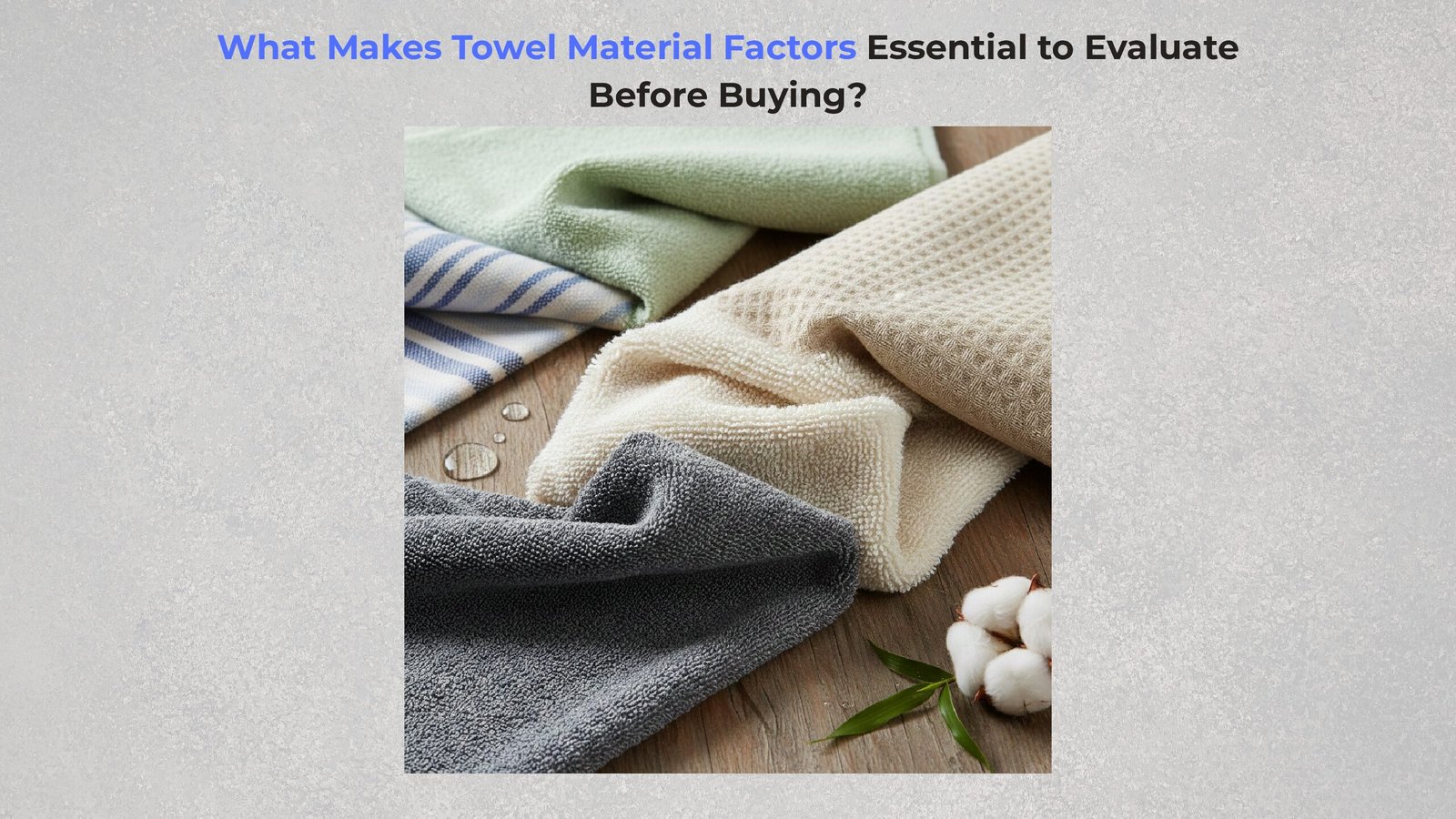
What Makes Towel Material Factors Essential to Evaluate Before Buying?
Textile Science & Engineering Audit
Evaluating Towel Material Factors is essential before buying because fiber composition and staple length directly influence a textile’s moisture-wicking efficiency, structural durability, and long-term skin compatibility.
In the domain of textile engineering, a towel’s performance is not a subjective byproduct of retail “softness,” but an objective result of material physics. The cellular structure of the chosen fiber—specifically its hydrophilicity and cellulose chain integrity—dictates how the textile interacts with both liquid water and the biological skin barrier. High-quality construction protocols, such as double-needle stitching, cannot compensate for a towel woven from inherently inferior, short-staple material.
Why Towel Material Factors Determine Long-Term Skin Health and Absorption Efficiency
Towel Material Factors determine long-term skin health and absorption efficiency because fiber hydrophilicity dictates how quickly a textile sheds moisture to mitigate bacterial colonization.
Because different fibers absorb water at different rates, it’s worth understanding why towel absorbency is important to consider before you buy before choosing between cotton, bamboo, or microfiber. Evaluating Towel Material Factorsidentifies optimal fiber wicking which subsequently reduces prolonged dampness and potential skin irritation.
| Material Profile | Wicking Speed | Microbial Resistance | Tactical Result |
|---|---|---|---|
| Long-Staple Cotton | High | Moderate | Superior comfort & dry-time |
| Bamboo / Modal | Moderate | High | Naturally odor-resistant |
| Synthetic Blends | Extreme | Low | Rapid dry; prone to biofilm |
Executing The Towel Material Factors Integrity Audit for Skin Safety
Executing the Towel Material Factors integrity audit protects buyers from abrasive fibers and synthetic coatings that mimic natural absorbency.
According to the American Association of Textile Chemists and Colorists (AATCC) Test Method 79, high-quality cotton materials often demonstrate rapid wetting times. If comfort is your priority, learning why soft towels are worth considering before you buy can help you see how certain materials stay plush longer than others. Surface-applied silicone softeners can temporarily reduce fiber wettability, masking underlying material deficiencies and reveals the intrinsic absorbency only after repeated laundering.
Checklist: Towel Material Factors Integrity Audit Checklist
- Absorbency Test: Apply a 10ml water drop; verify total absorption within <1.0 second.
- Cool-Touch Check: Assess if the Towel Material Factors naturally regulate temperature post-friction.
- Linting Audit: Rub the surface to detect loose fibers that signal short-staple material failure.
What Technical Fiber Specifications Define High-Performance Towel Material Factors
Technical fiber specifications define high-performance Towel Material Factors by providing measurable benchmarks for staple length, geographic origin, and ply configuration.
To understand how these material specifications hold up to industrial laundering, review our comprehensive [Textile Care Protocols].
How Towel Material Factors Dictate the Selection of Staple Length for Durability
Towel Material Factors dictate the selection of staple length for durability by determining the textile’s inherent resistance to structural fraying.
Since fiber strength affects how well a towel holds up after repeated washes, explore how evaluating durability helps you choose a better towel to avoid towels that thin or fray too quickly. Data from Cotton Incorporated defines Extra-Long Staple (ELS) cotton as fibers measuring 1 3/8 inches (~34.9 mm) or longer. Short-staple fibers possess fewer anchoring points within the yarn twist, which contributes to lint formation and gradual fabric thinning during repeated laundering.
What Fiber Origins Distinguish Superior Towel Material Factors Performance
Specific fiber origins distinguish superior Towel Material Factors performance due to the unique climate conditions that stress and strengthen the cotton plant during cultivation.
If you’re choosing bamboo or organic cotton for sustainability reasons, you may also want to explore what makes eco-friendliness an important factor when selecting a towel to understand which materials are truly lower-impact. Regional factors—including temperature stability and soil composition—impact the Hydrophilicity of the cellulose polymer chains, dictating their moisture affinity.
How to Quantify Towel Material Factors via Yarn Count and Ply Analysis
Quantifying Towel Material Factors via yarn count and ply analysis provides an objective measurement of the textile’s tensile resilience and plushness.
Material and construction often work together, so understanding how towel thickness impacts its performance before you purchase it can help you choose the right feel without sacrificing practicality. Two-ply yarn constructions can enhance tensile performance and yarn uniformity compared to comparable single-ply constructions, effectively doubling localized yarn density to mitigate premature thinning.
| Material Type | Technical Origin | Performance Strength |
|---|---|---|
| Egyptian Cotton | Nile Delta (ELS) | Highest durability & structural luster |
| Turkish Cotton | Aegean Region | Optimal balance of softness & rapid dry-time |
| Micro-Modal | Beechwood Pulp | Up to 50% more absorbent than cotton |
How to Calibrate Towel Material Factors Selection for Specialized Use-Case Environments
Calibrating Towel Material Factors selection for specialized use-case environments ensures that the fiber’s natural physics align with specific atmospheric and mechanical demands.
How to Adjust Towel Material Factors for High-Humidity Spa and Pool Settings
Adjusting Towel Material Factors for high-humidity spa and pool settings requires prioritizing bast fibers or regional cottons that facilitate rapid evaporation.
Some materials hold moisture longer than others, which is why it helps to review how quick-dry towels provide advantages worth considering when you want towels that dry faster in humid spaces. Studies in the Textile Research Journal indicate that linen (flax) blends demonstrate faster evaporative behavior than dense cotton under standardized laboratory conditions.
Technical Matrix: Environment-Specific Selection
| Environment | Primary Metric | Recommended Fiber |
|---|---|---|
| Dermatology Clinic | Bio-Safety (GOTS) | 100% Organic Combed Cotton |
| Fitness / Travel | Mass-to-Wicking | Polyamide / Polyester Microfiber |
| Residential Spa | Tactile Softness | Bamboo / Turkish Aegean Blend |
How to Verify the Integrity of Towel Material Factors via Professional Inspection Protocols
Verifying the integrity of Towel Material Factors via professional inspection protocols empowers buyers to detect counterfeit claims and low-tier manufacturing shortcuts.
For protocols on sourcing verified bulk textiles, read our deep dive on [Hospitality Towel Sourcing].
How to Inspect Towel Material Factors for Combed vs. Carded Consistency
Inspecting Towel Material Factors for combed versus carded consistency immediately reveals whether the manufacturer invested in the removal of weak, lint-producing staples.
Why the Recovery of Your Towel Material Factors Depends on Fiber-Safe care Protocols
The recovery of your Towel Material Factors depends on fiber-safe care protocols because harsh oxidative chemicals systematically destroy the molecular structure of natural cellulose.
Some materials are more sensitive to heat and detergents, which makes how care instructions affect your choice of towel important if you want your towels to stay absorbent and soft. Research from the American Chemical Society demonstrates that repeated exposure to sodium hypochlorite can significantly reduce the degree of polymerization (DP) of cellulose, leading to measurable declines in tensile strength.
Checklist: Physical Inspection Protocol
- The Stretch Test: Pull the pile; ELS Towel Material Factors resist shedding under tension.
- The Burn Test: Pure cellulose turns to ash; hidden polyester melts into a plastic bead.
- The Certification Audit: Verify GOTS or BCI tracking numbers on the physical label.
Final Summary: How to Execute a Professional Towel Material Factors Audit Strategy
Executing a professional Towel Material Factors audit strategy requires shifting the purchasing metric from upfront retail cost to total material efficiency and lifespan.
How to Determine Long-Term Value Based on Towel Material Factors Longevity
Determining long-term value based on Towel Material Factors longevity allows buyers to mathematically calculate the true cost of textile ownership over time.
If you’re using GSM as a quality clue, it also helps to read why towel weight is important to consider before you buy, since heavier towels can behave very differently depending on the material. Hospitality lifecycle models from HFTP prove that higher-spec ELS constructions reduce replacement frequency, potentially lowering long-term procurement costs.
(Fiber Tensile Strength x Staple Length) / Unit Price = Material Efficiency Score
What Final Execution Steps Ensure a Successful Towel Material Factors Strategy
Following specific execution steps fosters a successful and durable Towel Material Factors strategy that protects both the end-user’s skin and the operating budget.
| Material Grade | Fiber Staple Length | Typical GSM | Performance Lifecycle |
|---|---|---|---|
| Elite (ELS) | > 35mm | 600 – 900 | 250+ High-Heat Cycles |
| Standard | 25mm – 30mm | 450 – 650 | 100 – 150 Cycles |
| Utility | < 20mm | 200 – 400 | < 50 Cycles; High Fraying |
Implementation Checklist
- • Prioritize ELS fibers for high-contact body towels.
- • Launder sample units 5 times to check for material collapse.
- • Map material types (Turkish/Egyptian) to facility humidity zones.
- • Verify OEKO-TEX “Standard 100” bio-safety compliance.
- • Audit for Ring-Spun vs. Zero-Twist yarn architecture.
Ultimately, a superior towel is not defined by its brand name, but by the precise biological origin and physical physics of its material factors.