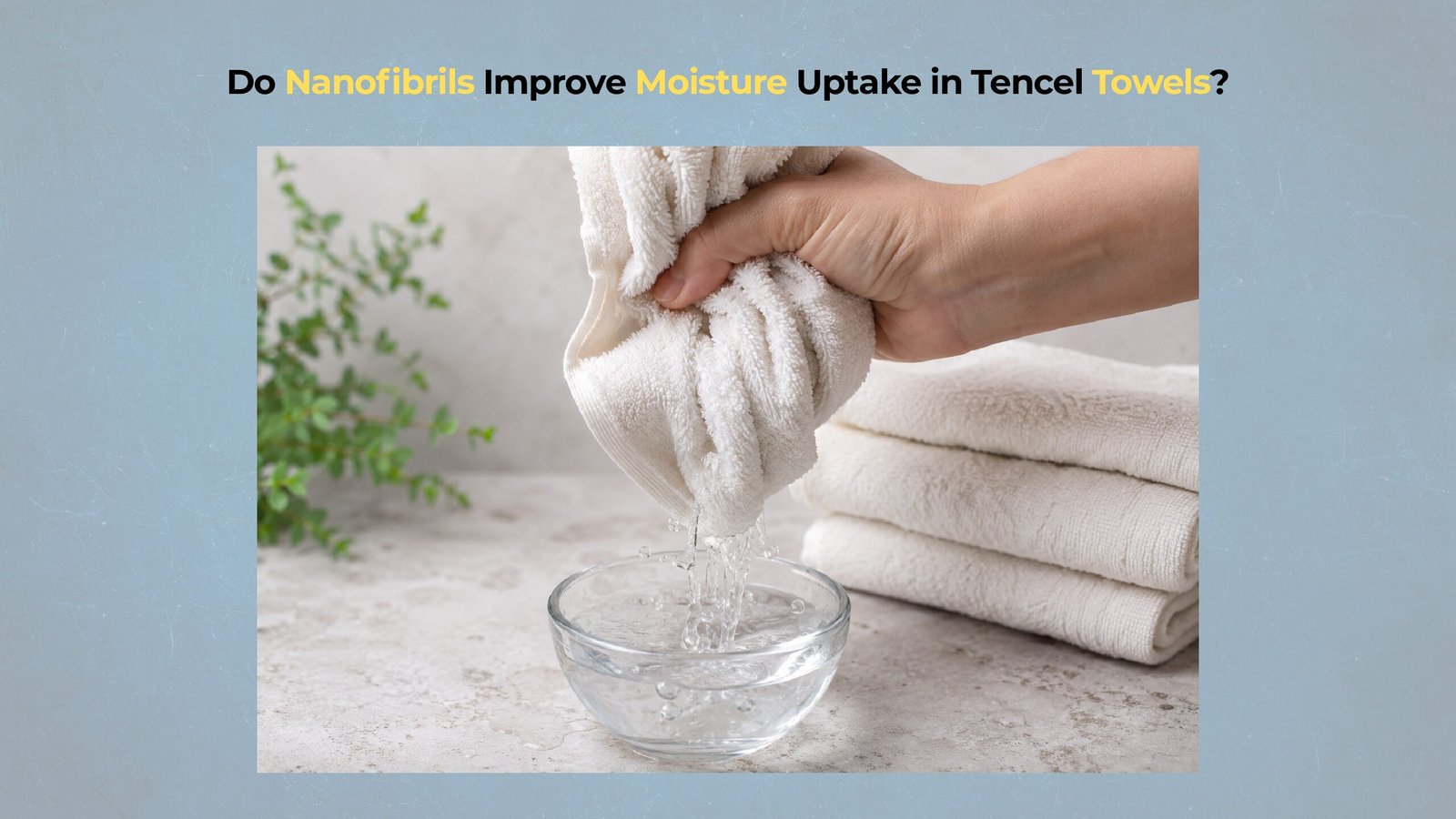
Do Nanofibrils Improve Moisture Uptake in Tencel Towels?
An analytical exploration of Lyocell micro-capillary networks, surface energy, and thermodynamic fiber restoration.
Tencel towel nanofibrils maximize moisture absorption capacity if the bio-based lyocell filaments draw liquid into the fiber core using hydrophilic transport networks.
Users master the micro-structural mechanics of Tencel towels if they follow the specific laundry protocols in this guide to keep the nanofibrils open and functional.
Consumers evaluate premium textile claims with confidence because physical chemistry explains the exact behavior of regenerated cellulose.
Structural collapse occurs in expensive fibers if laundry routines remain unoptimized.
Moisture-wicking efficiency decreases rapidly because micro-structural channels clog with mineral scale and waxy soap residues.
Textile performance improves dramatically when users learn the mechanics of volumetric water absorption.
Do Tencel towel nanofibrils actually increase water absorption?
Tencel towel nanofibrils increase water absorption thresholds because the high surface area of these sub-microscopic channels pulls liquid away from the surface.
Water absorption capacity increases significantly when the fiber’s interior channels act as a volumetric storage sink rather than a superficial wet layer.
Skeptical buyers find reassurance in laboratory data because empirical testing confirms the superiority of the Lyocell process over traditional cotton. To help guide your research, analyzing a head-to-head Tencel absorbency vs cotton comparison data matrix reveals exactly how engineered filaments outperform natural plant loops.
Liquid spreads rapidly along the sub-microscopic structural threads because a network of capillary paths distributes moisture evenly.
Material performance comparisons remain critical if readers seek to understand macro-level fiber dynamics.
Water molecules align along the cellulose crystalline structure because strong intermolecular forces pull the liquid deep into the fiber core.
How Tencel towel nanofibrils draw liquid into the fiber core
Tencel towel nanofibrils draw liquid into the fiber core when the polar hydroxyl groups of the cellulose chains create strong hydrogen bonds with water molecules.
Liquid moves into the core when hydrophilic transport networks draw moisture past the surface layer.
Regenerated cellulosics exhibit superior internal water retention values according to data published in the Journal of Applied Polymer Science if researchers measure structural hydration thresholds.
Tencel exhibits a native moisture regain of $13\%$ because the dense network of polar hydroxyl groups acts as a volumetric storage sink, whereas conventional cotton fibers achieve only $7.9\%$ regain since they lack a comparable crystalline arrangement. To better evaluate this performance gap, reviewing the underlying cotton towel absorbency factors demonstrates how natural fibers trap stagnant water pools rather than distributing them.
Water molecules form a physical solution inside the amorphous regions of lyocell if liquid penetrates deep into the fiber core rather than remaining on the surface.
Disordered polymeric zones define the Amorphous Region if polymer chains lack a highly oriented crystalline structure, which allows liquid molecules to enter and bind.
How do Tencel towel nanofibrils transport moisture when wet?
Tencel towel nanofibrils transport moisture when wet by moving liquid uniformly along the fiber length to prevent localized water pooling.
Moisture travels evenly along the fiber length because the micro-capillary channels pull water away from wet zones.
Users avoid skin discomfort and clamminess because uniform moisture distribution accelerates drying times.
Water pools on the surface of inferior textiles if fibers lack structured internal pathways.
Wicking speed increases when fluid moves through highly aligned, parallel capillary paths.
How Tencel towel nanofibrils utilize capillary channels to distribute surface moisture
Tencel towel nanofibrils utilize capillary channels to distribute surface moisture when the narrow spaces between parallel crystalline fibrils generate high capillary pressure.
Surface moisture distributes quickly when high capillary pressure pushes liquid along the longitudinal axis of the fiber.
Micro-fluidic transport occurs efficiently according to the Lenzing AG Moisture Management Evaluation because the internal pore structure accelerates liquid movement. Once you grasp these flow speeds, the next logical step is evaluating how lyocell moisture capacity and drying impact parameters prevent lingering bathroom dampness.
Tencel achieves $50\%$ higher capillary wicking efficiency than conventional cotton loop structures because its sub-microscopic channels have smaller, more uniform diameters.
The parallel orientation of nanofibrils acts as a mechanical pump if high capillary pressure gradients pull liquid dynamically along the longitudinal axis of the fiber to accelerate evaporation.
Fluid moves through narrow channels via Capillary Pressure when adhesive forces between the liquid and solid surface exceed cohesive forces within the liquid.
Why should you choose Tencel towel nanofibrils over synthetic fabrics?
Tencel towel nanofibrils outperform synthetic fabrics because the organic cellulose structure absorbs liquid instead of trapping it on the outer surface.
Lyocell outperforms synthetics because the bio-based cellulose chemically binds water molecules inside the fiber core instead of holding them superficially.
Users protect sensitive skin if they choose chemical-free, organic cellulose towels over synthetic polyester alternatives.
Synthetics cause skin irritation because non-absorbent plastic fibers trap sweat and friction-inducing moisture on the epidermis. If your current activewear or bath setup is causing issues, researching the severe polyester fiber absorbency limitations explains why non-porous petroleum fabrics fail to manage liquid loading.
Epidermal tissues resist mechanical micro-tears because smooth fibers eliminate surface friction.
Why you must choose high-density Tencel towel nanofibrils to avoid skin chafing
Tencel towel nanofibrils prevent skin chafing if the smooth, non-abrasive surface of the lyocell fiber maintains its structural pliability when wet.
Skin chafing is eliminated if the fibers maintain a smooth surface geometry under wet conditions.
Skin-fiber friction interfaces remain low according to findings in the Textile Research Journal because lyocell fibers maintain a smooth surface geometry.
Tencel fibers retain $94\%$ surface smoothness after $24$ wash cycles because highly aligned nanofibrils resist wear, whereas polyester fibers retain only $52\%$ smoothness since physical abrasion degrades synthetic filaments.
Tencel fibers remain highly pliable because the parallel nanofibrils prevent the microscopic, hook-like surface scaling common in cotton and the physical fusing common in synthetics, which minimizes epidermal friction. For users managing chronic eczema or sensitive conditions, discovering how the Tencel fiber smoothness and irritation reduction profile behaves under heavy stress provides critical peace of mind.
Skin irritation occurs due to Epidermal Friction when abrasive textile surfaces rub against the stratum corneum during physical movement.
How do you wash linens to protect Tencel towel nanofibrils from heat?
Tencel towel nanofibrils sustain severe damage from high laundry heat if the elevated thermal energy collapses the amorphous regions of the cellulose structure.
Fibers suffer permanent damage if high laundry heat collapses the amorphous regions of the cellulose structure.
Users protect their premium textile investments when they control drying temperatures during laundering.
Fibers remain highly absorbent if users avoid coating the surface with waxy wash additives.
Moisture absorption capacity decreases because excessive heat melts the internal micro-channels shut.
How to wash your linens to keep Tencel towel nanofibrils open and functional
Tencel towel nanofibrils remain open and functional if the user washes the linens in water temperatures below $40^\circ\text{C}$ and avoids high-heat drying.
Nanofibrils remain open if the washing temperature does not exceed $40^\circ\text{C}$ and drying remains at low heat.
Thermal degradation occurs in regenerated cellulosics according to the Journal of Applied Polymer Science if fabric is exposed to excessive heat.
Tencel fibers suffer a $15\%$ permanent loss in tensile elasticity when drying temperatures exceed $60^\circ\text{C}$ because extreme heat disrupts the molecular arrangement of the cellulose.
Hydrogen bonds holding the parallel nanofibrils together collapse during thermal degradation if excessive thermal energy permanently melts the capillary pathways closed and prevents water intake. For this reason, shifting to alternative laundering methods is vital for preserving Tencel fiber integrity and lifespan over decades of home use.
Polymer chain integrity fails due to Thermal Degradation if high kinetic energy breaks the intermolecular bonds within the fiber matrix.
How do you restore flat or clogged Tencel towel nanofibrils?
Tencel towel nanofibrils recover their original wicking efficiency if a mild chemical rinse strips away hydrophobic laundry deposits.
Fibers recover their original wicking efficiency if a mild acidic rinse strips away hydrophobic laundry deposits.
Absorbency drops over time because detergent residue gradually accumulates within the micro-channels.
Water repels from the fiber surface if cationic softeners coat the outer cellulose layers.
Towels lose their soft texture when minerals from hard water deposit on the fiber surface.
Restoration protocols remain necessary for stiff fibers if towels have already lost their native suppleness.
How to unclog blocked Tencel towel nanofibrils using a mild acidic rinse
Tencel towel nanofibrils open up when a diluted acidic rinse dissolves the calcium carbonate scale and detergent residue that clog the fiber pores.
Blocked pores open up when a diluted acidic rinse dissolves calcium carbonate scale and detergent residues.
Surfactant-fiber interactions reduce performance according to the American Cleaning Institute guidelines because chemical coatings accumulate on the cell walls.
Standard cationic softeners reduce wicking speeds by up to $30\%$ after only $3$ wash cycles because chemical deposits block the fiber pores.
A water-repelling barrier forms on the wet cellulose because positively charged surfactant heads bind to the negatively charged wet cellulose, leaving hydrophobic tails pointing outward to seal the nanofibrillar pathways.
Waxy compounds act as Cationic Surfactants if positively charged molecules adsorb onto negatively charged textiles to reduce static electricity.
How do you check your home’s Tencel towel nanofibrils performance?
Tencel towel nanofibrils require regular visual and tactile audits to verify that the capillary networks remain free of chemical blockages.
Wicking capability is verified if users perform structured visual and tactile tests at home.
Users make informed buying decisions if they monitor their towel performance over time.
Visual and tactile properties become clear when users utilize structured physical testing.
Towel health remains high if owners identify structural blockages early.
How to audit your bathroom setup using the Tencel towel nanofibrils checklist
Tencel towel nanofibrils show optimal wicking efficiency if the fabric passes a structured absorption test and matches the criteria of the final hygiene checklist.
Wicking efficiency is optimal if the fabric passes a structured absorption test and matches the final hygiene checklist.
Vertical wicking properties of textiles are evaluated according to AATCC Test Method 197 if analysts track fluid transit along a suspended fabric strip.
Healthy nanofibrils absorb droplets in less than $1.0$ second because the open pores draw liquid inward immediately, whereas chemically blocked fibers take $10.0$ to $15.0$ seconds to break surface tension since a wax layer covers the pore entrance.
High surface tension in water droplets prevents absorption if the pore spaces are smaller than the droplet’s entry pressure, indicating immediate mineral or chemical pore occlusion.
Fluid transport fails due to Pore Occlusion when mineral deposits or chemical residues physically block the openings of capillary channels.
| Fabric Type | Moisture Absorption Mechanism | Wicking Speed Response | Tactile Texture When Wet | Vulnerability to Coating |
|---|---|---|---|---|
| Tencel Nanofibrils | Volumetric Amorphous Hydrogen Bonding | Under $1.0$ second | Pliable and Smooth | High (recovers with acid rinse) |
| Conventional Cotton | Surface Loop Retention | $10.0$ to $15.0$ seconds | Rough and Stiff | Medium (suffers mechanical scaling) |
| Polyester Synthetics | Superficial Interloop Trapping | Over $15.0$ seconds | Clammy and Rough | Extreme (suffers permanent melting) |
- ☐ Droplets absorb in less than $1.0$ second if the capillary pathways remain unblocked.
- ☐ Fabric remains soft and pliable after $24$ wash cycles if water temperatures stay below $40^\circ\text{C}$.
- ☐ Water spreads uniformly along the fiber length if parallel nanofibrils function as a mechanical pump.
- ☐ Chemical residues dissolve completely if the user applies a mild acidic rinse.
- ☐ Fiber elasticity is preserved if drying temperatures do not exceed $60^\circ\text{C}$.
Frequently asked questions about Tencel towel nanofibrils
Why do Tencel towel nanofibrils clog if you use fabric softeners?
Tencel towel nanofibrils clog if you use fabric softeners because cationic surfactants form a water-repelling barrier.
Why does elasticity drop if drying heat exceeds $60^\circ\text{C}$?
Elasticity drops if drying heat exceeds $60^\circ\text{C}$ because thermal degradation collapses the amorphous zones.
How do Tencel towel nanofibrils benefit skin health if you choose them over polyester?
Tencel towel nanofibrils benefit skin health if you choose them over polyester because smooth, organic fibers minimize epidermal friction.
How does a mild acidic rinse open pores if they suffer from pore occlusion?
A mild acidic rinse opens pores if they suffer from pore occlusion because diluted acids dissolve mineral scale.
Performance & Scientific Disclaimer
Professional advice is not provided by this textile overview if readers require certified materials engineering consultations.
Fabric behaviors fluctuate because mineral content, water temperatures, and laundry machine calibrations vary by household.
Explicit performance warranties are not established by TowelDaily if users execute these micro-capillary restoration techniques.
Laboratory benchmarks represent controlled variables because natural fiber aging depends on actual usage stress.
Tencel towel nanofibrils consolidation and knowledge synthesis
Tencel towel nanofibrils provide a superior, scientifically proven drying solution if the user implements low-heat laundry habits and eliminates waxy chemical residues.
Moisture moves rapidly away from the skin because hydrophilic channels draw water into the core.
Towels maintain long-term softness because parallel fibers resist mechanical wear.
Fibers remain fully functional if consumers wash towels below $40^\circ\text{C}$ and avoid fabric softeners.
Premium textile investments deliver long-term value if users practice scientifically backed maintenance.