How Fast Do Modal Towels Absorb Water?
Scientific Analysis of Regenerated Cellulose Fluid Dynamics
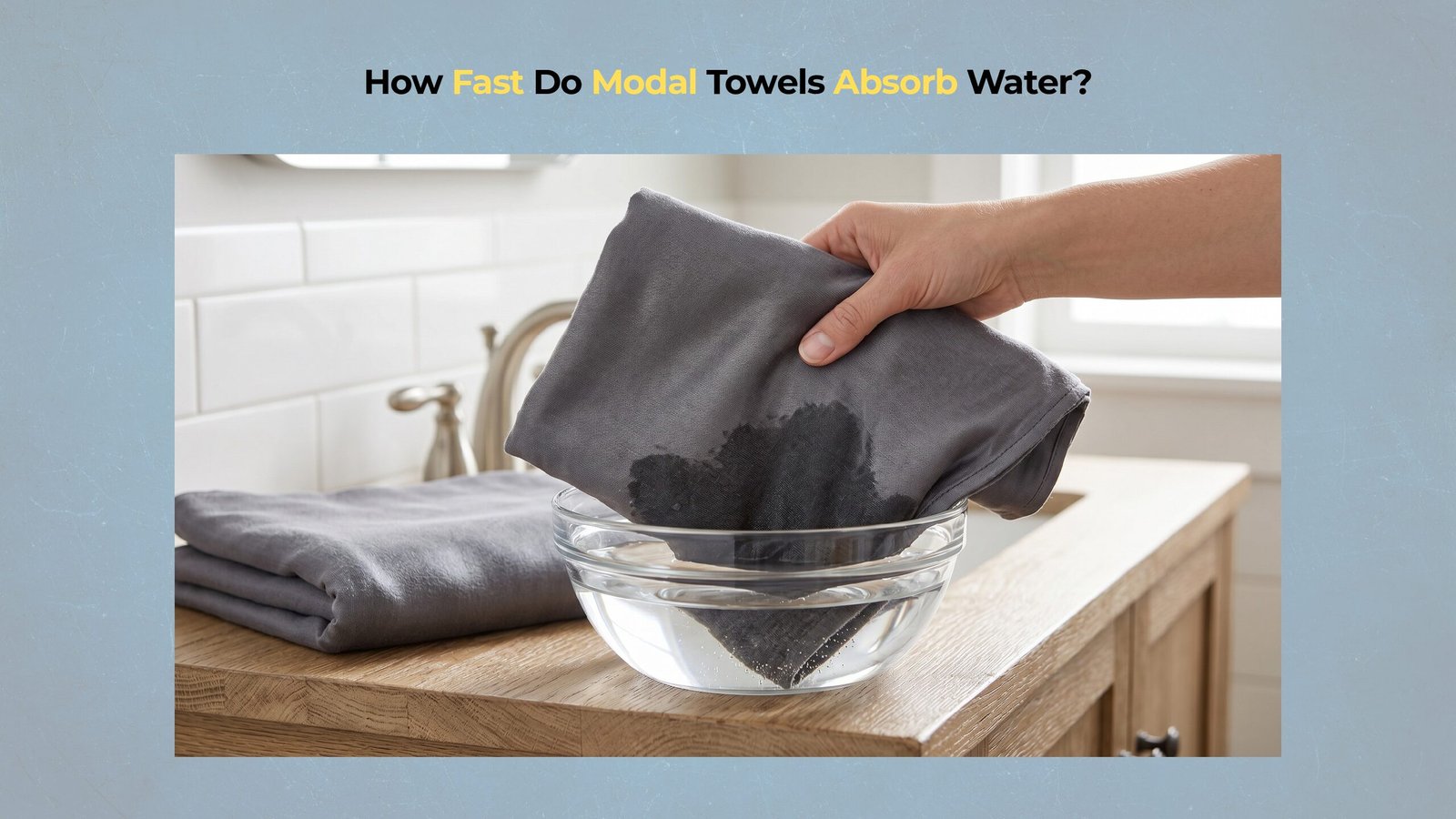
Superior Modal towel wicking speed results if smooth regenerated cellulose fibers facilitate instantaneous moisture transfer away from the skin surface. Instantaneous moisture transfer occurs if the absence of microscopic fiber scales minimizes surface resistance. Minimal surface resistance induces a rapid "pat-dry" sensation for the user.
Why does capillary action drive Modal towel wicking speed?
Capillary action drives Modal towel wicking speed if the consistent spacing between uniform fibers facilitates suction pressure within the interfiber spaces. Suction pressure within the interfiber spaces initiates the upward movement of liquid through the textile loops. Liquid movement accelerates if the hydraulic conductivity of the yarn remains unobstructed by particulate debris.
Capillary transport efficiency also depends on how rapidly liquid penetrates the fiber core after skin contact. To understand the relationship between penetration velocity and textile responsiveness, see how rapid absorption improves Modal towel drying performance.
Snippet Definition: Capillary Action
Capillary action is the ability of a liquid to flow in narrow spaces without the assistance of external forces. This phenomenon is optimized in modal textiles because uniform filament geometry creates thousands of narrow, uninterrupted channels that pull water into the core.
Does the Continuous Capillary Pathway Model improve Modal towel wicking speed?
Modal towel wicking speed improves if the "Continuous Capillary Pathway Model" (descriptive framework) facilitates uninterrupted fluid movement through the yarn core (Lenzing AG). Uninterrupted fluid movement ensures that moisture reaches the interior of the towel before the surface becomes saturated.
Instantaneous moisture transfer becomes even more effective when the fiber structure can retain larger volumes of liquid without becoming oversaturated. Readers comparing liquid capacity between regenerated cellulose materials may also want to explore how Modal moisture capacity influences long-term absorbency performance.
How do yarn construction variables influence Modal towel wicking speed?
Optimized Modal towel wicking speed results occur if low-twist yarn construction and specific pile heights facilitate a high surface-area-to-moisture contact ratio. A high surface-area-to-moisture contact ratio accelerates the transition of liquid from the skin to the absorbent fiber core.
Since low-twist yarn construction increases surface-area exposure, users researching optimized towel engineering may also benefit from reading how absorption speed changes with Modal fiber construction.
Does moisture regain influence Modal towel wicking speed saturation?
Modal towel wicking speed saturation thresholds correlate with hygroscopy if the fibers exhibit moisture regain values between 11–14% within the amorphous regions (Textile Research Journal). Amorphous regions act as high-capacity reservoirs for liquid storage.
Moisture regain performance is closely connected to overall absorbency behavior in regenerated cellulose fabrics. For a broader comparison against traditional towel fibers, explore how Modal absorbency compares to standard cotton towels.
Is Modal towel wicking speed superior to synthetic microfiber?
Direct comparisons of Modal towel wicking speed confirm that modal textiles are widely recognized for rapid moisture distribution compared to synthetic microfiber. Synthetic microfiber often transports moisture rapidly through hydrophobic channeling.
Because microfiber relies on hydrophobic channeling rather than cellulose-based absorption, users comparing drying efficiency across towel materials may also want to review which towel materials dry the fastest under repeated use conditions.
How does performance consistency increase the value of Modal towel wicking speed?
Sustained long-term value for Modal towel wicking speed results if the smooth fiber morphology facilitates resistance to the mineral deposits that stiffen cotton loops. Mineral deposits create a sandpaper-like texture in aged cotton.
Long-term softness retention often determines whether a towel maintains comfortable skin contact after repeated laundering. Readers interested in wash-cycle durability can continue with how Modal fibers preserve softness after frequent washing.
Which laundry protocols preserve peak Modal towel wicking speed?
Maintenance of peak Modal towel wicking speed requires the total exclusion of liquid fabric softeners to prevent the formation of a hydrophobic surfactant film. A hydrophobic surfactant film blocks the entry points of the capillary channels.
Since surfactant buildup can clog capillary pathways and reduce moisture transfer, users troubleshooting poor towel performance may also need to understand how mineral buildup impacts Modal towel texture and absorbency.
Does surfactant-free rinsing improve Modal towel wicking speed efficiency?
Modal towel wicking speed remains stable if additional rinse cycles significantly reduce residual surfactant accumulation (Journal of Surfactants and Detergents).
What care errors compromise Modal towel wicking speed efficiency?
Repeated high-temperature drying accelerates fiber fatigue and surface roughening, which compromises Modal towel wicking speed utility over time. Fiber fatigue and surface roughening increase the risk of bacterial-induced odors.
Frequently Asked Questions (FAQ) — Modal towel wicking speed
Why do Modal towels absorb water faster than cotton?
Superior absorption results if the absence of microscopic fiber scales minimizes surface resistance. Modal fibers utilize High Wet-Modulus (HWM) regenerated cellulose, which facilitates instantaneous moisture transfer.
Does the wicking speed decrease as the towel ages?
Performance consistency remains stable if the smooth fiber morphology resists mineral calcification. Modal towels typically maintain their wicking velocity longer than cotton.
How can I restore Modal towel wicking speed?
Efficiency restoration succeeds if a deep-clean rinse cycle removes residual surfactants. Using distilled white vinegar facilitates the dissolution of waxy films, reopening capillary pathways.
Which checklist verifies genuine Modal towel wicking speed?
| Requirement | Verification Step | Verifiable Result |
|---|---|---|
| Origin | Check label for "100% Lenzing Modal." | Genuine HWM origin occurs if the tag specifies Lenzing. |
| Wicking | Apply water drop test to surface. | Rapid uptake results if absorption happens in < 3 seconds. |
| Finish | Audit for "slick" initial feel. | Wicking stability results if the fiber lacks silicone coatings. |
| GSM | Verify weight is 500-650 range. | Balanced results occur if the GSM remains below 650. |
Technical Disclaimer
Reported wicking speeds are based on laboratory conditions. Actual Modal towel wicking speed varies if users apply chemical treatments or reside in high mineral water areas.