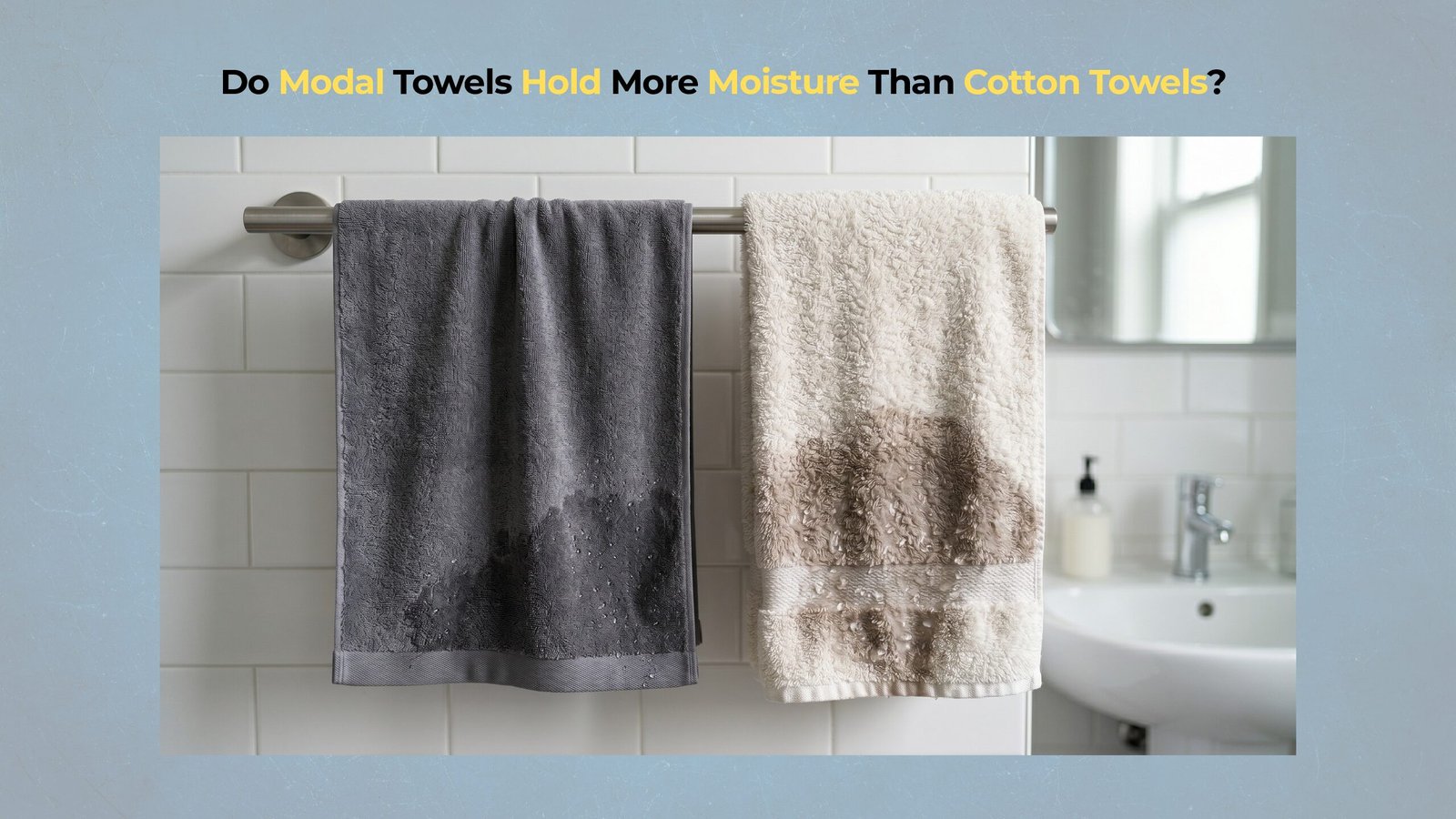
Do Modal Towels Hold More Moisture Than Cotton Towels? — Modal towel moisture holding capacity
Analyzing the intersection of High Wet-Modulus chemistry and hygroscopic storage efficiency in modern textiles.
High Modal towel moisture holding capacity results if the regenerated cellulose fibers facilitate a standard moisture regain that exceeds cotton by approximately 50%.
This standard moisture regain determines how much liquid a textile can sequester within its internal molecular structure before feeling physically “wet” to the touch. Readers comparing regenerated cellulose performance often also want to understand how modal absorbency compares directly to cotton towels under repeated daily use conditions.
Why does moisture regain drive Modal towel moisture holding capacity?
Hygroscopic performance drives Modal towel moisture holding capacity if the molecular structure of the fiber facilitates the absorption of ambient vapor into the amorphous regions of the cellulose.
📚 Definition: Standard Moisture Regain is the amount of water a bone-dry fiber absorbs from the air at 70°F and 65% relative humidity, expressed as a percentage of the dry mass.
These amorphous regions of the cellulose act as storage reservoirs because they lack the rigid, crystal-like structure of synthetic fibers, allowing water molecules to penetrate the fiber core. This internal penetration facilitates the expansion of the fiber diameter, which creates a “swelling” effect that increases the total volumetric storage of the textile. Consequently, the mechanical wicking action between yarns accelerates because the saturated fibers create a stronger capillary gradient. Once users understand moisture transport mechanics, the next logical comparison is why modal towels absorb water faster than traditional cotton fibers.
Does hydroxyl group density influence Modal towel moisture holding capacity?
Modal towel moisture holding capacity increases if the high density of hydroxyl groups facilitates a strong chemical bond with water molecules. According to Lenzing AG’s Technical Analysis of Regenerated Cellulose (2020), modal fibers maintain a structural advantage over cotton due to their higher purity and uniform molecular orientation. This purity ensures that the 13% moisture regain threshold is consistently met, preventing the “dry-scratchy” feel associated with lower-quality cotton textiles. We define this mechanism as the “Hydrophilic Core Sequestration Model,” which explains how water is stored inside the fiber rather than just on the surface.
How does Modal towel moisture holding capacity compare to cotton and bamboo?
Direct comparisons of Modal towel moisture holding capacity confirm that modal provides faster moisture transfer than cotton, while bamboo viscose typically offers the highest total volumetric capacity.
📚 Definition: Specific Heat Capacity in textiles refers to the amount of thermal energy required to raise the temperature of the wet textile mass, which impacts how cold or warm a damp towel feels against the skin.
Bamboo viscose typically holds more total liquid because its fibers are even more porous than modal, yet modal remains the preferred choice for hair care and daily luxury due to its superior wicking speed. Users evaluating these regenerated fibers often continue with the differences between bamboo and other lyocell-based towel materials before choosing a fabric type.
Moisture Management Matrix for Modal towel moisture holding capacity
| Material Type | Liquid Capacity | Wicking Response | Preferred Use Case |
|---|---|---|---|
| Lenzing Modal | High | Fast / Efficient | Daily Luxury / Hair Care |
| Bamboo (Viscose) | MAXIMUM | Moderate | Maximum Volume / Spa Use |
| Egyptian Cotton | High | Moderate (Heavy) | Plushness / Weighted Warmth |
| Standard Cotton | Low to Moderate | Slower | Budget / Utility |
Which limitations affect the utility of Modal towel moisture holding capacity?
Performance trade-offs for Modal towel moisture holding capacity initiate if high liquid retention facilitates excessive wet-weight and extended ambient drying durations.
📚 Definition: Drying velocity is the rate at which a textile returns to its dry mass through evaporation. For readers prioritizing quicker evaporation after showers or gym use, understanding how Tencel towels manage drying speed helps contextualize the trade-off between absorbency and airflow efficiency.
📚 Definition: Grams per Square Meter (GSM) is the measurement of a fabric’s density; a higher GSM indicates a thicker, more absorbent towel that also carries higher wet-weight.
How does absorbency stability increase the value of Modal towel moisture holding capacity?
Enhanced long-term value for Modal towel moisture holding capacity results if the smooth fiber morphology facilitates resistance to the mineral calcification that hardens cotton loops.
Mineral calcification acts as a physical barrier in aging cotton towels, creating a “crust” that prevents water from reaching the hydrophilic center of the yarn. This long-term performance advantage becomes even clearer when compared with how cotton towels gradually lose softness and absorbency after repeated laundering.
📚 Definition: Absorbency stability is the ability of a textile to maintain its original liquid-retention metrics after repeated laundering and exposure to detergent surfactants.
Which laundry protocols preserve Modal towel moisture holding capacity?
Maintenance of Modal towel moisture holding capacity requires the total exclusion of liquid fabric softeners to prevent the formation of a hydrophobic surfactant film. Anyone optimizing long-term towel performance should also review how fabric softeners interfere with towel absorbency and moisture transport across different cotton constructions.
📚 Definition: A hydrophobic surfactant film is a waxy coating deposited by fabric softeners that repels water molecules. This hydrophobic surfactant film blocks the capillary channels of the fibers, effectively neutralizing Modal towel moisture holding capacity and resulting in a “slick” but non-absorbent textile surface.
📚 Definition: Cationic Surfactants are positively charged cleaning agents that, while making fabrics feel soft, bind to the negative charges on cellulose fibers and create the aforementioned water-repellent barrier.
Does water temperature influence Modal towel moisture holding capacity efficiency?
Modal towel moisture holding capacity remains optimal if low-heat wash cycles prevent the thermal yellowing that compromises cellulose fiber porosity. Readers building a complete maintenance routine typically next explore how proper washing protocols improve modal towel durability over time.
What care errors destroy Modal towel moisture holding capacity results?
Catastrophic failure of Modal towel moisture holding capacity precipitates if detergent overload or high-heat drying cycles compromise the hydrophilic core of the cellulose.
This hydrophilic core of the cellulose becomes brittle when exposed to excessive heat, leading to an “over-baked” effect where the fibers can no longer swell to accommodate water.
Absorbency Hazards for Modal towel moisture holding capacity
| Hazard | Effect on Wicking | Corrective Care Action |
|---|---|---|
| Fabric Softeners | Hydrophobic Coating | Execute Vinegar Strip Wash |
| Detergent Overload | Clogged Fiber Pores | Reduce Dose by 50% |
| High-Heat (>120°F) | Cellulose Brittleness | Tumble Dry Low / Air Finish |
| Hard Water Ions | Mineral Calcification | Use Citric Acid Rinse |
Which checklist verifies genuine Modal towel moisture holding capacity?
Verification of Modal towel moisture holding capacity quality succeeds if a definitive quality audit confirms genuine fiber origin and construction techniques before purchase.
Final Quality Checklist for Modal towel moisture holding capacity
- ☐ Verification of genuine HWM origin results if the tag specifies “100% Lenzing Modal.”
- ☐ Achievement of peak wicking occurs if a water drop test shows absorption in <3 seconds.
- ☐ Prevention of chemical interference is supported if the towel avoids a “slick” initial feel.
- ☐ Maintenance of moisture transport results if the loops are verified as “Low-Twist” or “Zero-Twist.”
- ☐ Optimization of dry-time and capacity occurs if the GSM remains between 500 and 700.
Common Questions About Modal towel moisture holding capacity
Does washing reduce Modal towel moisture holding capacity over time?
Preservation of Modal towel moisture holding capacity succeeds if users avoid silicon-based softeners and high-heat drying. Superior performance remains stable for over 100 cycles because the smooth fiber structure resists the mineral buildup that typically degrades cotton absorbency.
How does towel weight (GSM) impact Modal towel moisture holding capacity?
Optimization of Modal towel moisture holding capacity results if the GSM remains between 600 and 700 for maximum volume. However, faster drying velocity occurs if the towel is manufactured at a mid-range GSM of 550, balancing total sequestration with airflow efficiency.
Can you use bleach without destroying Modal towel moisture holding capacity?
Degradation of Modal towel moisture holding capacity precipitates if chlorine bleach compromises the molecular integrity of the regenerated cellulose. Maintaining wicking efficiency requires the use of oxygen-based brighteners to avoid dissolving the hydrophilic core of the fibers.
Why do modal towels feel heavier than cotton when wet?
Increased wet-weight for Modal towel moisture holding capacity results if the fibers sequester water internally within the amorphous regions. This internal sequestration creates a denser textile mass compared to cotton, where water primarily resides on the loop surface.
Technical Disclaimer for Modal towel moisture holding capacity
Individual variance in Modal towel moisture holding capacity occurs if manufacturing discrepancies or specific water chemistry profiles alter the fiber performance metrics. Metric accuracy results if laboratory conditions match the standard atmospheric benchmarks defined by Lenzing AG. Benchmarks provided in this guide utilize explanatory frameworks to illustrate complex molecular interactions for educational purposes and do not constitute an absolute guarantee of performance for every consumer-grade textile.