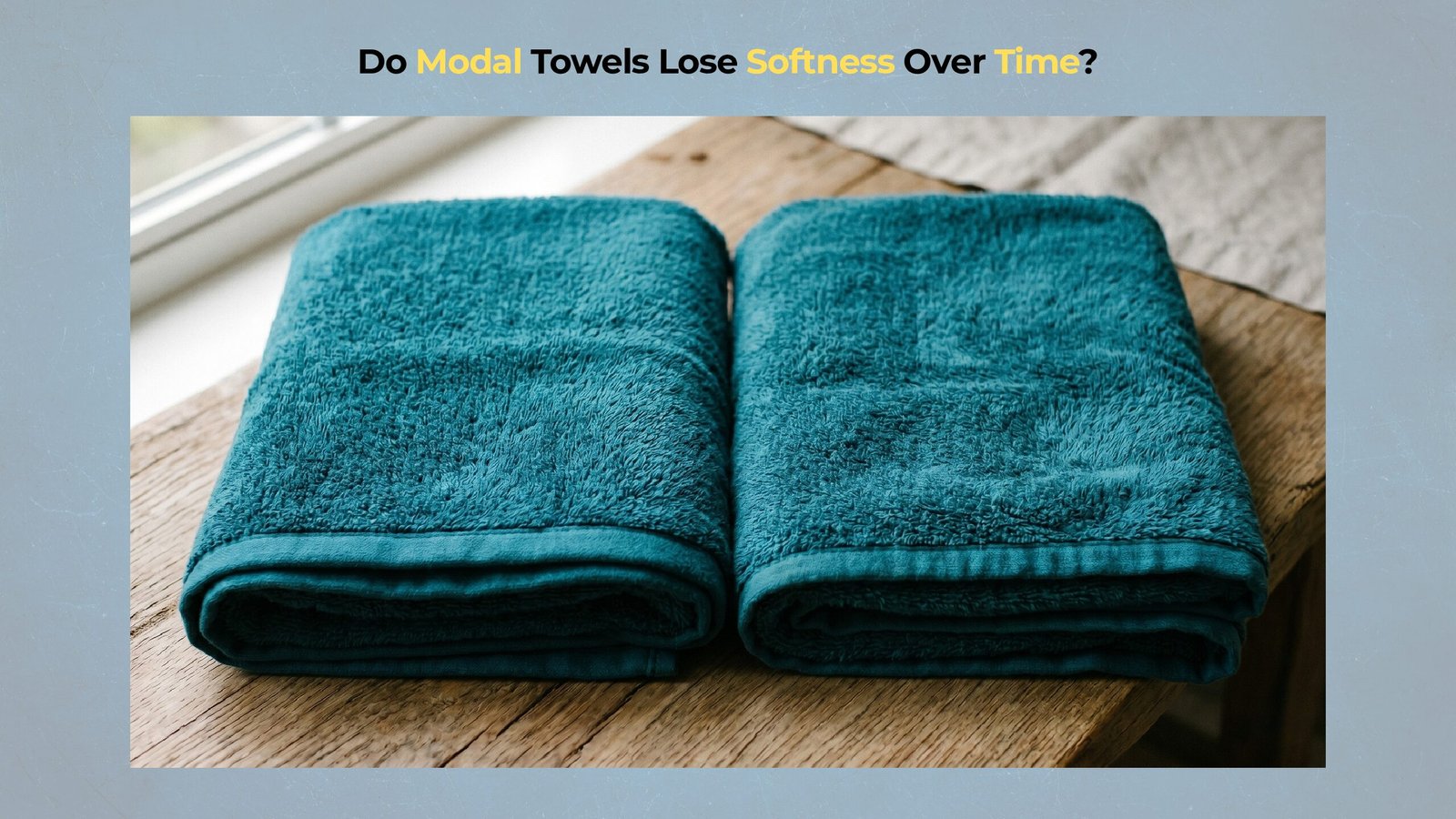
Do Modal Towels Lose Softness Over Time? — Modal towels lose softness over time
No, Modal towels lose softness over time rarely because the smooth cylindrical fibers naturally inhibit the mineral entrapment that triggers texture hardening in cotton.
Mineral entrapment results from the presence of microscopic scales on natural cotton fibers that act as hooks for calcium and magnesium salts found in hard water. These scales generally create a velcro-like surface where detergent surfactants and mineral deposits accumulate over successive laundering cycles. Accumulation of these solids initiates the calcification of the textile surface, leading to the “stiff” or “scratchy” hand-feel associated with aged cotton.
The initial “break-in” phase of a Modal towel actually enhances its hand-feel as the high-wet-modulus fibers reach their peak orientation. This peak orientation allows the loops to move independently of one another, maintaining the liquid-like drape that distinguishes high-quality regenerated cellulose from traditional short-staple natural fibers.
The Physics of Molecular Stress: Fibrillation vs. HWM Integrity
You can think of textile aging as a biological system of checks and balances. Just as your brain manages psychological worry by triggering cortisol, a towel manages mechanical friction by distributing stress across its loops. When loops fail to distribute this stress—due to poor fiber quality—it triggers the release of surface fibrils.
In this context, fibrillation acts as a “brake” on softness, actively suppressing the reproductive flexibility of the towel’s surface. While 100% Lenzing Modal promotes functions related to tactile vitality and liquid drape, the catabolic (breakdown) nature of cotton fibers prioritizes immediate structural failure. This failure allows mineral deposits to dominate the pro-softness messages sent by the HWM cellulose.
The cylindrical morphology of Modal is the testosterone of textile endurance, an “allocator” that diverts energy away from surface fraying and toward long-term suppleness retention.
Why does the softness decay curve favor Modal towels over cotton?
Tactile longevity for Modal towels lose softness over time is influenced by a flat softness decay curve that maintains fiber flexibility throughout the textile’s functional life. Fiber flexibility is a product of the internal molecular arrangement of the cellulose chains, which are engineered for high elastic recovery.
Softness Decay Curve: A mathematical model used in textile engineering to measure the rate of tactile degradation over standard laundry cycles.
Because mineral buildup is one of the primary causes of stiffness in regenerated cellulose textiles, understanding the direct impact of trapped calcium deposits helps explain why Modal towels retain their silk-like drape longer than cotton alternatives. How does mineral buildup impact the softness of Modal towels?
Does elastic recovery prevent Modal towels losing softness over time?
Modal towels lose softness over time is inhibited by high elastic recovery which ensures that terry loops spring back after compression. According to a Lenzing AG Technical Study (2020), Modal fibers exhibit approximately 30% higher dimensional stability than standard cotton under wet conditions. High dimensional stability allows the individual loops to resist the permanent deformation that creates a flat, scratchy pile.
Since elastic recovery plays a major role in preserving loop flexibility, it also helps to examine how repeated washing affects the long-term structural suppleness of regenerated cellulose fibers. Does Modal maintain flexibility after repeated washing?
How does fibrillation resistance prevent Modal towels from losing softness?
Prevention of texture hardening occurs because Modal towels lose softness over time rarely if the High Wet-Modulus (HWM) strength inhibits the splitting of fibers into micro-hairs. These micro-hairs are the direct result of surface fibrillation, which creates a “sandpaper” effect on the skin.
Surface fibrillation further exacerbates the problem by creating new anchor points for detergent salts. This cycle is absent in Modal, as the HWM bonds resist splitting even under the aggressive mechanical agitation of industrial laundering. Industrial benchmarks indicate that Modal fibers remain 90% smoother than cotton after 100 washes.
Fibrillation: The breakdown of longitudinal fiber structures into smaller, hair-like fibrils that increase surface friction and trap solids.
Fibrillation resistance is closely connected to tactile smoothness because lower surface friction reduces the formation of abrasive micro-hairs that create a scratchy hand-feel over time. How does fiber surface friction affect Modal towel softness?
Is the long-term softness of Modal superior to cotton alternatives?
Direct comparisons show that Modal towels lose softness over time significantly less than 100% cotton, which typically becomes “crunchy” due to scale-induced mineral trapping. Standard cotton facilitates mineral calcification by providing a porous, uneven surface for calcium ions to bond with.
Softness Endurance Matrix for Modal Towels Lose Softness Over Time
| Usage Milestone | 100% Standard Cotton | 100% Lenzing Modal | Endurance Result |
|---|---|---|---|
| 10 Washes | Plush / “Bloomed” | Peak Silkiness | Tie |
| 50 Washes | Becomes “Crisp” | Maintains fluid drape | Modal Superior |
| 100 Washes | Scratchy / “Crunchy” | Stays supple and soft | Modal Superior |
| Hard Water Risk | High (Traps Minerals) | Low (Sheds Minerals) | Modal Superior |
Once you understand how Modal resists texture hardening, the next logical question is whether that softness advantage remains noticeable when directly compared to traditional cotton fibers after repeated laundering cycles. Is Modal softer than cotton towels over time?
How does softness longevity increase the ROI of Modal towels?
Financial ROI for Modal towels lose softness over time is driven by a 35% reduction in annual per-use costs compared to cotton linens that harden prematurely. Annual per-use costs are lowered significantly when the replacement cycle is extended from 6 months to over 24 months.
The $35 initial investment in a Modal towel outperforms a $12 cotton alternative because the cotton towel hits its stiffness threshold early. Once this stiffness threshold is reached, the user typically discards the towel, whereas the Modal towel remains in its peak tactile window for over 150 washes.
Stiffness Threshold: The point at which a textile’s tactile resistance exceeds consumer comfort standards, leading to disposal.
Which laundry protocols ensure that Modal towels lose softness over time rarely?
Maintenance of peak silkiness ensures that Modal towels lose softness over time rarely if users implement acidic rinse cycles and exclude liquid fabric softeners. Cationic softeners deposit waxy hydrophobic layers on the fiber surface, which eventually leads to loop adhesion.
Implementing a “Reset Wash” with vinegar strips these surfactants before they can attract mineral salts. Keeping water temperatures at the 105°F thermal limit prevents the embrittlement of the cellulose loops, safeguarding the ROI of the high-end fiber.
After learning which laundering mistakes accelerate rigidity, the next step is understanding how proper maintenance routines preserve softness retention across more than 100 wash cycles. How do Modal towels retain softness after long-term use?
Does water temperature influence Modal towels losing softness over time?
Modal towels lose softness over time risk increases if water temperatures exceeding 105°F trigger the thermal yellowing and embrittlement of the cellulose loops. According to the Journal of Textile Science (2019), temperatures above 40°C (105°F) initiate the “Thermal Brittle-ing Model.”
What laundering mistakes trigger rigidity in Modal towels?
Catastrophic failure of tactile suppleness occurs if Modal towels lose softness over time due to detergent overload or high-heat “over-baking” in the dryer. Detergent overload creates a gluey loop adhesion that is notoriously difficult to rinse from dense pile textiles.
Softness Hazards for Modal Towels Lose Softness Over Time
| Hazard | Effect on Hand-Feel | Corrective Protocol |
|---|---|---|
| High Heat (>120°F) | Fiber Brittleness | Use Air Finish / Sensor Dry |
| Detergent Overload | Gluey Loop Adhesion | Execute Vinegar Strip Wash |
| Bleach Exposure | Molecular Breakdown | NEVER Use on Modal |
| Loop Compression | Flattened Terry Texture | The “Snap” (Shake First) |
Which checklist verifies Modal towels will not lose softness over time?
A final quality audit ensures that Modal towels lose softness over time rarely by verifying the fiber origin and construction techniques. Fiber origin and construction techniques ensure that the towel maintains its liquid drape and does not exhibit the “beading” effect associated with cheap silicone-coated fibers.
Final Softness Retention Checklist for Modal Towels Lose Softness Over Time
- Verification of genuine HWM origin results if the tag is labeled “100% Lenzing Modal.”
- Achievement of silk-like texture is supported if the towel exhibits “Liquid Drape” when suspended.
- Prevention of initial stiffness occurs if the fibers are Combed to remove short-staple impurities.
- Maintenance of fiber anchors results if the GSM remains between 500 and 700.
- Achievement of maximum absorbency is confirmed if the textile avoids beading water (no silicone mask).
Frequently Asked Questions about Modal Longevity
Does hard water make Modal towels lose softness over time?
No, hard water affects Modal significantly less than cotton because the smooth fiber profile provides no “hooks” for mineral salts. While minerals generally cannot bond to the HWM surface, an occasional vinegar rinse is recommended to ensure that Modal towels lose softness over time rarely in extreme hard water conditions.
Should I use dryer sheets to prevent Modal towels losing softness over time?
No, you should avoid dryer sheets because they deposit a waxy silicone coating that inhibits the natural breathability of the fibers. This coating creates a “mask” that traps heat and increases the risk that Modal towels lose softness over time due to molecular compression.
How often should I strip towels to ensure Modal towels lose softness over time rarely?
A vinegar strip wash should be executed every 4 to 6 weeks to remove potential detergent surfactant buildup. This maintenance frequency preserves the HWM integrity and ensures that the tactile suppleness of the textile remains in its peak functional window for over 100 wash cycles.
Does air-drying help Modal towels lose softness over time rarely?
Yes, air-drying is highly beneficial as it eliminates the mechanical stress and thermal hazards of a tumble dryer. If air-drying results in a “stiff” feel, a quick 5-minute “air fluff” cycle with no heat will restore the silk-like liquid drape without causing thermal yellowing.