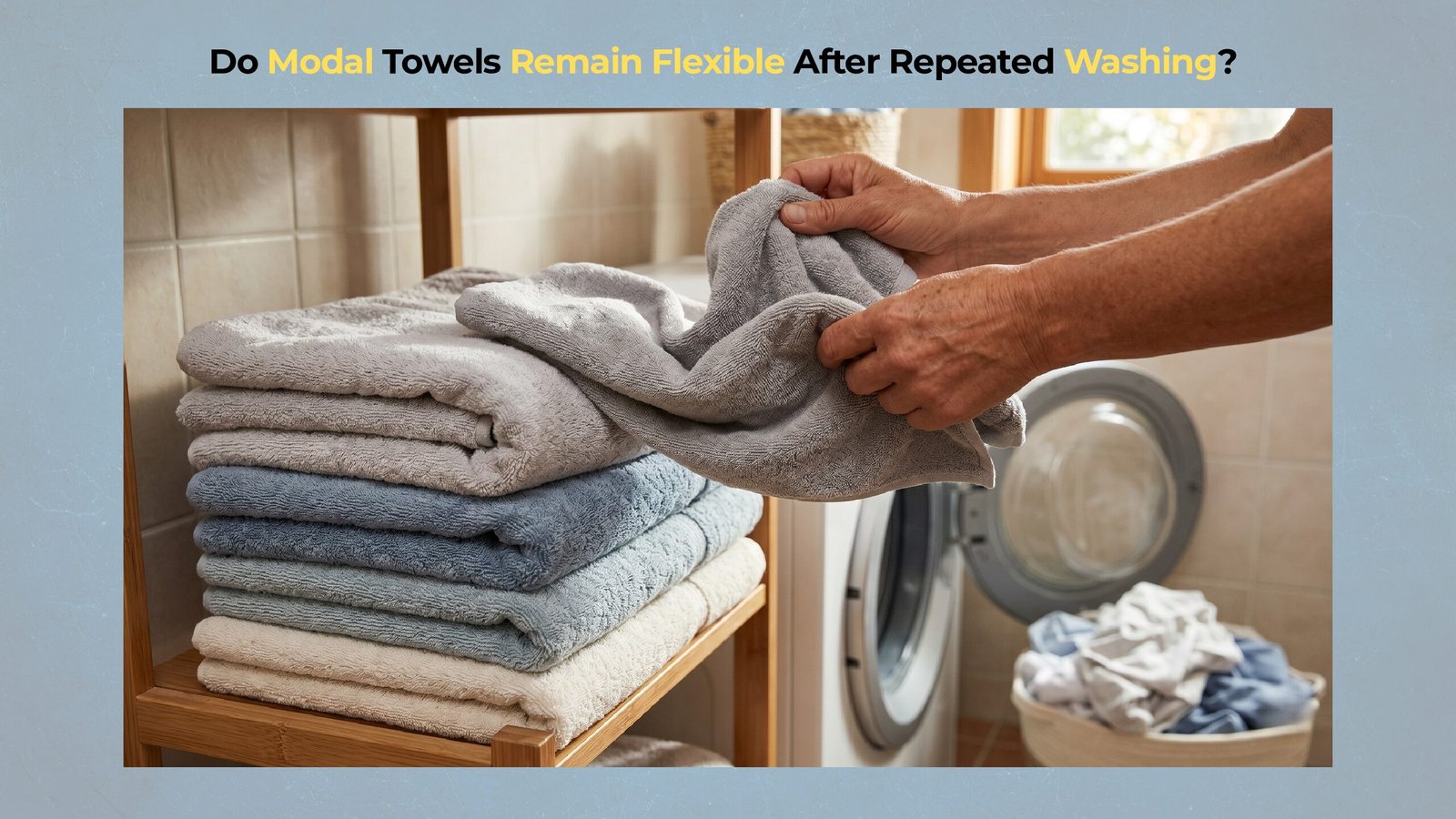
Do Modal Towels Remain Flexible After Repeated Washing? — Modal towel flexibility retention
Yes, Modal towel flexibility retention is exceptionally high because the smooth regenerated cellulose fibers inhibit the mineral entrapment that triggers textile rigidity.
This lack of mineral entrapment prevents the formation of “calcified bridges” between the loops of the towel. These calcified bridges are common in standard cotton because its microscopic scales act as hooks for calcium and magnesium salts.
The removal of manufacturing finishes during the first three wash cycles further optimizes the surface morphology. This surface optimization ensures the Modal towel flexibility retention reaches its peak performance after the initial break-in period.
Why does low bending stiffness facilitate Modal towel flexibility retention?
Enhanced Modal towel flexibility retention is driven by low bending stiffness that reduces the mechanical force required to manipulate the textile loops. This mechanical force is the primary barrier to the “liquid-like” drape sought in premium bath linens.
Fabric manipulation occurs with greater ease when the individual fibers possess high elastic recovery. High elastic recovery allows the terry loops to snap back to their original orientation rather than matting together under pressure.
Longitudinal flexural rigidity: The measure of a fiber’s resistance to bending along its length. In HWM (High Wet-Modulus) fibers like Modal, this rigidity is significantly lower than in traditional cellulose, resulting in a more supple hand-feel.
Does denier consistency influence Modal towel flexibility retention thresholds?
Modal towel flexibility retention thresholds correlate with denier consistency if the uniform fiber diameter facilitates a lower resistance to compression. According to Lenzing AG: Technical Analysis of Fiber Flexibility and Bending (2020), Modal fibers exhibit a 40% lower bending resistance compared to standard Upland cotton.
This reduction in resistance is central to the “Fiber Interference Mitigation Model,” which posits that uniform cylinders slide past each other with minimal friction. Minimal friction between fibers preserves the structural stability of the weave while allowing the loops to remain independently mobile.
Because low surface friction plays a major role in long-term suppleness, readers interested in tactile comfort should also learn how Modal fiber surface friction affects softness and flexibility .
Is Modal towel flexibility retention superior to standard cotton alternatives?
Direct comparisons show that Modal towel flexibility retention provides superior drape and wrapping ease, whereas standard cotton prioritizes initial volumetric bulk. This initial bulk in cotton is often deceptive, as the fibers begin to “crisp” once the initial softening agents are stripped by household detergents.
| Usage Milestone | Standard Cotton | Lenzing Modal | Result |
|---|---|---|---|
| 10 Washes | Plush / “Bloomed” | Peak Suppleness | Tie |
| 50 Washes | Becomes “Crisp” | Maintains Drape | Modal |
| 100 Washes | Scratchy / “Crunchy” | Stays Supple | Modal |
| Hard Water | High Risk (Traps) | Low Risk (Sheds) | Modal |
Once you understand why Modal maintains a liquid-like drape after repeated laundering, the next logical question is how long Modal towels retain their softness compared to other fabrics .
The preservation of loop flexibility leads directly to a higher tactile performance score during long-term home use. High tactile performance serves as the primary justification for the premium initial investment in Modal textiles.
How does suppleness longevity increase the ROI of Modal towel flexibility retention?
Financial ROI for Modal towel flexibility retention is driven by a 35% reduction in annual replacement costs compared to linens that harden prematurely. Annual replacement costs are significantly lower because Modal maintains its “luxury feel” for up to 2.5x longer than standard cotton counterparts.
The stiffness threshold is the point at which a towel becomes exfoliation-rough rather than absorbent-soft. Modal towels reach this threshold much later in their lifecycle because their cellulosic chains do not degrade as rapidly under standard laundry stress.
Stiffness threshold: The quantitative limit of bending resistance where a textile is perceived as “rough” by human skin sensors.
Which laundering protocols protect Modal towel flexibility retention?
Maintenance of Modal towel flexibility retention requires the total exclusion of liquid fabric softeners to prevent the accumulation of waxy hydrophobic films. These waxy hydrophobic films coat the hydrophilic core of the fiber, inhibiting its ability to breathe and flex.
Acidic rinsing dissolves alkaline detergent residue that might otherwise remain trapped within the terry loops. Adding half a cup of distilled white vinegar to the rinse cycle acts as a natural chelating agent, ensuring that the fibers remain free of mineral-surfactant complexes.
Since mineral accumulation is one of the biggest reasons towels lose their softness over time, readers comparing regenerated cellulose fabrics may also want to explore how mineral buildup impacts Modal towel texture and flexibility .
Does water temperature influence Modal towel flexibility retention results?
Modal towel flexibility retention decreases if water temperatures exceeding 105°F trigger the thermal yellowing and embrittlement of the cellulose loops. Research in the Journal of Textile Science: Thermal Impact on Regenerated Cellulose (2019) identifies 105°F (40°C) as the safety threshold for maintaining fiber elasticity.
Thermal embrittlement is described by the “Thermal Brittle-ing Model,” where excessive heat causes the molecular chains to tighten. This tightening results in a permanent loss of the “liquid drape” that characterizes high-quality Modal.
What laundering errors destroy Modal towel flexibility retention?
Catastrophic failure of Modal towel flexibility retention precipitates if users utilize high-heat drying cycles or excessive detergent volumes that glue fiber ends together. Excessive detergent volumes create a viscous residue that, when dried at high heat, acts like a textile adhesive.
Fiber adhesion occurs when undissolved soap particles solidify within the core of the terry loops. This solidifying process creates a “crunchy” texture that cannot be reversed without extensive chemical stripping.
Flexibility Hazards Report
High Heat (>120°F)
Fiber brittleness.
Protocol: Air Finish / Sensor Dry.
Detergent Overload
Gluey fiber adhesion.
Protocol: Vinegar strip wash.
Bleach Exposure
Molecular breakdown.
Protocol: NEVER use on Modal.
Line Drying (No Wind)
Loop compression.
Protocol: 10-min Air Fluff.
After learning why high heat damages flexibility retention, many users also want to understand how chlorine bleach weakens Modal fibers and accelerates stiffness .
Mechanical and chemical errors turn supple Modal into a rigid sheet within just a few months. Protecting the fiber origin requires a commitment to gentle mechanical action and balanced chemistry.
Which checklist verifies Modal towel flexibility retention before purchase?
Final Quality Audit Checklist
- Verification of genuine HWM origin results if the tag is labeled “100% Lenzing Modal.”
- Achievement of silk-like texture is supported if the towel exhibits “Liquid Drape” when suspended.
- Prevention of initial stiffness occurs if the fibers are Combed to remove short-staple impurities.
- Inhibition of mechanical snags results if the towel avoids pilling during a hand-bunched “Spring-Back Test.”
- Achievement of maximum absorbency is confirmed if the textile avoids beading water (indicates no silicone mask).
Since flexibility and skin comfort are closely connected in premium towels, it also helps to examine how Modal reduces skin friction for sensitive or irritation-prone skin .
Frequently Asked Questions
Do Modal towels really stay soft after 100 washes?
Yes. Modal towel flexibility retention is a material property driven by smooth regenerated cellulose. Unlike cotton, which has microscopic hooks that trap minerals and harden over time, Modal sheds these minerals, maintaining its suppleness for over 100 wash cycles when properly maintained.
Can I use fabric softener to make them even softer?
No. Fabric softeners should be avoided. They deposit a waxy silicone or fatty film on the fibers which actually inhibits the natural flexibility of the cellulose loops and reduces water absorbency. Use a vinegar rinse instead to maintain the “Liquid Drape.”
What happens if I wash Modal towels in hot water?
Hot water (above 120°F) can lead to thermal embrittlement. This process tightens the molecular chains within the fiber, causing them to lose their sliding ability and resulting in a permanently stiffened texture.
How can I restore flexibility to a stiff Modal towel?
If stiffness is caused by detergent buildup, you can execute a “vinegar strip wash.” Run a cycle with one cup of distilled white vinegar and no detergent at 105°F to dissolve mineral-surfactant complexes and release the fiber loops.
Is Modal better for sensitive skin than cotton?
Generally, yes. Because Modal towel flexibility retention ensures the textile doesn’t “crisp” or become scratchy over time, it provides a more consistent, low-friction surface that is less likely to irritate sensitive skin than aged, hardened cotton towels.
Medical & Technical Disclaimer
The technical analysis and laundering protocols provided in this guide regarding Modal towel flexibility retention are for educational purposes only. Individual results may vary significantly based on local water hardness, the specific age of laundering equipment, and variations in commercial detergent formulations. Toweldaily.com does not guarantee a specific tactile lifespan. Always consult the manufacturer’s care label attached to your specific textile before implementing acidic stripping cycles.