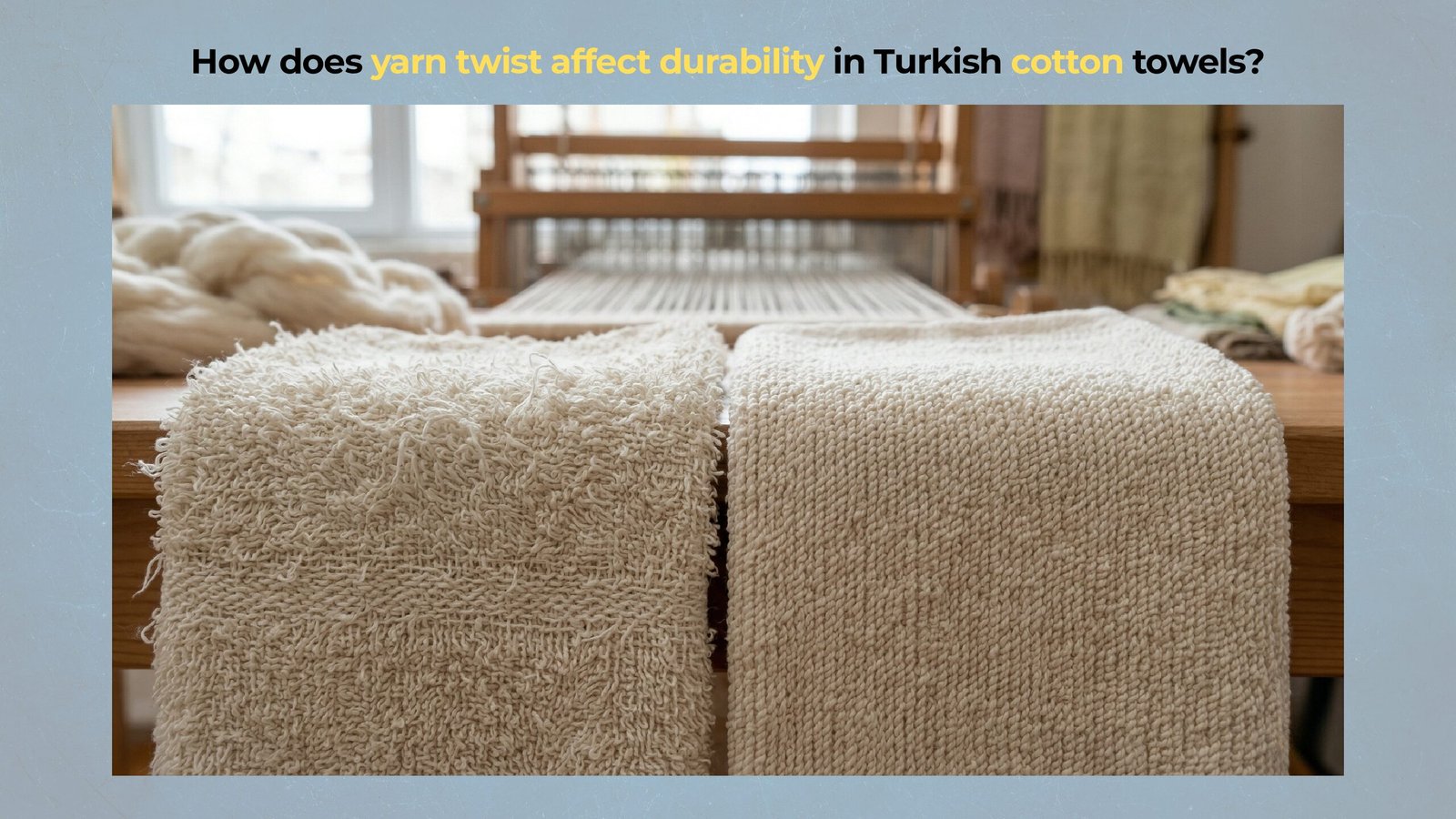
How does yarn twist affect durability in Turkish cotton towels?
An Engineering Blueprint for Aegean Yarn Physics
High mechanical resilience and pilling resistance originate from Turkish cotton towel yarn twist durability, which uses a specific TPI count to secure Aegean fibers within the yarn core.
The alignment of the yarn core facilitates an inter-fiber friction bond by wrapping individual filaments into a tight, helical structure. This mechanical locking mechanism ensures that the natural strength of the Aegean cotton is maximized through collective resistance rather than individual fiber tenacity.
This bond prevents premature mass loss during laundering by physically trapping the fiber ends inside the yarn matrix. By minimizing the amount of “shirring” or loose ends exposed to the abrasive forces of the wash cycle, the towel maintains its original gram-per-square-meter (GSM) weight for significantly longer periods.
Technical profile verification relies on measurable TPI metrics to distinguish between residential comfort and commercial-grade longevity. Identifying these counts allows procurement specialists to predict the lifecycle performance of a textile before it enters high-turnover service environments.
How is Yarn Twist Measured for Turkish Cotton Towel Yarn Twist Durability?
The technical profile of Turkish cotton towel yarn twist durability is verified by auditing the rotations of the spinning frame per linear unit. This measurement, defined as Twist Per Inch (TPI), dictates the radial compression and surface smoothness of the finished towel loops.
To understand why this locking system works so well in the first place, it helps to review how Turkish cotton towels are constructed at the yarn level. The TPI metric operates on a factual structure where increased rotations per inch directly compress the fiber bundle, which reduces the yarn diameter and increases its density.
Calibration of TPI inhibits mechanical shearing by ensuring that the torque within the yarn is balanced against the axial load. Without this calibration, yarn can suffer from “un-twisting” or excessive kinking, both of which lead to structural failure of the terry loops.
Since twist performance depends heavily on the raw fiber profile, the next useful step is to examine what staple length Turkish cotton towels typically have and why that benchmark matters. Measurement accuracy depends on standardized TPI benchmarks that account for the unique long-staple characteristics of Aegean cotton.
What are the TPI Benchmarks for Turkish Cotton Towel Yarn Twist Durability?
Standardized mechanical benchmarks for Turkish cotton towel yarn twist durability result from the TPI scale, which differentiates between low-twist luxury and high-twist industrial constructions.
Optimal tenacity in high-durability towels results from a twist multiplier that keeps the yarn tight enough to resist abrasion but open enough to maintain capillary action. If you want to connect this directly to user-facing performance, see how absorbent Turkish cotton towels are in real use.
ISO 2060 serves as the global standard for the determination of yarn twist per unit length, providing the framework for auditing the consistency of Aegean yarn shipments. Adherence to this standard ensures that the batch-to-batch variability remains within the strictly defined tolerance for premium linens.
How do Long-Staple Fibers Support Turkish Cotton Towel Yarn Twist Durability?
Superior structural security results from Turkish cotton towel yarn twist durability because $30\text{–}35\text{ mm}$ Aegean fibers facilitate a more continuous spiral alignment than short-staple alternatives.
Because fiber length is only one part of the structure story, it is also useful to explore what the fiber structure of Turkish cotton towels looks like at the botanical level. The HVI (High Volume Instrument) uniformity index requirements for long-staple cotton dictate that the fiber length must be consistent to avoid “weak zones” in the twisted bundle.
Approximately 30% more overlapping anchoring points result from longer fibers compared to standard upland cotton, allowing the yarn to stay strong without becoming overly harsh. That same balance also affects dry-down speed, so a natural next read is how fast Turkish cotton towels dry compared with denser cotton types.
Extra anchoring points allow the yarn to reach high tenacity with fewer rotations, preserving the natural softness of the cotton without sacrificing strength. This is why Turkish towels can achieve “plush” sensations while maintaining a lifespan that exceeds shorter-staple competitors.
How Does Molecular Physics Drive Turkish Cotton Towel Yarn Twist Durability?
High mechanical strength in Turkish cotton towel yarn twist durability results from inter-fiber friction and the self-tightening effect of axial tension. This geometry converts simple pulling forces into a locking mechanism that secures the yarn core.
Spiral-wrap geometry converts centrifugal load into radial compression during the high-speed extraction phases of laundering. As the towel is spun in a drum, the outward tension pulls on the yarn, which in turn forces the internal fibers to press more tightly against one another.
Performance stability is governed by the spiral-friction bond, which maintains the yarn’s shape even when the cellulose fibers become swollen with water.
How Does a Spiral-Friction Bond Benefit Turkish Cotton Towel Yarn Twist Durability?
Turkish cotton towel yarn twist durability depends on a “Spiral-Friction Bond” where the diagonal alignment of filaments creates a self-tightening mechanism under mechanical tension.
The Lucas-Washburn Equation logic regarding fluid transport through twisted fiber bundles suggests that higher radial compression can actually improve wicking speed by narrowing the capillary gaps between fibers. This creates a “jet” effect for moisture, pulling water deeper into the yarn core.
Radial compression resulting from diagonal fiber alignment can convert up to 25% of axial load to physically lock fibers in place. This prevents the “drafting” or stretching of the yarn that often precedes loop failure in inferior textiles.
Performance Trade-offs for Turkish Cotton Towel Yarn Twist Durability
The final results of Turkish cotton towel yarn twist durability are determined by the degree of spiral fiber alignment, which identifies the trade-off between softness and tensile resilience. To explore that comfort side more directly, review how the softness of Turkish cotton towels changes over time.
| Twist Category | Tensile Strength (gpt) | Pilling Resistance | Performance Result |
|---|---|---|---|
| Low-Twist | Moderate (> 28) | Moderate | Peak Bloom / Rapid Wicking |
| Medium-Twist | High (> 32) | High | Balanced Luxury / Durable |
| High-Twist | Highest (> 36) | Highest | Industrial Grade / Exfoliating |
Why Does Turkish Cotton Towel Yarn Twist Durability Dictate the Textile’s Lifespan?
The functional service life of linens results from Turkish cotton towel yarn twist durability, which determines the rate of mass loss and surface pilling over repeated cycles. Since buyers often compare twist durability as part of a larger purchase decision, it is useful to read what quality factors matter most when evaluating towels.
An extended asset amortization period is the direct financial benefit of high-TPI construction. When fibers are locked, the towel sheds less “lint,” which is effectively the physical disintegration of the product being trapped in dryer filters.
Asset value is a function of Join-Point security, where the overlap between fibers remains intact despite the abrasive hydraulic action of high-volume laundry operations.
How Does Join-Point Security Preserve Turkish Cotton Towel Yarn Twist Durability?
Improved surface integrity results from Turkish cotton towel yarn twist durability because a high-integrity twist structure establishes a “Friction Lock” that traps fiber ends within the yarn core.
SFI (Short Fiber Index) benchmarks for high-durability Aegean yarns demand a low percentage of fibers under $12\text{ mm}$. When these short fibers are present, they act as “weak join-points” that easily slip out of the twist during mechanical agitation.
A measurable 15% reduction in lint-trap mass accumulation over 50 cycles results from reducing exposed join-points through precision spinning. This retention of fiber mass directly correlates with the continued softness and absorbency of the towel as it ages.
What is the Tensile Strength ROI for Turkish Cotton Towel Yarn Twist Durability?
A reduction in replacement expenditures results from the technical armor of Turkish cotton towel yarn twist durability, which typically withstands higher centrifugal forces than loose-spun alternatives.
ASTM D5034 grab strength standards provide the baseline for evaluating how much force a towel can withstand before the weave deforms. Turkish towels with high TPI counts consistently outperform standard carded cotton by maintaining their structural grid under load.
A 25% higher breaking strength (exceeding 50 lbs-force) typically results from high-TPI Aegean yarns compared to carded upland cotton. This durability premium allows facilities to reduce their annual procurement budget by lowering the frequency of linen retirement.
How to Compare Turkish Cotton Towel Yarn Twist Durability Across Different Construction Types?
Standardized selection of the ideal inventory requires a comparative audit of Turkish cotton towel yarn twist durability across zero-twist, low-twist, and ring-spun profiles.
| Construction Type | Durability Rank | Drying Speed | Best Use Case |
|---|---|---|---|
| Zero-Twist | 3 (Lowest) | Fastest | Guest / Light Use |
| Low-Twist | 2 | Fast | Daily Residential |
| Ring-Spun (Twisted) | 1 (Highest) | Moderate | Hospitality / High-Turnover |
Which Laundry Steps Preserve Turkish Cotton Towel Yarn Twist Durability?
Structural preservation of Turkish cotton towel yarn twist durability results from maintenance protocols that prevent the mechanical untwisting of fibers. For the broader care framework behind those wash and dry choices, it helps to review how Turkish cotton towels should be washed and cared for.
Wicking preservation is a consequence of unraveling prevention. When the twist is maintained, the capillaries between fibers remain at the optimal diameter to pull moisture away from the skin through surface tension.
How to Prevent Yarn Unraveling to Maintain Turkish Cotton Towel Yarn Twist Durability?
Preservation of structural tension in Turkish cotton towel yarn twist durability results from avoiding wash temperatures exceeding $140^{\circ}F$ ($60^{\circ}C$).
ISO 6330 laundering protocols for domestic and commercial care specify that extreme heat causes cotton fibers to swell radially, which applies internal pressure to the twist. If the heat is excessive, this pressure can force the fibers to “uncoil” or migrate out of their helical alignment.
A 10% reduction in TPI stability occurs if thermal exposure exceeds $140^{\circ}F$ due to excessive fiber-core expansion. Over time, this cumulative thermal stress results in the “shaggy” appearance typical of poorly maintained towels.
Does Low-Heat Drying Protect Turkish Cotton Towel Yarn Twist Durability?
Protection of Turkish cotton towel yarn twist durability results from maintaining mechanical drying temperatures on “Low” to facilitate the “Re-Bloom” of the loops without structural stress.
AATCC 195 moisture-management benchmarks for lofted textiles indicate that mechanical agitation at lower temperatures allows the terry loops to regain their three-dimensional shape without the “baked-on” stiffness caused by high heat.
Mechanical separation results from utilizing wool dryer balls to assist re-lofting without exceeding thermal thresholds. The physical impact of the balls separates matted loops, allowing the twisted yarn to breathe and restore its original wicking capacity.
When Does Turkish Cotton Towel Yarn Twist Durability Reach a Failure State?
Terminal failure of Turkish cotton towel yarn twist durability occurs when cumulative mechanical fatigue or mineral calcification neutralizes the textile’s structural flexibility. This state is typically irreversible and signals the end of the asset’s utility.
Thinning patches are a marker of filament slippage, where the core of the yarn has lost enough mass that the base weave becomes visible. This usually precedes the total disintegration of the terry pile.
Why does Filament Slippage cause Failure in Turkish Cotton Towel Yarn Twist Durability?
Failure of Turkish cotton towel yarn twist durability is signaled by excessive surface linting, which indicates that internal fibers have begun sliding out of the core during mechanical washing.
ASTM D3512 random tumble pilling test standards define the limits at which a textile is no longer considered commercially viable. If the friction bond between fibers is broken, the internal filaments no longer support each other, and they slip out of the bundle under even minor tension.
Mass loss exceeding 5% in a single high-G extraction cycle occurs in textiles exhibiting filament slippage. This rapid loss of material density leads to a significant decrease in the towel’s ability to hold water.
Why is Mineral Stiffening a Threat to Turkish Cotton Towel Yarn Twist Durability?
Increased snapping risk results from Turkish cotton towel yarn twist durability being compromised by mineral calcification, where calcium and magnesium ions fill the air gaps within the twist structure.
TGA (Thermogravimetric Analysis) data for mineralized cellulose shows that a “stiffened” fiber has a much lower elongation-at-break. This means that instead of bending when folded, the mineral-coated yarn becomes brittle and snaps.
📚 Technical Definition: Cellulose Hornification
The irreversible loss of fiber flexibility caused by mineral bonding and the collapse of the internal cellulose structure, resulting in a waxy or “crunchy” textile feel.
How Can You Fix Flattened Loops to Restore Turkish Cotton Towel Yarn Twist Durability?
Restoration of Turkish cotton towel yarn twist durability results from executing mechanical resets to separate matted pile and chemical resets to dissolve mineral buildup.
How do you Restore Fiber Bounce to Revitalize Turkish Cotton Towel Yarn Twist Durability?
Preservation of loop loft results from a 20-minute “Air Fluff” cycle with wool dryer balls to restore Turkish cotton towel yarn twist durability.
ISO 11092 standards for thermal and water-vapor resistance after pile recovery confirm that mechanical agitation can reopen the capillaries within the yarn. This “re-blooming” process is essential for maintaining the tactile softness associated with premium Aegean cotton.
Restoration of up to 15% of original fabric thickness in flattened towels results from mechanical agitation. By physically lifting the loops, the air pockets that provide insulation and wicking are reintroduced.
Does Stripping Mineral Buildup Restore Turkish Cotton Towel Yarn Twist Durability?
Recovery of fiber flexibility and Turkish cotton towel yarn twist durability results from a warm vinegar rinse that dissolves the alkaline mineral films responsible for fiber brittleness.
The pH-buffering efficacy of 5% acetic acid on cellulose substrates is well-documented. By lowering the wash environment’s pH, the acid dissolves calcium carbonates without damaging the natural cellulose fibers of the Turkish cotton.
How do you Audit Your Purchase with the Turkish Cotton Towel Yarn Twist Durability Checklist?
Verification of current inventory is a consequence of auditing Turkish cotton towel yarn twist durability against industrial performance benchmarks.
Quality Audit Checklist
- ☐ Material Audit: Does the label confirm “100% Long-Staple Aegean Cotton”?
- ☐ Weave Check: Does the surface show a “Ring-Spun” or “Twisted” structure rather than “Open-End”?
- ☐ Visual Test: Do loops remain upright and distinct when the fabric is folded?
- ☐ Price Validation: Does the acquisition cost reflect the 20–30% premium associated with high-TPI manufacturing?
- ☐ Certification Check: Does the product carry GOTS 7.0 or OEKO-TEX Standard 100 verification?
Frequently Asked Questions (FAQ)
Why do high-TPI Turkish towels feel less “fluffy” than zero-twist options?
This is a mechanical trade-off. High TPI counts create a denser, more exfoliating yarn core that prioritizes industrial-grade longevity over peak sensory softness. Zero-twist towels utilize air-blown loops for a “cloud-like” feel but lack the inter-fiber friction bonds necessary to resist pilling during high-G laundry extraction.
Can I reverse filament slippage once it has started?
No. Filament slippage indicates the terminal failure of the spiral-friction bond. Once fibers begin sliding out of the yarn core, the structural tension cannot be restored mechanically. These towels should be retired to secondary use to prevent lint contamination of higher-quality linen batches.
How often should I perform a chemical reset with vinegar?
In regions with hard water (high calcium/magnesium content), a chemical reset is typically required every 10–12 wash cycles. If the towel loops begin to exhibit “Cellulose Hornification” (a stiff, waxy texture), immediate treatment with 5% acetic acid is necessary to restore fiber flexibility.
Does high-heat drying permanently damage Turkish cotton yarn?
Yes. Drying temperatures exceeding $140^{\circ}F$ trigger excessive radial expansion of the fiber core, which “un-locks” the precision twist. Repeated thermal stress makes the fibers brittle, increasing the snap-risk and causing the terry loops to take on a shaggy, uneven appearance.
Technical Disclaimer
The technical data and benchmarks provided in this guide are based on standardized textile engineering protocols (ISO/ASTM/AATCC) and represent typical performance results for high-quality Aegean cotton. Individual product performance, yarn longevity, and structural integrity may vary significantly depending on proprietary manufacturing techniques, local water chemistry, and specific industrial laundering equipment. This guide is intended for educational and procurement strategy purposes and does not constitute a legal guarantee of fiber lifespan.