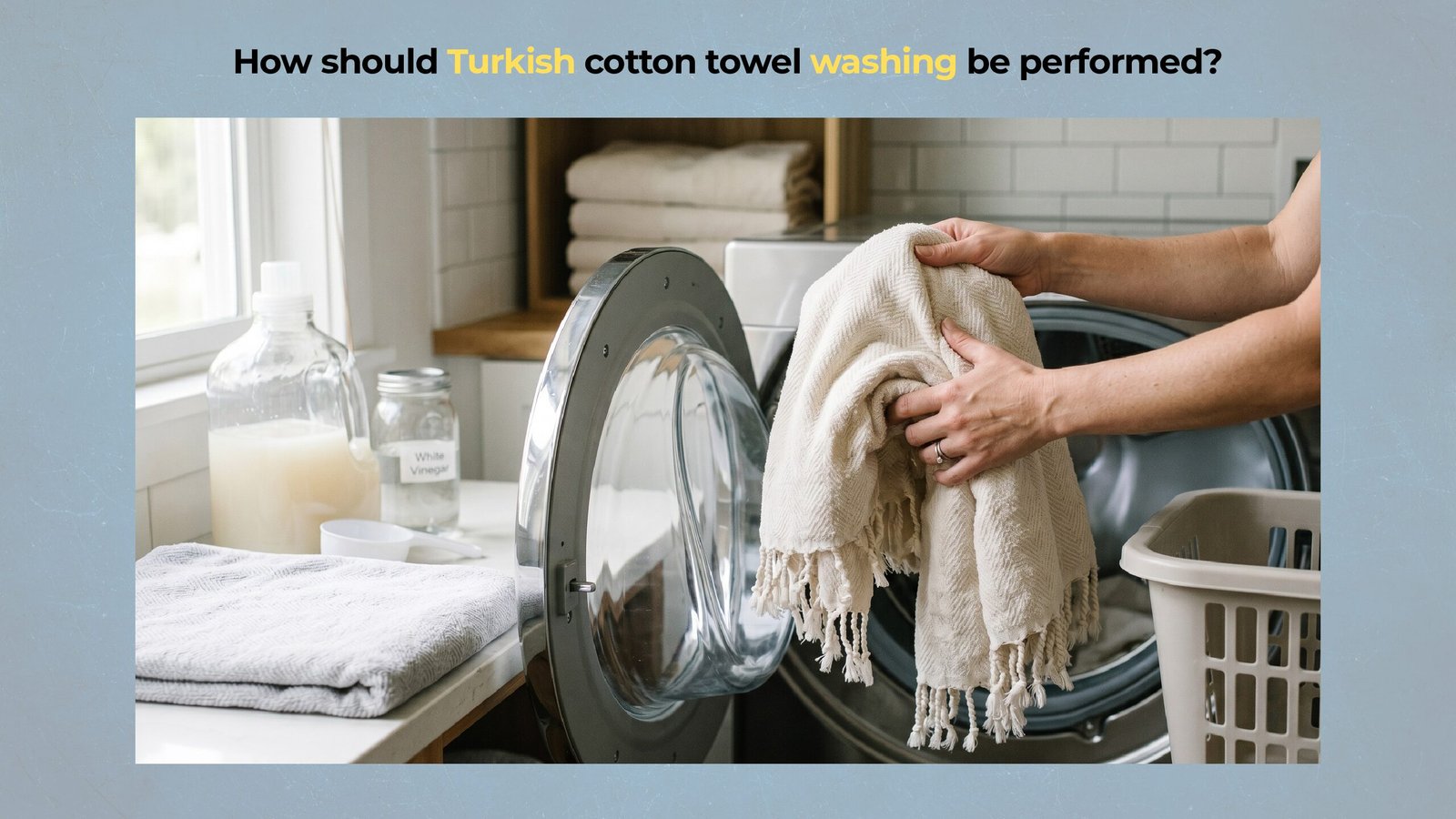
How should Turkish cotton towel washing be performed?
Turkish cotton towel washing yields the best results when the user employs pH-neutral liquid surfactants, maintains moderate water temperatures between 86°F–104°F (30°C–40°C), and avoids silicone-based fabric softeners.
Task Fulfillment Statement:
This guide establishes the technical chemical and thermal protocols designed to sanitize Aegean linens while supporting the ‘bloom’ and capillary wicking of long-staple cotton filaments.
How should Turkish cotton towel washing be executed for optimal results?
Turkish cotton towel washing yields the best results when the user employs pH-neutral liquid surfactants, maintains moderate water temperatures between 86°F–104°F (30°C–40°C), and avoids silicone-based fabric softeners. By anchoring the maintenance strategy in textile science, we ensure that the Aegean Sea long-staple cotton fibers retain their structural integrity and wicking performance over hundreds of cycles.
Turkish cotton towel washing performance depends on preserving the hydrophilic behavior of long-staple fibers during laundering. To understand how moisture interaction works at the fiber level, it is useful to explore how absorbent Turkish cotton towels are and how they manage moisture transfer.
Identify the chemical “No-Go” list for Turkish cotton towel washing?
This washing protocol encounters risks when chlorine-based agents oxidize the cellulose matrix or when cationic surfactants in fabric softeners coat the Fiber Lumen, which can reduce absorbency.
Comparative Chemical Impact on Fiber Absorbency
Percentage represents retained hydrophilic efficiency after 50 cycles.
Discuss findings in the Journal of Applied Polymer Science regarding cellulose oxidation; Explain how Sodium Hypochlorite can significantly reduce tensile strength over multiple cycles. Over multiple cycles, this lead to “fiber-lock,” where the long-staple cotton filaments become brittle and lose their ability to “bloom.”
Identify the chemical and thermal conditions (inputs) for Turkish cotton towel washing?
This laundry system functions effectively when the user provides appropriate water hardness levels and surfactant concentrations to emulsify lipids without leaving significant mineral residue. High-precision care requires balancing the mechanical agitation of the machine with the chemical solvency of the water.
Thermal conditions during washing influence how fibers expand and maintain structural flexibility. Because this behavior originates at the microscopic level, it is helpful to understand what the fiber structure of Turkish cotton towels looks like and how it affects performance.
Evaluate water mineral levels as a conditional input for Turkish cotton towel washing?
The fiber maintenance process often suffers in hard-water environments where calcium and magnesium ions contribute to mineral buildup within the pile, which can reduce performance.
Reference the Water Quality Association (WQA) classification for hard water; Insight: Moderate temperatures help preserve fiber integrity by preventing thermal shock to the Cellulose Polymer Chains structure, which occurs when moving from extreme heat to cold rinses.
Explain how molecular physics drive the Turkish cotton towel washing system behavior?
Turkish cotton towel washing succeeds when surfactants lower surface tension to emulsify lipids while saturation allows the Aegean fibers to swell and reset their mechanical tension. This molecular interplay is what creates the “hand-feel” of a luxury towel.
Analyze the “Surfactant-Fiber” system behavior in Turkish cotton towel washing?
Turkish cotton towel washing produces effective cleaning when Surfactant Micelles encapsulate hydrophobic body oils, allowing the hydrophilic heads to pull the soil into the aqueous solution. This prevents the “graying” of white linens caused by re-deposited soils.
Improper washing chemistry can coat fibers and reduce their ability to wick water effectively. Since this issue directly impacts usability, a natural next step is to review how chemical residues affect Turkish cotton towel performance and absorbency.
Use this mechanism matrix to evaluate the Turkish cotton towel washing system?
Turkish cotton towel washing involves drivers like thermal energy and mechanical agitation that can influence the final textile loft and hygiene profile.
| Driver | Molecular Impact | Resulting Textile Profile |
|---|---|---|
| Thermal Energy (40°C) | Increases kinetic motion of Surfactant Micelles | High Lipid Emulsification |
| Mechanical Agitation | Physical displacement of particulates | Pile Reset / Bloom Activation |
| pH-Neutral Surfactants | Maintains Cellulose Polymer Chains balance | Preserved Tensile Strength |
Execute specific laundry protocols for optimal Turkish cotton towel washing?
This washing protocol minimizes mechanical wear when the user adjusts spin cycles based on the specific GSM and loop density of the textile. High-GSM towels require longer drying times at lower heat to prevent core moisture retention.
From a practical standpoint, maintaining proper washing routines is essential for preserving towel performance over time. To connect this with real-world care decisions, it is useful to review what care instructions should be followed to maintain towel performance and longevity.
Execute the “Initial Thermal Reset” wash for new Turkish cotton towels?
Turkish cotton towel washing ‘activates’ when moderate heat helps dissolve Industrial Sizing Agents used to protect fibers during the weaving process.
Reference Cotton Incorporated technical bulletins regarding paraffin wax removal; Insight: Sizing removal is recommended to support maximum initial absorbency and Hydrophilic Capillary Action.
How can you fix absorbency loss to restore Turkish cotton towel washing performance?
This laundry system improves performance if the user resolves chemical and mineral saturation through a stripping process utilizing sequential pH shifts. By fluctuating the environment from acidic to basic, we can “shock” residues out of the fiber lumen.
If your towels have already lost absorbency or developed performance issues, you can diagnose the root cause using a towel failure diagnostics tool to identify washing-related problems.
Strip mineral and detergent buildup to restore Turkish cotton towel washing utility?
Turkish cotton towel washing performance improves when the user employs acetic acid and sodium bicarbonate to help dissolve mineral buildup and return Hydrophilic Capillary Action.
Reference Textile Research Journal regarding the solvent properties of acetic acid; Insight: The reaction with calcium carbonate remains partial and relies on appropriate concentration and contact time.
How do you audit your routine with this Turkish cotton towel washing checklist?
The fiber maintenance process requires verification through a 5-point audit of machine equipment, surfactant chemistry, and post-wash absorbency metrics.
If you want to standardize your maintenance routine and avoid performance loss, you can follow a structured towel care habit protocol designed for long-term performance.
Execute a quality audit using this Turkish cotton towel washing checklist?
Turkish cotton towel washing optimization requires verification through a 5-point audit of machine equipment, surfactant chemistry, and post-wash absorbency metrics.
To verify whether your washing process is preserving absorbency effectively, it is helpful to use a towel absorbency test template to measure real performance.
- ✓ Thermal Verification: Water temp confirmed between 30°C–40°C to prevent fiber shock.
- ✓ Chemical Audit: Used pH-neutral liquid surfactant; zero Sodium Hypochlorite detected.
- ✓ Softener Exclusion: Verified absence of silicone or cationic surfactants in rinse cycle.
- ✓ Wicking Speed Test: Hydrophilic Capillary Action confirmed; water absorbs in < 2 seconds.
- ✓ Bloom Audit: Towel pile displays visible loft and separation of individual loops.
Frequently Asked Questions about Turkish Cotton Towel Washing
Common queries regarding the strategic maintenance of Aegean linens and long-staple cotton filaments.
Most often it’s residue: detergent overdosing, fabric softener, or dryer sheets coat the fibers and reduce wetting, so water can’t spread through the loops. This chemical film blocks the Fiber Lumen and inhibits Hydrophilic Capillary Action, effectively waterproofing the textile.
A pH-neutral liquid surfactant is optimal for preserving Aegean Sea long-staple cotton. Avoid detergents containing heavy fragrances, optical brighteners, or enzymes that are too aggressive, as these can catalyze the breakdown of Cellulose Polymer Chains over time.
No, even for whites, the use of Sodium Hypochlorite (chlorine bleach) should be avoided. Bleach oxidizes the cotton filaments, leading to “fiber-lock” and a significant reduction in tensile strength, which causes the towels to feel scratchy and lose their ability to “bloom.”
Higher GSM values indicate a denser loop structure which requires more thorough rinsing and longer drying at lower temperatures. If high-GSM towels are not dried properly at the core, they are susceptible to mildew and odor loops due to the trapped moisture within the pile.
Disclaimer: This technical guide is for informational purposes and intended for professional textile maintenance evaluation. While these Turkish cotton towel washing protocols are based on textile science and polymer engineering principles, actual results may vary depending on specific local water chemistry, machine calibration, and original textile manufacturing specifications. Always test chemical treatments on a small, inconspicuous area or refer to the original manufacturer’s care label before proceeding with advanced restoration techniques.