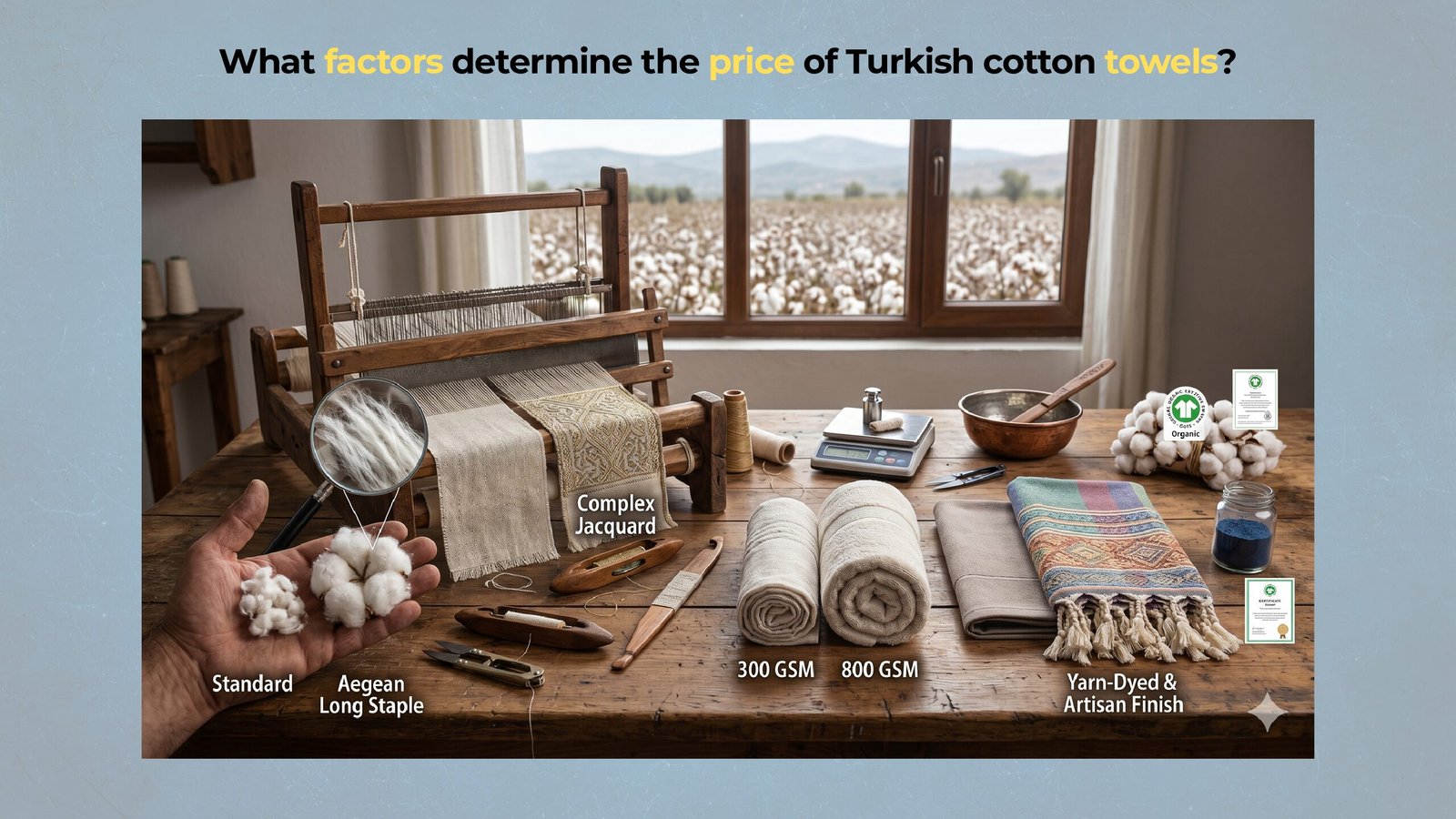
What factors determine the price of Turkish cotton towels?
The primary Turkish cotton towel price factors are established by the geographical origin of the raw material, the mechanical complexity of the spinning process, and the specific weight density measured in GSM. These elements converge to define the textile’s durability, hygroscopy, and long-term economic value for the consumer.
Why understanding Turkish cotton towel price factors protects your investment
Understanding Turkish cotton towel price factors protects your investment by enabling you to distinguish between genuine performance-based costs and artificial marketing markups. When purchasing high-end linens, the risk of buyer’s remorse is high if one cannot verify the technical justification for a premium price point, as luxury aesthetics often mask significant deficiencies in fiber quality.
Many consumers fall into the “Softener Trap,” where a towel feels exceptionally plush in the showroom due to chemical silicone coatings. However, these coatings eventually wash away, revealing low-quality, short-staple fibers that pill and fray; treating a towel as a long-term utility purchase rather than a disposable accessory requires an audit of its physical attributes to ensure the price reflects the manufacturing integrity.
How does price transparency influence Turkish cotton towel utility?
Transparent Turkish cotton towel price factors allow consumers to shop by technical specifications like fiber origin rather than misleading retail labels. From a broader decision-making perspective, towel pricing is closely tied to material selection and construction quality, so it is useful to review how towel material affects performance, durability, and cost to evaluate retail claims properly.
How Aegean cotton quality acts as a primary Turkish cotton towel price factor
The specific fiber grade acts as a foundational Turkish cotton towel price factor, as Aegean-grown cotton is often associated with the long-staple quality required for premium linens. To understand this at a deeper level, it is useful to explore what staple length Turkish cotton towels typically have and why it influences performance and cost during the early stages of textile development.
These longer fibers contribute to stronger yarn formation and improved resistance to breakage during manufacturing. Because this originates at the microscopic level, it is helpful to understand what the fiber structure of Turkish cotton towels looks like and how it affects durability by providing superior tensile strength.
Which manufacturing processes drive Turkish cotton towel price factors?
Advanced manufacturing methods, specifically ring-spun yarn construction and double-ply weaving, are critical Turkish cotton towel price factors that increase production costs while enhancing durability. Since structural integrity directly impacts long-term value, you may want to explore how durable Turkish cotton towels are with regular use and high-temperature laundering cycles.
Ring-spinning continuously twists and thins the cotton strands, creating a smooth, strong yarn surface. The slower output of ring-spinning machines means lower factory throughput, which is a significant contributor to the higher retail cost of premium towels.
Manufacturing Cost Matrix
| Process Stage | Standard (Low Cost) | Premium (High Cost) | Cost Impact |
|---|---|---|---|
| Spinning | Open-End | Ring-Spun | Increases Construction Costs |
| Yarn Treatment | Carded | Combed | Removes 15% of short fibers |
| Ply Count | Single-Ply | Double-Ply | Doubles fiber volume |
| Loom Type | Dobby | Jacquard | Adds pattern complexity |
How GSM and weave density determine Turkish cotton towel price factors
Weave density, measured as Grams per Square Meter (GSM), is a major Turkish cotton towel price factor because higher GSM towels require a significantly larger volume of raw cotton fibers. Since this influences buying decisions, you may want to explore how towel weight affects performance, drying behavior, and overall usability before committing to a specific density category.
Plushness influences drying behavior and maintenance costs, especially for higher-density towels. Because of this, it is helpful to understand how fast Turkish cotton towels dry compared to other materials to ensure they align with your bathroom’s ventilation capacity.
GSM-to-Price Influence Matrix
| GSM Range | Weight Category | Performance Profile | Cost Impact |
|---|---|---|---|
| 300 – 400 | Lightweight | Quick-dry / Travel | Budget to Mid-range |
| 400 – 600 | Medium | Daily / Absorbent | Mid-range |
| 600 – 900 | Heavy / Plush | Luxury / Spa-like | Premium |
Why brand certifications are essential Turkish cotton towel price factors
Third-party safety labels, such as OEKO-TEX Standard 100, are essential Turkish cotton towel price factors that account for the rigorous chemical auditing and sustainable sourcing costs. These certifications require annual laboratory testing for over 100 harmful substances, ensuring the product is safe for prolonged skin contact.
Performance characteristics such as moisture absorption also play a role in determining overall value. To connect this with real-world usability, it is useful to review how absorbent Turkish cotton towels are and how they manage moisture through efficient hygroscopic bonding.
Avoid artificial markups that inflate Turkish cotton towel price factors
Identifying artificial retail markups is vital for isolating the actual Turkish cotton towel price factors that reflect material quality rather than boutique packaging. To objectively compare different towels based on price, performance, and durability, you can use a data-driven towel comparison template to evaluate real value across materials and avoid inflated brand premiums.
Watch for the “softener trap,” characterized by a greasy or overly shiny feel on new towels. This often indicates the use of low-grade cotton that has been heavily treated with silicones to simulate the hand-feel of Aegean-grown long-staple fibers.
Price vs. Quality Red Flag Table
| Red Flag | Indication | Price Justification |
|---|---|---|
| “Luxury” Label Only | Missing GSM/Fiber Origin | None (Marketing Markup) |
| Excessive Linting | Short-staple fibers | Should be budget-tier |
| Waxy/Greasy Feel | Silicone coating | Low (Hides poor fiber) |
| Single-Stitched Hems | Fast production | Low (Will fray) |
Frequently Asked Questions regarding Turkish cotton towel price factors
Answering common queries regarding Turkish cotton towel price factors ensures that technical specifications remain the primary driver for consumer decision-making. By applying economic logic to material science, we can clarify why certain manufacturing variables command a market premium.
Aegean cotton represents a foundational price factor due to its unique long-staple geometry. This specific fiber length minimizes the number of joins required during spinning, resulting in a yarn with higher tensile strength and a smoother hand-feel compared to generic short-staple cotton.
Double-ply weaving involves twisting two strands of yarn together before they are woven into the towel’s base or loops. This process essentially doubles the volume of physical cotton fiber used, which directly increases material overhead and production time.
Not necessarily. While higher GSM towels offer increased absorbency and plushness, they are more expensive to produce and maintain. For quick-dry environments or gym use, a mid-range GSM (400-600) often provides better utility value than a premium 800 GSM luxury towel.
Yes. OEKO-TEX Standard 100 requires rigorous laboratory testing and recurring administrative audits. These costs ensure the absence of harmful irritants and justify the higher price floor compared to non-certified towels that may use lower-grade chemical finishers.
Follow this checklist to audit Turkish cotton towel price factors
Turkish Cotton Towel Price Factors Audit Checklist
- ☐ Is the cotton source explicitly identified as Aegean or 100% Turkish?
- ☐ Does the GSM align with the retail price (e.g., premium pricing for 700+ GSM)?
- ☐ Is the yarn verified as “Ring-Spun” or “Combed” to ensure durability?
- ☐ Are there third-party safety certifications (OEKO-TEX) listed on the label?
- ☐ Are the edges reinforced with double-turning or piping to prevent fraying?
Legal Disclaimer
The information provided in this guide regarding Turkish cotton towel price factors is for educational and illustrative purposes only. Technical specifications (GSM, fiber origin, manufacturing methods) are directional indicators of material quality and production overhead. Actual retail prices vary significantly across different brands, geographical markets, and retail channels. TowelDaily does not guarantee specific pricing or product performance for third-party manufacturers.