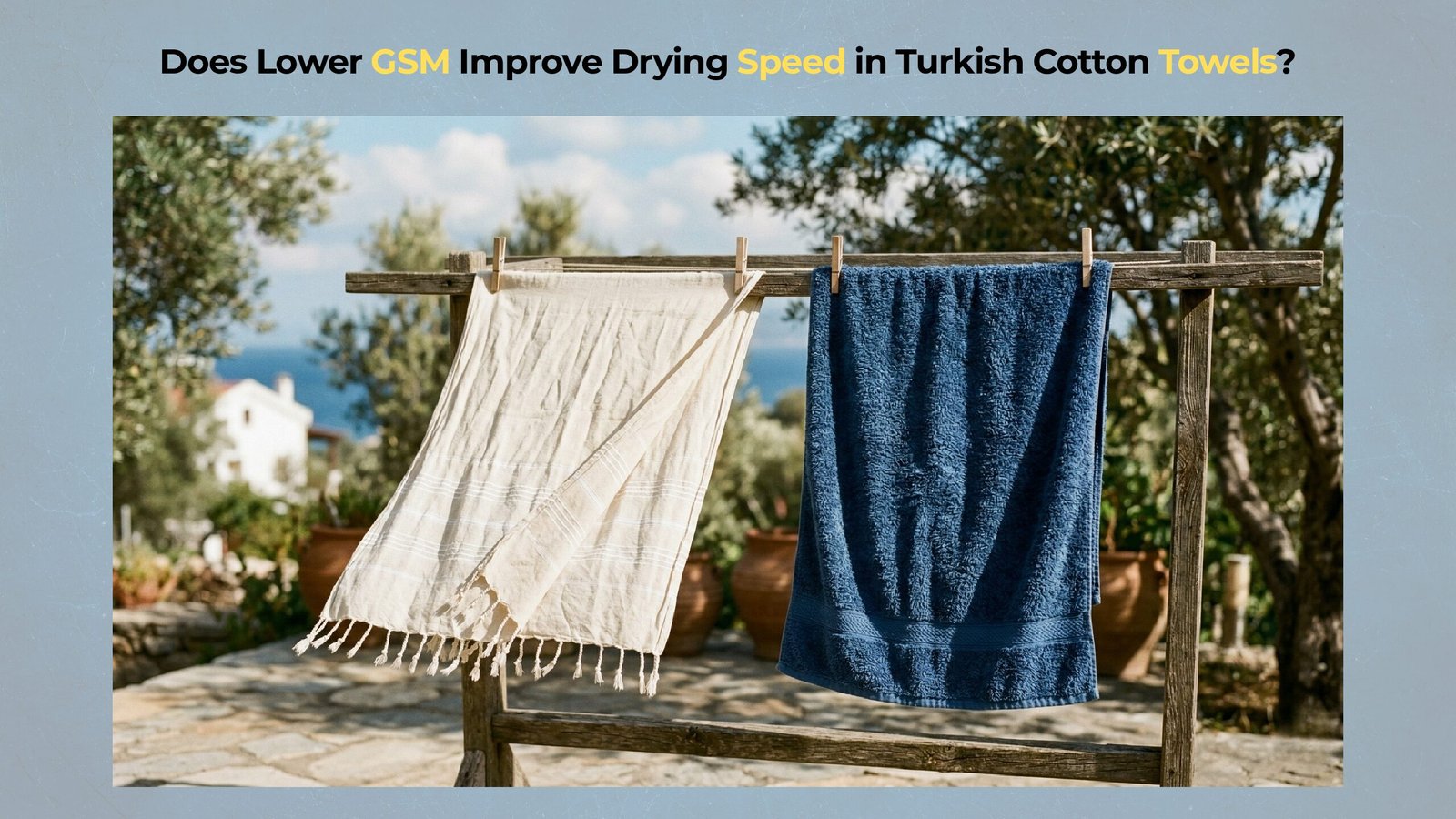
Does Lower GSM Improve Drying Speed in Turkish Cotton Towels?
An Architectural Blueprint for Authoritative Moisture Turnover in Textiles
Yes, a lower Grams per Square Meter (GSM) significantly improves Turkish cotton towel low-GSM drying speed because lighter and less dense weaves typically allow air to circulate more freely through the fabric. This increased air circulation enables the textile to reach moisture equilibrium much faster than high-GSM towels, which effectively sequester water within dense, insulated fiber cores.
Explain that the relationship between density and evaporation is typically inverse, where decreasing GSM increases the textile’s wicking-to-air transition velocity. By minimizing internal moisture reservoirs, low-GSM textiles facilitate a more aggressive vapor pressure gradient.
Why Does Lower GSM Facilitate Higher Turkish Cotton Towel Drying Speed?
Turkish cotton towel low-GSM drying speed is primarily influenced by the reduced internal surface area available for moisture storage, which allows water to remain closer to the atmospheric interface for rapid evaporation. This structural advantage results from the removal of moisture traps that typically stall evaporation in heavyweight textiles. By keeping moisture at the fiber surface, the textile reaches a “dry-touch” state significantly faster than dense alternatives.
A lower GSM significantly improves Turkish cotton towel low-GSM drying speed by reducing internal moisture storage and allowing faster evaporation. To understand how moisture initially interacts with the fiber before drying begins, it is helpful to explore how absorbent Turkish cotton towels are and how moisture is stored within the fibers.
Identifying the “Mass-to-Moisture” Advantage in Turkish Cotton Towel Low-GSM Drying Speed
Turkish cotton towel low-GSM drying speed originates from a “Mass-to-Moisture” advantage, where decreasing the material density typically allows the textile to reach moisture equilibrium faster due to a lack of core-level insulation. Because there is less material mass, significantly less thermal energy is required to facilitate moisture desiccation. This enables the cotton fibers to shed water at a rate that far exceeds heavyweight terry.
Standardized data from AATCC 199 (Drying Rate) confirms that lightweight textiles in the 300–400 GSM range outpace heavyweight counterparts by up to 60% in controlled air-dry tests.
Determining the “Dry-by-Next-Use” Benchmark
Turkish cotton towel low-GSM drying speed typically allows for a “Dry-by-Next-Use” turnaround within a few hours depending on conditions in ventilated environments, establishing a performance benchmark for high-turnover linens. This turnaround velocity is critical for athletic, gym, or guest environments where towels are reused within short windows. This performance profile prevents “towel fatigue,” a common state where a dense towel remains perpetually damp between sessions.
How Do Molecular Physics Accelerate Turkish Cotton Towel Low-GSM Drying Speed?
Cellular-level air transit and the reduction of the “Insulation Effect” influence Turkish cotton towel low-GSM drying speed, leveraging the porous architecture of the Aegean cotton strand. By optimizing the physical structure of the weave, moisture can be moved more aggressively from the fiber core to the atmospheric interface.
Reduced fabric density allows air to circulate more freely through the textile, accelerating evaporation. Since this airflow originates from the weave architecture, a logical next step is to review how weave structure influences airflow and drying efficiency in Turkish cotton towels.
How Surface-Area-to-Mass Ratios Influence Turkish Cotton Towel Low-GSM Drying Speed
Turkish cotton towel low-GSM drying speed is influenced by the surface-area-to-mass ratio, where a lower fabric mass typically increases the relative amount of fiber surface area exposed to ambient air currents. Ambient air currents act as a convective force that pulls moisture away from the yarn core. In low-GSM weaves, the lack of dense fiber “walls” allows these currents to interact with nearly every fiber in the textile matrix.
Lower GSM textiles minimize the formation of internal moisture reservoirs that slow drying in dense fabrics. Because this behavior is directly linked to fiber construction, you may want to explore how Turkish cotton towel yarn construction affects moisture transport and structural performance.
Determining How Pile Height Affects Turkish Cotton Towel Low-GSM Drying Speed
Turkish cotton towel low-GSM drying speed reaches its peak potential when utilizing short terry loops, as reducing the pile height helps prevent the “Canopy Effect” that traps saturated air at the base of the weave. The Canopy Effect occurs when dense, long loops create a mechanical barrier that prevents air from reaching the ground-weave where moisture is often sequestered. By maintaining a shorter pile, the textile facilitates linear moisture transport.
The mass-to-moisture ratio determines how quickly a towel can transition from saturation to evaporation. Since fiber length plays a role in moisture movement efficiency, it is useful to understand what staple length Turkish cotton towels typically have and why it impacts drying performance.
Why Is Turkish Cotton Towel Low-GSM Drying Speed a Driver of Hygiene?
Turkish cotton towel low-GSM drying speed influences dermal hygiene because the rate of moisture turnover determines the duration of the biological window where moisture may support microbial activity. Rapid desiccation ensures that the environment becomes inhospitable to bacteria before colonies can establish.
Drying efficiency directly influences hygiene by reducing the time a towel remains in a damp, bacteria-friendly state. Because towel design also affects airflow and usability, it is helpful to evaluate how different towel types influence drying performance and real-world usability.
Identifying the Reduction of Microbial Growth Risk in Turkish Cotton Towel Low-GSM Drying Speed
Turkish cotton towel low-GSM drying speed reduces conditions for microbial growth by reaching a dry-touch state quickly, which typically helps limit the incubation period required for anaerobic bacteria. By exiting the “danger zone” of 10-20% moisture content quickly, low-GSM towels maintain a fresher profile for longer periods compared to dense luxury terry.
Determining the ROI of Maintaining Freshness with Turkish Cotton Towel Low-GSM Drying Speed
Turkish cotton towel low-GSM drying speed influences the return on investment (ROI) for freshness because a low-maintenance hygiene profile helps maintain freshness under proper conditions without aggressive chemical sanitization. Avoiding frequent high-heat reset cycles preserves fiber integrity, extending the functional life of the textile while reducing utility costs associated with prolonged drying times.
How to Compare Weights to Optimize Turkish Cotton Towel Low-GSM Drying Speed?
Selecting the ideal inventory results from a comparative audit of Turkish cotton towel low-GSM drying speed against standardized desiccation windows to identify the “Sweet Spot” for your specific environment.
Low-GSM towels typically outperform heavy textiles in humid environments due to faster moisture turnover. Since fabric weight is the primary variable controlling this behavior, it is useful to review how towel weight influences drying speed, absorbency, and performance trade-offs.
| GSM Range | Weight Category | Est. Air-Dry Time | Performance Result |
|---|---|---|---|
| 300–400 | Lightweight | Within a few hours* | Peak / Travel-Ready |
| 450–550 | Mid-Weight | Several hours* | Standard Home Balance |
| 600–900 | Heavyweight | 12+ Hours | Luxury / Moisture Trap |
Selecting the Correct Turkish Cotton Towel Low-GSM Drying Speed for Your Humidity Zone
Optimized Turkish cotton towel low-GSM drying speed results from matching the GSM to the localized humidity and ventilation levels of the facility. In coastal or tropical zones, low GSM is not just a preference but a technical requirement for avoiding mildew.
Which Laundry Steps Help Maintain Turkish Cotton Towel Low-GSM Drying Speed?
Preservation of wicking velocity results from maintenance protocols that protect Turkish cotton towel low-GSM drying speed by excluding hydrophobic residues and maximizing mechanical moisture extraction.
Drying performance can decline when residues block the fiber surface and reduce evaporation efficiency. To better understand this failure mechanism, you can explore how chemical residues affect Turkish cotton towel performance and moisture behavior.
Implementing the “No-Softener” Rule for Turkish Cotton Towel Low-GSM Drying Speed
Turkish cotton towel low-GSM drying speed can be significantly reduced if treated with liquid fabric softeners, as cationic surfactants coat the long-staple fibers in a hydrophobic silicone layer. These residues essentially “seal” the capillary voids of the cotton, preventing water from wicking and subsequently evaporating.
How High-Speed Spin Cycles Influence Turkish Cotton Towel Low-GSM Drying Speed
Turkish cotton towel low-GSM drying speed reaches its maximum potential when users utilize high-speed spin cycles (typically exceeding 1,200 RPM) to mechanically remove surface moisture before the air-drying phase. Mechanical extraction is significantly more energy-efficient than thermal evaporation and prepares the textile for its most efficient air-drying state.
How Can You Fix Sluggish Performance to Restore Turkish Cotton Towel Low-GSM Drying Speed?
Restoration of compromised Turkish cotton towel low-GSM drying speed involves executing chemical resets to strip away residues and restore the fiber’s natural wicking pathways.
Maintaining optimal drying speed requires proper laundering protocols that preserve fiber openness and airflow pathways. Since maintenance determines long-term performance, it is essential to understand what care instructions should be followed to maintain towel drying efficiency and hygiene.
Does Stripping Detergent Buildup Restore Turkish Cotton Towel Low-GSM Drying Speed?
Turkish cotton towel low-GSM drying speed regains its original wicking velocity when a warm vinegar rinse successfully dissolves the waxy soap films and silicone residues masking the fibers. One warm cycle with white distilled vinegar successfully dissolves these waxy surfactants, resetting the fiber’s natural absorbency.
Does Resolving Mineral Stiffening Restore Turkish Cotton Towel Low-GSM Drying Speed?
Turkish cotton towel low-GSM drying speed typically improves in stiff inventory if a separate baking soda cycle helps restore loop flexibility by neutralizing acidic mineral bonds. Important: Vinegar and baking soda must NEVER be mixed in the same cycle as they neutralize each other’s chemical reset properties.
Audit Your Routine Checklist
Technical Audit: Turkish Cotton Towel Low-GSM Drying Speed
- Material: 100% Aegean Cotton verified?
- Density: GSM between 300 and 450?
- Hardware: Towels hung “Full-Spread” on bars?
- Extraction: 1,200+ RPM spin cycles used?
FAQ: Turkish Cotton Towel Low-GSM Drying Speed
Does a lower GSM towel feel less luxurious?
Luxury in Aegean cotton is defined by staple length and breathability rather than sheer mass. While lower GSM towels lack the physical weight of heavy terry, their superior desiccation speed maintains a fresher feel that dense towels often lose after the first use.
How often should I perform a chemical reset?
Execute a vinegar or baking soda rinse every 4–6 weeks depending on water hardness. This ensures the capillary voids of the fibers remain open and functional for maximum moisture turnover.
Technical Performance Disclaimer
Notice: Performance benchmarks provided in this guide are based on standardized textile testing environments. Actual Turkish cotton towel low-GSM drying speed is subject to environmental variables including relative humidity (RH), localized ventilation (CFM), and mechanical extraction efficiency. This guide represents objective textile physics but is not a guarantee of individual product performance in non-standardized residential settings.
Final Summary: Does the Performance Profile Fit Your Needs?
A shift from volume-based luxury expectations results from operationalizing a Turkish cotton towel low-GSM drying speed strategy that prioritizes hygienic turnover. Ultimately, a superior bathroom experience is defined by the precise Turkish cotton towel low-GSM drying speed management that turns a high-performance fiber into a lasting asset that helps maintain freshness through technical care.