How Does Weave Structure Improve Airflow in Turkish Cotton Towels?
A specialized mechanical balance between moisture-mass and atmospheric release typically influences Turkish cotton towel weave airflow performance, utilizing specific inter-yarn spacing to facilitate high-velocity moisture turnover.
This moisture turnover is a critical byproduct of the long-fiber Aegean Gossypium hirsutum structure, which allows for thinner, stronger yarns that do not sacrifice structural integrity for porosity. Optimized Turkish cotton towel weave airflow performance can help limit the “saturation stagnation” often found in dense, non-Aegean linens.
Technical Directive:
This guide audits the fluid dynamics, pore-volume physics, and surface-area-to-mass ratios of Aegean linens to verify Turkish cotton towel weave airflow performance and provide technical data for weave selection.
Why Does Weave Geometry Influence the Baseline of Turkish Cotton Towel Weave Airflow Performance?
The physical “knit” of the base fabric influences the baseline of Turkish cotton towel weave airflow performance because inter-yarn spacing establishes the primary path for water vapor removal. This airflow advantage originates from long-staple Aegean fibers that allow thinner, more uniform yarns without sacrificing strength. Since fiber length is the foundation of this structure, a logical next step for textile researchers is to review what staple length Turkish cotton towels typically have and why it matters.
How Does the “Aperture Effect” Benefit Turkish Cotton Towel Weave Airflow Performance?
Turkish cotton towel weave airflow performance utilizes the “Aperture Effect,” where the specific density of the warp and weft determines the open space available for air to pass through the textile. We define Aperture as the mechanical vent or open space between yarn intersections that influences fabric breathability. Inter-yarn apertures act as ventilation channels that enable rapid vapor escape from the textile core. Because this mechanism depends on how yarns are constructed, you may want to explore how Turkish cotton towel yarn construction influences airflow and moisture transport.
How Does Pile Height Influence Turkish Cotton Towel Weave Airflow Performance?
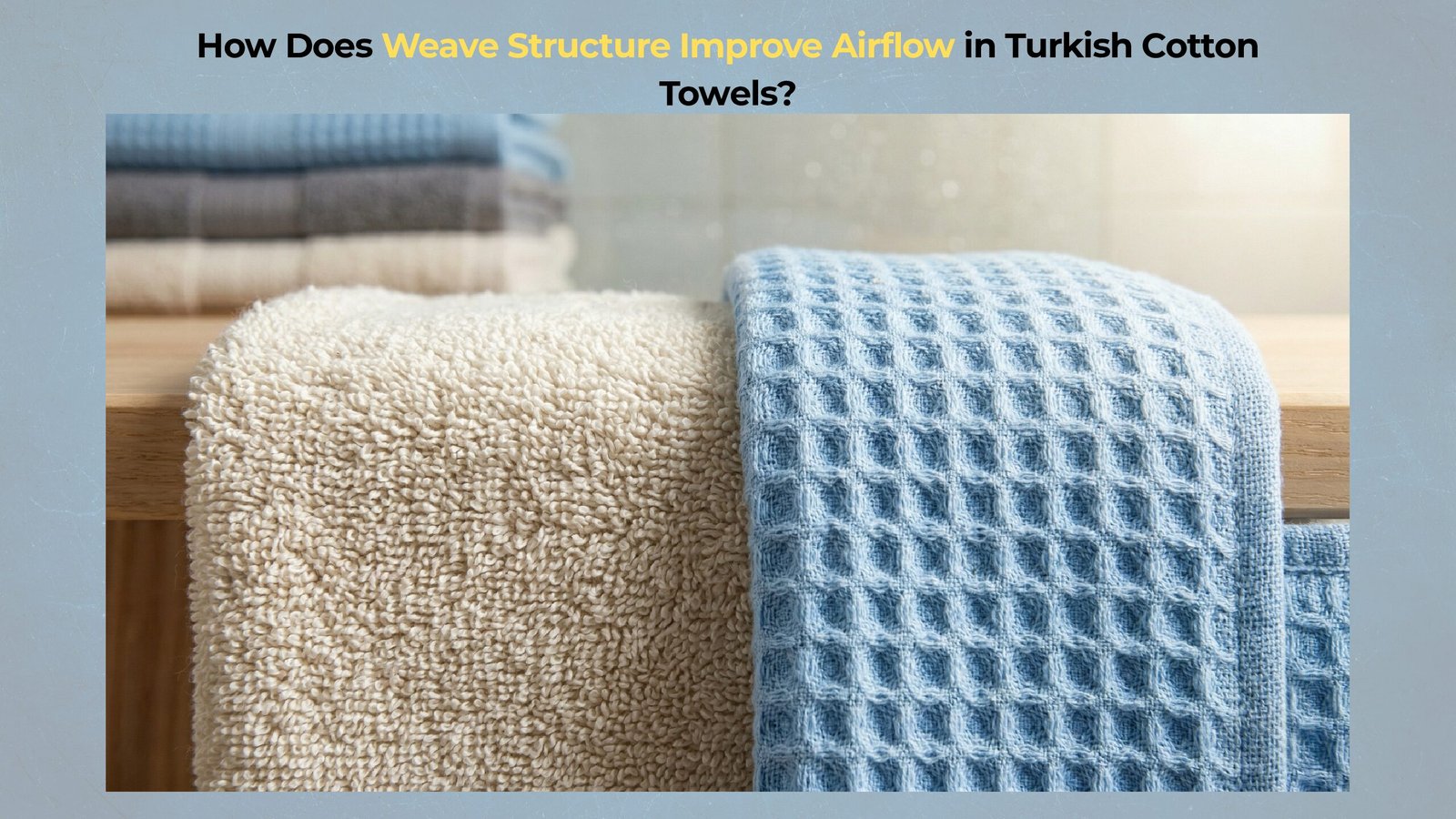
Vertical loops in a terry structure can influence Turkish cotton towel weave airflow performance by creating a “Boundary Layer” of air that can either trap heat or facilitate evaporation depending on loop density. Pile density plays a critical role in determining whether airflow is restricted or enhanced at the ground-weave level. To optimize the drying process, it is useful to understand how absorbent Turkish cotton towels are and how moisture moves through the fibers.
Which Technical Drivers Influence Turkish Cotton Towel Weave Airflow Performance?
A combination of “Void Volume” and Grams per Square Meter (GSM) calibration typically influences the technical drivers of Turkish cotton towel weave airflow performance. Fabric mass, measured in GSM, determines how much water the textile retains and how quickly it can release that moisture. To better evaluate this relationship, it is helpful to review how towel weight influences drying time, airflow, and overall performance.
How Does the “Honeycomb Advantage” Influence Turkish Cotton Towel Weave Airflow Performance?
Turkish cotton towel weave airflow performance can reach higher efficiency through the “Honeycomb Advantage,” where the 3D recessed squares of a Waffle weave increase surface exposure to ambient air. Different weave categories such as waffle, flat, and terry structures create varying airflow pathways and evaporation speeds. Since these structural differences define usability, you may want to explore how different towel types influence drying performance and airflow efficiency.
How Do Molecular Physics Influence the Turkish Cotton Towel Weave Airflow Performance Mechanism?
The interaction between moisture vapor and moving air influences the mechanism of Turkish cotton towel weave airflow performance, leveraging the “Vapor Pressure Gradient” found within the fabric gaps. To understand how this airflow directly impacts drying behavior at a technical level, it is helpful to explore why Turkish cotton towels dry faster than standard cotton textiles.
Which Specific Laundry Steps Help Maintain Turkish Cotton Towel Weave Airflow Performance?
Helping maintain the wicking channels required for Turkish cotton towel weave airflow performance results from maintenance protocols that exclude hydrophobic residues and facilitate fiber expansion. Airflow performance can decline when pore volume is restricted by detergent buildup or fabric softeners that block ventilation channels. To better understand this failure mechanism, you can explore how chemical residues affect Turkish cotton towel performance and moisture behavior.
How Does the Sizing-Removal Protocol Support Turkish Cotton Towel Weave Airflow Performance?
Turkish cotton towel weave airflow performance remains restricted until an initial wash removes the industrial waxes that can create a solid barrier over the weave apertures. Maintaining optimal airflow requires following precise washing protocols that preserve the open structure of the textile. Since maintenance directly affects performance and hygiene, it is essential to understand what care instructions should be followed to maintain towel airflow and drying efficiency.
How Can You Restore Matted Fibers to Improve Turkish Cotton Towel Weave Airflow Performance?
Restoring compromised Turkish cotton towel weave airflow performance involves executing chemical and mechanical resets to help reopen the air channels blocked by residue or loop crushing. These resets return the fabric to its engineered porosity, allowing air to move freely through the yarn interstices once again.
How to Audit Your Routine with the Turkish Cotton Towel Weave Airflow Performance Checklist?
Checklist: Turkish Cotton Towel Weave Airflow Performance Quality Audit
- Aperture Check: Does the weave show visible light when held up to a direct bulb?
- Airflow Test: Does the surface pass the “Blow Test” (air moves through fabric with minimal resistance)?
- Desiccation Check: Does the towel typically reach a near-dry state within reasonable daily windows?
- Visual Check: Do the fibers show a visible “Bloom” (raised, open loops) post-wash?
- Chemistry Audit: Is the laundry routine 100% free of liquid fabric softeners?
Frequently Asked Questions: Turkish Cotton Towel Weave Airflow Performance
Why do Turkish cotton towels dry so fast?
High-velocity moisture turnover typically influences the drying speed, facilitated by the long-staple fibers that allow for higher yarn porosity without sacrificing tensile strength. This structural efficiency is the primary driver behind Turkish cotton towel weave airflow performance.
Waffle weave vs. Terry: Which has better airflow?
Waffle weave geometry typically provides superior airflow performance compared to Terry because the 3D honeycomb structure increases surface exposure to ambient air. While Terry excels at absolute liquid capacity, Waffle weave is engineered for elite atmospheric transition.
Technical Disclaimer
The data provided in this guide regarding Turkish cotton towel weave airflow performance represents standardized textile engineering benchmarks and is intended for informational purposes only. Actual desiccation velocity and vapor turnover rates remain conditional upon localized ambient humidity levels, relative indoor air-exchange rates (HVAC), and the rigorous removal of factory sizing waxes.