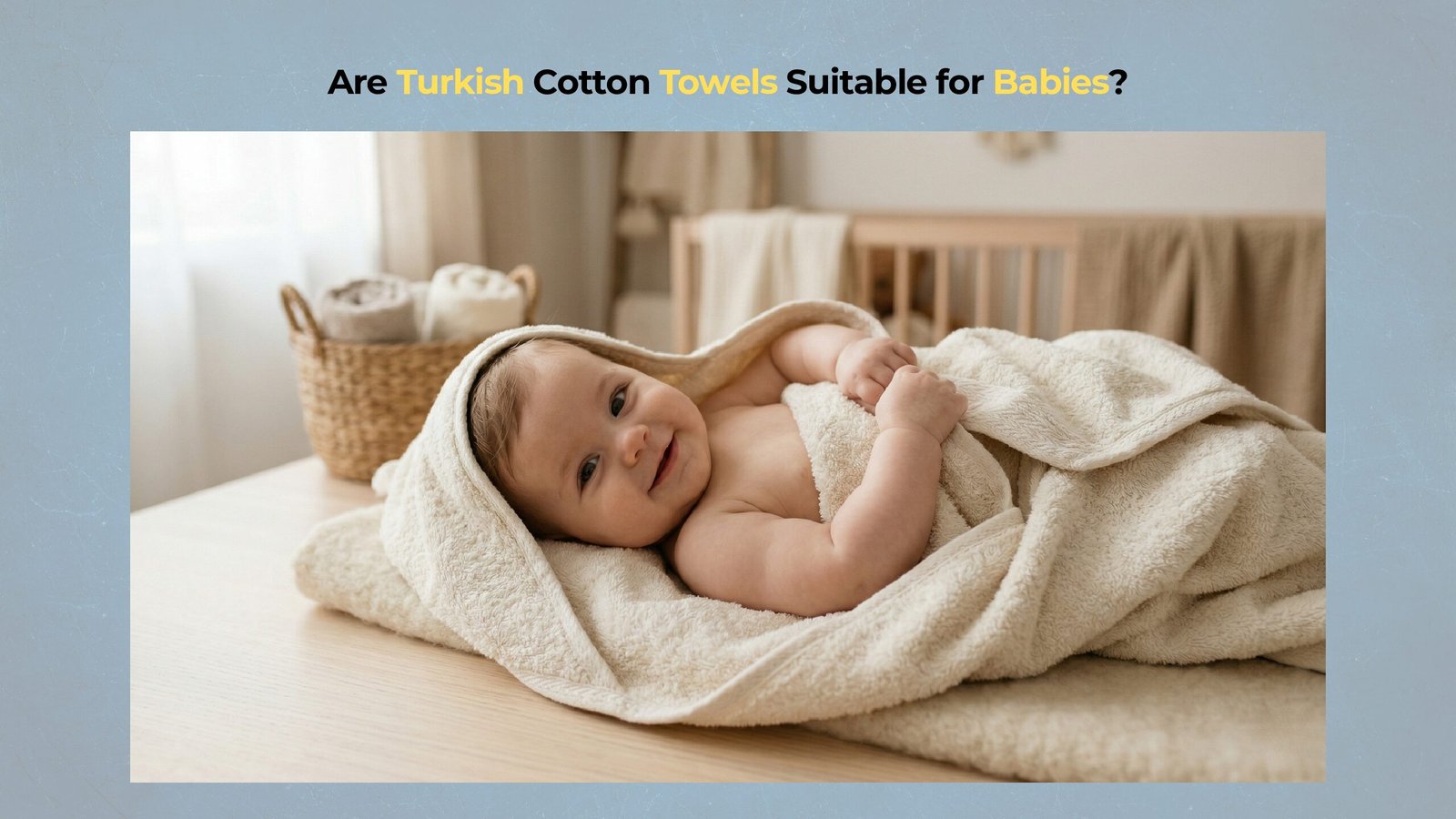
Are Turkish Cotton Towels Suitable for Babies?
Yes, superior dermatological compatibility typically results from Turkish cotton towel baby suitability, as the utilization of long-staple Aegean fibers facilitates a low-friction interface that can reduce mechanical and chemical irritation risk for infants.
These long-staple Aegean fibers (measuring between $28.5\text{–}35\text{ mm}$) create a smoother yarn surface with significantly fewer “join-points” compared to standard cotton. This structural integrity is vital because infant skin is typically 20–30% thinner than adult skin, lacking a fully developed acid mantle and robust stratum corneum.
This thinness necessitates a focus on “Low-Shear” textiles that prevent the disruption of the fragile epidermal barrier. This guide audits the friction coefficients, pH balance, and fiber morphology of Aegean cotton to verify Turkish cotton towel baby suitability and provide technical benchmarks for infant skin care.
Why Is Irritation Prevention a Consequence of Turkish Cotton Towel Baby Suitability?
Turkish cotton towel baby suitability helps maintain the integrity of the stratum corneum because the structural smoothness of the filaments typically minimizes the micro-abrasions associated with standard utility linens.
Turkish cotton towel baby suitability depends on how gently moisture is removed from delicate infant skin without friction. To understand how this process works at the fiber level, it is useful to explore how absorbent Turkish cotton towels are and how they manage moisture transfer.
Technical Summary
These filaments, derived from Gossypium hirsutum, exhibit a parallel alignment that reduces the risk of dermal inflammation by lowering the kinetic friction coefficient during the drying process. This ensures that moisture is removed without compromising lipid barrier stability.
Identifying the Low-Abrasion Outcome for Turkish Cotton Towel Baby Suitability
Minimal epidermal stress is typically achieved by Turkish cotton towel baby suitability because Aegean long-staple fibers can reduce friction significantly (~15–30% depending on construction) compared to standard cotton.
The low-friction performance of Aegean cotton originates from its long-staple fiber structure, which minimizes exposed ends on the yarn surface. Because this directly impacts skin safety, it is helpful to understand what the fiber structure of Turkish cotton towels looks like and how it affects skin contact.
According to evaluations using the Kawabata Evaluation System (KES-FB), fabric surface properties are heavily influenced by the number of exposed fiber ends. Longer strands create a surface profile that glides rather than scrubs, optimizing Turkish cotton towel baby suitability by minimizing mechanical irritation.
Determining the Wicking-Speed ROI for Turkish Cotton Towel Baby Suitability
Turkish cotton towel baby suitability can help reduce the risk of secondary irritation, such as intertrigo or bacterial flare-ups, by utilizing high-speed wicking to dry the skin surface without the need for aggressive mechanical rubbing.
Infant skin requires rapid moisture removal to prevent irritation and bacterial buildup in skin folds. Since drying efficiency is critical in this context, a natural next step is to review how fast Turkish cotton towels dry and why this reduces irritation risk.
The American Academy of Pediatrics (AAP) emphasizes the importance of drying skin folds thoroughly to prevent moisture-induced breakdown. High-wicking Aegean cotton supports the “Pat-Dry” technique, which preserves the natural lipid barrier while achieving rapid moisture removal through superior capillary action.
How Do Molecular Physics and Fiber Geometry Drive Turkish Cotton Towel Baby Suitability?
Protection of the infant’s developing skin barrier typically results from Turkish cotton towel baby suitability by leveraging the low friction coefficients and parallel fiber alignment of the Aegean cotton strand.
Long-staple fibers reduce mechanical irritation by creating a smoother surface with fewer friction points. Since this advantage is driven by fiber length, you may want to explore what staple length Turkish cotton towels typically have and why it matters for softness and safety.
By utilizing ring-spun yarns, manufacturers align filaments in a spiral that maximizes tensile strength while maintaining a soft exterior. This reduces the “grab-and-pull” mechanism on the skin, which is a primary cause of contact redness in reactive infant skin types.
Identifying How the “Bloom” Mechanism Influences Turkish Cotton Towel Baby Suitability
Volumetric expansion typically improves Turkish cotton towel baby suitability over the textile’s lifecycle as the fibers can increase in thickness after initial washes to create a soft, upright pile.
From a practical perspective, parents should also evaluate how softness and material choice influence comfort during daily use. To connect fiber science with real-world selection, it is helpful to review how towel softness affects comfort for sensitive and delicate skin.
Studies published in the Journal of The Textile Institute confirm that Aegean fibers exhibit a unique relaxation response. The material’s $8.5\%$ moisture regain facilitates molecular flexibility, allowing the loops to “bloom” and increase in loft, thereby enhancing the cushioning effect against the baby’s skin.
Which Certifications Verify Turkish Cotton Towel Baby Suitability?
Identification of third-party safety labels verifies Turkish cotton towel baby suitability by highlighting low-residue, skin-compatible materials that strictly regulate toxic manufacturing residues.
If you want to verify whether a towel is truly suitable for your baby’s skin type and daily usage conditions, you can use a towel selection tool that helps match materials to specific needs and environments.
| Certification | Infant Safety Rank | Toxicological Screen | Recommendation |
|---|---|---|---|
| Oeko-Tex Standard 100 Class I | Highest | Screens for ~100+ toxins (Baby Grade) | 1 (Best) |
| GOTS Organic | High | Regulates synthetic pesticides | 2 |
| Hypoallergenic | Unverified | Marketing designation only | 3 (Unverified) |
| Oeko-Tex Class II | Moderate | Screens for adult-level contact | 4 (Standard) |
Evaluating Safety Tiers for Turkish Cotton Towel Baby Suitability
Turkish cotton towel baby suitability reaches the peak “Non-Toxic” tier when adherence to Oeko-Tex Standard 100 Class I benchmarks ensures the finished textile is safe for direct contact with infants.
This certification specifically prohibits Azo Dyes—synthetic pigments that can release aromatic amines, which are potentially mutagenic or allergenic. Furthermore, GOTS (Global Organic Textile Standard) ensures the cotton is grown without neurotoxic pesticides, validating the textile’s nursery safety.
Which Laundry Protocols Preserve Turkish Cotton Towel Baby Suitability?
Preservation of a low-irritant profile results from maintenance protocols that support Turkish cotton towel baby suitability by excluding chemical additives and alkaline detergent residues.
Implementing the “No-Softener” Rule for Turkish Cotton Towel Baby Suitability
Turkish cotton towel baby suitability can be compromised if liquid fabric softeners are utilized, as these cationic surfactants may reduce rinsability and promote residue retention that could trigger contact dermatitis.
Chemical residues and improper washing routines can increase the risk of irritation for infants with highly reactive skin. Because maintenance plays a critical role here, it is important to understand what care instructions should be followed to keep towels safe for sensitive skin.
The Environmental Working Group (EWG) notes that quaternary ammonium compounds (“Quats”) found in softeners create a silicone-like “glazing.” This film is hydrophobic, meaning it repels water and can trap bacteria or dead skin cells against the infant’s epidermis, neutralizing the towel’s hygienic benefits.
Executing the “Double-Rinse” Protocol to Maintain Turkish Cotton Towel Baby Suitability
Turkish cotton towel baby suitability improves when users execute a second rinse cycle to help approach a more neutral pH surface by reducing trapped alkaline detergent salts.
Standard ISO 6330 laundering protocols suggest that high-density terry weaves can sequester surfactants. Since infant skin pH typically trends toward a slightly acidic ~5.5, removing alkaline residues via a double rinse is a technical requirement for ensuring a pH-compatible textile surface.
How Can You Fix Mineral-Stiffness to Restore Turkish Cotton Towel Baby Suitability?
Restoration of original loop flexibility typically results from executing chemical resets to revitalize Turkish cotton towel baby suitability before fibers reach a state of mineral-based stiffness.
Stripping Mineral “Crust” to Restore Turkish Cotton Towel Baby Suitability
Turkish cotton towel baby suitability regains its original pliability when a warm vinegar rinse successfully dissolves the calcium deposits, which improves perceived softness by removing mineral buildup.
This process relies on Calcium Acetate Formation, where acetic acid reacts with limescale to create a water-soluble salt that rinses away. Removing this mineral “crust” results in a measurable reduction in tactile roughness, restoring the towel’s gentle glide.
Technical FAQ: Common Queries on Turkish Cotton Towel Baby Suitability
Are Turkish towels safe for newborns with extremely sensitive skin?
Yes, superior safety is achieved through Oeko-Tex Standard 100 Class I certification. This specific infant-grade benchmark ensures the textile is free from over 100 harmful substances, including Azo dyes and formaldehyde, which is critical for the high-permeability barrier of newborn skin.
How many washes are required to achieve maximum softness for an infant?
Maximum Turkish cotton towel baby suitability typically requires 3-5 initial wash cycles. These preliminary cycles serve a dual purpose: they fully remove industrial sizing (starch-based finishing agents) and trigger the “blooming” mechanism where the long-staple fiber loops relax and expand into their high-loft state.
Can I use distilled white vinegar in every laundry load for my baby’s towels?
Frequent use is technically safe and highly recommended for hard water areas. Adding half a cup of white vinegar to the rinse cycle facilitates Calcium Acetate Formation, dissolving microscopic mineral deposits before they can harden the loops and irritate the infant’s epidermis.
Why does the towel feel rougher after machine drying versus air drying?
This typically results from fiber desiccation. While Turkish cotton benefits from the mechanical agitation of a dryer to “fluff” the loops, over-drying at high temperatures can strip the fiber’s natural $8.5\%$ moisture regain, leading to brittleness. Use a low-heat setting to preserve molecular flexibility.
How Do You Audit Your Linens with the Turkish Cotton Towel Baby Suitability Checklist?
Systematic technical audits verify Turkish cotton towel baby suitability by ensuring maintenance protocols and purchase quality align with objective dermatological safety benchmarks.
Establishing a consistent washing routine is essential to maintaining a low-irritation textile surface for babies. To implement this correctly, you may want to follow a structured towel care habit protocol designed for long-term performance and safety.
Checklist: Turkish Cotton Towel Baby Suitability Quality Audit
Final Summary: Does the Hypoallergenic Profile of Turkish Cotton Suit Your Infant’s Needs?
Operationalizing a Turkish cotton towel baby suitability strategy requires a commitment to technical care that honors the unique fiber physics and chemical purity of Aegean cotton.
While Turkish towels require a deliberate “break-in” period to reach maximum absorbency, this investment supports a textile that remains durable, low-friction, and non-toxic for years. Ultimately, a superior bathroom experience for your infant is defined by the precise Turkish cotton towel baby suitability management that turns a high-performance fiber into a lasting, irritation-free household asset through technical care.
Medical Disclaimer
The information provided in this guide is for educational and informational purposes only. While Turkish cotton towel baby suitability refers to technical safety standards, it does not constitute medical advice, diagnosis, or treatment. Always consult with a qualified pediatrician or dermatologist regarding specific skin conditions, such as infant eczema or dermatitis, before altering your infant’s skin care regimen.