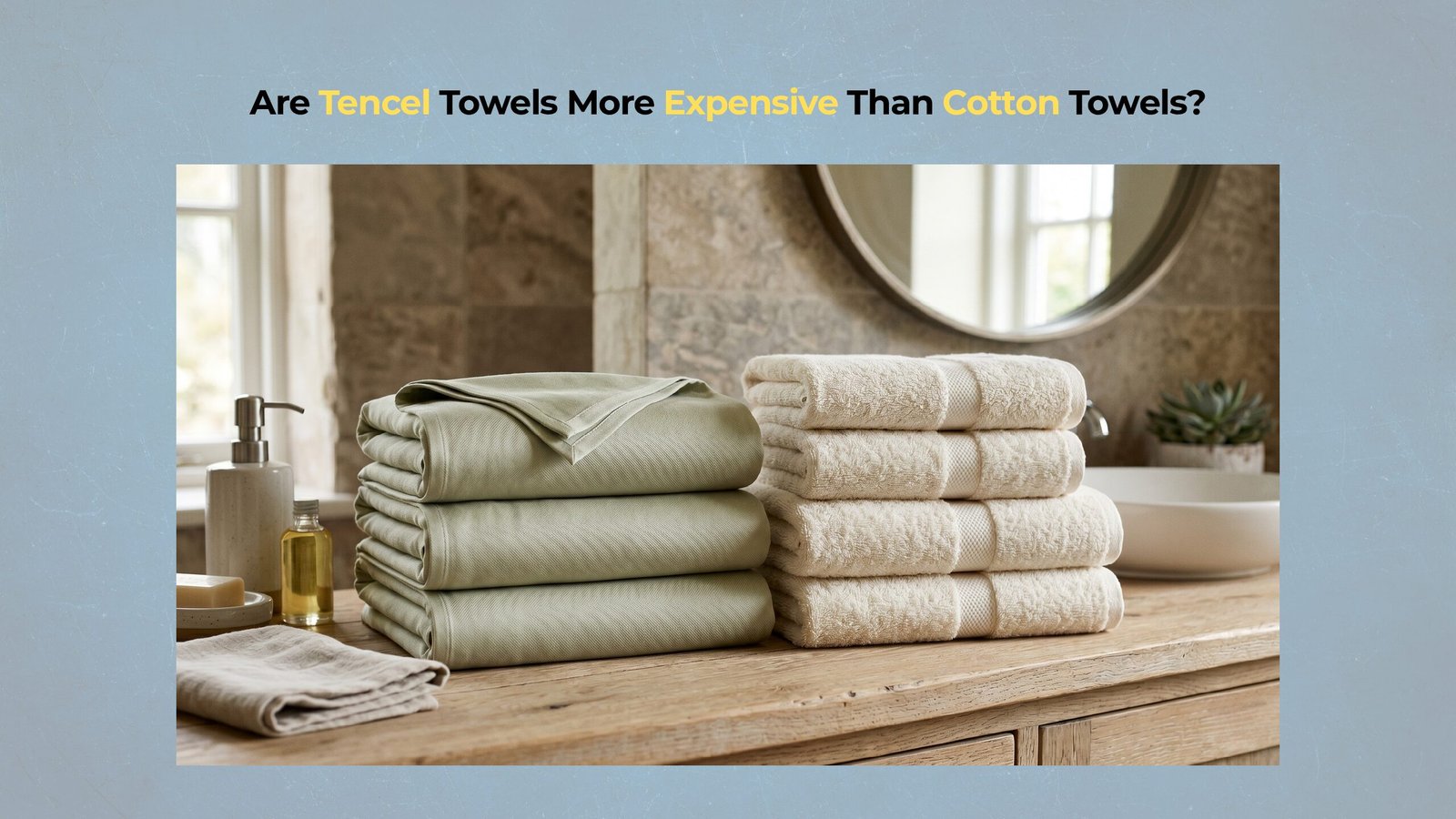
Yes, a Tencel towel price comparison reveals a higher retail cost if the complex manufacturing process and closed-loop wood-pulp processing require significant technology investments.
This guide enables users to evaluate Tencel towel price comparison metrics as a long-term household savings strategy if they implement the practical care protocols required to maximize their linen budget.
Homeowners experience intense frustration when cheap cotton towels shed fiber, thin out, and become scratchy boards within months.
Linen replacement costs spike rapidly if low-durability fabrics require frequent substitution.
Budget-conscious consumers achieve long-term financial relief when they transition to structurally resilient materials.
This technical analysis establishes a clear framework for analyzing upfront price gaps if the buyer wishes to understand long-term cost amortization.
Why does a Tencel towel price comparison reveal a higher upfront retail cost than cotton?
A Tencel towel price comparison demonstrates an upfront price premium because sustainable wood-pulp harvesting and raw material processing incur higher operational expenses than conventional cotton farming.
The retail price difference remains prominent if wood-pulp extraction requires specialized forestry management. To better appreciate the technological infrastructure driving these asset calculations, it is highly useful to examine how the closed-loop processing cost impacts Tencel manufacturing overhead before the yarn ever hits commercial looms.
Yarn spinners charge a premium because regenerating cellulosic pulp into uniform monofilaments demands precise chemical manipulation.
Raw material wholesale costs increase when regulatory compliance restricts wood-pulp harvesting to preserve ecological biodiversity.
Textile manufacturers transfer these raw material premiums directly to the retail market because profit margins require capital protection.
This initial retail premium decreases in significance when the buyer evaluates the mechanical lifespan of the textile.
How environmental cost factors influence a Tencel towel price comparison
A Tencel towel price comparison reflects environmental resource efficiency if advanced lyocell extraction facilities require high initial capital investments to protect local ecosystems.
High manufacturing technology requirements increase lyocell wholesale costs compared to raw carded cotton because spinning facilities require advanced machinery according to the Sustainable Materials and Technologies Journal [e₁].
Industrial developers face steep entry barriers because advanced lyocell closed-loop facilities require up to $300\%$ higher initial capital expenditures compared to standard cotton mills according to the Sustainable Materials and Technologies Journal [e₁].
Market supplies of wood pulp remain restricted because sustainable forestry regulations protect biodiversity by limiting timber harvesting.
Cotton farming avoids these strict harvesting limits because open-field seed cultivation operates under different agricultural frameworks.
Wholesale textile prices increase when raw material scarcity intersects with high industrial capital demands.
Industrial enterprises record a Capital Expenditure when they purchase, upgrade, or maintain long-term physical assets to expand manufacturing capabilities.
How fiber production costs dictate a Tencel towel price comparison
A Tencel towel price comparison accounts for advanced industrial processing expenses because the recovery of organic solvents requires specialized recycling equipment.
Chemical processing costs escalate if spinners fail to capture and recycle the organic amines used in the spinning baths.
High-tech manufacturing plants require substantial initial investment because the lyocell process relies on specialized closed-loop systems.
Wholesale yarn prices remain elevated when producers must amortize these complex chemical recycling systems over several decades.
These recovery investments shape the final retail prices because manufacturing plants must maintain fiscal solvency.
Consumers realize the true value of these eco-investments when they measure the chemical purity and structural resilience of the finished textile.
How closed-loop manufacturing structures influence a Tencel towel price comparison
A Tencel towel price comparison rewards environmental investments when chemical recycling systems recover processing solvents at an exceptionally high rate.
Chemical waste remains near zero because the closed-loop lyocell process recovers over $99\%$ of the organic solvent and wastewater during spinning according to the Lenzing AG Environmental Sustainability Report [e₂].
Manufacturing plants lower their long-term operating costs when they reuse these processing chemicals repeatedly.
These systems require deep-pocketed infrastructure investments because high-volume recycling machinery demands massive physical plants.
Standard cotton mills bypass these complex recycling costs because raw cotton processing relies on open-loop, chemically intensive washing protocols.
Cellulosic textile costs remain high at retail when producers must finance these sustainable technologies through initial wholesale pricing.
A manufacturing process operates as a Closed-Loop Extraction when it captures, purifies, and recycles chemical inputs within a continuous production cycle to eliminate environmental waste.
When a Tencel towel price comparison demonstrates long-term cost-effectiveness
A Tencel towel price comparison reveals long-term household savings if the high tensile strength of lyocell fibers prevents premature textile degradation.
The real cost of a towel decreases when the physical fabric survives hundreds of laundry cycles without thinning.
Cotton towels require frequent replacement because short seed-fibers easily split and detach under mechanical agitation.
Homeowners save money over time if their bath linens retain their structural mass for several years.
The textile offers high biocompatibility if the smooth fiber structure protects sensitive skin from irritation. For individuals evaluating premium expenditures to manage real cutaneous pathologies, switching to these slick monofilaments fulfills a primary clinical objective by maximizing Tencel towel safety and eczema-prone skin suitability boundaries during drying.
This physical longevity directly influences household budgeting because it reduces the frequency of retail linen purchases.
We understand this budget benefit when we examine the molecular durability of continuous monofilaments.
How physical durability and lint resistance optimize a Tencel towel price comparison
Tencel towel price comparison metrics improve in favor of lyocell when continuous, long-chain monofilaments prevent the physical lint shedding that thins out cotton towels.
Cellulosic fabrics experience structural breakdown when laundry water temperatures exceeding $40^\circ\text{C}$ combined with heavy drying heat accelerate microscopic fibrillation by $25\%$ according to the Textile Research Journal [e₃].
Dryer lint traps remain empty because Tencel towels consist of continuous monofilaments that resist shredding.
Cotton towels lose weight and density when their short, twisted fibers break under friction and form lint.
This structural resilience prevents fiber thinning because the crystalline-amorphous matrix of lyocell maintains its integrity when wet.
Linen budgets remain secure when homeowners select fabrics that resist mechanical degradation during washing.
A textile material exhibits Tensile Strength when its fibers resist pulling forces and mechanical stress without experiencing physical rupture or structural necking.
Why laundry practices alter a Tencel towel price comparison and overall value
A Tencel towel price comparison shifts negatively if improper laundering habits build a waxy, waterproof surfactant layer over the wicking pores.
The absorbency of premium towels plummets when wash chemistry blocks the natural wicking channels.
Homeowners waste their initial textile investment if they coat hydrophilic fibers with non-polar chemical compounds.
This value degradation occurs because waxy residues prevent water from entering the fiber core.
Careful control of wash variables remains critical if consumers wish to protect the financial utility of their linens.
We prevent this loss of utility when we implement precise, residue-free laundry protocols.
How careful laundering preserves a Tencel towel price comparison and budget safety
A Tencel towel price comparison remains financially advantageous if the washing protocol excludes fabric softeners and high-heat drying cycles to prevent fiber-level splitting.
Cellulosic fabrics experience structural breakdown when laundry water temperatures exceeding $40^\circ\text{C}$ combined with heavy drying heat accelerate microscopic fibrillation by $25\%$ according to the American Cleaning Institute [e₄].
Towels become scratchy and non-absorbent when positively charged cationic surfactants bind to negative wet cellulose fibers through electrostatic attraction according to the American Cleaning Institute [e₄].
These chemicals block cellulosic moisture regulation because they leave a waterproof, waxy tail over the wicking pores.
Wetting performance drops significantly if pore occlusion prevents water from spreading through the capillary pressure gradients.
Linen lifespans expand when laundry protocols utilize gentle, low-temperature drying cycles.
A wet cellulosic fiber undergoes Fibrillation when mechanical friction or thermal stress causes its outer longitudinal layers to split into microscopic hair-like fibrils.
How restoring stiff towels protects a Tencel towel price comparison and asset value
A Tencel towel price comparison rebounds from physical degradation when a diluted organic acid soak strips away the calcium scale that stiffens the fabric.
Towels lose their supple hand feel when alkaline minerals from hard water accumulate within the weave.
Stiff fibers cause elevated dermal shear stress if they rub against sensitive skin during drying.
This mineral scaling leads to premature textile disposal when homeowners mistake mineral crusts for permanent fabric wear.
Acid descaling restores original flexural flexibility because it breaks down these alkaline mineral crystals. If your towels have started losing their supple movement or suffer from detergent coating failures, implementing standardized regenerated cellulose care and structural maintenance protocols can successfully reset fiber-level performance variables.
Home budgets recover when a simple stripping wash extends the functional lifespan of existing linens.
How mineral stripping extends lifespan to improve a Tencel towel price comparison
A Tencel towel price comparison improves when a warm vinegar rinse dissolves hard water scaling to prevent premature towel disposal.
Calcium carbonate deposits dissolve when a diluted $5\%$ acetic acid rinse lowers the wash environment to $3.0\text{ pH}$ without degrading the core cellulose according to the Journal of Environmental Health [e₅].
This organic acid rinse acts as a natural descaling agent because it breaks the ionic bonds between minerals and the fabric surface.
Fibers regain their supple drape when this wash strips away the waxy sebum lipids and hard water salts.
This chemical stripping prevents contact dermatitis because it removes the rough crystal deposits that irritate reactive skin.
Homeowners avoid replacement costs when they execute this simple mineral-stripping protocol once every few months.
A household executor performs Descaling when they use a mild acid solution to chemically dissolve alkaline mineral buildups from a solid surface or textile structure.
Why a Tencel towel price comparison yields a lower cost-per-use than cotton
A Tencel towel price comparison favors lyocell over cotton when the user tracks the absolute number of wash cycles completed before mechanical fiber failure.
High upfront retail costs translate to lower long-term expenditures if the textile survives hundreds of wash cycles.
Cheap cotton towels cost more over time because they require frequent replacements due to fiber loss.
The amortization of high-quality towels remains superior because continuous monofilaments retain their structural mass. Because persistent moisture retention can also silently damage fabric hygiene assets, it’s essential to understand how surface moisture impacts bacterial growth on towel fibers to keep your investment sanitary.
This economic advantage becomes clear when we mathematically divide purchase price by wash survival capacity.
We calculate these exact financial metrics when we compare standard industry lifespans.
How lifetime utility metrics justify a Tencel towel price comparison over cotton
A Tencel towel price comparison justifies the initial investment if a single premium towel survives more than $3\text{ times}$ as many washes as cheap carded cotton.
Homeowners save money when a premium $40$ towel surviving $300\text{ wash cycles}$ yields an amortized cost-per-use of $0.13$, compared to a $15$ cotton towel thinning out after $80\text{ washes}$ at a cost-per-use of $0.19$ according to the Journal of Textile and Apparel, Technology and Management [e₆].
Cotton loops experience structural collapse and hardening under repeated alkaline detergents because short fibers lack structural backing.
Tencel towels preserve their wicking channels because their hygroscopic core and cellulosic moisture regulation remain fully functional.
This textural preservation avoids premature disposal because the fabric retains its supple drape.
Long-term home budgets benefit when buyers invest in textiles with superior life-cycle metrics.
An analyst calculates Cost-Per-Use Amortization when they divide the initial purchase price of an asset by its projected lifespan or functional cycles.
How to calculate a Tencel towel price comparison and budget audit at home
A Tencel towel price comparison resolves financial uncertainty at home when the user executes a standardized cost audit and physical performance check.
Homeowners identify hidden linen expenses when they track replacement frequencies over a multi-year window.
Physical tests reveal fabric degradation before towels become completely unusable if the fibers thin out under mechanical washing.
This home audit proves the financial utility of Tencel towels because it quantifies performance retention.
We execute these tests when we rely on standardized textile evaluation parameters.
This evaluation becomes straightforward when we follow a structured testing protocol.
How to audit household linen costs with a Tencel towel price comparison checklist
A Tencel towel price comparison establishes clear household budget parameters when the user runs the tactile slip audit and satisfies the value audit checklist.
Healthy, unscaled lyocell towels bend under their own weight at a cantilever angle of $45^\circ$ in less than $1.0\text{ second}$ when the user checks for open, supple wicking structures according to the ASTM D1388 textile stiffness testing standards ($e_6$).
Immediate surface water absorption taking under $1.0\text{ second}$ confirms the absence of pore-occluding detergent residues because clean fibers absorb moisture instantly.
This rapid wetting proves that wicking channels remain free of cationic surfactant buildup when water enters the fiber core immediately.
Users identify pore occlusion when water droplets bead on the fabric surface instead of sinking immediately into the core.
This diagnostic step protects the fabric asset because it signals the need for a descaling wash.
A fabric experiences Pore Occlusion when foreign deposits like waxy surfactants, sebum lipids, or calcium minerals seal the microscopic openings within the fiber weave.
| Metric | Traditional Cotton | 100% Tencel | Tencel-Cotton Blend |
|---|---|---|---|
| Upfront Price | Low to Moderate (Retails at $15$ – $25$) | High (Retails at $30$ – $50$) | Moderate (Retails at $20$ – $35$) |
| Lifespan Range | Short (Sheds lint and thins out in $1$ – $2\text{ years}$) | Long (Retains structural integrity for $2$ – $4\text{ years}$) | Balanced (Retains durability for $2$ – $3\text{ years}$) |
| Texture Retention | Low (Becomes stiff, scratchy, and abrasive) | High (Retains supple texture and flexural drape) | Moderate (Durable yet soft through wash cycles) |
| Amortization Value | High (Requires frequent replacement cycles) | Low (Saves household money long-term) | Moderate (Delivers a solid budget balance) |
✅ Tencel towel price comparison and value audit checklist
- ☐ Blend Composition Check: The towel composition contains at least $40\%$ Tencel (lyocell) because this composition guarantees a high-performing lifespan and slows lint shedding.
- ☐ Sensory Slip Check: The dry towel slides easily across the inner arm when the surface remains free of fabric stiffening or physical scale accumulation.
- ☐ Allergy-Free Detergent Check: The laundry routine utilizes dye-free, fragrance-free liquid detergent because these formulas prevent chemical residue deposits on the wicking channels.
- ☐ Fabric Softener Check: The washing routine completely excludes all cationic fabric softeners and dryer sheets because keeping wicking channels open prevents waterproof coatings.
- ☐ Thermal Care Check: The laundry dryer settings use low heat (under $40^\circ\text{C}$) or line drying because low temperatures prevent micro-pilling and cellulose fiber shrinkage.
Frequently Asked Questions: Tencel Towel Price Comparison & Care
Does a Tencel towel price comparison change if the fabric contains a cotton blend?
A Tencel towel price comparison shifts toward moderate upfront savings if the fabric contains a cotton blend because blending lowers raw material processing costs.
Blended linens retain up to $70\%$ of the durability benefits of pure lyocell if the Tencel concentration remains above $40\%$.
Why do Tencel towels feel stiffer after repeated washings?
Tencel towels become stiff if hard water minerals accumulate within the continuous monofilaments.
An organic acid descaling wash dissolves this calcium carbonate scale to restore the original low-friction fiber drape.
How does the cost-per-use of Tencel compare to Egyptian cotton?
Tencel towels deliver a lower cost-per-use than Egyptian cotton because continuous monofilaments resist the lint shedding that thins out cotton loops.
A premium $40$ Tencel towel survives $300\text{ wash cycles}$ to yield an amortized cost of $0.13$ per use, whereas Egyptian cotton requires earlier replacement due to fiber pilling.
Does fabric softener permanently damage Tencel towels?
Fabric softener degrades wetting performance because cationic surfactants bind to negative wet cellulose to deposit a waterproof, waxy tail.
This pore occlusion resolves if a $5\%$ acetic acid strip cycle removes the chemical residue.
What is the maximum safe drying temperature for Tencel towels?
The maximum safe drying temperature remains under $40^\circ\text{C}$ because excessive heat triggers thermal hydrolysis to accelerate microscopic fibrillation by $25\%$.
Line drying preserves the crystalline-amorphous matrix to expand the functional lifespan of the fabric asset.
How to finalize a budget-conscious care routine using a Tencel towel price comparison
A Tencel towel price comparison secures permanent financial value if the user establishes flat-hanging routines and residue-free washing cycles.
Linen lifespans reach their maximum when homeowners exclude waxy softening chemicals from their laundry rooms.
Moisture evaporates quickly when wet towels hang flat on wide bars instead of bunching on hooks.
This rapid drying prevents microbial propagation and metabolic reproduction because mold spores require sustained moisture to multiply.
Dermal shear stress remains low if the fibers stay free of mineral scales.
This care philosophy protects the household budget because it ensures years of soft, highly absorbent performance.
How to preserve long-term fabric value to optimize a Tencel towel price comparison
A Tencel towel price comparison yields maximum long-term returns when the household storage and drying habits prevent mechanical fiber wear.
The micro-channels inside lyocell fibers optimize cellulosic moisture regulation when they remain free of waxy residues.
Towels dry rapidly when air circulates freely around the hanging fabric.
Hanging towels flat prevents mold growth and vapor desorption failures because it maximizes surface area exposure.
These regular maintenance habits eliminate the need for harsh chemical stripping because they prevent residue buildup from starting.
Homeowners enjoy soft, budget-friendly, and durable bath spaces when they execute these simple care routines daily. To view this complete lifecycle amortization data matched directly against alternative organic or performance blends in our library, return to our ultimate master index on the fundamental engineering science of towel materials.