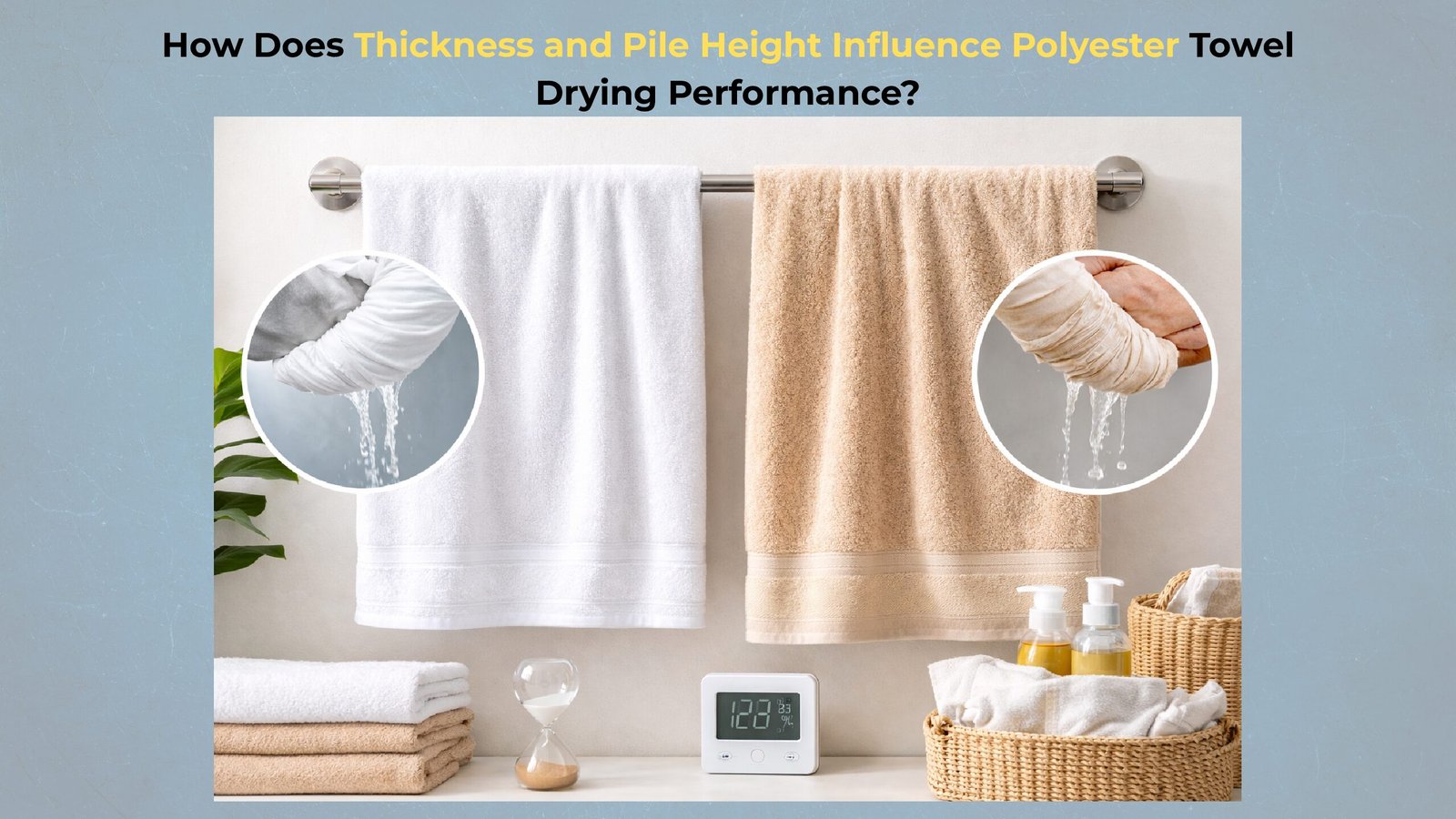
How Does Thickness and Pile Height Influence Polyester Towel Drying Performance?
Technical Performance Guide • Selection Optimization
Polyester towel drying performance is determined by the mechanical relationship between fabric thickness and atmospheric airflow because the total volume of the textile dictates the amount of moisture held in the interstitial gaps between synthetic filaments. Thickness serves as a “water reservoir” independently of the fiber’s hydrophobic nature. Establishing the concept that thickness dictates the total volume of atmospheric interaction, we must consider how moisture escape is restricted by textile mass. Concluding this section, excessive mass facilitates efficiency and microbial risks.
Why Does Thickness Dictate the Efficiency of Polyester Towel Drying Performance?
Polyester towel drying performance depends on material thickness because the cumulative mass of the weave determines the thermal energy and duration required to move moisture from the ground-yarn to the evaporation surface. Although polyester is hydrophobic, overall drying behavior still depends on how much water the structure can temporarily hold between filaments. For that variable, see polyester absorbency. This optimization confirms that higher GSM (Grams per Square Meter) correlates with exponentially longer mechanical drying cycles because the fabric volume restricts vapor escape.
How Do Dense Piles Trap Water in Polyester Towel Drying Performance?
Polyester towel drying performance suffers in dense-pile constructions because the tight packing of hydrophobic filaments creates a high-volume moisture reservoir between the fibers that resists passive airflow. For broader comparisons, review polyester drying speed comparison. Reference standardized moisture analyzer test methods confirm that increasing fabric weight from 300 GSM to 600 GSM often increases moisture retention by over 100%, creating a stubborn moisture-trap.
What Are the Hygiene Risks of Excessive Thickness in Polyester Towel Drying Performance?
Polyester towel drying performance directly impacts hygienic safety because thick-pile textiles maintain a “damp-zone” for extended durations, facilitating the colonization of anaerobic, odor-causing bacteria. Internal buildup and slow post-use drying can increase smell retention over time, even in synthetic textiles. For that issue, see polyester odor retention. Textiles that fail to reach a 5% residual moisture equilibrium within 4 hours show a significantly higher probability of hosting microbial colonies.
What Technical Factors of Pile Height Influence Polyester Towel Drying Performance?
Technical factors of pile height influence polyester towel drying performance by manipulating the textile’s surface-area-to-mass ratio and the depth of the stagnant air layer. To understand the capacity limits of specific weaves, see polyester water capacity to weight ratio.
How Does Pile Height Determine Polyester Towel Drying Performance?
Polyester towel drying performance is inversely proportional to pile height because shorter loops reduce the distance that moisture must travel to reach the atmospheric interface. Standardized evaporation test protocols reveal that a 2mm pile height dries up to 50% faster than a 6mm pile height of identical fiber composition. Low pile heights facilitate “linear moisture transport,” allowing water to move quickly from the skin to the weave surface for immediate evaporation.
Why Does Loop Density Cause a “Canopy Effect” in Polyester Towel Drying Performance?
Polyester towel drying performance degrades in high-density loop configurations because a “canopy effect” occurs where the surface loops shield the ground-weave from ambient airflow. High-density loop weaves often reduce internal airflow by up to 40%, creating a stagnant micro-climate at the base of the towel. For insight into how this affects user experience, see polyester breathability and wrap comfort. Dense loop geometry restricts core airflow and inhibits the speed of polyester towel drying performance.
How Does Bathroom Ventilation Interact with Polyester Towel Thickness for Drying Performance?
Polyester towel drying performance results from the interaction between textile thickness and bathroom ventilation because the ambient air exchange rate determines the speed of vapor pressure equalization.
Why Do Evaporation Rates of Thick-Pile Towels Fail in Low-Airflow Spaces?
Polyester towel drying performance fails in unventilated or humid spaces when thick-pile weaves saturate the immediate surrounding air layer with moisture, neutralizing the vapor pressure gradient. Reference psychrometric charts indicate that in environments with >70% relative humidity, a heavyweight 650 GSM towel remains damp for >8 hours. Selecting a lower pile height is a functional requirement for small, windowless bathrooms to ensure the textile reaches dryness between uses.
What Internal Factors Impede Polyester Towel Drying Performance?
Internal factors impede polyester towel drying performance when foreign substances or improper laundering habits physically block the capillary wicking channels within the weave.
How Does Detergent Buildup Act as a Barrier to Polyester Towel Drying Performance?
Polyester towel drying performance declines over time when excessive detergent residue coats the synthetic filaments, creating a waxy “clogging effect” that traps moisture within the core. Standardized absorbency drop testing shows that detergent salts often reduce the wicking surface area by up to 20% over 50 cycles. Buildup transforms a fast-dry towel into a non-absorbent “slick” textile that merely smears water across the skin rather than wicking it.
Why Does Machine Overloading Reduce Initial Polyester Towel Drying Performance?
Polyester towel drying performance is compromised by machine overloading because insufficient space during the spin cycle prevents the mechanical extraction of surface moisture. Overloaded machines result in a 15% to 25% higher wet-weight baseline, adding significant time to the subsequent evaporation phase. Restricted spin-cycle volume increases residual water mass and stresses the limits of polyester towel drying performance.
How to Compare Pile Heights to Select Optimal Polyester Towel Drying Performance?
Selecting optimal polyester towel drying performance requires a comparative analysis of GSM weight and loop geometry to identify the “sweet spot” of tactile comfort and evaporation velocity.
| Towel Type | GSM Range | Pile Height | Est. Air-Dry Time | Rank |
|---|---|---|---|---|
| Ultralight Ribbed | 200–300 | Flat / Zero-Pile | 30–60 Mins | Elite |
| Split-Fiber Microfiber | 300–400 | Low / Split | 60–90 Mins | High |
| Standard Terry | 400–550 | Short Loop | 2–3 Hours | Optimal |
| Heavy Duty Spa | 650+ | High Pile | 5+ Hours | Slowest |
How Do You Match Polyester Towel Drying Performance to Specific Use-Cases?
Matching polyester towel drying performance to specific use-cases involves balancing the need for rapid turnover in commercial settings with the absorbency requirements of residential environments. In high-turnover settings such as gyms or repeated daily use, odor accumulation patterns become even more important. That is covered in polyester odor retention in frequent use.
| Activity | Ideal GSM | Benefit |
|---|---|---|
| Travel / Field Use | 200–300 | Maximum packability and rapid air desiccation |
| Gym / Athletic | 350–450 | Rapid moisture turnover for high-frequency use |
| Home Bath / Spa | 500–600 | Optimized wicking capacity for full-body saturation |
Which Maintenance Steps Preserve the Loft and Polyester Towel Drying Performance?
Preserving the loft and polyester towel drying performance requires technical adherence to thermal limits and mechanical agitation to prevent fiber fusion and loop collapse.
Why Is Low-Heat Critical to Prevent Pile Fusion in Polyester Towel Drying Performance?
Polyester towel drying performance fails when exposed to high-heat drying cycles because temperatures exceeding the glass transition threshold ($T_g$) of PET cause synthetic loops to soften and fuse into a non-porous mass. Maintaining dryer temperatures below 60°C prevents the polymer chain relaxation that leads to the “glazing” of synthetic fibers. Controlled drying heat prevents loop fusion and maintains the porous loft of polyester towel drying performance.
How Does Mechanical Agitation Restore Pile-Based Polyester Towel Drying Performance?
Polyester towel drying performance regains its original velocity when mechanical agitation from wool dryer balls lifts and separates matted loops during the drying cycle. Agitation prevents the formation of “dead zones” where matted loops trap moisture against the ground-weave, improving drying speed by an estimated 15%.
How Can You Fix Flattened Piles to Restore Polyester Towel Drying Performance?
Restoring polyester towel drying performance in matted inventory involves executing chemical and mechanical resets to reopen the wicking channels blocked by mineral stiffness or loop crushing.
How Do You Restore Matted Loops to Improve Polyester Towel Drying Performance?
Polyester towel drying performance recovers its original wicking profile if a soft-bristle brush or an acidic vinegar rinse dissolves the mineral films and mechanically separates fused fibers. Improved airflow through the restored pile results in a measurable increase in evaporation velocity and a material restriction in musty odor potential.
How Do You Verify Polyester Towel Drying Performance for Quality Assurance?
Verifying optimal polyester towel drying performance requires periodic technical audits to ensure that maintenance protocols align with the molecular needs of the polymer filaments. Audits are anchored in moisture-equilibrium thresholds, requiring textiles to reach < 5% residual moisture for validation.
Polyester Towel Drying Performance Audit Checklist
FAQ: Critical Insights into Polyester Towel Drying Performance
Material thickness dictates the drying time of polyester textiles because increased fabric mass creates a larger moisture reservoir and blocks internal airflow channels.
Thick synthetic towels stay damp for extended periods because high-density loop structures create a “canopy effect” that prevents ambient air from reaching the saturated ground-weave.
The best GSM for fast polyester towel drying performance falls between 200 and 400 because this weight range balances effective wicking with minimal moisture retention.
Disclaimer: The technical data and performance metrics provided in this guide are based on standardized textile laboratory environments. Actual polyester towel drying performance may vary significantly depending on local relative humidity levels, specific machine extraction velocities (RPM), water hardness, and ambient atmospheric airflow exchange rates.