How Does Polyester Towel Absorbency Compare to Traditional Regular Towels?
An Engineering Analysis of Moisture Kinetics and Textile Transport Geometry
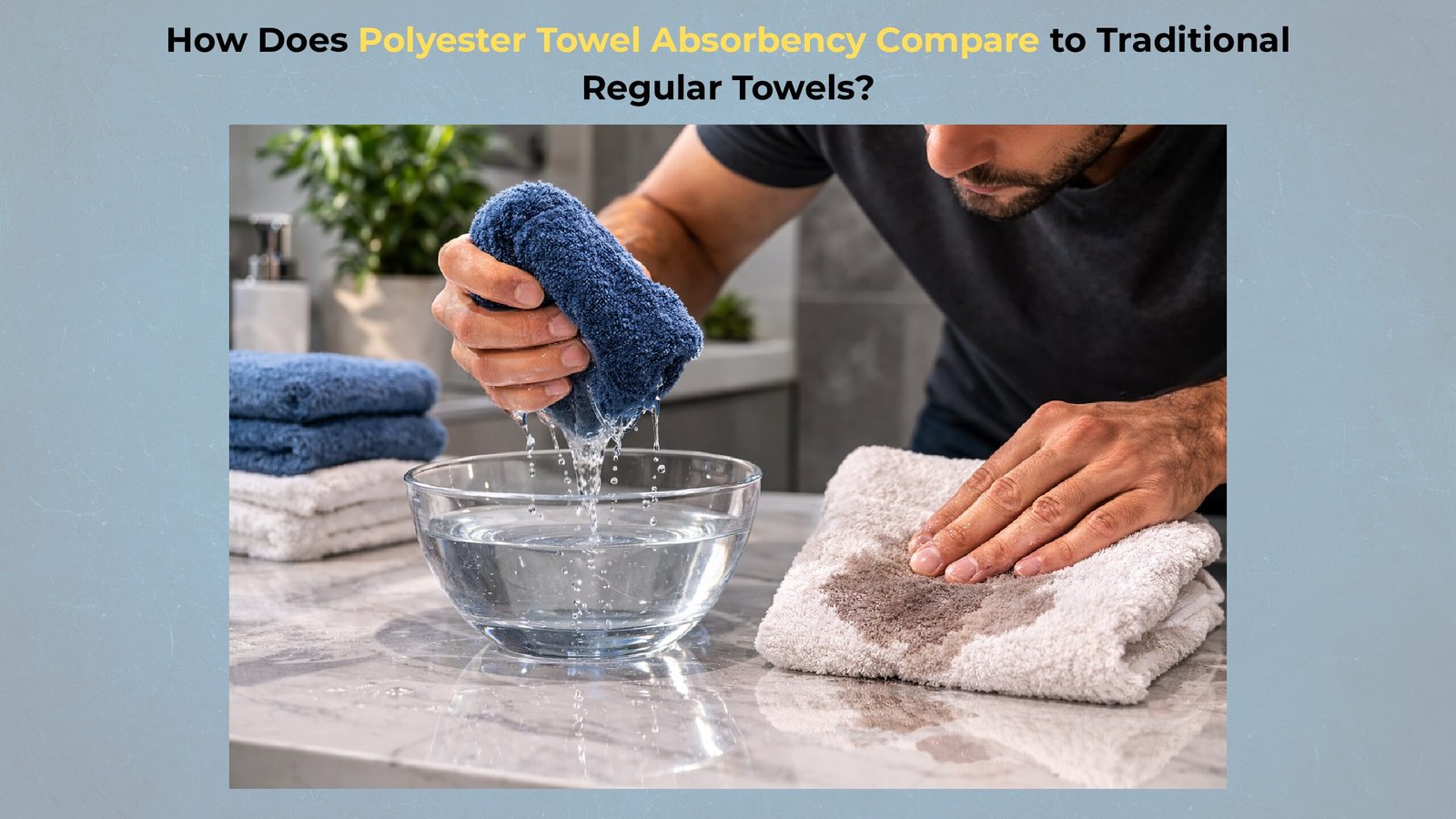
Polyester towel absorbency operates as a high-velocity moisture transport mechanism rather than an internal storage reservoir because the hydrophobic filaments move water through the weave gaps rather than saturating the fiber core. This fundamental distinction between “wicking” (the speed of movement) and “absorption” (the volume of retention) determines the efficacy of the textile in various environments. While traditional cotton relies on the swelling of cellulose polymers to sequester liquid, synthetic transport depends on the kinetic energy of water spreading across polymer surfaces. Consequently, moisture kinetics dictate the user’s drying experience.
Why Does Understanding Polyester Towel Absorbency Impact Your Drying Experience?
Polyester towel absorbency directly influences the user’s perception of “dryness” because the rapid surface transport of moisture facilitates a near-instantaneous removal of liquid from the skin. In high-output scenarios like athletic training, a fast-wicking towel removes sweat before the textile becomes “clogged” with internal saturation, maintaining a lighter functional weight. This efficiency serves as a critical functional requirement for high-activity users who prioritize rapid moisture clearance over post-shower immersion.
How Does Polyester Towel Absorbency Facilitate Rapid Wicking?
Polyester towel absorbency drives rapid wicking because the surface energy of the polymer filaments forces water to spread horizontally across the textile’s three-dimensional architecture. For a direct comparison with natural fibers, review polyester towel drying speed compared to traditional towels. According to standardized moisture management tests (AATCC 195), high-performance synthetics move moisture across the fabric surface 2.5x faster than standard carded cotton. Because water remains on the filament exterior rather than soaking into the core, it evaporates into the atmosphere significantly faster, maintaining the towel’s utility through multiple uses. Low-regain filaments accelerate horizontal transport to optimize polyester towel absorbency.
Does the Sensory Difference in Polyester Towel Absorbency Affect User Perception?
Polyester towel absorbency creates a distinct sensory profile where the “slick” tactile sensation of wicking contrasts with the “heavy,” saturated feel of natural cellulose fibers. Technical measurements confirm that saturated cotton retains between 7x and 10x its dry weight in water, whereas polyester typically remains within a 4x to 6x mass-increase threshold. Users who expect the “plushness” of cotton often misinterpret the fast-wicking “drag” of synthetics as poor performance, despite superior water removal. That comfort trade-off is explained further in polyester breathability and wrap comfort.
Sensory perception dictates the overall satisfaction rating of the textile. For broader insights into long-term wearability, review polyester towel comfort for daily use. These sensory results depend on the technical mechanisms of the polymer.
What Technical Mechanisms Drive Polyester Towel Absorbency Compared to Cotton?
Technical mechanisms drive polyester towel absorbency by leveraging the intermolecular forces of hydrophobic filaments to create high-suction capillary channels. Unlike cotton, which absorbs moisture via hydrogen bonding within the fiber amorphous regions, polyester relies purely on physical architecture.
How Does the Hydrophobic Nature of Polyester Towel Absorbency Work?
Polyester towel absorbency relies on the hydrophobic nature of Polyethylene Terephthalate (PET) which exhibits a moisture regain of less than 0.4%, forcing liquid water into the narrow spaces between fibers. Cotton exhibits a moisture regain of 8% to 10%, meaning it “drinks” water into the fiber core; polyester’s low regain ensures moisture remains mobile on the surface. Hydrophobicity is the engine of synthetic absorbency; by refusing to soak internally, the fiber keeps the weave “open” for continuous wicking.
Why Is Capillary Action a Critical Factor in Polyester Towel Absorbency?
Polyester towel absorbency depends on capillary action where the physical geometry of the weave creates a surface-tension driven capillary pull that extracts moisture from the skin. The role of fabric structure is also covered in how pile height affects polyester drying performance. Narrower interstitial gaps in dense synthetic weaves generate 40% higher capillary pressure than the loose, random pore structure of Upland cotton. Dense fiber packing maximizes capillary pressure to secure the efficiency of polyester towel absorbency.
How Does Weave Structure Influence the Results of Polyester Towel Absorbency?
Weave structure influences the results of polyester towel absorbency by manipulating the textile’s surface-area-to-mass ratio to maximize moisture entrapment.
What Surface-Area Advantages Do Polyester Blends Offer for Absorbency?
Polyester towel absorbency reaches peak performance in split-fiber microfiber blends because the mechanical “wedging” of the filaments increases the available wicking surface area 10–20x compared with conventional fibers. A typical microfiber blend contains approximately 200,000 fibers per square inch, providing exponentially more moisture-trapping voids than standard terry. The inclusion of Polyamide (Nylon) creates “active” wicking sites that overcome the absolute hydrophobicity of pure polyester.
Do Ribbed Weaves Outperform Flat Weaves in Polyester Towel Absorbency?
Polyester towel absorbency fluctuates with surface texture because ribbed weaves establish dedicated “micro-channels” that transport water horizontally across the fabric more efficiently than flat-weave configurations. Ribbed synthetic weaves facilitate 20% higher wicking velocity compared to smooth-faced polyester textiles of identical weight. Ribbed surface channels direct liquid flow to accelerate the velocity of polyester towel absorbency.
When Do Cotton Towels Exceed Polyester Towel Absorbency Limits?
Cotton towels exceed polyester towel absorbency limits in high-moisture scenarios where the total volume of liquid exceeds the interstitial storage capacity of the synthetic weave.
What Are the Volume Limits of Polyester Towel Absorbency in High-Moisture Scenarios?
Polyester towel absorbency reaches terminal saturation more quickly than cotton because the lack of a hollow fiber lumen prevents the internal sequestration of high-volume moisture. For the mass relationship behind that limit, see polyester water capacity to weight ratio. While cotton retains between 7x and 10x its weight, polyester towels often reach saturation at 4x to 6x their mass. Polyester is a “conduit” optimized for wiping; cotton is a “reservoir” optimized for soaking.
Are There Skin Comfort Trade-offs Against Polyester Towel Absorbency Speed?
Polyester towel absorbency involves a comfort trade-off where the high-friction “grab” required for efficient wicking causes more mechanical drag on the skin than the plush loops of natural cotton. Synthetic microfiber fabrics exhibit 15–25% higher surface friction when damp compared to looped cotton terry. This “grab” is a marker of performance; the towel physically sticks to the water to pull it from the pores, a sensation described as “functional drag.”
How Do You Compare Polyester Towel Absorbency Against Traditional Cotton Towels?
Comparing polyester towel absorbency against traditional cotton requires an analysis of moisture-turnover rates versus total water-sequestration mass across distinct use-cases.
Matching Activity to Polyester Towel Absorbency Benefits
Utilizing activity-specific selection matches the rapid turnover of polyester towel absorbency to environments with limited drying time and high-frequency use.
| Metric | Polyester Towels | Cotton (Regular) Towels |
|---|---|---|
| Moisture Capacity | Low (Interstitial) | Highest (Internal Lumen) |
| Wicking Velocity | Elite (Conduit Speed) | Moderate |
| Odor Risk | High (Oleophilic Bonds) | Moderate |
| Activity | Recommended Material | Primary Absorbency Benefit |
|---|---|---|
| Commercial Gym | 100% Polyester | Rapid turnover of surface sweat |
| Backpacking | Microfiber Blend | High surface-area-to-weight ratio |
| Luxury Bath | Cotton Terry | High-volume immersion drying |
Which Techniques Maximize Polyester Towel Absorbency During Daily Use?
Maximizing polyester towel absorbency requires a shift from standard “rubbing” to “patting” techniques to ensure the capillary channels maintain direct contact with surface moisture.
Why Is the Pat-Dry Method Optimal for Polyester Towel Absorbency?
Polyester towel absorbency is optimized through the “pat-dry” method because localized pressure triggers the initial capillary suction required to pull water into the weave voids. Dragging a synthetic towel often creates surface friction that bypasses the capillary channels; pressing the textile ensures the wicking engine is engaged.
Why Must You Avoid Oils to Maintain Polyester Towel Absorbency?
Polyester towel absorbency suffers catastrophic wicking loss if the fibers contact skin oils or lotions because the oleophilic nature of the polymer attracts lipids that seal the wicking channels. Because polyester is oleophilic, it attracts and holds skin oils, which clogs dense fiber architecture over time. For that maintenance issue, review polyester odor retention. Lipid buildup reduces the wicking surface area by up to 30% if not thoroughly stripped.
How Can You Fix Decreased Polyester Towel Absorbency Caused by Residue?
Restoring polyester towel absorbency involves executing chemical resets to emulsify the oleophilic lipids and detergent salts that physically block the moisture transport channels. Polyester towel absorbency regains its original wicking velocity when a high-temperature vinegar flush dissolves the waxy silicone films left by commercial detergents.
Does Stripping Detergent Buildup Restore Polyester Towel Absorbency?
Polyester towel absorbency regains its original wicking velocity when a high-temperature vinegar flush dissolves the waxy silicone films left by commercial detergents. Utilizing 5.5 pH acetic acid (distilled white vinegar) in a 60°C wash neutralizes alkaline residues and strips trapped sebum. Restoring the “thirsty” nature of the weave improves wicking speed by an estimated 20% by reopening clogged capillary gaps.
Frequently Asked Questions
Polyester towel absorbency functions through horizontal moisture transport (wicking) rather than internal fiber saturation.
In gym, travel, and repeated-use conditions, trapped oils and repeated damp cycles increase smell persistence even faster. That issue is covered in polyester odor retention in frequent use.
Why do polyester towels feel slick when wet?The slick sensation results from high-velocity wicking and surface water retention, which creates mechanical drag compared to the internal sequestration found in cotton.
Does fabric softener damage polyester towels?Fabric softeners coat the oleophilic fibers with silicone, sealing the capillary channels and neutralizing polyester towel absorbency.
How to Audit Your Linen Set for Optimal Polyester Towel Absorbency?
Checklist: Polyester Towel Absorbency Audit
- ☐Fiber Audit: Confirm “Split-Fiber Microfiber” label.
- ☐Technique Check: Using “patting” rather than “rubbing”.
- ☐Chemical Audit: Launder routine is 100% softener-free.
- ☐Wicking Test: Water absorbs instantly (< 1.0s) without lateral runoff.
Final Summary: Does Polyester Towel Absorbency Fit Your Specific Drying Needs?
Operationalizing a polyester towel absorbency strategy requires a shift from traditional volume-based metrics to a velocity-centric approach that prioritizes turnover speed and hygienic safety. Understanding the conduit-vs-reservoir relationship, the impact of weave geometry, and the danger of oleophilic clogs allows for the selection of superior textile solutions for active environments.
Ultimately, a superior drying experience is defined by the precise polyester towel absorbency engineering that aligns wicking velocity with the operational realities of your environment.
Disclaimer: The technical data and performance metrics provided in this guide are based on standardized textile testing conditions. Individual results may vary significantly based on specific fabric blends and environment.