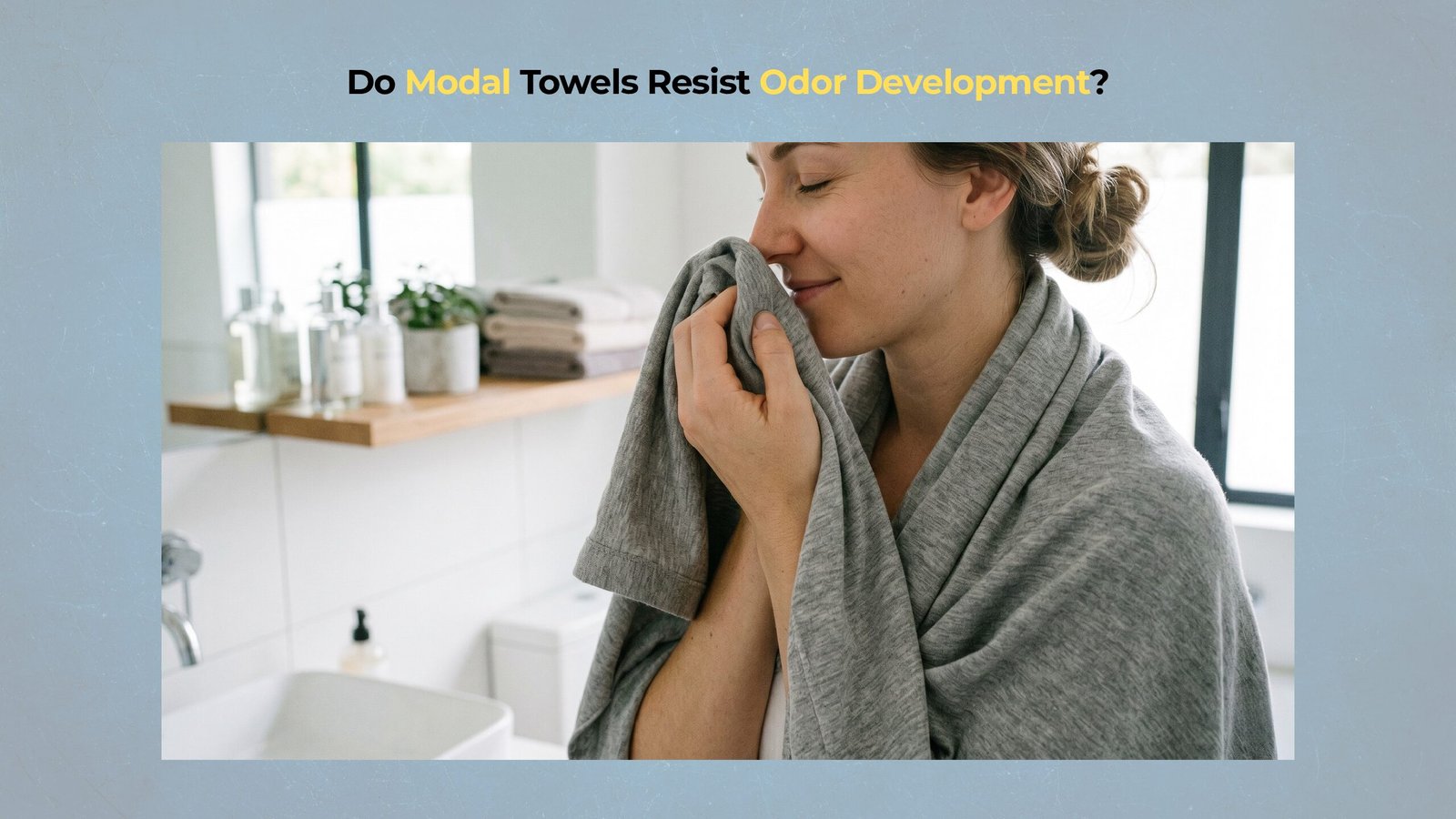
Do Modal Towels Resist Odor Development? — Modal towel odor resistance
High levels of Modal towel odor resistance result if the textile utilizes smooth High Wet Modulus (HWM) fibers that facilitate rapid moisture evaporation.
Rapid moisture evaporation ensures a “dry-core” environment within the base weave, preventing the saturation required for microbial colonization. This environmental management effectively inhibits the metabolic activity of Micrococcus and other common skin flora.
Why does fiber topology drive Modal towel odor resistance?
Modal towel odor resistance reaches peak levels if the extruded, scale-free fiber surface inhibits the anchoring of odor-causing Bacterial biofilm.
Bacterial biofilms require microscopic pits or scales to establish structural integrity during the initial colonization phase. Smooth HWM cellulose fibers, unlike the jagged, multi-layered cuticle of upland cotton, offer a low Bacterial adhesion potential. This same surface engineering also explains how Modal fibers reduce bacterial growth inside towel loops during repeated daily use.
Biofilm anchoring fails on these smooth surfaces because the physical lack of “micro-pockets” denies bacteria the necessary Fibrillation resistance required to withstand mechanical washing forces. Once readers understand microbial anchoring failure, the next logical question is usually how low-friction Modal fibers minimize surface abrasion and residue buildup.
Does surface uniformity determine the threshold for Modal towel odor resistance?
Modal towel odor resistance thresholds correlate with surface uniformity as consistent fiber diameters facilitate the removal of organic sebum during laundering.
Research from the Textile Research Journal (2021) indicates that regenerated cellulose structures like Lenzing Modal retain $50\%$ less sebum-related residue than cotton. Users comparing freshness retention between textiles may also benefit from understanding how Modal absorbency differs from traditional cotton structures. This performance supports the Bio-Sequestration Resistance Model, an explanatory framework describing how fibers prevent oils from becoming trapped in internal fiber lumens where bacteria thrive.
How does wicking efficiency facilitate Modal towel odor resistance?
Effective Modal towel odor resistance is driven by wicking efficiency if rapid Capillary action prevents the formation of stagnant moisture pockets. This moisture regulation mechanism closely relates to how rapid absorption improves overall towel refreshing efficiency.
Stagnant moisture pockets provide the high-humidity anaerobic microbial environment necessary for the production of sulfurous odors. Because Modal maintains a Standard moisture regain of $11\%–14\%$, the fibers absorb water into their internal structure while the surface remains dry. This mechanism facilitates Ambient refreshing, a descriptive framework where the fiber loops shed moisture to the air faster than bacterial colonies can multiply. Readers exploring moisture transport mechanics often also want to understand how Modal moisture capacity influences long-term drying behavior.
How does Modal towel odor resistance compare to cotton and synthetics?
Superior Modal towel odor resistance results if the material’s natural breathability excludes the Oleophilic attraction characteristic of synthetic polyesters. Readers comparing odor behavior across fabrics frequently continue into why polyester towels permanently retain sebum-based odors under repeated use conditions.
| Material Type | Odor Resistance | Main Odor Driver | Hygiene Rating |
|---|---|---|---|
| Lenzing Modal | HIGHEST | Chemical Residue | Excellent |
| Egyptian Cotton | Moderate | Internal Stagnation | Good |
| Standard Cotton | Low | Mineral Trapping | Fair |
| Polyester | POOR | Oil/Sebum Attraction | Poor |
What environmental factors compromise Modal towel odor resistance?
Functional limitations of Modal towel odor resistance initiate if ambient relative humidity exceeds $60\%$ in unventilated storage environments.
Unventilated storage environments lead to Hygroscopic saturation, where the fiber’s Hydroxyl group density becomes fully bonded with atmospheric water vapor. Once saturation occurs, the material loses its ability to wick additional moisture from the skin, resulting in inter-loop moisture stagnation. In humid environments, many readers also investigate which towel fibers perform best under high ambient humidity.
Which laundry protocols preserve Modal towel odor resistance?
Preservation of Modal towel odor resistance requires a monthly acidic reset cycle to dissolve the alkaline soap films that trap odors.
Alkaline soap films create a cellulose-surfactant complex that physically blocks the capillary channels of the fiber. These Cationic surfactants, found in fabric softeners, deposit a waxy Cationic surfactant residue that attracts dirt and feeds bacterial growth. This buildup mechanism is closely connected to how mineral deposits gradually reduce Modal softness and airflow performance.
Does rinse frequency protect Modal towel odor resistance from detergent buildup?
Modal towel odor resistance remains stable if additional rinse cycles ensure the total displacement of residual surfactant molecules from the fiber loops.
The AATCC Test Method 197 confirms that residue saturation triggers a $40\%$ increase in microbial scent markers. This phenomenon follows the Surfactant-Bacterial Complex Model, an explanatory framework where surfactants act as a sticky substrate that anchors bacteria to the otherwise smooth modal surface. Readers focused on preserving fiber integrity should also review how repeated washing impacts long-term Modal towel durability.
Which checklist verifies genuine Modal towel odor resistance?
Validation of genuine Modal towel odor resistance succeeds if a definitive care audit confirms high fiber purity and the absence of waxy finishes.
The product is certified as 100% Lenzing Modal to ensure Modal towel odor resistance.
The fabric surface exhibits a “Dull Matte” finish to verify the absence of silicone odor-traps.
A breathability test confirms low resistance to airflow, supporting Modal towel odor resistance.
The GSM remains between 500 and 650 to balance Modal towel odor resistance and air-dry speed.
The yarn utilizes a “Low-Twist” construction to keep capillary channels unblocked.
Frequently Asked Questions: Modal towel odor resistance
High levels of Modal towel odor resistance are achieved because the smooth fiber topology prevents Bacterial biofilm from anchoring in the microscopic pits common in cotton fibers. Additionally, the rapid Capillary action keeps the surface dry, inhibiting Micrococcus growth.
No. Fabric softeners leave a Cationic surfactant residue that blocks capillary channels and attracts organic sebum. This accumulation compromises Modal towel odor resistance by creating a nutrient-rich environment for anaerobic microbes.
To maintain optimal Modal towel odor resistance, you should perform an acidic reset (using white vinegar) once per month. This dissolves the cellulose-surfactant complex and clears the way for efficient moisture transport and refreshing.
Yes. High heat can lead to fiber brittleness and surface degradation, which creates micro-abrasions that harbor bacteria. Using a low-heat setting preserves the smooth topology essential for consistent Modal towel odor resistance.
Technical Disclaimer
The performance metrics regarding Modal towel odor resistance provided in this technical guide are based on standardized textile laboratory conditions and High Wet Modulus (HWM) fiber specifications. Individual results in microbial management and odor suppression may fluctuate based on localized variables including municipal water mineral density, ambient bathroom humidity, and specific laundry appliance mechanical action. This guide serves as an explanatory framework for material physics and does not replace specific manufacturer care labels.