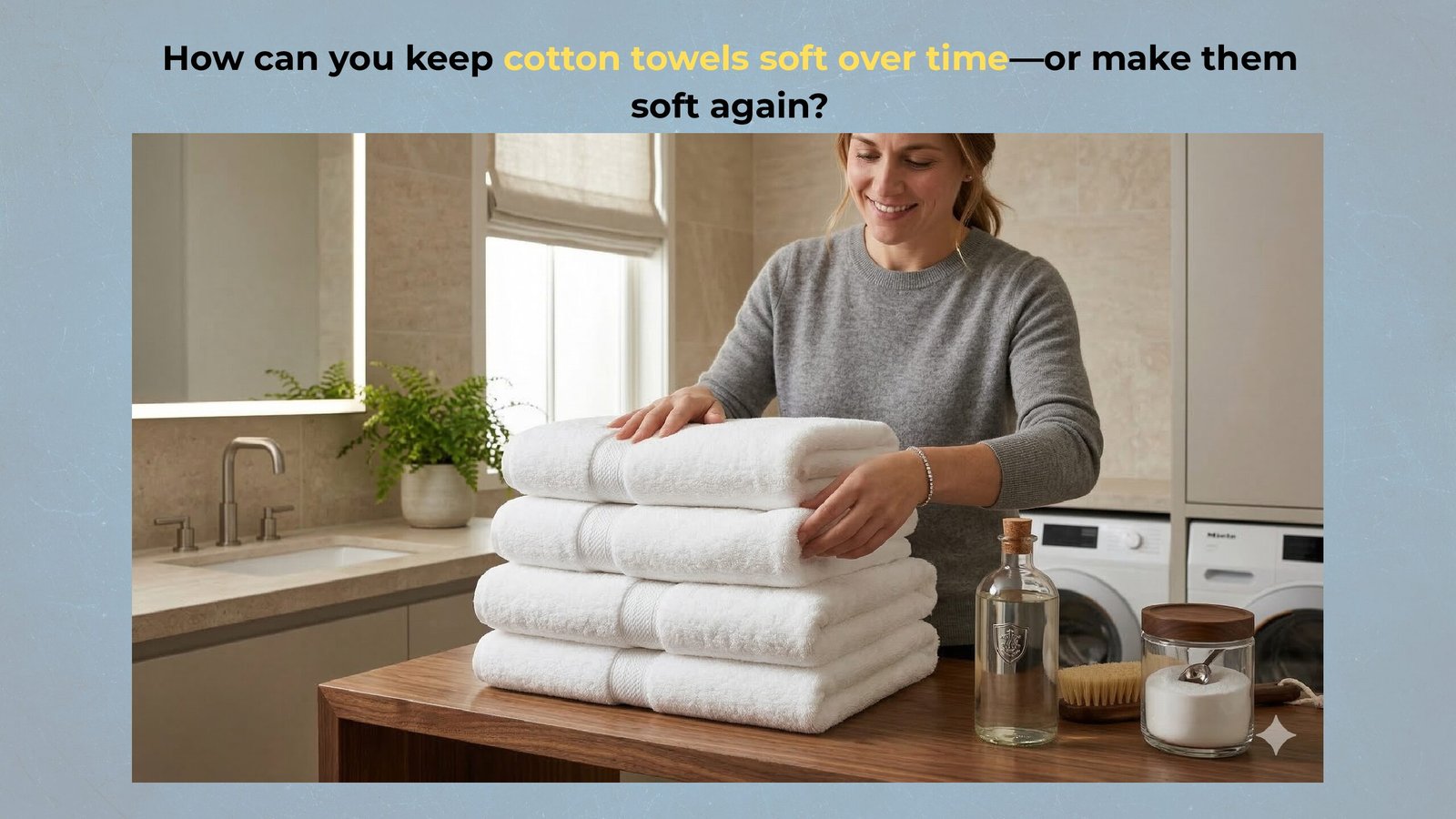
How can you keep cotton towels soft over time—or make them soft again?
This article provides a dual-action chemical and physical protocol to restore Cotton Towels Softness by eliminating mineral scale and waxy buildup.
You can keep Cotton Towels Softness over time by consistently applying a dual protocol that addresses both mineral buildup and chemical residue, the primary causes of stiffness. Stiffness in cotton textiles originates at the molecular level, where environmental and wash-cycle factors conspire to flatten the natural terry loops. These flattened loops results in a “sandpaper” texture that compromises the user experience and the towel’s mechanical utility.
Why do cotton towels lose softness and absorbency over time?
Cotton Towels lose softness and absorbency over time because their hydrophilic fibers are gradually sealed by chemical and mineral deposits, defeating their natural function. This sealing effect acts as a barrier to water molecules, which can no longer penetrate the cellulose core of the fiber.
What are the primary causes of lost cotton towels softness?
The primary drivers of texture degradation are surfactant buildup and calcium carbonate precipitation. In regions with hard water, defined as exceeding 7 GPG (Grains per Gallon), calcium and magnesium ions bond with soap molecules to create “soap scum” that adheres to the cotton weave. This adhesion is compounded by the use of synthetic fabric softeners, which coat the fibers in a waxy layer.
When mineral scale and detergent films begin to block wicking channels, the next step is understanding Cotton Towels Absorbency Factors so users can connect softness loss with reduced moisture performance.
Hydrophobic Residue
Hydrophobic Residue refers to a non-polar, water-repelling coating (often from softeners or detergent fats) that prevents cotton fibers from wicking moisture effectively.
Does high heat impact cotton towels softness?
Analyzing the impact of high heat on Cotton Towels Softness reveals that excessive temperature permanently damages the cotton cellulose structure. When internal drying temperatures exceed 150°F (65°C), the fibers begin to suffer structural moisture loss that renders the cotton brittle. This brittleness causes the individual threads to snap or fray, leading to a permanent loss of tactile comfort that chemical treatments cannot reverse.
If your towels still feel rough after repeated washing, use the Towel Failure Diagnostics tool to identify whether stiffness is being caused by heat damage, residue buildup, or structural pile collapse.
How does fiber compression lead to a loss of cotton towels softness loft?
Understanding fiber compression is key to preventing loss of Cotton Towels Softness Loft, as over-stuffing the machine physically crushes the fibers. When towels are crammed into a drum, the weight of the wet fabric flattens the terry loops before they can dry into an upright position.
Loft
Loft is the physical height and air volume contained within the towel’s weave. High loft correlates directly with the sensation of softness and increased surface area for absorption.
What are the essential chemical stripping methods for restoring cotton towels softness?
The essential chemical stripping methods for restoring Cotton Towels Softness involve an acid treatment (vinegar) to dissolve minerals and an alkaline buffer (baking soda) to neutralize detergent. This two-stage process breaks down the complex bonds between mineral scale and hydrophobic residues.
How do different stripping agents affect cotton towels softness?
| Softness Agent | Chemical Action | Target Buildup | Towel Softness Impact |
|---|---|---|---|
| White Vinegar | Mild Acid (Acetic) | Mineral Deposits | Restores Natural Absorbency |
| Baking Soda | Mild Alkaline Buffer | Detergent Residue | Neutralizes Odor, Boosts Fluff |
| Chlorine Bleach | Oxidizing Agent | Color/Stains | Destroys Fiber Strength |
When should you use mechanical agitation to enhance cotton towels softness?
You should use mechanical agitation to enhance Cotton Towels Softness after the wash and drying cycles to physically force air back into the compressed pile. This mechanical action serves to “unstick” fibers that have been glued together by residual moisture or lingering surfactants.
Can dryer balls physically restore cotton towels softness loft?
Utilizing Dryer Balls physically restores Cotton Towels Softness Loft by acting as a continuous, mild mechanical pounding throughout the drying process. As the balls bounce between the towels, they create “air gaps” within the fiber loops. This physics-based approach ensures that the loops dry in an expanded state rather than a collapsed one.
How can you prevent future loss of cotton towels softness in your routine?
You can prevent future loss of Cotton Towels Softness by replacing softening agents with natural alternatives and reducing unnecessary chemical usage.
To apply the correct wash temperature, detergent load, and drying method for this restoration protocol, consult the Towel Care Diagnosis Engine for a more targeted maintenance recommendation.
Which maintenance practices preserve everyday cotton towels softness?
| Action Item | Cotton Towels Softness Goal | Impact on Fiber |
|---|---|---|
| Use Less Detergent | Prevent Residue Buildup | Keeps fiber pores open |
| Air Dry in Wind/Sun | Prevent Heat Damage | Locks in natural moisture |
| Shake Towels Vigorously | Restore Loft Immediately | Forces air into compressed pile |
How do you validate cotton towels softness restoration results?
You validate Cotton Towels Softness restoration results by executing a 4-step functional audit that checks for both chemical and physical success.
4-Step Cotton Towels Softness Audit
The Water Drop Test: Water absorbs instantly (< 3 seconds), verifying the successful stripping of hydrophobic residue.
The Snap Check: The towel feels silent and pliable when snapped, indicating the successful removal of alkaline mineral deposits.
The Drape Test: The towel conforms to the shape of an arm without resistance, verifying mechanical pliability.
The Smell Check: The fabric emits a neutral or slightly acetic scent, confirming the removal of soap perfume buildup and mildew.
For readers dealing with musty odors alongside stiffness, this issue often overlaps with Cotton Towels Mildew Prevention, where moisture retention and airflow are analyzed as part of the same maintenance problem.