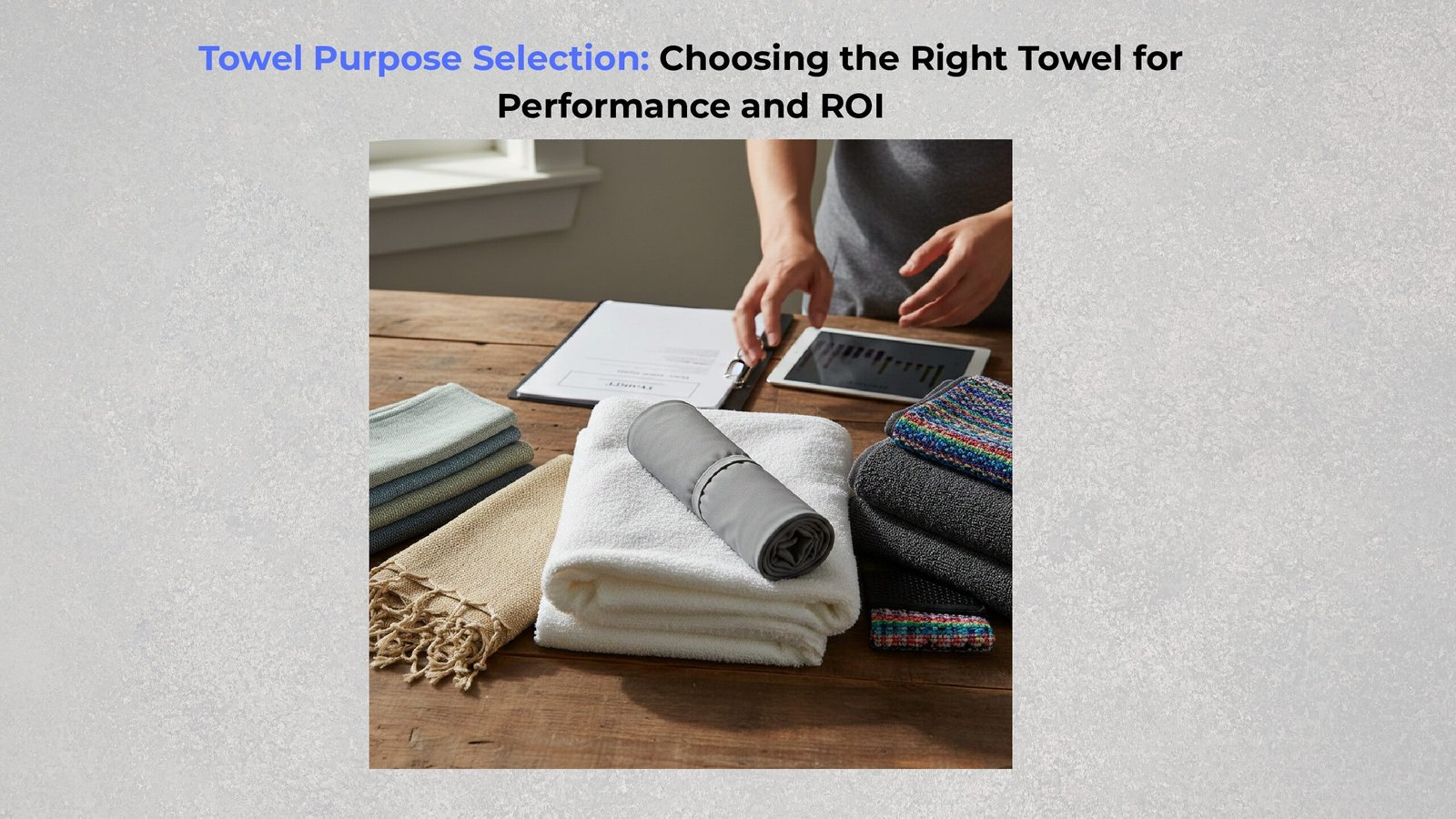
Towel Purpose Selection: Choosing the Right Towel for Performance and ROI
Towel Purpose Selection is the strategic process of aligning textile engineering specifications with specific usage environments to optimize both physiological safety and fiscal ROI.
This guide provides a technical framework for analyzing textile specifications—including GSM, Staple Length, and Weave architecture—to ensure optimal post-purchase performance. To understand every detail before making a purchase, start by reviewing the complete framework on 16 towel buying factors. Once your purpose is clear, it’s important to explore which towel type best matches your intended use, whether for spa, gym, kitchen, or beach. Trusted manufacturers often deliver more consistent performance, so explore why choosing the right brand matters.
Why Towel Purpose Selection Determines Microbial Proliferation and Epidermal Integrity?
Towel Purpose Selection directly influences the rate of capillary action and the subsequent formation of damp micro-environments within the textile weave. Since towels function as high-surface-area drying tools, check how absorbent the towel is for your intended purpose. Strategic **Towel Purpose Selection** aligns fiber hydrophilicity with task frequency and reduces abrasive epidermal contact.
How Does Mismatched Towel Purpose Selection Compromise Textile Hygiene?
Towel Purpose Selection failures result in moisture stagnation, where high-GSM cotton used in high-frequency gym environments facilitates rapid bacterial colony formation [Journal of Hospital Infection]. In busy or humid environments, quick-dry towels are particularly advantageous.
Laboratory studies show that many bacteria double in number every 20–60 minutes under warm, moist conditions. When textiles remain damp, they create a microenvironment that supports microbial adhesion and biofilm formation, especially in warm environments.
Which Industrial Textile Standards Drive Towel Purpose Selection?
Towel Purpose Selection relies on verified industrial benchmarks to remove the subjective aesthetic bias from the procurement process. The fiber composition also affects performance, so consider what material will work best for your purpose.
How Towel Purpose Selection Dictates the Required Fiber Staple Length for High-Cycle Durability?
Towel Purpose Selection for high-frequency environments necessitates the use of **Extra-Long Staple (ELS)** fibers to minimize surface friction and prevent pilling [Textile Research Journal]. Integration of Giza 45 as the premium ELS variety ensures maximum tensile strength. To ensure it lasts over time, consider towel durability as part of your selection criteria.
Extra-Long Staple (ELS) cotton yarns demonstrate greater tensile strength and reduced lint generation compared to short-staple Upland cotton due to longer fiber length and improved cohesion. Improved durability results from fewer exposed fiber ends in longer-staple yarns, reducing fiber migration and mechanical pilling during agitation.
What GSM Benchmarks are Essential for Scientifically Sound Towel Purpose Selection?
Towel Purpose Selection utilizes **GSM (Grams per Square Meter)** as a proxy for both liquid capacity and the required thermal load for desiccation [Industrial Laundering Research]. Use **Combed Ring-Spun Cotton** as the benchmark for residential utility to balance softness with structural stability. Fabric density matters too, and understanding towel weight (GSM) helps you choose one that suits your needs. Thickness influences both comfort and drying efficiency, making evaluating towel thickness an essential step.
| Towel Purpose Selection Segment | GSM Benchmark | Fiber Requirement |
|---|---|---|
| Gym / High Mobility | 200–400 GSM | Polyamide Blend |
| Residential Utility | 400–600 GSM | Ring-Spun Cotton |
| Premium Hospitality | 600–900 GSM | Giza 45 / ELS |
How to Quantify Towel Purpose Selection via Twist-Ratio and Weave Mechanics Analysis?
Towel Purpose Selection involving zero-twist yarn architectures maximizes instantaneous moisture wicking by increasing the available air-trapping volume within the loops. Standardized vertical wicking procedures follow **AATCC Test Method 197** for wicking verification. Comfort is essential for personal use, so review how soft the towel feels.
Under controlled vertical wicking tests, zero-twist yarn constructions typically exhibit greater initial capillary rise compared to high-twist yarn structures. Enhanced wicking results from increased inter-fiber capillary space due to reduced yarn compaction, enabling more rapid moisture migration along the fabric structure.
How to Apply Specialized Towel Selection Based on Intended Purpose Across Diverse Environments?
Towel Purpose Selection necessitates adaptation for localized environmental variables such as ambient relative humidity and high-frequency travel constraints.
What Logic for Selecting Towels for Specific Purposes Applies to Specialized Dermatological Needs?
Towel Purpose Selection for sensitive skin prioritizes **Bamboo-Modal** blends, which exhibit lower friction coefficients to reduce mechanical exfoliation stress. Adherence to **OEKO-TEX Standard 100** serves as a prerequisite for chemical safety [Dermatology & Tribology Research].
How to Execute Strategic Towel Purpose Selection for Travel and Compact Storage Units?
Towel Purpose Selection for high-mobility scenarios utilizes **Polyamide/Polyester Blends** to increase packing efficiency and accelerate evaporation [Journal of Engineered Fibers and Fabrics].
Microfiber constructions engineered with fine denier filaments exhibit reduced compressible bulk and high surface area-to-mass ratios compared to conventional terry cotton fabrics. Moisture transport in synthetic microfiber fabrics occurs primarily through inter-filament capillary channels rather than deep fiber absorption.
How to Maintain Structural Integrity After Initial Purpose-Based Towel Selection?
Towel Purpose Selection success depends on verifying structural reinforcements like SPI count and hem construction during the procurement phase.
How to Inspect Structural Reinforcements During the Preliminary Towel Purpose Selection Phase?
Towel Purpose Selection validation requires a minimum of **12-14 Stitches Per Inch (SPI)** to prevent seam failure during commercial laundering [ISO 13935-1]. Beyond brand, the construction and fiber grade define towel quality and comfort.
How to Use Color-Coded Identification to Maintain Rigorous Towel Purpose Selection Standards?
Towel Purpose Selection utilizes **Vat-Dyeing** chemistry to establish a zone-based system that remains colorfast despite exposure to industrial bleaches [AATCC Colorfastness Testing].
Vat-dyed textiles exhibit strong resistance to oxidative bleaching under standardized testing. Color durability results from the reduction–oxidation dyeing process, which converts vat dyes into an insoluble form within the cellulose structure.
How to Finalize Your Inventory Strategy Using the Ultimate Towel Purpose Selection Checklist?
Towel Purpose Selection concludes with the application of a tactical efficiency formula and the implementation of a structural health audit. Budget also plays a role, so consider how cost aligns with towel value.
Tactical Efficiency Mapping (SEM)
Scientific Towel Purpose Selection Formula
Why Selecting Towels Based on Purpose Must Inform Your Chemical Care and Laundering Protocol?
Towel Purpose Selection for high-absorbency tasks excludes the use of hydrophobic fabric softeners to preserve the fiber’s natural capillary action [Textile Chemistry Research].
Silicone-based softeners reduce vertical wicking performance by increasing fiber surface hydrophobicity. Reduced capillary action results from hydrophobic residue deposition on cellulose fibers, which interferes with hydrogen bonding.
Selection Audit Checklist
- Verify GSM matches segment frequency benchmarks.
- Validate ELS fiber presence (Giza 45 variety).
- Audit SPI count for high-cycle seams (>12 SPI).
- Confirm OEKO-TEX Standard 100 for dermal safety.