Disclaimer: The information provided in this analysis is for educational and informational purposes only and is not intended as professional medical advice. Always consult with a board-certified dermatologist or healthcare professional regarding specific skin conditions like eczema or chronic dermatitis.
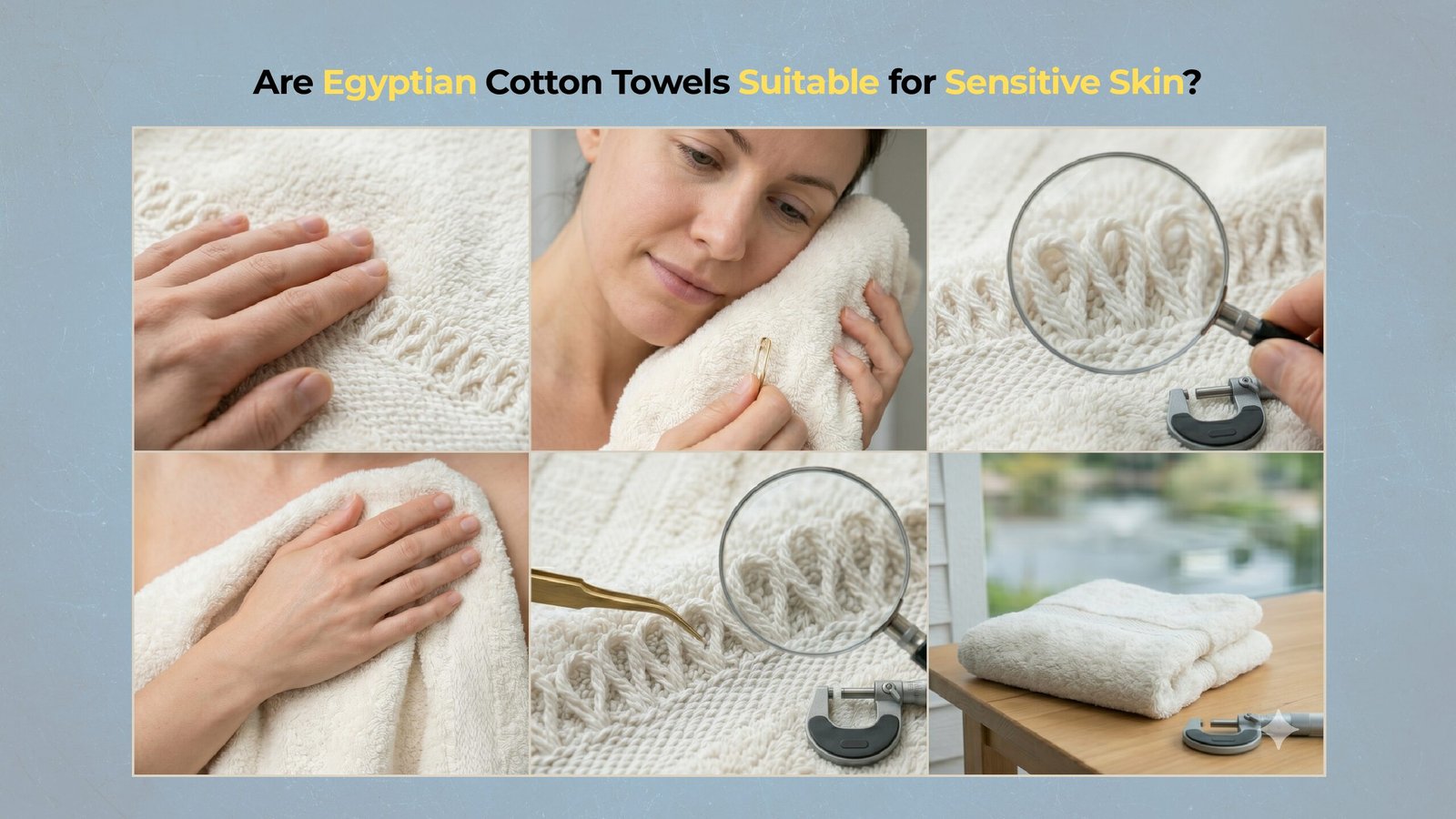
Yes, an Egyptian cotton towel for sensitive skin facilitates a smoother surface that reduces mechanical friction compared to standard cotton. This benefit results from the inherent length of Extra-Long Staple (ELS) fibers, which minimize the density of exposed fiber ends. Tactile suppleness increases when the yarn is spun from these longer strands, providing a consistent pile that glides across reactive epidermal surfaces.
This structural advantage ensures that the material does not catch on micro-fissures in the skin barrier. Micronaire values for high-end cultivars typically fall between 3.5 and 4.5, indicating a fine, mature fiber structure that prioritizes comfort for users managing chronic sensitivities.
Why is an Egyptian cotton towel for sensitive skin recommended for eczema sufferers?
Reduction of friction that aggravates the stratum corneum results from utilizing an Egyptian cotton towel for sensitive skin to avoid coarse fiber stressors. Shorter, standard cotton fibers often feature rough “ends” that create micro-abrasions, triggering inflammatory cytokine release in eczema-prone skin. This inflammation compromises the skin’s ability to retain moisture, leading to a cycle of dryness and itching.
Epidermal integrity is maintained when the drying process relies on blotting rather than rubbing. By selecting longer-staple textiles, users ensure that the material’s high absorbency removes moisture quickly, a process rooted in Egyptian cotton towel comfort and absorbency science, without requiring aggressive mechanical contact.
Stratum corneum: The outermost layer of the epidermis, acting as the primary barrier against environmental pathogens and irritants.
Can an Egyptian cotton towel for sensitive skin increase microbial risks in damp bathrooms?
High density in an Egyptian cotton towel for sensitive skin increases the risk of pathogenic colonization if the environment inhibits rapid drying. Pathogenic colonization is more likely in textiles with a density above 700 GSM if bathroom ventilation is poor, as the thick loops sequester moisture. Environmentally, if the relative humidity (RH) stays above 60%, bacteria can linger within the fibers.
This risk occurs because dense loops trap water deep within the base weave, illustrating how fabric structure impacts drying speed and moisture retention in humid environments.
Which technical features identify a high-quality Egyptian cotton towel for sensitive skin?
Verified pile softness and third-party safety certifications identify a high-quality Egyptian cotton towel for sensitive skin. Third-party safety certifications like OEKO-TEX Standard 100 verify that the textile is free from over 100 known harmful substances. Dermal reactivity is significantly reduced when a product is confirmed to be free from formaldehyde, pentachlorophenol, and allergenic dyes.
Micronaire value: A measurement of the air permeability of cotton fibers; a lower value (3.5–4.5) indicates a finer, softer fiber suitable for sensitive skin.
How does staple length make an Egyptian cotton towel for sensitive skin non-irritating?
Reduced mechanical irritation in an Egyptian cotton towel for sensitive skin occurs because Extra-Long Staple (ELS) yarn features significantly fewer exposed fiber ends. These exposed ends act as tiny irritants that can prick sensitive nerve endings during use. Reduced yarn hairiness—a result of using fibers between 32mm and 40mm—ensures a smoother finish that is less likely to pill or lint over time.
Combing the fibers aligns the high-quality staples in a parallel fashion, removing immature strands. This alignment results in a uniform surface that maintains its hypoallergenic profile throughout years of home laundering.
Do smoother fibers in an Egyptian cotton towel for sensitive skin reduce surface friction?
Reduction of surface friction for an Egyptian cotton towel for sensitive skin depends on staple length to inhibit the fiber snapping associated with linting. Fiber snapping in shorter-staple cotton creates lint-aggregation that feels rough and abrasive after a few washes. Cultivars like Giza 88 ensure higher tensile strength, which prevents the structural breakdown of the loops during the drying cycle.
How does an Egyptian cotton towel for sensitive skin compare to standard cotton?
Direct comparisons show that an Egyptian cotton towel for sensitive skin provides a smoother surface because ELS fibers undergo combing to remove abrasive impurities. Understanding towel material differences and fiber performance highlights how specialized region cultivars produce a cleaner, more consistent fiber that translates to a “silk-like” experience for the user.
Skin Comfort Comparison Matrix for Egyptian Cotton Towel for Sensitive Skin
| Material Type | Surface Texture | Chemical Auditing | Comfort Rating |
|---|---|---|---|
| Egyptian (ELS) | Smooth (Low-linting) | Required (OEKO-TEX) | HIGHEST |
| Turkish (Aegean) | Smooth | Required (OEKO-TEX) | HIGH |
| Standard Cotton | Textured (Slubs) | Often Uncertified | MODERATE |
| Synthetic Blend | Variable | Variable | LOW |
Which certifications verify an Egyptian cotton towel for sensitive skin is chemically safe?
The OEKO-TEX Standard 100 label verifies that an Egyptian cotton towel for sensitive skin is tested for a wide range of harmful substances. Substances introduced during bleaching and dyeing can trigger contact dermatitis in sensitive individuals. Testing protocols also monitor pH levels to ensure compatibility with the skin’s natural acidic mantle.
Chemical auditing at every step ensures that “hypoallergenic” claims are backed by data, specifically when evaluating how synthetic fibers like nylon affect skin contact and drying compared to organic long-staple cotton.
How should you wash an Egyptian cotton towel for sensitive skin to prevent buildup?
Laundering an Egyptian cotton towel for sensitive skin requires fragrance-free detergents and an extra rinse cycle to eliminate detergent residue buildup. Detergent residue is a leading cause of “surfactant-induced alkalinity,” which strips the skin of its protective oils. By ensuring all micelles are washed away, the towel remains soft and chemically inert for everyday use.
Surfactant: A chemical agent in soap that reduces surface tension. If left on towels, surfactants can cause persistent itching and skin barrier breakdown.
Can an Egyptian cotton towel for sensitive skin trigger hygiene-based reactions?
Hygienic irritation from an Egyptian cotton towel for sensitive skin occurs if high-density loops harbor bacteria due to incomplete drying. This is best avoided by hanging towels in areas with high airflow, similar to the ventilation required for linen towel durability and moisture performance, or using a tumble dryer on a medium-heat setting until 100% dry.
Frequently Asked Questions
Washing an Egyptian cotton towel for sensitive skin every three to four uses prevents the accumulation of skin cells and bacteria. For active eczema flares, washing after every single use may be necessary to maintain a sterile drying surface.
Yes, 100% Egyptian cotton is often superior because ELS fibers provide a more durable, low-linting surface, while fast-drying alternatives like microfiber towels might offer speed but differ significantly in tactile comfort.
Utilizing white vinegar in the rinse cycle is recommended to dissolve mineral deposits. This is safer for reactive skin than commercial fabric softeners, which contain fragrances that exacerbate dermal reactivity.
The ideal GSM is between 600 and 800 to balance plushness with drying efficiency. Towels below 600 GSM may lack sufficient cushioning to protect the skin from friction during use.
Which checklist audits an Egyptian cotton towel for sensitive skin before use?
The final audit of an Egyptian cotton towel for sensitive skin ensures that the material grade and chemical certifications align with dermatological comfort needs. This verification process should be completed before the first contact with reactive skin.
Final Skin-Safety Audit Checklist for Egyptian Cotton Towel for Sensitive Skin
Verification of genuine ELS origin results if the label specifies 100% Giza or Egyptian cotton.
Prevention of chemical irritation occurs if the product carries the OEKO-TEX Standard 100 or GOTS seal.
Achievement of maximum tactile comfort results if the GSM is 600 or higher for a plush surface.
Maintenance of a low-linting surface occurs if the user excludes liquid fabric softeners.
Protection against pathogenic colonization is secured if towels reach 100% dryness between uses.