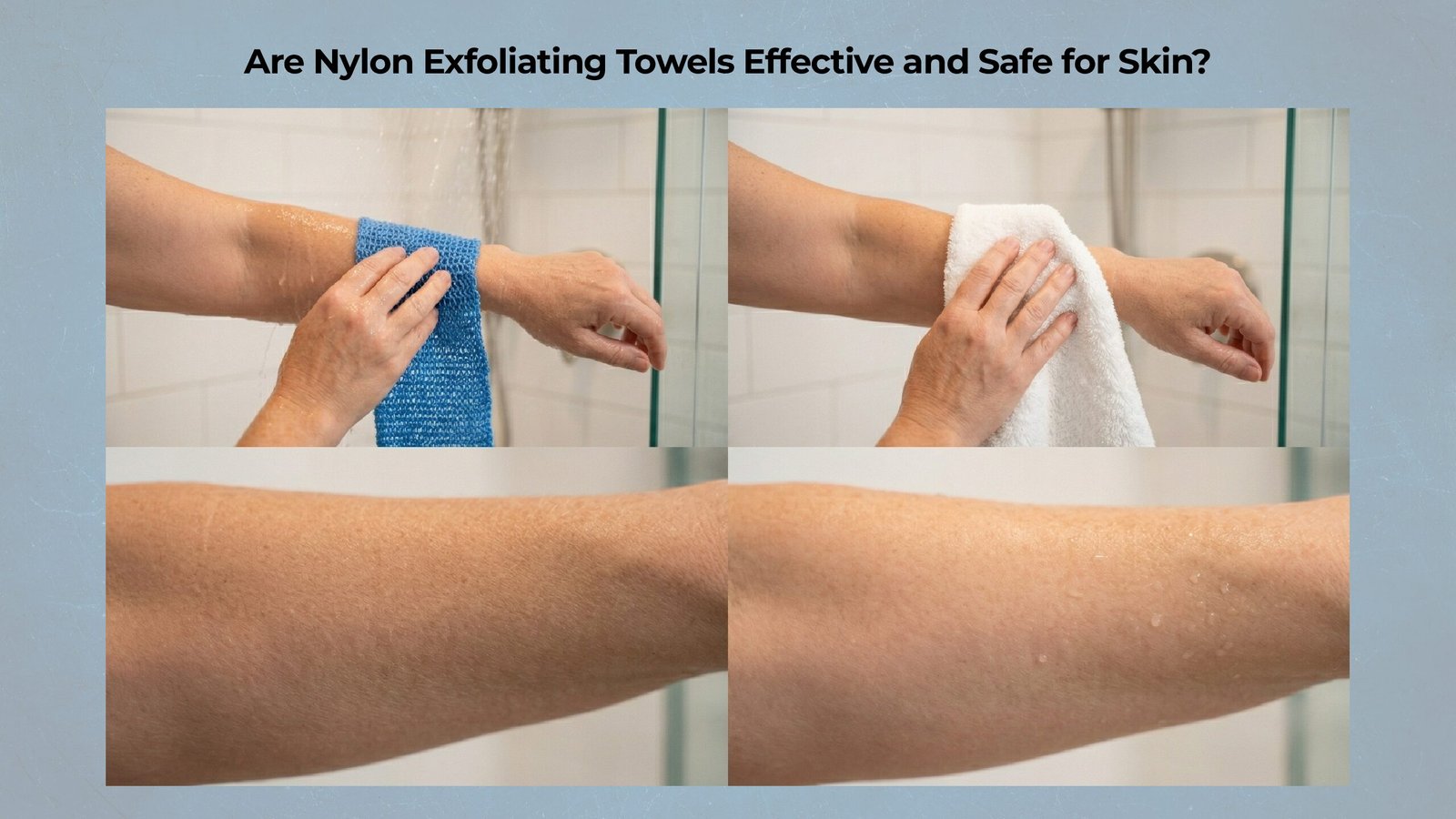
Architectural Blueprint for Mechanical Skin Surfacing
Nylon exfoliating towel effectiveness and safety depend on the mechanical relationship between high-friction monofilaments and the skin’s protective barrier, providing a tool that helps dislodge loosely attached surface cells. This “roughness” is not a material defect but a functional specification engineered for mechanical desquamation. By utilizing a high-friction grid, these towels manage to capture debris that softer cotton fibers simply slide over, making them a preferred choice for deep-cleansing protocols. Texture selection, however, remains the primary variable in determining whether this mechanical action enhances or compromises skin health.
Why Does Nylon Exfoliating Towel Effectiveness Matter for Skin Health?
Nylon exfoliating towel effectiveness and safety primarily dictate the rate of surface cell removal by providing the mechanical force necessary to dislodge loosely attached skin and prevent pore-clogging buildup. When executed correctly, this process supports the natural renewal cycle without inducing micro-tears in the epidermal layer. Furthermore, understanding cotton mildew prevention highlights why fast-drying synthetics are often preferred in humid shower environments.
Identifying the “Mechanical Desquamation” benefit of Nylon Exfoliating Towel Effectiveness
Nylon exfoliating towel effectiveness and safety facilitate mechanical desquamation by physically shearing away already shedding skin cells to reveal smoother epidermal layers. Mechanical Desquamation is defined as the process of using a physical object to accelerate the natural shedding of the outermost skin layer. The unique insight here is that the “rough” weave is precision-engineered to catch the edges of loose skin cells that standard soft towels typically bypass.
[Abrasive nylon weave] → [dislodges surface cells] → [accelerates the removal of shedding skin in nylon exfoliating towel effectiveness].
Does Nylon Exfoliating Towel Effectiveness Provide Circulation-Boosting Impacts?
Nylon exfoliating towel effectiveness and safety can cause a temporary increase in local blood flow during use because the mechanical stimulation against the skin triggers localized vasodilation. Vasodilation refers to the widening of blood vessels that creates a feeling of skin revitalization and an invigorated sensory result. While this creates a healthy “glow,” it is vital to understand that it is a transient sensory effect rather than a permanent change in skin physiology.
What Molecular Physics Define Nylon Exfoliating Towel Safety and Effectiveness?
Nylon exfoliating towel effectiveness and safety originate from the material physics of stiff monofilaments and textured knit patterns that maximize surface friction during contact. To compare rough synthetic textures against other material options, review our towel material guide. Unlike cotton, which collapses when wet, polyamide retains its structural integrity, ensuring that the “grit” remains consistent throughout the cleansing ritual.
Analyzing “Monofilament Friction” in Nylon Exfoliating Towel Safety
Nylon exfoliating towel effectiveness and safety rely on high levels of surface friction because single-strand nylon monofilaments are significantly stiffer than the multifilament bundles found in soft microfiber. In technical terms, the friction coefficient—measured under standards like ASTM D1894—is notably higher for nylon. These monofilaments lack the internal “give” of spun yarns, resulting in a “hard” tactile profile that maintains its shape even when fully saturated. Because our guide on polyester drying speed illustrates, synthetic fibers provide distinct advantages in both hygiene and physical performance.
Does Weave “Grit” Determine Nylon Exfoliating Towel Safety?
Nylon exfoliating towel effectiveness and safety result from weave “grit”—the specific geometry of loops and waves—which creates the physical peaks that provide scrubbing power without the need for heavy pressure. Roughness is often a result of “Air-Jet” texturing, which creates rigid contact points that act as a high-friction grid for surface debris.
Which Specific Techniques Maximize Nylon Exfoliating Towel Effectiveness While Maintaining Safety?
Nylon exfoliating towel effectiveness and safety reach their peak potential when users shift from high-pressure scrubbing to a monitored circular motion that protects the skin’s protective barrier. The goal is to let the textile’s engineering perform the work rather than relying on muscular force.
Executing the “Low-Pressure Circular Motion” for Nylon Exfoliating Towel Safety
Nylon exfoliating towel effectiveness and safety are maintained when users execute a low-pressure circular motion, allowing the nylon’s high friction coefficient to do the mechanical work. Users must avoid linear “sawing” motions with heavy force, as this drastically increases the risk of epidermal abrasion. While a mild, transient redness is normal, persistent irritation indicates that mechanical force has exceeded the skin’s threshold for safe friction.
Why the “Lather-First” Rule Optimizes Nylon Exfoliating Towel Safety
Nylon exfoliating towel effectiveness and safety remain optimized only when paired with high-slip surfactants that act as a lubricant for the abrasive loops. A thick lather creates a buffer that allows for effective desquamation while preventing the monofilaments from snagging the skin.
[High-slip soap lather] → [calibrates surface friction] → [secures the comfort of nylon exfoliating towel effectiveness and safety].
Who Should Avoid These Textiles for Nylon Exfoliating Towel Safety?
Nylon exfoliating towel effectiveness and safety protocols require the identification of fundamentally incompatible skin types to prevent the accidental disruption of compromised epidermal barriers.
Identifying Dermatological Contraindications for Nylon Exfoliating Towel Safety
Nylon exfoliating towel effectiveness and safety can be compromised in users with active eczema, psoriasis, roomsacea, or cystic acne, as mechanical friction may aggravate inflammation in these affected areas. For these conditions, the Stratum Corneum (the outermost skin layer) is too fragile for monofilament contact. High-risk users should opt for chemical exfoliants or specialized soft textiles instead.
Recognizing Situational Vulnerabilities for Nylon Exfoliating Towel Safety
Nylon exfoliating towel effectiveness and safety remain restricted during periods of extreme skin fragility, such as after a fresh sunburn, a chemical peel, or on open wounds. The “Repair First” rule mandates that the skin must be physically intact and non-inflamed before mechanical surfacing is reintroduced.
How to Select the Correct Grit to Optimize Nylon Exfoliating Towel Effectiveness?
Selecting the correct grit level for nylon exfoliating towel effectiveness and safety involves auditing monofilament density to match the specific sensitivity of different body zones. Use the Towel Finder tool to identify the best towel type for exfoliation, hygiene, and skin comfort tailored to your needs.
| Label / Tier | Texture Profile | Best Use-Case | Safety Rank |
|---|---|---|---|
| Soft / Gentle | Fine weave; light | Sensitive Skin / Beginners | 1 (Safest) |
| Normal / Standard | Balanced ridges | General Body / 2x Weekly | 2 |
| Hard / Rugged | Thick monofilaments | Feet / Elbows / Back | 3 (Aggressive) |
Identifying the “Body-Only” Limitation for Nylon Exfoliating Towel Safety
Nylon exfoliating towel effectiveness and safety typically remain restricted to “Body-Only” use because the high-grit weave may irritate delicate facial skin and delicate capillaries. Never use a body-grit towel on facial skin or the thin eye-area epidermis, as the risk of micro-tearing is significantly higher in these regions.
When Does Nylon Exfoliating Towel Effectiveness Compromise Skin Barrier Safety?
Nylon exfoliating towel effectiveness and safety can fail when users ignore signals of over-exfoliation or handle the material in a non-saturated state.
Recognizing the “Over-Exfoliation” Signals in Nylon Exfoliating Towel Safety
Identifying over-exfoliation from nylon exfoliating towel effectiveness and safety involves monitoring the skin for a “waxy” shine or a stinging sensation, signals that mechanical action has compromised the skin’s protective barrier. These symptoms indicate that mechanical force has exceeded the skin’s regenerative capacity. If these signs appear, a rest period of several days is mandatory.
Does “Dry-Handling” Increase the Risk to Nylon Exfoliating Towel Safety?
Nylon exfoliating towel effectiveness and safety decrease when the material is handled dry, as water and soap act as essential lubricants that make monofilaments feel less abrasive. The “Water-Softening” effect is purely mechanical: hydration increases the flexibility of the nylon polymer, making it less aggressive than in its dry state.
How Can You Restore “Sharpness” or Restore Nylon Exfoliating Towel Safety?
Restoring nylon exfoliating towel effectiveness and safety in towels that have become matted or less effective requires a chemical reset to dissolve mineral deposits and soap scum. Because abrasive synthetic tools need correct maintenance, check the Towel Care Diagnosis Engine for cleaning protocol guidance.
Does Mineral Stripping Restore the Texture of Nylon Exfoliating Towels?
Nylon exfoliating towel effectiveness and safety regain their original “spring” when a 1:4 vinegar-to-water soak dissolves the mineral “crust” that often develops in hard-water environments. It is recommended to perform a 30-minute soak once a month to prevent stiff, “stony” textures that can become overly abrasive.
How to Repair Frayed Monofilaments for Nylon Exfoliating Towel Safety?
Nylon exfoliating towel effectiveness and safety require immediate maintenance if monofilaments fray, as loose strands can act like stiff wires that cause micro-scratches. Use the Towel Failure Diagnostics tool to detect fraying, stiffness, or surface damage before the towel becomes too harsh on skin. Use sharp shears to cut loose threads flush with the weave (the “Snip-and-Seal” method) to prevent accidental injury during use.
How to Audit Your Routine with a Nylon Exfoliating Towel Safety Checklist?
Systematic technical audits of your usage habits verify that current protocols for nylon exfoliating towel effectiveness and safety align with skin safety limits. For lifespan planning, the Towel Lifespan Calculator helps estimate replacement timing accurately based on your usage frequency.
Common Questions: Nylon Exfoliating Towel Effectiveness and Safety
Final Summary: Does the Mechanical Profile of Nylon Exfoliating Towel Effectiveness Fit Your Goals?
Operationalizing a strategy for nylon exfoliating towel effectiveness and safety necessitates a technical commitment to precision that prioritizes long-term epidermal barrier health over immediate mechanical friction satisfaction. The trade-off between surface desquamation and barrier preservation requires constant monitoring of pressure, lubrication, and material integrity.
Ultimately, a superior exfoliation experience is defined by the precise nylon exfoliating towel effectiveness and safety management that turns a rugged mechanical tool into a safe, high-performance asset for skin health.