How Should Egyptian Cotton Towel Storage Be Managed?
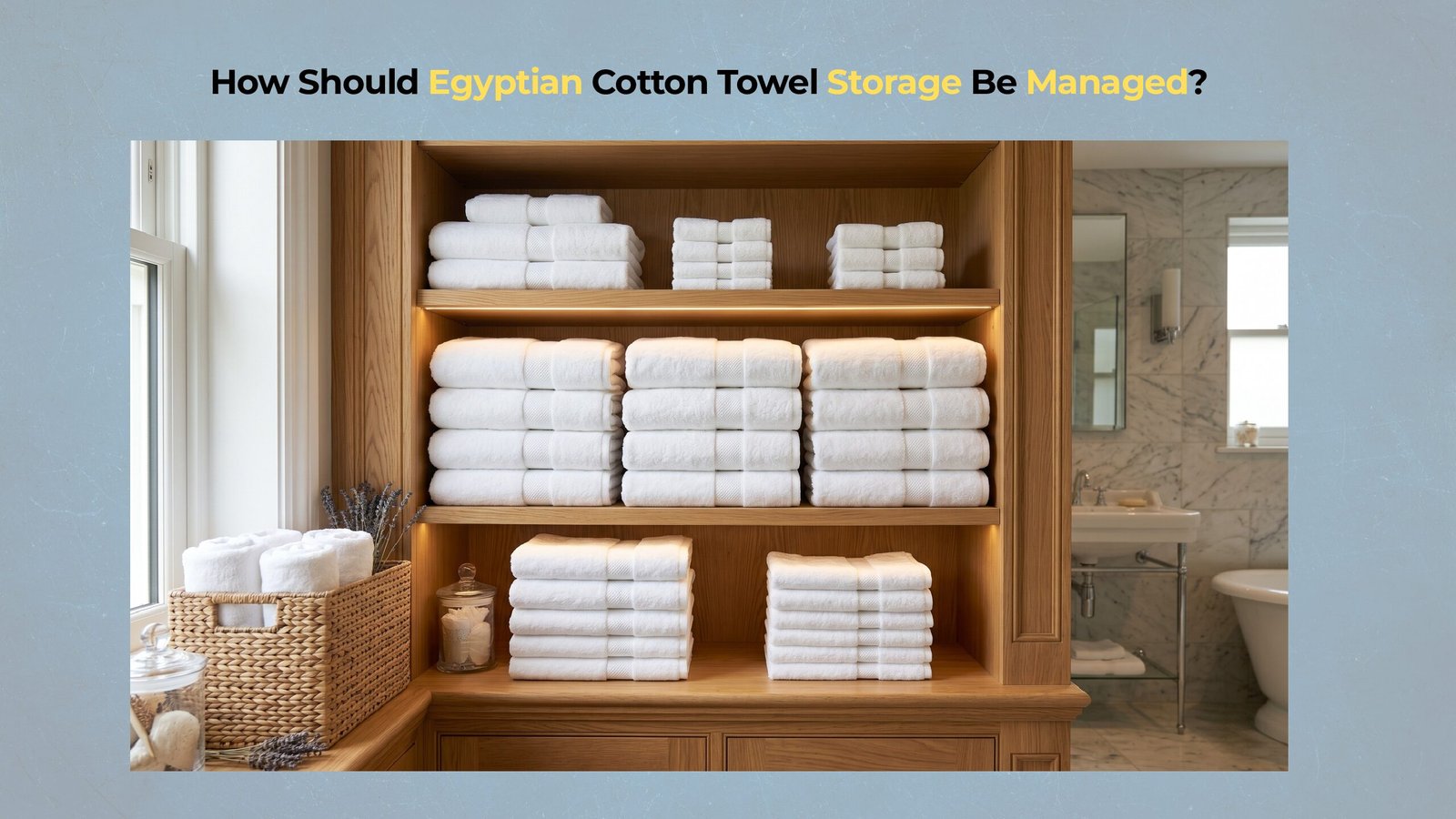
Egyptian cotton towel storage success results if the environment maintains a relative humidity below 60% and facilitates constant 360-degree ventilation.
Restricted airflow around high-density 800 GSM loops precipitates the accumulation of latent thermal energy within the fiber core. This stagnant microclimate inhibits the evaporation of residual vapor, effectively turning a storage shelf into a localized incubation zone for opportunistic microbes.
Strict adherence to ventilation protocols facilitates the preservation of the fiber resilience modulus in Giza 88 staples. Constant air exchange ensures that the Extra-Long Staple (ELS) structure avoids the structural softening associated with chronic moisture saturation.
How is Egyptian cotton towel storage optimized for moisture regain equilibrium?
Maximum freshness in Egyptian cotton towel storage results if moisture levels remain at or below the standard moisture regain point before transition to the shelf. This is especially critical for high-density towels, where density impacts absorbency and airflow limitations increase the risk of trapped vapor.
Trapped vapor in 900 GSM loops triggers bacterial colonization if the towel core fails to reach thermal equilibrium with a 72°F (22°C) environment. Before storage, towels must be fully dried using controlled heat, as low-heat drying is essential to prevent structural damage while maintaining softness.
Does moisture retention in Egyptian cotton towel storage precipitate bacterial growth?
Egyptian cotton towel storage failure correlates with bacterial growth if internal moisture levels exceed the equilibrium moisture regain threshold.
According to Cotton Incorporated: Technical Bulletin (2019), Giza linens demonstrate a critical saturation point when stored in environments exceeding 65% RH. The mechanism of Hygroscopic Moisture Sequestration occurs when the porous ELS core traps microscopic steam, facilitating microbial colonization.
Why does the microclimate impact Egyptian cotton towel storage odors?
Odorous degradation of Egyptian cotton towel storage initiates if ambient relative humidity surpasses the 60% threshold in the storage zone. If towels are stored incorrectly, long-term degradation accelerates, reducing their expected lifespan and overall value.
The absorption capacity of Giza 92 fibers exceeds that of standard short-staple cotton by approximately 20% due to increased surface area. Compared to faster-drying materials like microfiber towels, Egyptian cotton retains more moisture due to its dense loop structure, making proper storage even more critical.
Why does restricted airflow compromise Egyptian cotton towel storage quality?
Egyptian cotton towel storage quality decreases if stagnant air facilitates a measurable increase in moisture regain for stored ELS fibers.
The Textile Research Journal (2015) identifies a direct correlation between humidity and microbial proliferation. Atmospheric Vapor Absorption occurs when dense loops act as a sponge for unventilated steam, leading to irreversible odor entrapment.
Where is the optimal microclimate for Egyptian cotton towel storage?
Inhibition of mildew in Egyptian cotton towel storage results if users maintain adequate vertical airflow space between stacks and utilize open-wire shelving. Moisture buildup directly impacts odor formation, similar to issues seen in cotton mildew prevention.
Hallway closets outperform bathroom cabinets because they provide a lower differential vapor pressure. Similarly, fabrics like linen behave differently in storage due to their faster evaporation rates and lower moisture retention.
Does storage microclimate influence Egyptian cotton towel storage wicking?
Egyptian cotton towel storage wicking performance remains stable if the storage zone limits moisture absorption to a measurable range under 10%.
Per AATCC Test Method 197 (2018), Giza cotton stored at high humidity experiences Differential Vapor Pressure Absorption. This pulls moisture from the air, saturating the fibers before use and diminishing their absorbent performance during post-bath utility.
How does folding influence the Egyptian cotton towel storage resilience modulus?
Preservation of Egyptian cotton towel storage loft results if users avoid excessive stacking height to prevent mechanical loop compaction.
Weight-induced pressure on 800 GSM stacks facilitates a decrease in the fiber resilience modulus. This compaction reduces the air-trapping capacity of Giza 45 loops, resulting in a flat tactile experience that contradicts the inherent premium quality of ELS cotton.
Does cumulative compression in Egyptian cotton towel storage reduce tactile volume?
Egyptian cotton towel storage volume decreases if excessive stack weight induces measurable loss in loop height over extended intervals.
Textile Research Journal (2020) highlights the Cumulative Compression Set, where ELS fibers lose elastic recovery due to weight saturation. This reduces the functional GSM performance of the towel by collapsing the air gaps between Giza loops.
Which chemical hazards compromise Egyptian cotton towel storage results?
Deterioration of Egyptian cotton towel storage results if users utilize BHT-treated packaging materials or untreated wood shelving. Improper handling—similar to bleach-related fiber weakening—can permanently damage cellulose structure during sequestration.
The specific reaction between phenolic antioxidants and nitrogen oxides precipitates a yellow stain on Giza 45 fibers. Untreated wood facilitates the transfer of lignins and tannins, initiating acidic degradation of the cellulose polymer.
Does BHT-treated packaging trigger Egyptian cotton towel storage discoloration?
Egyptian cotton towel storage discoloration precipitates if phenolic antioxidants from packaging films induce a measurable increase in the Yellowness Index (YI).
Per AATCC Standards (2021), BHT Oxidative Discoloration results when chemical transfer from synthetic packaging reacts with atmospheric gases. This effectively stains ELS fibers, permanently altering the optical brightness of high-end white linens.
Frequently Asked Questions: Egyptian Cotton Towel Storage
Q1: Why do my towels smell musty even after washing?
This failure correlates with the lack of moisture regain equilibrium before storage. If high-GSM loops fail to reach room temperature and a dry state before folding, the porous core traps heat and residual vapor, triggering anaerobic microbial activity.
Q2: Can I store Egyptian cotton in plastic storage bins?
Storage failure precipitates if bins contain BHT-treated plastic. These antioxidants migrate to the ELS fibers and react with nitrogen oxides, causing irreversible phenolic yellowing. Always prioritize ventilated, fabric-based organizers.
Q3: Is wire shelving better than solid wood?
Open-wire shelving facilitates 360-degree ventilation, whereas raw wood precipitates cellulose degradation via lignin transfer. Wire shelving ensures the relative humidity equilibrium remains stable across the entire stack height.
Q4: How many towels can I stack before they lose their loft?
Preservation of loft succeeds if users limit stacks to 3-4 units. Exceeding this weight induces a mechanical compression set, where Giza fiber loops lose their elastic recovery modulus and become permanently flattened.
Which checklist validates the success of your Egyptian cotton towel storage?
Egyptian cotton towel storage validation succeeds if a definitive care audit confirms the maintenance of <60% relative humidity and moisture regain equilibrium. Proper storage directly impacts cost efficiency, as poor practices reduce the price-to-value ratio of luxury linens by shortening their usable lifespan.
Final Storage Audit Checklist
- ☐ Achievement of moisture regain equilibrium results if Giza 88 towels reach room temperature before folding.
- ☐ Prevention of fiber compaction results if users avoid excessive stacking height.
- ☐ Inhibition of phenolic yellowing results if shelves exclude BHT-treated packaging materials.
- ☐ Elimination of mildew risk occurs if storage relative humidity remains below 60%.
- ☐ Preservation of loop loft initiates if adequate vertical airflow space exists between stacks.
Technical Disclaimer
The protocols and environmental thresholds presented in this guide result from textile engineering research and are provided for educational purposes. Variations in local climatic conditions, specific textile GSM (Grams per Square Meter), and chemical composition of cleaning agents precipitates individual variances in storage outcomes. Toweldaily.com does not accept liability for fiber degradation or discoloration resulting from the misapplication of these environmental standards.
© Toweldaily.com | Unraveling the Science and Art of Towels, Daily.