How Can White Vinegar Mitigate Egyptian Cotton Towel Mineral Buildup?
Material Science & Domestic Engineering
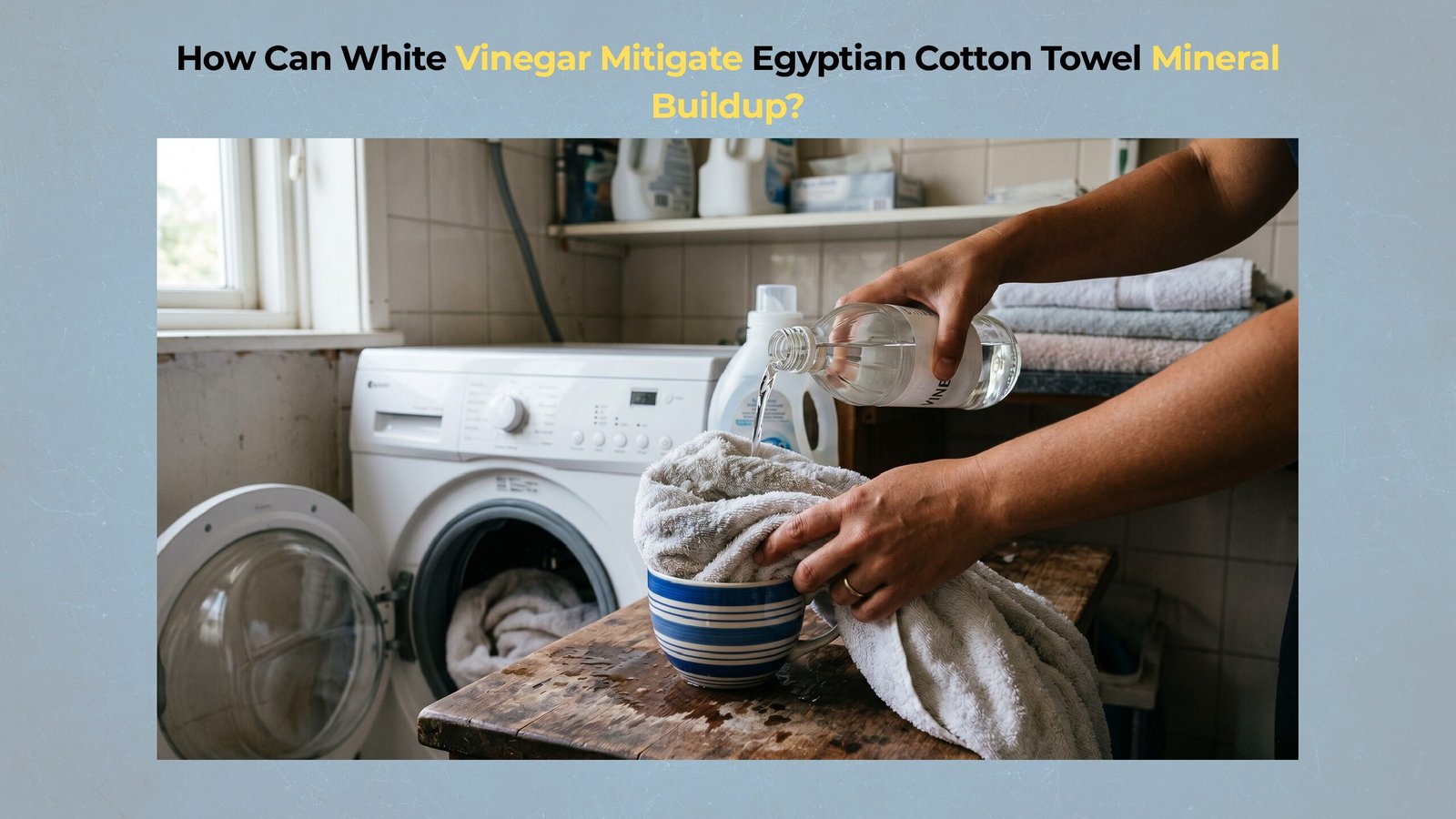
Egyptian cotton towel mineral buildup dissolves if users implement a periodic white vinegar rinse to neutralize and displace calcium and magnesium carbonates.
The chemical introduction of acetic acid (CH₃COOH) initiates a displacement reaction that breaks the bond between alkaline earth metal carbonates and the cellulosic surface of Extra-Long Staple (ELS) fibers. This reaction facilitates the removal of the microscopic “stiffness shell” that inhibits natural yarn flexibility in Giza-grade linens.
Material life-extension results from the successful purging of these deposits, which otherwise act as abrasives against the delicate Giza 45 or 88 staples. Preserving the 600–900 GSM density requires this specific decalcification to maintain the towel’s return on investment (ROI) and intended luxury tactile profile.
Why do hard water ions trigger Egyptian cotton towel mineral buildup?
Egyptian cotton towel mineral buildup precipitates if hard water ions crystallize between the porous ELS fibers.
In hard water environments, calcium and magnesium cations possess a high affinity for the hydroxyl groups found on cotton fibers. To fully understand why this process matters, it’s useful to explore how Egyptian cotton absorbency works at the fiber level, since mineral buildup directly blocks these pathways.
The loss of moisture pathway efficiency follows this crystallization, as the mineral deposits bridge the gaps between the terry loops. This mechanical obstruction prevents the towel from exhibiting its characteristic “wicking” performance, transforming a soft Giza textile into a hydrophobic, sandpaper-like surface.
Technical Term: Cellulose Structural Stability – The inherent resistance of the cotton polymer chain to degradation, which remains intact during acetic acid treatments while the external mineral crust dissolves.
Does high GSM correlate with the severity of Egyptian cotton towel mineral buildup?
Egyptian cotton towel mineral buildup correlates with increased severity if the textile GSM (Grams per Square Meter) exceeds 600.
Dense luxury linens provide a larger total surface area and deeper interstitial spaces for mineral entrapment compared to standard towels. If you’re wondering how density influences this issue, see how GSM affects absorbency and plushness in Egyptian cotton towels.
How does white vinegar dissolve Egyptian cotton towel mineral buildup?
Egyptian cotton towel mineral buildup dissolves if the low pH of white vinegar converts insoluble alkaline deposits into water-soluble acetates.
The displacement of mineral salts occurs when the hydrogen ions in acetic acid react with calcium carbonate. This ties closely to how heavyweight Egyptian cotton impacts water absorption performance.
Restoration of effective moisture pathways is the immediate byproduct of this chemical flush. By clearing the “pore blockages” within the cotton yarn, white vinegar restores the capillary action required for the towel to absorb water upon contact with the skin.
Technical Term: Micelle Entrapment – The process where detergent molecules surround mineral particulates; white vinegar disrupts these structures to release the trapped minerals.
Mineral Dissolution Comparison Matrix
| Agent | Target Entity | Chemical Outcome | Fiber Impact |
|---|---|---|---|
| White Vinegar | Calcium Carbonate | Soluble Acetate Conversion | Restores Flexibility |
| Standard Detergent | Organic Soil | Surfactant Encapsulation | Increases Buildup (w/ Hard Water) |
| Fabric Softener | Fiber Surface | Hydrophobic Coating | Decreases Absorbency |
If you’re comparing performance across materials, you may also want to examine how Tencel absorbency compares to cotton under moisture load.
How do you remove Egyptian cotton towel mineral buildup through a stripping protocol?
Egyptian cotton towel mineral buildup clears if users execute a three-step stripping wash using a standardized household white vinegar concentration (~5% acidity).
Vinegar Wash
1 Cup @ 105°F
Extra Rinse
Flush Acetates
Low-Heat Dry
< 120°F
The application of moderately warm water (~105°F) improves mineral dissolution efficiency by increasing the kinetic energy of the acetic acid molecules. High temperatures exceeding 140°F must be avoided, as extreme heat can “set” certain mineral-detergent complexes into a permanent crystalline state.
An extra rinse cycle is mandatory to ensure the complete purging of the liberated acetates. Without this secondary flush, the dissolved minerals can redeposit onto the fibers as the water cools, negating the effects of the stripping protocol.
Technical Term: Saponification – The breakdown of body oils that often bind minerals to the fibers.
How does heat damage differ from Egyptian cotton towel mineral buildup?
Egyptian cotton towel mineral buildup manifests if tactile performance tests distinguish between reversible calcification and permanent thermal degradation.
Tactile improvements following a vinegar soak indicate that the stiffness originated from mineral accumulation. This is similar to how high heat damages Egyptian cotton fibers and reduces longevity.
Diagnostic verification relies on the “Wick Test.” A mineral-laden towel exhibits a “beading” effect where water sits on the surface. In such cases, reviewing how long Egyptian cotton towels typically last under proper care can help determine whether replacement is necessary.
Technical Term: Hydrophobic Surfactant Film – A waxy layer created by fabric softeners and minerals that repels moisture.
Does internal moisture regain decrease if Egyptian cotton towel mineral buildup remains unmitigated?
Egyptian cotton towel mineral buildup requires intervention if internal moisture regain exhibits a measurable decline under controlled conditions.
Data from the Textile Research Journal: Organic Acid Performance (2014) indicates that acetic acid treatments result in a particulate reduction range of 20–35% in heavily calcified cotton samples.
Which habits accelerate Egyptian cotton towel mineral buildup?
Egyptian cotton towel mineral buildup accelerates if users combine high detergent volumes with hard water wash cycles.
Insoluble soap scum formation results when surplus detergent molecules bind with calcium ions. Over time, this directly contributes to detergent residue stiffness in Egyptian cotton towels, compounding the mineral buildup problem.
The mineral “heat-setting” process occurs when towels are transferred directly from a hard-water wash to a high-heat dryer cycle.
Technical Term: Cationic Bridging – Positive ions acting as a bridge between the negatively charged cotton fiber and detergent residue.
FAQ: Managing Egyptian Cotton Towel Mineral Buildup
Does white vinegar damage Giza-grade cotton fibers?
Egyptian cotton towel mineral buildup removal via white vinegar preserves fiber integrity because the standard household acidity (~5%) remains too weak to initiate cellulosic chain scission.
Is apple cider vinegar suitable for decalcification?
Egyptian cotton towel mineral buildup mitigation utilizes distilled white vinegar to prevent the permanent organic staining associated with the high tannin content found in apple cider vinegar variants.
How frequently must the stripping protocol occur?
Egyptian cotton towel mineral buildup prevention requires a bi-annual restoration cycle unless water hardness testing reveals concentrations exceeding 150 PPM (Parts Per Million).
Does vinegar neutralize laundry odors?
Egyptian cotton towel mineral buildup often provides a matrix for odor-causing bacteria; white vinegar functions as a natural antimicrobial agent that neutralizes volatile organic compounds (VOCs) trapped within the fibers.
Which checklist validates the removal of Egyptian cotton towel mineral buildup?
Egyptian cotton towel mineral buildup removal is confirmed if a definitive care audit verifies strict protocol adherence.
The restoration of moisture pathways is verified when the textile absorbs water in under 3 seconds (AATCC Test Method 197).
Final Mineral Removal Audit Checklist
- ☐ Egyptian cotton towel mineral buildup decalcification occurs if standardized household white vinegar serves as the agent.
- ☐ Prevention of new soap scum results if the detergent dispenser remains empty.
- ☐ Purging of loosened mineral particulates occurs if the ‘Extra Rinse’ setting is active.
- ☐ Maintenance of fiber flexibility results if dryer heat remains below 120°F.
- ☐ Sustained hydrophilic performance occurs if this protocol is executed bi-annually.
Reference: AATCC Test Method 197 (2018).
Technical Term: Hygroscopic Equilibrium – The state where the cotton fiber has reached a stable moisture content relative to humidity.
Technical Disclaimer
Egyptian cotton towel mineral buildup remediation involves household chemical agents. Users implement these protocols at their own discretion. Toweldaily.com assumes no liability for damage resulting from improper execution or deviation from manufacturer care labels. Always test a small inconspicuous area before full implementation.