Should Egyptian Cotton Towels be washed in warm water?
Textile Maintenance Protocol | Thermal Engineering Standards
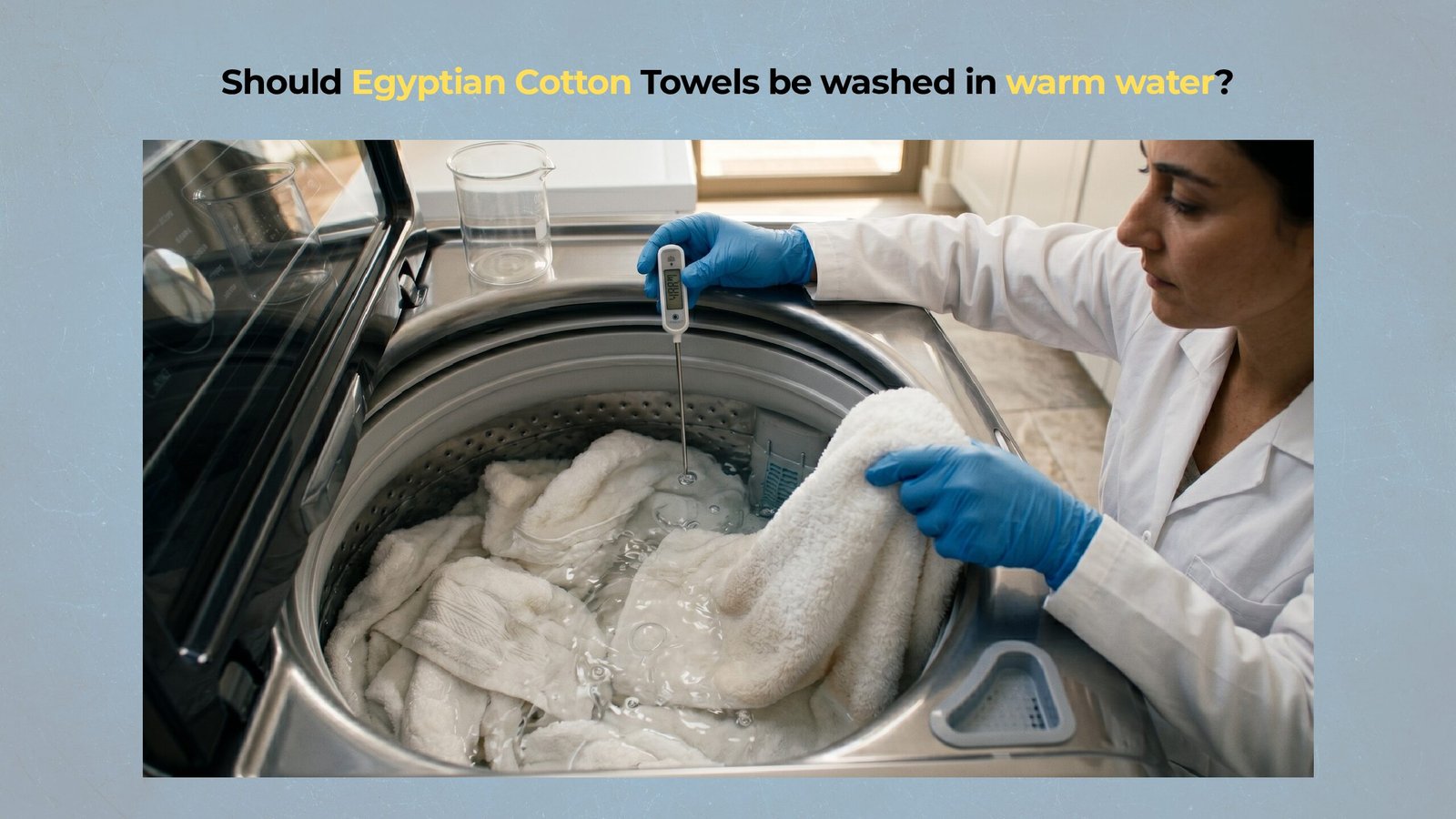
Yes, warm water (~30–40°C) is the ideal Egyptian cotton towel wash temperature for balancing the emulsification of body oils with the preservation of Extra-Long Staple (ELS) fiber integrity.
Establishing this specific thermal range ensures that the laundering cycle achieves effective cleaning without compromising the material science of Giza cotton. This balance optimizes the long-term utility of the textile by mitigating the chemical and mechanical stresses inherent in high-heat domestic wash cycles.
Extra-Long Staple (ELS) fiber integrity remains the primary determinant of the towel’s high surface fiber density. This integrity allows the cellulose structure to withstand repeated agitation while maintaining the hydrophilic capacity required for efficient moisture absorption.
How does Egyptian cotton towel wash temperature affect fiber structure?
The Egyptian cotton towel wash temperature affects fiber structure because repeated high-temperature washing accelerates fiber degradation while mechanical stress serves as the primary cause of wear.
Warm water is usually recommended because it balances soil removal with fiber preservation. To understand why Egyptian cotton responds differently than standard cotton, it is useful to explore how extra-long staple Egyptian cotton fibers improve durability and long-term towel performance.
Fiber degradation occurs as cumulative thermal stress weakens the molecular bonds within the cellulose chains. This weakening reduces the tensile strength of the individual loops, eventually leading to thinning and reduced hygroscopy.
Mechanical agitation during the spin cycle compounds this thermal damage by physically stripping away weakened micro-fibrils. This loss of material results in a noticeable decrease in tactile smoothness and overall material density.
Technical Definition: Fiber Relaxation Shrinkage
Fiber relaxation shrinkage is the physical process where fibers, previously stretched during textile manufacturing, return to their natural, shortened state when exposed to thermal energy and moisture.
How does cumulative thermal stress influence Egyptian cotton towel wash temperature?
Egyptian cotton towel wash temperature directly influences fiber longevity, as temperatures consistently exceeding 60°C (140°F) often lead to increased stiffness when combined with mineral residue or overdrying.
If your towels already feel rough, stiff, or less absorbent after repeated washing, the next logical step is diagnosing the cause with a towel softness loss troubleshooting template for residue, heat, and wear issues.
Increased stiffness impairs the hydrophilic capacity of the terry loops by flattening the fiber structure. This structural collapse prevents water from entering the interstitial gaps of the weave, effectively rendering the towel less absorbent over time.
Why is warm water the most effective default Egyptian cotton towel wash temperature?
Warm water (~30–40°C) is the most effective default Egyptian cotton towel wash temperature because it facilitates the emulsification of body oils and sebum without degrading the ELS fibers.
Emulsification of body oils and sebum requires a thermal threshold that liquefies these lipid-based soils. When temperatures fall below 30°C, detergents often fail to fully suspend these contaminants, leading to a graying effect on the fabric surface.
If your goal is preserving softness while still cleaning effectively, water temperature should be considered alongside towel quality and finishing standards. For broader buying guidance, you may want to explore how towel quality influences softness, durability, and long-term care results.
Cold water laundering frequently leaves behind microscopic residue that traps bacteria and odors within the dense weave of Egyptian cotton. In contrast, the ~30–40°C range provides sufficient energy for chemical surfactants to bond with soils and lift them from the hydrophilic fibers.
Technical Definition: Sebum Emulsification
Sebum emulsification is the chemical process of breaking down natural skin oils into smaller droplets that can be suspended in water and rinsed away by surfactants.
How should you adjust Egyptian cotton towel wash temperature based on fabric colors?
Adjusting the Egyptian cotton towel wash temperature based on fabric colors ensures that thermal settings maximize soil removal for whites while protecting the dye stability of darker textiles.
If you want to compare Egyptian cotton against other towel materials before replacing older towels, you can use a towel finder tool to match materials, care needs, and performance preferences.
Dye stability is highly sensitive to thermal fluctuations, particularly in the deep saturation found in Giza cotton products. Darker towels should be maintained strictly at the 30°C threshold to prevent the leaching of pigments.
Dye migration occurs when excessive heat releases pigment particles into the wash liquor, which may then redeposit on lighter items. For bright whites, a slightly higher temperature of 40-50°C may be utilized to activate oxygen-based bleaches effectively.
Technical Definition: Dye Migration
Dye migration is the undesired movement of pigment from a colored textile into the laundering solution, typically caused by thermal stress or improper pH levels.
Thermal Selection Matrix (By Color)
| Towel Color/Type | Recommended Temp | Rationale |
|---|---|---|
| Optical Whites | 40°C – 50°C | Activates brighteners and maximizes soil suspension. |
| Light Pastels | 30°C – 40°C | Balances sanitation with pigment preservation. |
| Deep/Dark Tones | 30°C (Max) | Prevents dye migration and fading of ELS fibers. |
| Giza 45 Speciality | 30°C | Protects ultra-fine cellulose structural integrity. |
How can you optimize cycles to maintain a consistent Egyptian cotton towel wash temperature?
Optimizing washing cycles to maintain a consistent Egyptian cotton towel wash temperature involves selecting ‘Normal’ settings and utilizing a cool rinse to facilitate residue removal and prevent redeposition.
Warm washes can improve oil and residue removal, but moisture retention after laundering also depends on how well the towel absorbs and releases water. Because of that next-step concern, it is helpful to understand what determines towel absorbency and how washing habits affect performance over time.
Residue removal is critical for maintaining the tactile smoothness of the towel. If detergents are not fully rinsed at the end of the warm cycle, they can dry into a waxy film that reduces the material’s hygroscopic properties.
Detergent dissolution happens most effectively in the initial warm phase. Transitioning to a cool rinse helps “shock” the fibers into a more compact state, which aids in the expulsion of mineral-heavy water during the final spin.
Technical Definition: Residue Redeposition
Residue redeposition refers to the process where soil or detergent previously lifted from the fabric is deposited back onto the fibers due to insufficient rinse energy or over-crowding.
Which thermal errors degrade Egyptian cotton towel wash temperature results?
Specific thermal errors degrade Egyptian cotton towel wash temperature results, primarily through accelerated fiber wear caused by ‘Sanitize’ settings or fluctuating heater outputs.
After the wash cycle, drying method becomes just as important as wash temperature. If towels stay damp too long or are overdried, performance can decline, so it helps to review how quick-dry performance affects towel freshness, drying speed, and daily usability.
Accelerated fiber wear is the direct consequence of exceeding the 60°C threshold. While high heat provides sanitation, it simultaneously compromises the cellulose structural integrity of the ELS fibers.
Gradual cellulose degradation transforms a supple towel into a brittle, abrasive textile. This process is irreversible, as the heat permanently alters the crystalline structure of the cotton fibers, reducing their ability to flex and absorb.
Technical Definition: Gradual Cellulose Degradation
Gradual cellulose degradation is the slow breakdown of the polymer chains that make up cotton fibers, usually resulting from repeated chemical or thermal stress.
Thermal Error vs. Impact Analysis
| Thermal Error | Resulting Impact | Fiber Effect |
|---|---|---|
| Sanitize Cycle (90°C+) | Severe Stiffness | Complete cellulose structural collapse. |
| Constant Cold Wash | Odor Retention | Incomplete sebum emulsification. |
| Fluctuating Temps | Uneven Shrinkage | Irregular fiber relaxation shrinkage. |
| High Heat Drying | Frayed Borders | Differential shrinkage of the base weave. |
Which checklist verifies the correct Egyptian cotton towel wash temperature?
The following checklist verifies the correct Egyptian cotton towel wash temperature to ensure that all thermal and color-sorting protocols align for maximum fiber protection.
All thermal and color-sorting protocols must be cross-referenced with the machine’s actual output to prevent accidental heat spikes. Regular calibration of the domestic heater ensures that the intended 30–40°C range is accurately maintained across all cycles.
Final Thermal Audit Checklist
☐ Confirm wash water does not exceed 40°C for mixed color loads.
☐ Verify that ‘Sanitize’ or ‘Extra Hot’ settings are bypassed for daily care.
☐ Ensure darker ELS textiles are separated and washed at 30°C.
☐ Check that detergent is formulated for performance in warm water ranges.
☐ Align the rinse cycle to a cool/cold setting to prevent residue redeposition.
☐ Inspect terry loops for signs of gradual cellulose degradation after every 20 cycles.
☐ Calibrate the dryer to ‘Medium’ heat to match the wash-phase thermal logic.
Which frequently asked questions clarify Egyptian cotton towel wash temperature concerns?
Frequently asked questions clarify Egyptian cotton towel wash temperature concerns by addressing common laundering myths and reinforcing material science principles for ELS fibers.
Proper laundering is not only about heat settings but also detergent use, rinse quality, and drying choices. To build a complete maintenance routine, it is useful to review what care instructions should be followed to preserve towel softness and longevity.
While cold water prevents shrinkage, it lacks the kinetic energy required to emulsify sebum and body oils. Without warm water (~30°C+), these lipid soils remain trapped in the ELS weave, leading to bacterial growth and persistent odors.
Minimal fiber relaxation shrinkage occurs at 30-40°C, which is considered a natural structural reset for the weave. Permanent, destructive shrinkage only occurs when fibers are exposed to temperatures exceeding 60°C or subjected to high-heat drying cycles.
Occasional 60°C washes are acceptable for heavy sanitation or whitening optical whites. However, frequent use of high heat results in cumulative cellulose degradation, making the towel brittle and significantly reducing its hygroscopic capacity over time.
Scratchiness is usually caused by detergent residue or mineral redeposition rather than the temperature itself. Utilizing a cool rinse and avoiding fabric softeners ensures the fiber loops remain open and soft following a warm wash phase.