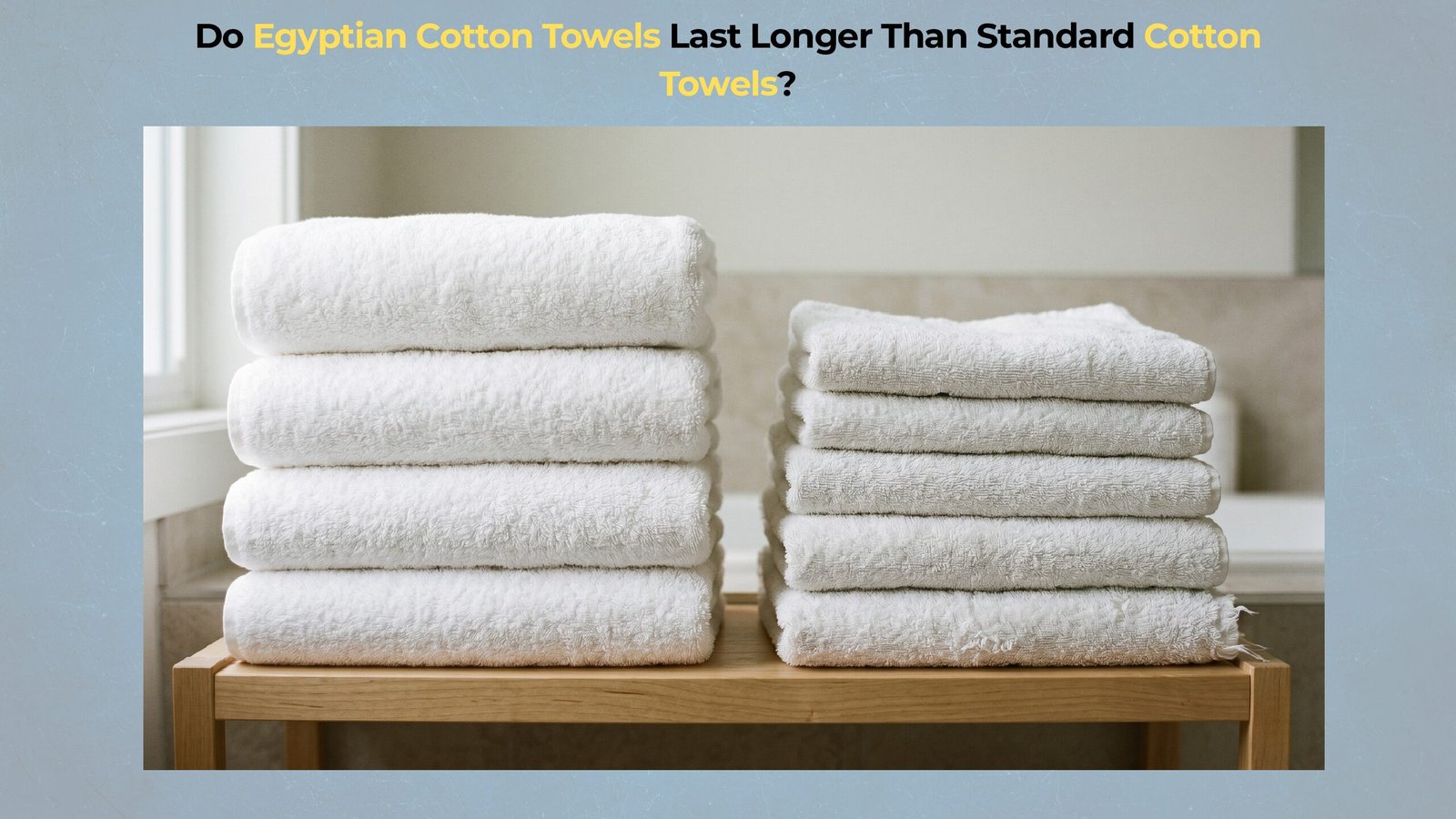
Do Egyptian Cotton Towels Last Longer Than Standard Cotton Towels?
Yes, Egyptian cotton towels generally provide superior longevity compared to standard varieties due to the high tensile strength of Extra-Long Staple (ELS) fibers and a significantly slower rate of tensile degradation over repeated wash cycles.
This extended utility cycle is functionally linked to the physical integrity of Giza-variety cotton, where increased fiber length minimizes the number of weak points in the yarn structure. Consequently, the resulting textile maintains its structural density and absorbency retention long after shorter fibers have suffered mechanical failure during high-friction laundering.
Assess why Egyptian cotton towel wear resistance makes them a superior investment
Assessing Egyptian cotton towel wear resistance reveals a superior investment model where the high initial capital outlay is offset by an extended utility cycle that outlasts standard cotton. Cite Cotton Incorporated research regarding the “wash-cycle durability” differences between ELS and upland cotton varieties shows that the high breaking force of Giza cotton prevents the premature thinning of the base weave.
Durability plays a central role in extending the usable life of the towel and reducing replacement frequency. Since this directly impacts performance over time, you may want to explore how towel durability behaves under repeated use and washing cycles.
This extended utility cycle reduces the necessity for frequent replacements, lowering the net economic impact of the purchase. Standard cotton towels typically reach a point of “non-functional thinness” twice as fast as ELS alternatives, making the cost-per-wash calculation favor the higher-density weave and material density found in Egyptian varieties.
“Consider the purchase of an ELS textile as buying a quality tool; it is designed for a functional purpose that serves a functional purpose for several years rather than months.”
How does the wash-cycle durability determine Egyptian cotton towel longevity?
Egyptian cotton towel longevity is anchored in a higher wash-cycle durability threshold, allowing the textile to withstand significantly more laundering events than standard cotton before exhibiting structural failure. The relationship between yarn density and “fray resistance” acts as a core durability factor, protecting the perimeter of the towel from edge-shredding.
If you notice early signs of thinning, stiffness, or reduced performance, it is helpful to follow a guide to identifying and preventing premature towel degradation.
Wash-cycle durability reduces the rate of loop breakage, which in turn limits replacement frequency. Instead of focusing on temporary “plushness,” material science prioritizes performance retention or textile integrity, ensuring that the capillary action of the fibers remains efficient after 50 or more industrial-grade washes.
Identify the fiber stability factors that sustain Egyptian cotton towel longevity
Specific fiber stability factors sustain Egyptian cotton towel longevity, primarily the use of Extra-Long Staple (ELS) fibers that result in reduced yarn hairiness and fewer exposed fiber ends. Reduced yarn hairiness is defined as a textile metric where fewer individual fiber tips protrude from the yarn surface, minimizing the friction that leads to pilling.
The superior longevity of Egyptian cotton towels is primarily driven by the structural integrity of extra-long staple fibers, which reduce breakage during repeated wash cycles. To understand this foundation, it is useful to explore how extra-long staple Egyptian cotton fibers improve durability and performance.
The Textile Research Journal notes how fiber length correlates with reduced yarn hairiness (lower fiber protrusion); hence, the 35mm+ length of Giza fibers prevents the “snapping” threshold seen in carded short-staple cotton versus combed Egyptian varieties. This stability involves lumen expansion, where the inner hollow canal of the cotton fiber allows for high moisture absorption (hygroscopy) without compromising the outer cell wall strength.
For a deeper understanding of these structural mechanics, refer to our comprehensive Guide to Cotton Fiber Engineering.
Compare Egyptian cotton towel performance retention against standard cotton
Comparing Egyptian cotton towel performance retention against standard cotton demonstrates that long-staple varieties maintain better absorbency retention due to structural integrity after 100+ laundry cycles. While standard weaves thin out as short fibers detach and collect in dryer lint traps, ELS loops expand without losing their bond to the base weave.
Maintaining absorbency over long periods is another key indicator of performance retention in high-quality cotton towels. To connect this with real-world usability, it is useful to review how absorbency works in cotton towels and how it affects long-term performance.
Material Durability Comparison Matrix for Egyptian Cotton Towel Longevity
| Usage Milestone | Standard Cotton Towels | Egyptian Cotton Towels | Longevity Impact |
|---|---|---|---|
| Early Wash Cycles | Visible pilling / loss of smoothness | Finishing agents removed; loops expand | Initial Activation |
| 75 Washes | Significant thinning of the weave | Maintains high surface fiber density | Performance Peak |
| 150+ Washes | Non-absorbent / frayed perimeters | Loops remain intact; minimal pilling | Sustained ROI |
Implement care protocols to maximize Egyptian cotton towel lifecycle durability
Implementing specific care protocols is essential to maximizing Egyptian cotton towel lifecycle durability and preventing the premature thermal degradation of cellulose. Cite AATCC or Cotton Incorporated laundry science to explain how chemical softeners build up a hydrophobic coating that causes performance degradation by blocking the hygroscopic properties of the fiber.
From a practical standpoint, proper care routines are essential for preserving fiber integrity and preventing premature wear. To connect this with everyday use, it is useful to review what care instructions should be followed to maintain towel performance and longevity.
Proper care protects structural integrity through methods like the “Vinegar Strip”—a restorative protocol for mineral-induced stiffness where acetic acid dissolves alkaline residues, effectively extending the functional lifespan of the towel.
Avoid habits that compromise Egyptian cotton towel longevity and texture
Avoiding specific laundering habits is critical to maintaining Egyptian cotton towel longevity, as high-heat environments can cause fibers to become brittle and snap. Sodium Hypochlorite (bleach) is particularly detrimental, as it oxidizes the molecular bonds of the long-staple cotton, leading to accelerated tensile failure.
Drying conditions also influence how quickly fibers degrade, especially when exposed to excessive heat. Because this directly impacts lifespan, it is helpful to understand how drying speed and conditions affect towel performance and durability.
Proof Asset: Longevity Hazards Table for Egyptian Cotton Towel Longevity
| Harmful Habit | Impact on Egyptian Cotton | Corrective Action |
|---|---|---|
| Sodium Hypochlorite (Bleach) | Weakens long-staple molecular bonds | Use oxygen-based, color-safe cleaners |
| Drum Overloading | Increases mechanical friction and snagging | Process in half-loads for airflow |
| Direct Out-of-Box Use | Finishing residues block absorbency | Wash twice to improve loop hydration |
Verify Egyptian cotton towel longevity before buying with this checklist
Verifying Egyptian cotton towel longevity before purchase requires an audit of the yarn type and construction methods to ensure the product meets Giza or ELS standards. While a high Grams per Square Meter (GSM) of 600–900 is associated with higher density, it must be paired with ring-spun construction to ensure the fibers do not shed excessively.
To estimate how long your towels should last based on usage frequency and care conditions, you can use a towel lifespan calculator to evaluate expected lifespan and replacement cycles.
Final Longevity Verification Checklist for Egyptian Cotton Towel Longevity
- ☐ Is the textile explicitly labeled as “Extra-Long Staple” (ELS)?
- ☐ Are the perimeters double-turned and reinforced with piping?
- ☐ Does the density (GSM) fall within the high-performance range for bath towels (600–900)?
- ☐ Does the product carry OEKO-TEX certification for fiber purity?
- ☐ Is the yarn verified as “Ring-Spun” or “Combed” to minimize breakage?
FAQ for Egyptian Cotton Towel Longevity
How does Extra-Long Staple (ELS) fiber specifically extend the towel’s life?
ELS fibers are significantly longer than standard cotton staples, which means fewer individual fibers are needed to spin a single yarn. This results in fewer splice points and exposed ends, which are the primary locations where fraying and structural failure begin during high-agitation wash cycles.
Will high-heat drying significantly shorten the functional lifespan?
Yes. High thermal environments cause the cellulose in the cotton fibers to undergo thermal degradation. This makes the loops brittle and prone to snapping, eventually leading to a loss of surface density and absorbency retention. Air drying or low-heat cycles are recommended for maximum lifecycle durability.
Is it true that Egyptian cotton towels get better with age?
Functionally, yes. In the early wash cycles, finishing agents are stripped away, and the ELS loops begin to expand or “bloom.” While standard cotton begins to thin at this stage, Egyptian cotton maintains its structural density, often feeling more absorbent and peak-performing after 15-20 washes.
How often should the ‘Vinegar Strip’ protocol be implemented?
The ‘Vinegar Strip’ is a restorative care protocol that should be used as needed—typically every 3 to 6 months—to dissolve alkaline mineral buildup and detergent residues. Implementing this habit prevents the “waxy” feel caused by softeners and protects the fiber’s natural hygroscopy.
Does the ‘Ring-Spun’ label guarantee higher durability?
Ring-spinning is a superior yarn-making process that continuously twists and thins the fiber strands. When paired with combed ELS cotton, it significantly reduces yarn hairiness, leading to a much higher wear resistance compared to carded or open-end spun yarns found in standard budget textiles.
Disclaimer: The technical analysis and material science findings presented in this report are based on standardized industry testing protocols (AATCC/Cotton Incorporated) and general textile engineering principles. Individual results regarding towel longevity and functional lifespan may vary significantly based on specific brand manufacturing variables, local water mineral content, and adherence to recommended laundering care protocols. This document is intended for educational purposes and should not be considered a financial guarantee of product utility.