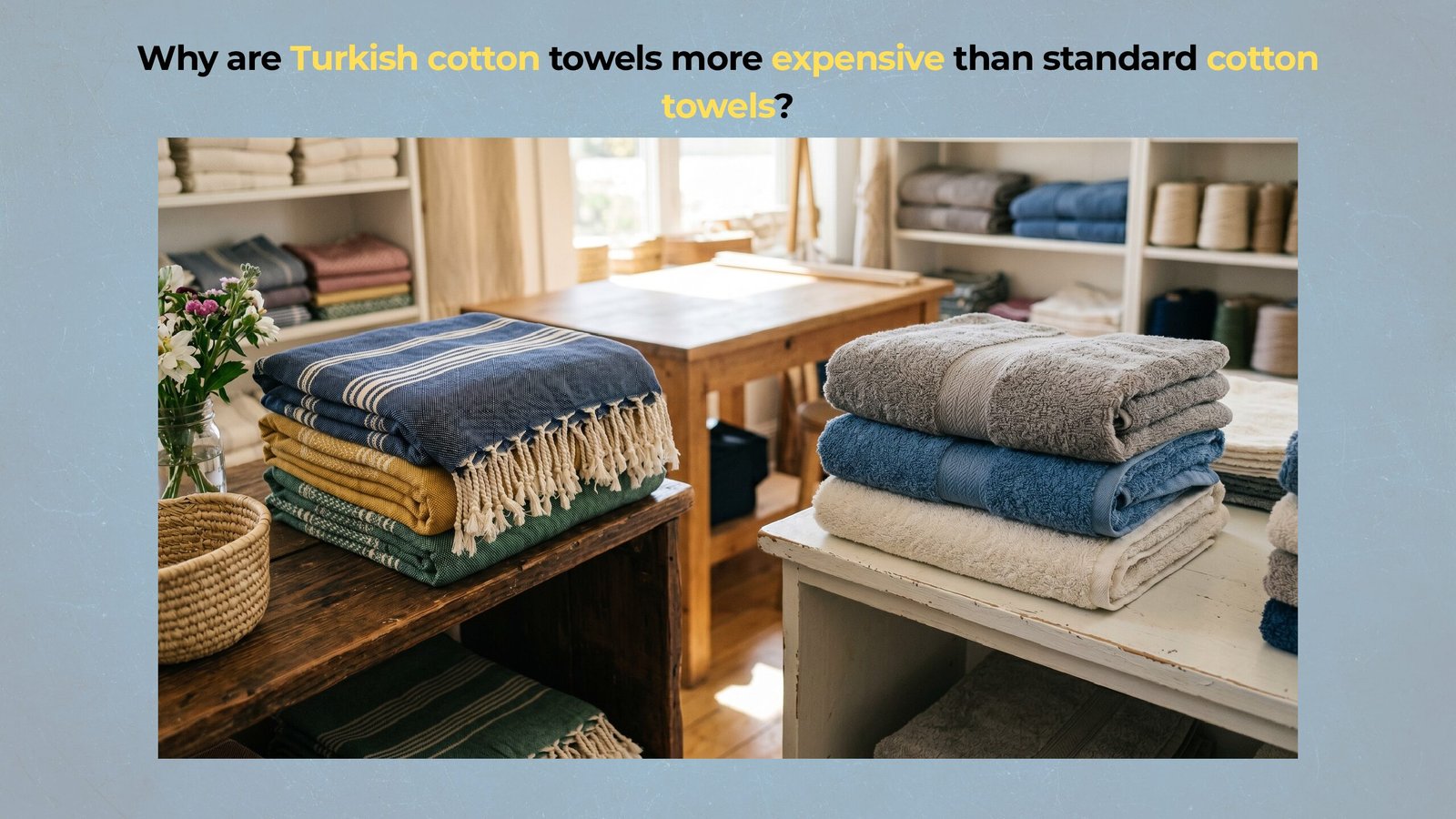
Why are Turkish cotton towels more expensive than standard cotton towels?
The Turkish cotton towel price premium is a direct result of the geographical scarcity of the Aegean growing region and the specialized ring-spun manufacturing required to process long-staple fibers.
This higher baseline cost is dictated by the biological necessity of Aegean long-staple fibers, which require significantly more time to mature and specialized machinery to harvest without damaging the delicate structure. Advanced manufacturing methods then transform these fibers into a superior, durable textile.
Explain how Aegean geography increases Turkish cotton towel prices
Aegean geography significantly influences the Turkish cotton towel price premium because the region’s ‘Golden Climate’ is a specialized environment capable of producing consistent long-staple quality that standard upland cotton cannot replicate. This regional micro-climate within the Aegean basin provides the precise thermal stability and soil drainage needed for fiber elongation.
Comparing the Aegean climate to a boutique vineyard helps clarify the high raw material costs. The higher price of Turkish cotton towels is largely driven by the structural advantages of long-staple fibers, which maintain integrity under repeated use. To understand this foundation, it is useful to explore what staple length Turkish cotton towels typically have and why it matters for performance.
Does geographical scarcity dictate the Turkish cotton towel price premium?
The Turkish cotton towel price premium is rooted in the limited regions meeting strict quality standards in the Aegean, which creates supply-constrained pricing that elevates raw material costs above mass-produced global cotton.
Supply-constrained pricing arises because quality-capable regions are geographically finite. While mass-yield upland cotton fields in Brazil and the US prioritize total tonnage, the Aegean farmers must prioritize fiber integrity within a smaller, non-expandable acreage, naturally driving up the auction price for raw bales.
Compare harvesting labor as a Turkish cotton towel cost driver
Careful harvesting methods contribute to the Turkish cotton towel price premium by reducing fiber breakage, which helps maintain the staple length integrity required for premium textiles. Staple length integrity acts as the primary benchmark for raw material collection quality.
These longer fibers also contribute to stronger yarn formation and reduced breakage during manufacturing. Because this stability originates at the fiber level, it is helpful to understand what the fiber structure of Turkish cotton towels looks like and how it affects durability.
How does fiber protection influence the Turkish cotton towel price premium?
The Turkish cotton towel price premium accounts for the extra precision required to prevent fiber breakage during harvest, ensuring the long-staple integrity remains intact for the spinning stage. This preservation ensures high tensile strength retention, a technical metric measuring the fiber’s ability to resist snapping under tension.
The durability advantage created by this structure plays a major role in justifying the higher upfront cost. Since this directly impacts long-term value, you may want to explore how durable Turkish cotton towels are with regular use.
Analyze how fiber length creates a Turkish cotton towel price difference
From a broader buying perspective, evaluating material type is essential when comparing premium and budget towels. To see how this fits into decision-making, it is useful to review how towel material affects performance, durability, and cost.
Ring-spun yarn generally produces smoother and stronger fibers compared to open-end spinning. The manufacturing stages below contrast the two methods.
| Manufacturing Stage | Standard (Open-End) | Premium (Ring-Spun) |
|---|---|---|
| Spinning Speed | Ultra-High | Low (Precision Twist) |
| Yarn Strength | Moderate | Superior Elasticity |
| Fiber Length Requirement | Short (< 25mm) | Long (> 35mm) |
Identify performance factors that justify the Turkish cotton price premium
Performance-driven utility justifies the Turkish cotton towel price premium, as these towels often dry faster than denser cotton varieties due to their lighter weave structure. This efficiency is powered by capillary action within the long-staple loops.
Faster drying behavior further improves usability and reduces maintenance frequency, which adds to overall value. Because of this, it is helpful to understand how fast Turkish cotton towels dry compared to other materials.
Does the moisture absorption capacity justify the Turkish cotton towel price premium?
The Turkish cotton towel price premium pays for a fiber that wicks water to the surface efficiently, which often reduces the risk of mildew growth compared to short-staple towels. Short-staple towels frequently fail in absorbency because their broken fiber ends create a dense, “matted” surface.
Performance benefits such as efficient moisture absorption also contribute to the price premium. To connect this with real-world usability, it is useful to review how absorbent Turkish cotton towels are and how they manage moisture.
Avoid paying the premium cost for low-quality Turkish-style blends
Securing true value requires avoiding the premium cost often applied to ‘Turkish-style’ blends, which frequently utilize synthetic fibers to mimic the feel of authentic long-staple cotton. Synthetic mimics result in significantly reduced absorbency and lower breathability.
Quality differences between authentic Turkish cotton and lower-grade alternatives also influence pricing. Since this impacts purchasing decisions, you may want to explore what quality factors matter most when choosing towels.
Authenticity Indicators
| Indicator | Authentic Turkish | Synthetic Blend |
|---|---|---|
| Labeling | 100% Turkish / Aegean | “Turkish-style” / “Soft-feel” |
| Absorbency | Improves after washing | Decreases as coatings fade |
Follow this checklist to verify Turkish cotton towel pricing authenticity
To objectively compare whether the higher cost is justified based on performance and lifespan, you can use a data-driven towel comparison template to evaluate value across different materials.
The product label explicitly states “100% Turkish Cotton” or “Aegean Cotton” rather than ambiguous blends.
The manufacturing method is confirmed as ring-spun, ensuring high tensile strength retention.
The towel maintains a GSM (Grams per Square Meter) between 600 and 900 for optimal performance.
Fiber origin is traceable to the Aegean Sea region to guarantee growth climate benefits.
Visual inspection shows a lack of “fuzz” or pilling, indicating high staple length uniformity.
Frequently Asked Questions
Why does Turkish cotton improve with washing?
Turkish cotton improves with washing because the long-staple fibers unfurl over time, which increases the total surface area available for moisture absorption. This increased surface area allows the towel to become more absorbent after several laundering cycles. Laundered fibers also shed any residual spinning waxes, revealing the pure hydrophilic core of the Aegean cotton.
Is a higher price always an indicator of quality?
A higher price serves as a baseline indicator of quality when it reflects the increased cost of Aegean raw materials and ring-spun manufacturing. These manufacturing costs are fixed by the scarcity of the Aegean region and the slow mechanical speed of premium spinning lines. Marketing-driven price hikes on “Turkish-style” blends, however, do not offer the same performance ROI.
How long should a premium Turkish towel last?
A premium Turkish towel typically maintains its integrity for five to ten years due to the superior tensile strength retention of its long-staple fibers. These long-staple fibers prevent the pilling and structural thinning that common upland cotton experiences after repeated use. Consistent durability justifies the initial investment through a significantly lower replacement frequency.