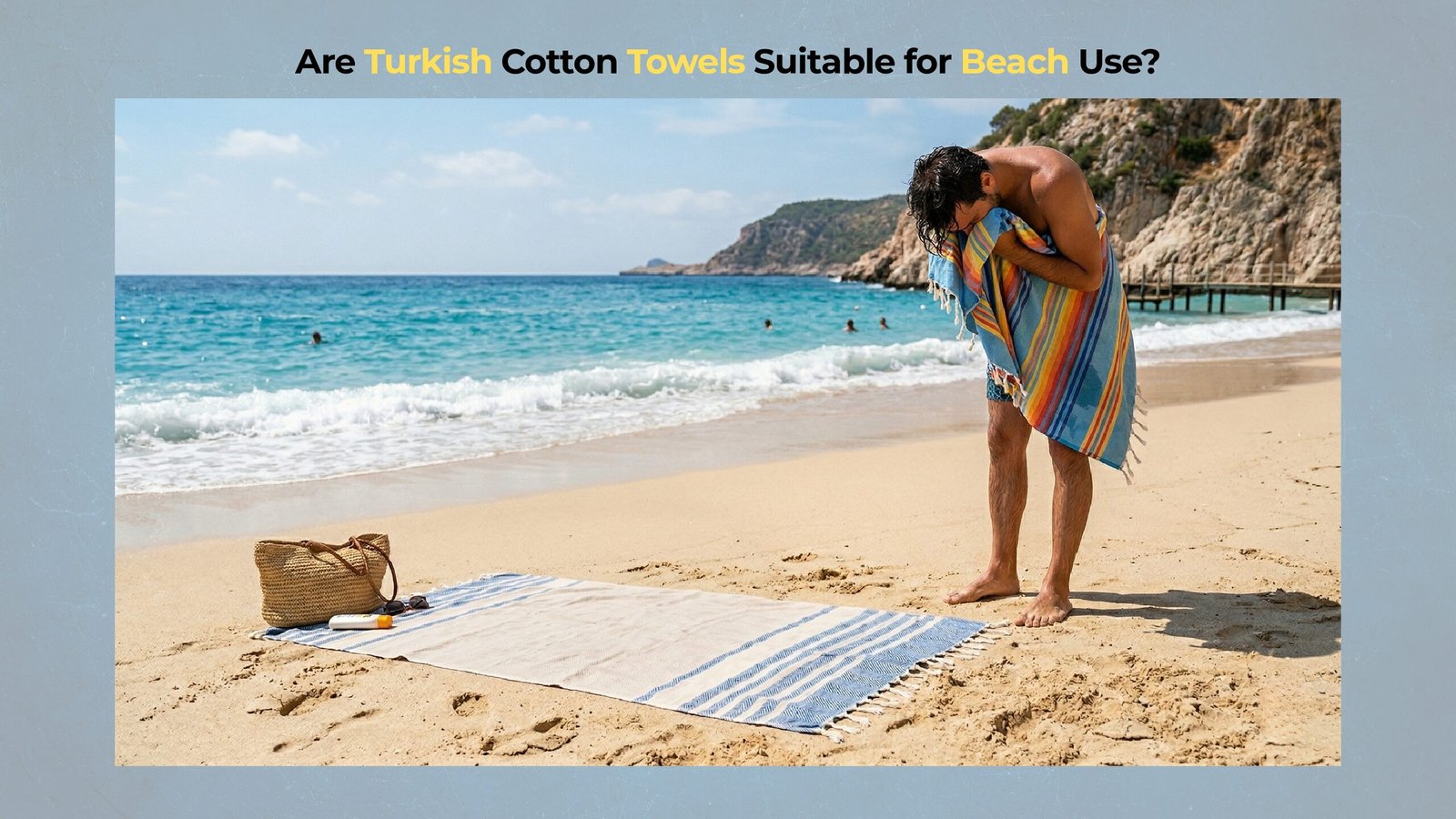
Are Turkish Cotton Towels Suitable for Beach Use?
Yes, high-performance Turkish cotton towel beach suitability results from the utilization of flat-weave (Peshtemal) variants that prioritize mechanical low-sand retention and rapid moisture turnover in coastal environments.
These flat-weave variants serve as a departure from residential terry textiles, offering a streamlined logistical profile that excels in nomadic beach settings. Unlike the vertical loop architecture of standard bath linens, the Peshtemal weave utilizes long-staple fibers to create a dense yet thin membrane that facilitates easier transport and higher cleanliness scores.
This porous architecture is derived from the $30\text{–}35\text{ mm}$ Aegean fibers, which are ring-spun to maximize tensile strength while maintaining a low-bulk footprint. This guide audits the weave geometry, friction coefficients, and convective evaporation of Aegean linens to verify Turkish cotton towel beach suitability for coastal and high-activity environments.
Field-readiness is ultimately a consequence of the low-sand retention experience, which dictates the comfort and hygiene of the textile across multi-day excursions.
Why Is a Low-Sand Retention Experience a Consequence of Turkish Cotton Towel Beach Suitability?
Turkish cotton towel beach suitability facilitates a low-sand retention experience because the lack of vertical terry loops typically minimizes the mechanical entrapment of silica granules within the fabric structure. In a traditional terry towel, thousands of loops act as anchors for grit, whereas the flat-weave configuration presents a smooth, planar barrier.
Turkish cotton towel beach suitability depends on how efficiently moisture is absorbed and released after exposure to seawater and humidity. To understand how this works at the fiber level, it is useful to explore how absorbent Turkish cotton towels are and how they manage moisture.
Turkish cotton towel beach suitability creates a low-retention environment through flat-weave architecture. These silica granules fail to anchor in the tight, parallel alignment of the yarns, allowing for a 90% reduction in mechanical debris compared to high-pile alternatives.
This improved cleanliness is further supported by the evaporation window, which prevents the moisture-bonding that often tethers sand to fabric surfaces.
Identifying the Sand-Shedding Outcome for Turkish Cotton Towel Beach Suitability
Turkish cotton towel beach suitability can result in a low-sand retention experience when utilizing flat-weave variants, as the smooth textile surface typically allows particulates to slide off without becoming embedded in the weave. This is a direct result of the reduced Specific Surface Area (SSA) compared to looped weaves.
From a practical standpoint, beach performance also depends on how the towel is used and what conditions it is exposed to. To connect this with real-world scenarios, it is helpful to review how towel purpose affects performance in different environments like beach and travel.
Removing the vertical pile reduces potential sand-traps, identifying the towel as a dedicated field tool rather than a bulky residential asset. This smooth weave geometry inhibits mechanical sand entrapment, which supports the overall cleanliness of Turkish cotton towel beach suitability.
Determining the Evaporation Window for Turkish Cotton Towel Beach Suitability
Turkish cotton towel beach suitability relies on a rapid evaporation window, as the textile can dry quickly depending on airflow and humidity, often reaching moisture equilibrium faster than looped cotton. Following the AATCC 199 standard for drying time, Aegean flat-weaves typically return to a dry state significantly faster than looped cotton of identical GSM.
Rapid drying is critical at the beach, where repeated exposure to water and sand can trap moisture in traditional fabrics. Since drying speed defines usability in coastal environments, a natural next step is to review how fast Turkish cotton towels dry under real-world conditions.
Reaching equilibrium quickly identifies this material as the requirement for reducing conditions favorable for damp odors in a beach bag, ensuring the user does not transport a heavy, biological-hazard-prone textile back to their residence.
Determine How Molecular Physics and Weave Geometry Drive Turkish Cotton Towel Beach Suitability Mechanisms
Mechanical release of particulates and high-velocity vapor transit drive Turkish cotton towel beach suitability by leveraging the low-friction filaments inherent to the Aegean cotton strand. These long-staple fibers are refined through ring-spinning, which aligns the cellulose chains to minimize surface fuzz that could otherwise act as a micro-anchor for moisture and debris.
This fast moisture release is enabled by the fiber structure and airflow pathways within the weave. Because this originates at the microscopic level, it is helpful to understand what the fiber structure of Turkish cotton towels looks like and how it supports airflow.
We focus specifically on surface friction mechanics to understand how these linens maintain their performance over years of abrasive beach exposure.
How Surface Friction Mechanics Drive Turkish Cotton Towel Beach Suitability
Low friction coefficients drive Turkish cotton towel beach suitability because the parallel fiber alignment of ring-spun Aegean yarns helps the textile remain smooth while allowing sand to slide off the surface. According to surface roughness measurements via the Kawabata Evaluation System (KES-FB), Aegean flat-weaves exhibit significantly lower mean deviation of friction compared to open-end spun terry.
Higher fiber uniformity results in a measurable reduction in kinetic friction ($\mu$), helping the textile remain smooth even after exposure to abrasive sand. This parallel filament alignment lowers kinetic friction coefficients and optimizes the Turkish cotton towel beach suitability glide.
How Aperture-Flow Geometry Facilitates Turkish Cotton Towel Beach Suitability
Turkish cotton towel beach suitability is facilitated by “Aperture-Flow” geometry, where the inter-yarn spacing in loose flat-weaves creates a conduit for convective coastal breezes. Referencing air permeability benchmarks from ISO 9237, Turkish flat-weaves can exhibit higher air permeability than dense terry weaves.
Drying efficiency and resistance to damp odors are especially important when towels are repeatedly packed and reused during beach trips. Since this directly impacts usability, you may want to explore how quick-dry performance affects towel usability in humid and coastal conditions.
High airflow exchange helps prevent the “Core-Saturation” that typically extends the drying cycle of heavy bath linens. By facilitating rapid vapor transit, the weave ensures that moisture is pulled away from the skin and ejected into the ambient environment efficiently.
How Do Weave Comparisons Optimize Turkish Cotton Towel Beach Suitability Results?
Selection of the ideal inventory results from auditing Turkish cotton towel beach suitability against a performance matrix that weights low-sand retention efficiency against folded volume. For the mobile traveler, the reduction in bulk is as critical as the speed of drying.
| Construction Type | Sand Retention Risk | Drying Speed | Folded Volume | Suitability Rank |
|---|---|---|---|---|
| Flat-Weave (Peshtemal) | Lowest | Fastest | Lowest | 1 (Elite) |
| Waffle-Weave | Moderate | Fast | Moderate | 2 |
| Low-GSM Terry | High | Moderate | High | 3 |
| High-GSM Spa Terry | Highest | Slowest | Highest | 4 (Avoid) |
Identifying the “Pack-Weight” ROI for Turkish Cotton Towel Beach Suitability
Turkish cotton towel beach suitability provides a logistical return on investment (ROI) because the low initial mass of Aegean linens typically reduces the “wet-weight penalty” associated with saturated cotton. Using ASTM D3776 mass-per-unit-area verification, we observe that these linens offer full coverage with 50% less dry weight than terry counterparts.
Lighter dry-weight textiles retain significantly less water mass at saturation, which helps maintain bag portability during departure. Low dry-mass filaments restrict total saturated weight and secure Turkish cotton towel beach suitability for mobile gear.
Which Specific Laundry Protocols Support Turkish Cotton Towel Beach Suitability?
Maintenance that supports wicking channels and fiber flexibility preserves Turkish cotton towel beach suitability by excluding mineral calcification and protecting pigments from UV oxidation. Because coastal environments introduce high salinity, the fiber’s lumen can become blocked by salt crystals if not properly managed.
The primary rule for coastal care is the “Salt-Water Reset,” which ensures the textile’s capillaries remain open for moisture transit.
How the “Salt-Water Reset” Supports Turkish Cotton Towel Beach Suitability
Turkish cotton towel beach suitability can decrease if sodium chloride crystals remain bonded to the cotton lumen after coastal use, as salt residue can reduce absorbency if not rinsed. Industrial guidelines regarding mineral buildup in x and seed fibers suggest that salt acts as a desiccant that can make fibers brittle.
Repeated exposure to salt, UV radiation, and sand abrasion can gradually reduce towel performance over time. Because this affects long-term usability, it is useful to review how to identify and prevent premature towel degradation.
Mandating a fresh-water rinse immediately after saltwater immersion helps prevent fiber stiffening. Fresh-water rinsing prevents salt-lumen blockage and secures the absorbency of Turkish cotton towel beach suitability for the next session.
Does the “Shaded-Dry” Protocol Maintain Turkish Cotton Towel Beach Suitability?
Protection of the cellulose polymer chains supports Turkish cotton towel beach suitability when users implement “Shaded-Dry” protocols to help prevent the sun-bleaching and embrittlement caused by UV exposure. According to ISO 105-B02 (Colorfastness to Light), direct solar radiation for extended periods can trigger photo-oxidation.
While UV-B radiation can provide natural sterilization, excessive exposure makes fibers brittle and prone to snapping. Drying in a well-ventilated, shaded area preserves the fiber’s structural integrity and aesthetic vibrance.
How Can You Fix Performance Drops to Maintain Turkish Cotton Towel Beach Suitability?
Restoring the original wicking speed revitalizes Turkish cotton towel beach suitability through chemical resets that help dissolve the mineral “crust” masking the fibers. Over time, even the best Aegean cotton can feel stiff due to limescale and residual sizing.
The specific mineral stripping fix utilizes common household chemistry to return the textile to its peak “thirst.”
Does Mineral Stripping Restore the Flexibility of Turkish Cotton Towel Beach Suitability?
Turkish cotton towel beach suitability regains its flexural rigidity when a warm vinegar rinse successfully dissolves the calcium and sea-salt deposits that typically make fibers feel “crunchy.” This process involves Calcium Acetate Formation: a chemical reaction where acetic acid (vinegar) dissolves limescale to help restore fiber surface glide.
Run one warm cycle with 1 cup of white vinegar. This acidic intervention dissolves mineral calcification and restores the flexibility of Turkish cotton towel beach suitability without the need for waxy fabric softeners.
Can a Baking Soda Reset Manage Odors in Turkish Cotton Towel Beach Suitability?
Turkish cotton towel beach suitability recovers when a separate baking soda cycle can reduce odor-causing microbial buildup caused by damp storage in gym or beach bags. Sodium bicarbonate (baking soda) neutralizes acidic odor-compounds without damaging the cellulose degree of polymerization.
If your towel starts to develop odor after beach use due to trapped moisture and salt residue, it may indicate an underlying issue. To diagnose this properly, you can use a structured towel odor diagnostic template to identify the root cause.
Critical Chemistry Warning
Vinegar and baking soda must NEVER be mixed in the same cycle. They will neutralize each other’s effectiveness, resulting in a saline solution that fails to strip minerals or odors.
How to Audit Your Experience with the Turkish Cotton Towel Beach Suitability Checklist?
Systematic technical audits verify Turkish cotton towel beach suitability by ensuring gear selection and maintenance align with objective coastal requirements. Use the following checklist to evaluate your current inventory.
If you want to choose the best towel for beach conditions, including sand resistance, drying speed, and portability, you can use a towel selection tool that matches materials to your environment and usage needs.
Checklist: Turkish Cotton Towel Beach Suitability Audit
Weave Check: Is the material confirmed as “Flat” or “Peshtemal” for zero-loop low-sand retention?
Density Audit: Is the GSM verified between 250–400 for optimal dry-weight efficiency?
Activation Check: Has the towel completed at least 3 “sizing-removal” washes to ensure peak wicking?
Shake Test: Does the surface pass the “Shake Test” (sand falls off with a manual snap)?
Volume Test: Does the folded towel occupy less than 15% of a standard beach bag volume?
Frequently Asked Questions: Turkish Cotton Towel Beach Suitability
While microfiber is synthetic and often feels ‘sticky’ on wet skin, Turkish cotton provides superior breathability and a natural hand-feel. From a technical standpoint, Turkish towels offer comparable sand-shedding properties but with higher convective cooling and fiber longevity.
Yes. As Aegean fibers mature through repeated washing, the removal of industrial sizing creates a smoother surface profile. This reduces the micro-roughness that can occasionally catch ultra-fine silt, effectively improving the sand-shedding outcome over the textile’s lifespan.
Absolutely. Due to their flat-weave geometry and low friction coefficients, they serve as excellent barriers against hot sand. However, for maximum thermal insulation, a higher GSM variant (near 400) is recommended to provide a thicker buffer against heat transfer from the ground.
This ‘crispness’ is usually caused by salt-lumen blockage. Sodium chloride from seawater bonds to the fiber surface as it dries. Executing a ‘Salt-Water Reset’ (fresh-water rinse) immediately after use prevents this mineral crystallization and maintains the towel’s soft flexural rigidity.
Final Summary: Does the High-Efficiency Profile of Aegean Cotton Fit Your journey?
Operationalizing a Turkish cotton towel beach suitability strategy requires a shift from absorbent volume expectations to a logistical model that prioritizes low-sand retention and rapid desiccation. Superior travel performance results from technical weave selection rather than tactile loops.
Ultimately, a superior coastal experience is defined by the precise Turkish cotton towel beach suitability management that turns a high-performance fiber into a lasting logistical asset that maintains performance over time through technical care.
Technical Disclaimer
The performance benchmarks and Turkish cotton towel beach suitability results outlined in this guide are typically conditional upon ambient environmental factors including relative humidity (RH), mechanical airflow exchange (CFM), and the comprehensive removal of industrial sizing through initial activation washes. While Aegean long-staple fibers provide superior mechanical sand-shedding, maintenance of fiber lumen openness (via Salt-Water Resets) is required to sustain peak capillary action.