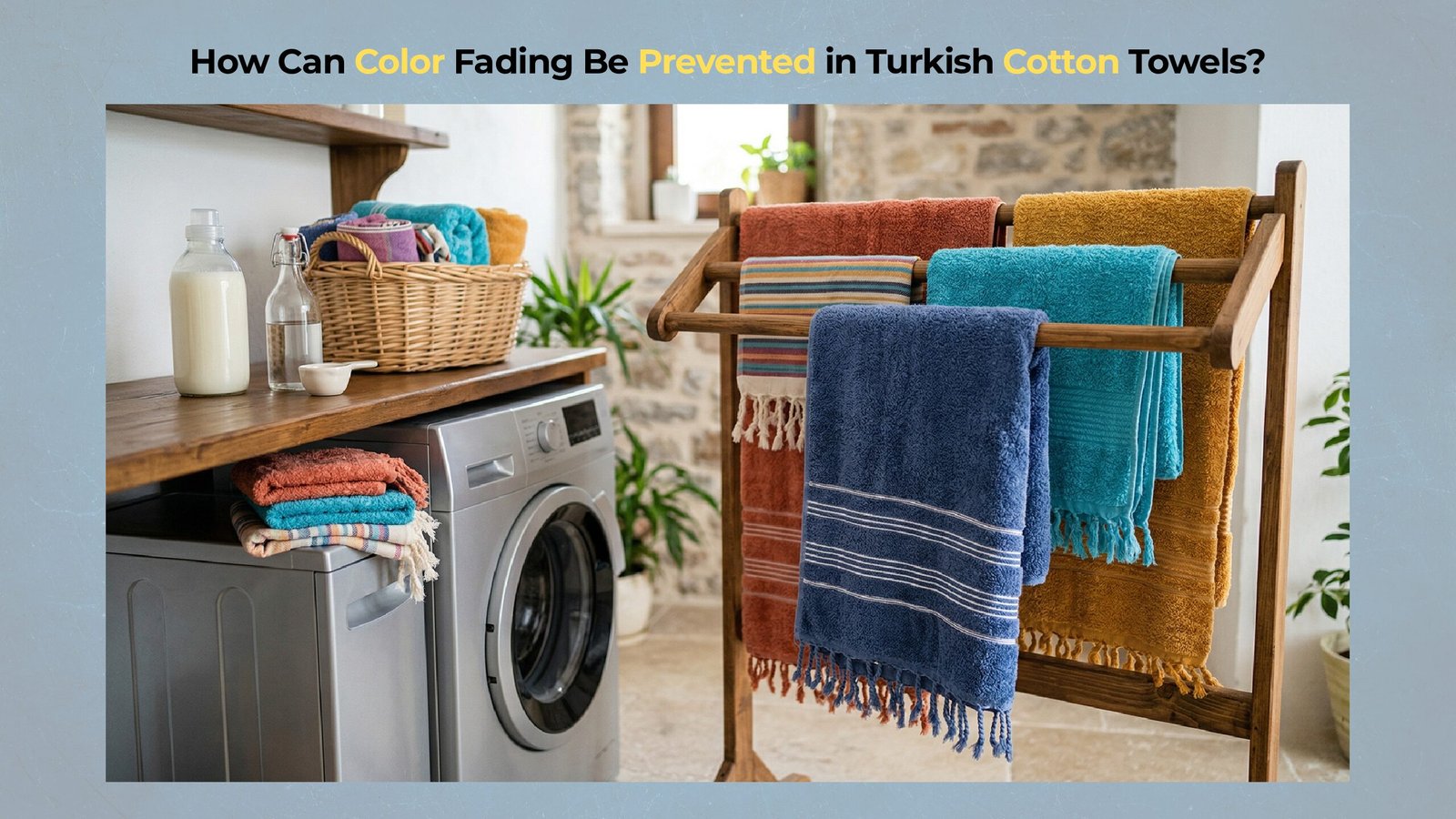
How Can Color Fading Be Prevented in Turkish Cotton Towels?
(Turkish Cotton Towel Color Preservation)
The maintenance of like-new vibrancy typically results from Turkish cotton towel color preservation, as specialized laundering and desiccation protocols protect the molecular bonds between Aegean fibers and their pigments.
These molecular bonds utilize the high wicking surface area of the fiber to secure reactive dyes deep within the cellulose cortex. This fiber reactivity is unique to the high-purity cellulose from the Aegean region, providing a reactive substrate for dye that ensures a long-term amortization ROI for luxury inventory.
Task Fulfillment Statement:
This guide audits the dye chemistry, pH-neutrality, and UV-oxidation prevention of Aegean cotton to verify Turkish cotton towel color preservation and provide technical steps for aesthetic maintenance.
Why Do Chemical and Thermal Inputs Compromise Turkish Cotton Towel Color Preservation?
Turkish cotton towel color preservation is influenced by two primary catalysts of degradation: chemical oxidation from bleach and thermal desorption during high-heat wash cycles.
These primary catalysts disrupt the dye-fiber bond by either cleaving the covalent linkage through oxidative stress or providing sufficient kinetic energy for pigment molecules to migrate out of the fiber pores.
Identifying Chemical Catalysts for Turkish Cotton Towel Color Preservation Failure
Turkish cotton towel color preservation is threatened by oxidative agents like chlorine bleach and heavy-duty detergents containing optical brighteners, which can chemically strip pigments or create a “hazy” residue on the fibers. Maintaining dye stability in Aegean textiles depends on controlling chemical exposure that can weaken pigment bonds. To better understand how these substances interfere with fiber performance, it is useful to explore how chemical residues affect Turkish cotton towel performance and color integrity.
Adherence to the AATCC 188 protocol for colorfastness to sodium hypochlorite confirms that even low-level chlorine exposure results in a measurable decline in color intensity. Oxidative agents such as chlorine and peroxide disrupt chromophores and permanently remove pigment from the fiber. Since this same mechanism leads to visible discoloration, a natural next step is to review why Turkish cotton towels discolor and how oxidation affects dye stability. Optical brighteners are fluorescent chemicals that do not clean; their deposition can create a bluish haze that alters the perceived hue of vibrant towels.
[Chlorine bleach] -> [oxidizes dye chromophores] -> [compromises Turkish cotton towel color preservation].
Determining the Role of Thermal Energy in Turkish Cotton Towel Color Preservation
Turkish cotton towel color preservation baseline levels are maintained when wash temperatures stay at or below $86^{\circ}F$ ($30^{\circ}C$), as excessive heat can expand fiber pores to facilitate dye migration.
Based on the ISO 105-C06 standard for wash fastness, high thermal energy provides the kinetic power needed to break reactive dye bonds. Thermal energy accelerates dye migration by expanding the cellulose structure and weakening dye-fiber bonds. Because heat also contributes to structural degradation, it is helpful to understand what causes fiber breakdown in Turkish cotton towels under repeated thermal stress. Keeping the cellulose structure tightly bound at low temperatures is the primary mechanical defense against “Bleeding.”
How Do Molecular Physics Drive Turkish Cotton Towel Color Preservation?
Molecular physics influence Turkish cotton towel color preservation through the strength of the covalent or ionic bonds established between the dye molecules and the Aegean cellulose chains.
These molecular bonds are analyzed via a mechanism matrix to determine the resistance of the textile to environmental stressors.
Evaluate the Dye-Bond System Using This Turkish Cotton Towel Color Preservation Matrix
Systematically auditing the drivers of Turkish cotton towel color preservation requires a causative analysis of thermal, chemical, and mechanical stressors.
| Cause (Input) | Physical Mechanism (System) | Result for Turkish Cotton Towel |
|---|---|---|
| High pH Detergent | Ionic bond weakening | Uniform dye leaching and loss of vibrancy |
| UV Exposure | Photo-Oxidation | Blotchy, irreversible pigment destruction |
| Mechanical Friction | Filament Fibrillation | “Frosty” surface sheen that masks color |
| Chlorine | Molecular Oxidation | Rapid, permanent chemical stripping |
Why Is Filament Fibrillation a Barrier to Turkish Cotton Towel Color Preservation?
Turkish cotton towel color preservation is visually compromised by “Filament Fibrillation,” where mechanical friction during washing creates a light-scattering surface “fuzz” that makes the fabric appear lighter. Mechanical friction during laundering can create filament fibrillation, producing a “frosting” effect that visually mimics fading. Since this effect originates from surface fiber damage, you may want to explore why Turkish cotton towels shed or lint and how it affects surface appearance.
According to ISO 12945 (Determination of fabric pilling/fuzzing), perceived fading is often an optical illusion. The micro-fibers reflect more light than the smooth yarn core, effectively masking the true pigment saturation.
Definition: “Frosting” is the visual lightening of a colored textile caused by the light-scattering effect of broken surface fibers.
Why Do Aegean Fiber Properties Support Turkish Cotton Towel Color Preservation?
Superior fiber uniformity and long-staple geometry support Turkish cotton towel color preservation by providing a smoother yarn surface that resists the pilling associated with color dullness.
Does Staple Length Influence the Success of Turkish Cotton Towel Color Preservation?
Turkish cotton towel color preservation improves when utilizing fibers between $30\text{–}35\text{ mm}$ because longer staple lengths generally improve durability against the mechanical fraying that greys the color’s appearance. Reference to the Nazilli 84 cultivar maturity benchmarks indicates that high fiber uniformity (UI > 82%) reduces the density of short fibers. Fewer yarn “Joins” result in fewer exposed fiber tips; this lack of “hairy” ends prevents the light-scattering that mimics fading. Dye retention also depends on how well pigment molecules anchor within the fiber structure. To understand this at a deeper level, it is useful to review what the fiber structure of Turkish cotton towels looks like and how it supports dye bonding.
Which Textile Finishes Predict Superior Turkish Cotton Towel Color Preservation?
Selecting optimized textile finishes can mitigate Turkish cotton towel color preservation failure by identifying dye-application methods that are technically engineered for color-fastness. Repeated exposure to harsh washing conditions can reduce fiber strength and accelerate color loss over time. Because this directly affects lifecycle performance, it is helpful to explore how durable Turkish cotton towels are with regular washing.
| Dye Method | Fade Resistance | Technical Detail | Recommendation |
|---|---|---|---|
| Yarn-Dyed | Highest | Pigment penetrates the yarn before weaving | Yes (Elite) |
| Vat-Dyed | High | Molecular “Locking” resistant to bleach | Yes (Commercial) |
| Piece-Dyed | Moderate | Finished towel is dipped; prone to bleed | No (Standard) |
Which Laundry Protocols Maximize Turkish Cotton Towel Color Preservation?
Preservation of original hue results from maintenance protocols that support Turkish cotton towel color preservation limits by excluding oxidative chemicals and maintaining thermal stability. Maintaining long-term color integrity requires consistent washing protocols that prevent chemical buildup and protect fiber bonds. Since maintenance defines long-term results, it is essential to understand how Turkish cotton towels should be washed and cared for.
Executing the “Cold-Wash” Protocol for Turkish Cotton Towel Color Preservation
Turkish cotton towel color preservation is secured during the “Cold-Wash” protocol, where temperatures at or below $86^{\circ}F$ ($30^{\circ}C$) reduce the kinetic solvent power of the wash water.
ISO 6330 domestic laundering standards indicate that maintaining low thermal energy prevents the dye-bond relaxation that facilitates bleeding. Cold water keeps the cellulose structure tightly bound, which can help trap dye molecules within the fiber core.
Implementing “Shaded-Air” Drying to Prevent Turkish Cotton Towel Color Preservation Loss
Turkish cotton towel color preservation protection results from “Shaded-Air” drying, as isolating the textile from solar radiation prevents the photo-oxidation of the pigment molecular chains. Drying conditions play a critical role in preventing photo-oxidation and thermal damage that degrade color stability. Since drying methods influence both structure and pigment retention, you may want to review how drying methods affect Turkish cotton towel performance and color preservation.
How Can You Fix Dullness to Restore Turkish Cotton Towel Color Preservation Baselines?
Restoration of the original visual depth results from executing chemical resets to revitalize Turkish cotton towel color preservation before fibers reach a terminal brittle state.
Stripping Mineral Buildup to Restore the Turkish Cotton Towel Color Preservation Baseline
Turkish cotton towel color preservation regains its original saturation when a warm vinegar rinse successfully dissolves the calcium “mask” that typically grays the appearance of dyed fibers. TRSA wash chemistry guidelines confirm that acetic acid (vinegar) dissolves Calcium Carbonate at pH levels below 5.0. Removing this white mineral film re-exposes the underlying pigment to restore tactile softness and visual vibrancy.
Resolving “Greyed” Whites Using an Oxygen-Reset for Turkish Cotton Towel Color Preservation
Restoration of original brightness for Turkish cotton towel color preservation results from a sodium percarbonate (oxygen bleach) soak that helps lift organic stains without inducing the fiber scission caused by chlorine.
How Do You Audit Your Linen Set with This Turkish Cotton Towel Color Preservation Checklist?
Systematic technical audits verify Turkish cotton towel color preservation levels by ensuring maintenance protocols align with objective structural and aesthetic benchmarks.
Quality Audit Checklist
- Chemistry Audit: Is the detergent verified as “Free and Clear” of optical brighteners and bleach?
- Thermal Audit: Is the wash temperature strictly confirmed at or below $86^{\circ}F$ ($30^{\circ}C$)?
- UV Verification: Is the drying location strictly protected from direct solar radiation?
- Wicking Test: Does the towel pass the “Drop Test” (water sinks in < 2s without beading)?
Technical FAQ: Turkish Cotton Towel Color Preservation
The absolute thermal ceiling is $86^{\circ}F$ ($30^{\circ}C$). Temperatures exceeding this threshold provide the kinetic energy required to break covalent dye-fiber bonds, leading to irreversible bleeding.
This results from chemical oxidation. Common culprits include chlorine bleach or benzoyl peroxide (found in acne treatments), which permanently cleave pigment chromophores from the Aegean cellulose chain.
While softeners don’t chemically remove dye, they leave a silicone-based film that traps mineral deposits. This creates a grey “mask” that dulls the visual vibrancy of the original pigment.
Executing a mineral-stripping reset with acetic acid (vinegar) every 4–6 weeks is recommended to dissolve calcium calcification and re-expose the underlying dye saturation.
Final Summary
Operationalizing a Turkish cotton towel color preservation strategy requires a shift from convenience-centric washing to a commitment to technical care that honors the unique physics of Aegean cotton.
Ultimately, a superior bathroom experience is defined by the precise Turkish cotton towel color preservation management that turns a high-performance fiber into a lasting asset that helps maintain performance over time through technical care.
Technical Disclaimer: The information provided in this guide is based on industrial textile chemistry benchmarks and standards (AATCC, ISO). Individual Turkish cotton towel color preservation results typically remain conditional upon localized variables including municipal water hardness ($ppm$), local UV-index exposure, and specific detergent pH levels. Performance claims are framed with scientific nuance; peak aesthetic results are contingent upon consistent adherence to the described technical care protocols.