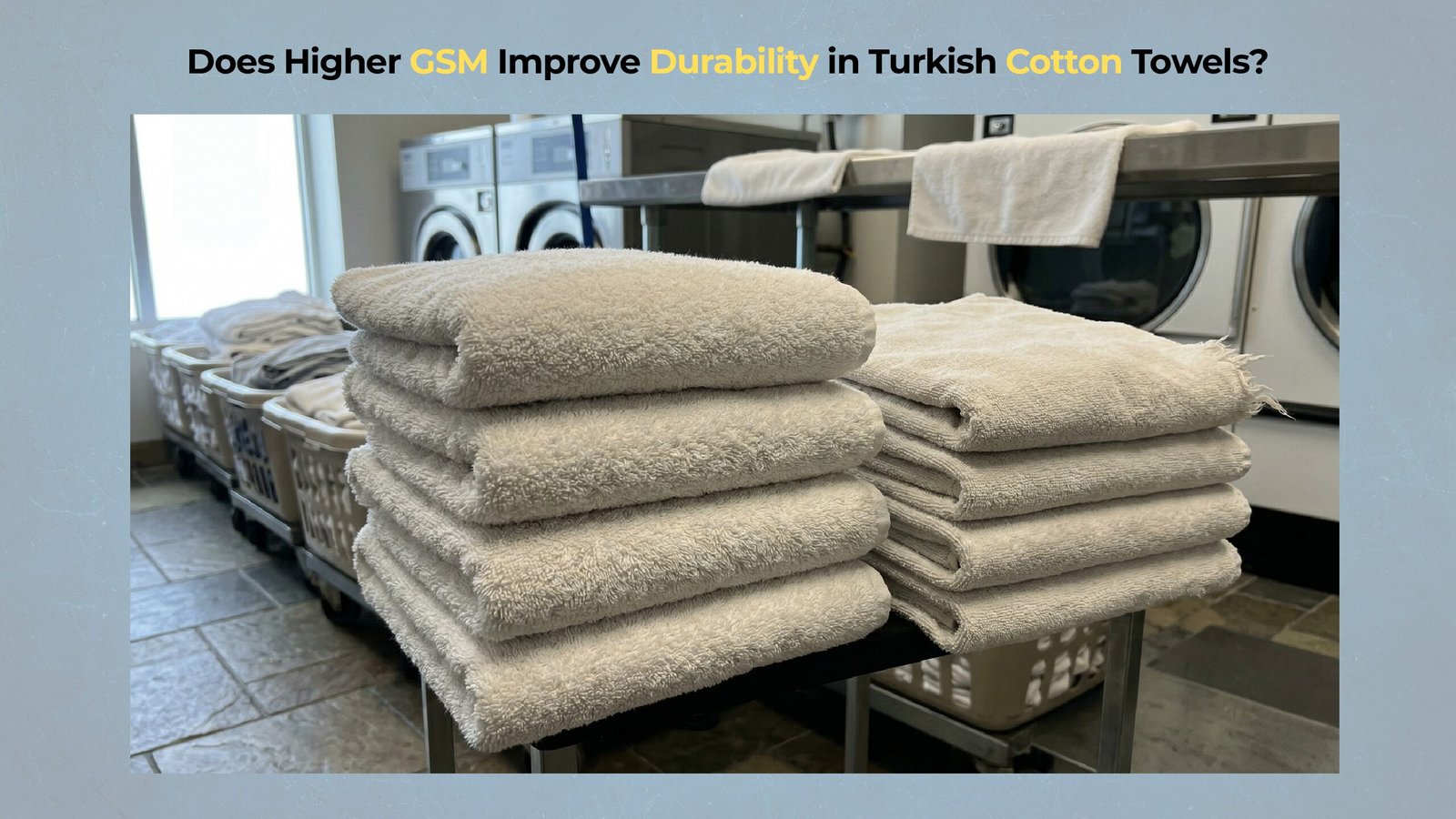
Does Higher GSM Improve Durability in Turkish Cotton Towels?
An Engineering Analysis of Turkish Cotton Towel GSM Durability
Increased mechanical resilience and a longer lifecycle typically result from high Turkish cotton towel GSM durability, provided the textile mass is supported by a high-density ground weave.
In textile engineering, durability is not merely a measure of thickness but a calculation of foundational integrity. A higher proportion of base weave improves durability by establishing the structural scaffold required to anchor terry loops, preventing the premature shedding or “loop-pulls” common in low-weight alternatives.
GSM contributes to durability when supported by strong construction, as fabric mass provides a buffer against the mechanical shearing of the laundry cycle. Without this density, the high-energy environment of commercial or residential laundering can degrade fiber bonds, leading to thinning and functional failure.
Why Is a Material Mass Advantage Central to Aegean Textile Longevity?
A material mass advantage typically results from higher Turkish cotton towel GSM durability, as increased fiber density provides a physical buffer against the friction of repeated laundry cycles.
Increased mechanical resilience and lifecycle extension result from Turkish cotton towel GSM durability when supported by a high-density ground weave. To understand how this density originates at the material level, it is helpful to explore what GSM means for Turkish cotton towels and how it defines fabric mass.
This physical buffer typically helps reduce the likelihood of “balding” or accidental loop extraction during heavy use. By providing more sacrificial fiber mass, high-GSM textiles can withstand surface abrasion that would otherwise penetrate and destroy the core structure of lighter towels. Structural stability is ultimately a function of foundational weave density.
How Does Base-Weave Density Scale Turkish Cotton Towel GSM Durability?
Turkish cotton towel GSM durability scales according to the ground-weight-to-pile-weight ratio, where a higher proportion of base weave improves durability and ensures the weave resists stretching.
Under the ASTM D5034 grab strength standard, high-performance Aegean towels can exhibit high breaking strength under ASTM testing when the foundation provides sufficient anchorage for the pile. A higher proportion of base weave anchors terry loops, which secures the structural integrity of Turkish cotton towel GSM durability.
Identifying the Material Mass Advantage in Turkish Cotton Towel GSM Durability
Turkish cotton towel GSM durability typically reduces the “balding” effect associated with low-weight utility towels because the $600\text{–}900\text{ GSM}$ range provides more sacrificial fiber mass for mechanical abrasion.
While GSM provides the mass, GSM contributes to durability only when supported by strong construction that prevents fiber migration. Mass acts as a “durability insurance” where heavyweight Aegean LS cotton typically possesses enough molecular depth to remain functional longer than carded alternatives.
Why Does Turkish Cotton Towel GSM Durability Matter for Long-Term Investment?
A superior return on investment results from Turkish cotton towel GSM durability because high-tenacity Aegean fibers can significantly lower the annual cost-per-use by extending the interval between inventory replacements.
Connecting inventory longevity to the potential reduction of facility or household operational expenditure (OpEx) is vital. High-mass Turkish cotton offers a lower Total Cost of Ownership (TCO) by outlasting lower-grade textiles. We focus specifically on the fiscal benchmarks of the wash cycle to prove this ROI.
Identifying the ‘Cost-per-Wash’ ROI of Turkish Cotton Towel GSM Durability
Turkish cotton towel GSM durability results in a lower cost-per-wash when the textile can sustain significantly more wash cycles than standard Upland cotton.
Referencing ISO 6330 laundering protocols, high-performance Aegean towels can exhibit high breaking strength. High-cycle Aegean towels can often double the service life of utility cotton, drastically reducing the lifecycle denominator. Ultimately, high wash-cycle thresholds lower the lifecycle denominator and optimize the ROI of Turkish cotton towel GSM durability.
How Does Sustainability Link to Turkish Cotton Towel GSM Durability?
Turkish cotton towel GSM durability supports ecological sustainability goals because extending the functional lifespan of a textile reduces the cumulative resource load of replacement manufacturing.
Based on botanical sustainability data, the greenest towel is typically the one that does not require frequent replacement. High durability supports a “Buy Once” philosophy that reduces environmental impact.
How Do Molecular Physics and Mechanics Drive Turkish Cotton Towel GSM Durability?
Inter-fiber friction and mechanical loop-pinching drive the structural integrity of Turkish cotton towel GSM durability, utilizing the specific morphology of the long-staple fiber.
Durability is not simply a function of thickness but of structural integrity anchored in the base weave. Since this structure begins with fiber architecture, a logical next step is to review how Turkish cotton towel yarn construction influences strength and performance. We focus specifically on the friction bonding at the yarn core to understand how these fibers resist pull-out.
How Do Spiral-Friction Bonds Support Turkish Cotton Towel GSM Durability?
Turkish cotton towel GSM durability relies on a “Spiral-Friction Bond” where the increased number of long-staple fibers in a high-density weave create more overlapping anchoring points.
Friction-Bonding is the mechanical interlocking of fibers achieved through yarn twist. Long-staple fiber overlapping maximizes friction bonds and secures the structural integrity of Turkish cotton towel GSM durability.
Do Loop-Security Mechanisms Impact Turkish Cotton Towel GSM Durability?
Turkish cotton towel GSM durability is maintained by loop-security mechanisms where a tighter ground weave physically “pinches” the terry loops to help prevent pulls and runs.
Ground-weave density anchors terry loops and prevents premature shedding during use. Since this structural anchoring also influences moisture handling, you may want to understand how absorbent Turkish cotton towels are and how moisture interacts with the fiber structure.
Higher-spec weaves can exhibit high breaking strength under ASTM testing while withstanding firm manual tension without loop distortion. A heavy ground weave acts as a structural clamp for the entire pile.
Comparing Weight Tiers to Optimize Turkish Cotton Longevity
Selecting the ideal inventory results from comparing Turkish cotton towel GSM durability tiers against performance matrixes to identify the material longevity sweet spot.
Excessive fabric mass can create a moisture reservoir that slows evaporation and increases the risk of internal dampness. Because this is strongly influenced by towel weight, it is useful to evaluate how towel weight influences durability, drying time, and overall performance.
| GSM Range | Weight Category | Tensile Rank | Lifecycle Expectation | Durability Profile |
|---|---|---|---|---|
| 300–450 | Lightweight | Low | Lower | Higher friction wear risk |
| 600–700 | Mid-Heavy | Highest | Maximum | The Durability Sweet Spot |
| 800–900 | Ultra-Heavy | High | Moderate | Risk of stagnation / Heat stress |
Which Laundry Protocols Preserve Turkish Cotton Towel GSM Durability?
Preservation of wicking mass and tensile strength results from maintenance protocols that protect Turkish cotton towel GSM durability by excluding oxidative chemicals.
Maintaining long-term durability requires proper laundering protocols that protect fiber integrity and prevent chemical damage. Since maintenance determines lifecycle performance, it is essential to understand what care instructions should be followed to preserve towel durability and structure.
Executing “Full-Spread” Drying to Protect Turkish Cotton Towel GSM Durability
Turkish cotton towel GSM durability is protected by the “Full-Spread” drying rule, as moisture trapped in bunched fabric can contribute to degradation over time.
Durability must be balanced with drying efficiency to avoid long-term performance decline caused by moisture retention. To better understand this trade-off, it is helpful to review why Turkish cotton towels dry faster or slower depending on structure and environment. Mandating the use of wide bars is essential; hanging on hooks can focus excessive wet-weight tension on a single point.
Why Must You Adhere to the “No-Bleach” Rule for Turkish Cotton Towel GSM Durability?
Turkish cotton towel GSM durability may lead to mass loss if treated with chlorine bleach because oxidative chemicals can significantly degrade cellulose structure over repeated exposure.
Repeated chlorine exposure can result in measurable functional decline and fibers that snap under minimal stress. Bleach acts as a chemical abrasive that effectively strips away the mass advantage that high GSM typically provides.
When Do These High-Mass Textiles reach a Point of Performance Decline?
A reduction in performance can occur in Turkish cotton towel GSM durability when excessive mass creates a humidity trap that leads to persistent internal dampness.
Identifying Persistent Internal Dampness as a Factor in Turkish Cotton Towel GSM Durability Decline
Turkish cotton towel GSM durability can reach a state of functional decline through persistent internal dampness, which can contribute to degradation over time and facilitate microbial growth.
Performance decline can occur when moisture remains trapped inside the textile, leading to microbial growth and fiber degradation. Since airflow determines how quickly moisture escapes, you may want to explore how weave structure improves airflow and drying efficiency.
Biofilm Shielding is the process where bacterial residues create a protective barrier that can resist standard laundering. Prolonged internal moisture facilitates microbial growth conditions and can weaken the cellulose core of Turkish cotton towel GSM durability.
Determining How “Dryer-Stress” Can Influence Turkish Cotton Towel GSM Durability
Thermal degradation can influence Turkish cotton towel GSM durability because extended high-heat cycles required for thick towels may trigger heat-brittleness.
The “Thick Towel Paradox” involves potentially reducing flexibility to achieve absolute dryness. It is recommended to use low-heat settings (< 60°C) to maintain flexibility.
How Can You Restore Flexibility to Revitalize Turkish Cotton Towel GSM Durability?
Restoration of the textile’s original flexural rigidity results from executing chemical resets to revitalize Turkish cotton towel GSM durability.
Resolving Mineral-Based “Crunch” to Improve Turkish Cotton Towel GSM Durability
Turkish cotton towel GSM durability and fiber elasticity regain their original profile if a warm vinegar rinse successfully dissolves the calcium “crust” that makes heavy towels feel board-like.
Run one cycle with 1 cup of white distilled vinegar to neutralize alkaline mineral bonds. Acetic acid rinses dissolve mineral calcification and restore the flexibility of Turkish cotton towel GSM durability.
Audit Your Routine with the Turkish Cotton Towel GSM Durability Checklist
Inventory verification is a consequence of auditing Turkish cotton towel GSM durability against industrial construction standards and tactile performance tests.
Turkish Cotton Towel GSM Durability Audit
Frequently Asked Questions
Does high GSM always mean a towel is more durable?
Not necessarily. Increased mechanical resilience typically results from high Turkish cotton towel GSM durability only when the mass is anchored by a high-density ground weave. Without a strong base, a heavy towel will shed loops and lose structural integrity quickly.
What is the absolute best GSM for Turkish towel longevity?
The durability “sweet spot” is 600–750 GSM. This range provides enough sacrificial fiber mass to withstand laundry friction while remaining thin enough to dry efficiently, preventing internal cellulose degradation from trapped moisture.
Why do my heavy Turkish towels feel stiff or “crunchy” after washing?
Heavy towels have a higher surface area that traps alkaline minerals from hard water. This calcium “crust” binds the fibers together. Restoring Turkish cotton towel GSM durability usually requires a warm vinegar rinse to dissolve these mineral bonds.
Is weave density more important than GSM for durability?
They are codependent. While GSM provides the mass buffer against abrasion, weave density (specifically ground-weave mass) provides the structural scaffold. A high GSM towel with a loose weave is significantly less durable than a mid-weight towel with a dense foundation.
Technical Disclaimer
The performance benchmarks and Turkish cotton towel GSM durability metrics provided are based on standardized textile engineering laboratory conditions (ASTM/ISO). Real-world longevity varies depending on local water hardness, detergent pH levels, and specific machine mechanical actions. This guide is for educational asset management purposes and does not guarantee a specific lifecycle for every environment.
Final Summary: Does the Performance Profile of Turkish Cotton Towel GSM Durability Meet Your Needs?
Operationalizing a Turkish cotton towel GSM durability strategy requires a commitment to balanced construction that prioritizes structural foundation over purely tactile density.
Mid-Heavy GSM typically provides elite longevity, whereas Ultra-Heavy GSM presents higher maintenance requirements. Balancing fiber mass with base-weave integrity is the key to a lifetime asset.
Ultimately, a superior bathroom experience is defined by the precise Turkish cotton towel GSM durability management that turns a high-performance fiber into a lasting asset that helps maintain freshness through technical care.