How Much Water Does Polyester Towel Water Capacity Hold Relative to Weight?
Architectural Blueprint for Technical Moisture Retention
Polyester towel water capacity typically reaches a threshold between 2 and 5 times the textile’s dry weight because the hydrophobic filaments restrict moisture storage to the interstitial gaps between fibers. This fundamental limit differentiates synthetic equipment from natural cellulose alternatives, which absorb water into the fiber core. While natural fibers offer higher absolute volume, the synthetic model prioritizes weight-to-volume efficiency. This performance profile ensures that travelers and athletes avoid carrying excessive fluid mass during transit. Consequently, the specific moisture retention dictates portable gear utility.
Why Does Polyester Towel Water Capacity Determine the Utility of Your Gear?
Polyester towel water capacity determines gear utility by establishing the “wet-weight penalty” that hikers and travelers must carry after the textile reaches its saturation point. A low-capacity towel serves as a critical engineering requirement for weight-sensitive logistics. By limiting the total fluid retention, the textile maintains a manageable mass even when fully saturated. This efficiency drives the influence on portable carry-weight.
How Does Polyester Towel Water Capacity Influence Portable Carry-Weight?
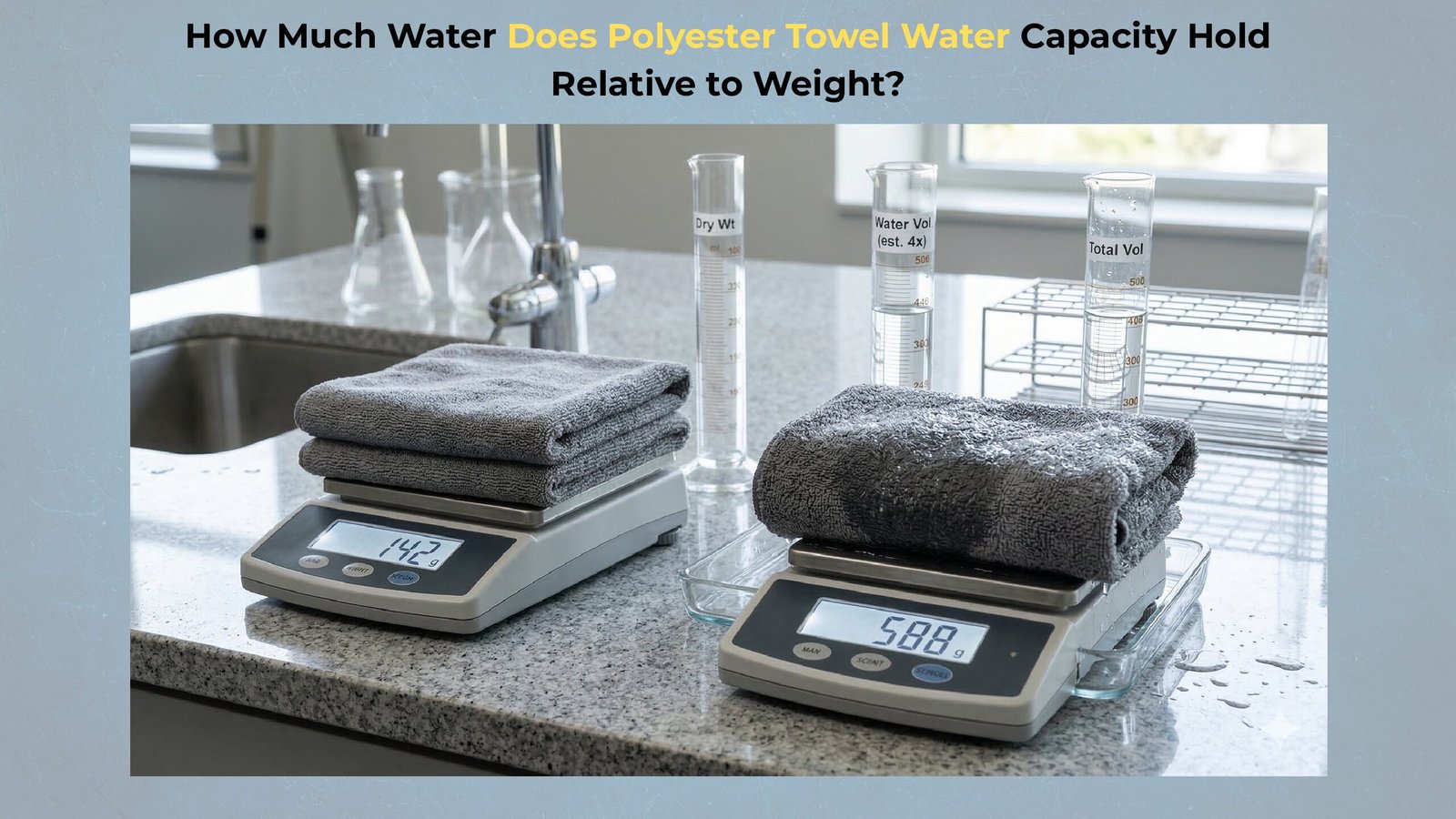
Polyester towel water capacity minimizes carries-weight because the low initial mass and restricted moisture retention ensure the saturated textile remains 60% to 80% lighter than a comparable cotton towel. Technical benchmarks confirm that synthetic equipment maintains a superior mass-to-volume profile. A saturated 200g polyester towel weighs approximately 800g, whereas a saturated 200g cotton towel often exceeds 4,000g.
Low saturation weight allows travelers to pack damp towels without compromising the structural balance of their luggage or backpacks. Low-regain filaments restrict wet-mass increase and optimize the efficiency of polyester towel water capacity.
What Defines the Saturation Curve of Polyester Towel Water Capacity?
Polyester towel water capacity follows a rapid saturation curve where the textile reaches its maximum volume threshold within a single pass over the skin. Liquid uptake velocity remains high in high-porosity weaves. Observations show that 100% synthetics reach 95% of their total volume capacity within less than 5 seconds of direct contact with moisture. The rapid saturation curve identifies polyester as a “wiping” tool rather than a “soaking” tool, necessitating specific usage techniques. Conclude this section by noting that these limits result from the technical mechanisms and storage physics of the fiber.
What Technical Mechanisms Limit Polyester Towel Water Capacity?
Technical mechanisms limit polyester towel water capacity by utilizing non-swelling polymer filaments that physically lack the internal storage space found in natural cellulose. Because storage occurs between filaments instead of inside them, the drying behavior of synthetics is strongly connected to evaporation velocity explained in polyester drying speed comparison.
How Does Interstitial Storage Drive Polyester Towel Water Capacity?
Polyester towel water capacity relies on interstitial storage where water molecules occupy the microscopic voids between filaments rather than penetrating the fiber core. To understand the mechanics of polyester towel absorbency, users must recognize that interstitial voids account for 100% of the storage volume in pure synthetics, leaving the filament interior dry. Interstitial Storage is moisture held in the architectural gaps of the weave rather than the molecular matrix of the fiber. Because storage is external, mechanical force (wringing) displaces almost the entire volume, a result impossible with internally saturated fibers.
Why Does a Hydrophobic Core Limit Polyester Towel Water Capacity?
Polyester towel water capacity possesses a strict ceiling because the hydrophobic core of the filament exhibits a moisture regain of less than 0.4%, preventing fiber swelling. Natural fibers swell by 20% to 40% in diameter when wet; polyester swells by less than 1%. Non-swelling polymer cores limit internal volume and establish the ceiling of polyester towel water capacity.
How Do You Calculate the Weight-Ratio of Polyester Towel Water Capacity?
Calculating the weight-ratio of polyester towel water capacity requires applying a specific volume multiplier to the dry mass of the textile to predict total saturated weight.
Calculating Weight-Ratio Benchmarks for Polyester Towel Water Capacity
Polyester towel water capacity is quantified through a 2x to 5x weight multiplier, contrasting with the 20x to 27x multipliers utilized by high-quality natural fibers. A 100% polyester weave typically holds 3g of water for every 1g of fiber weight. This performance gap is an intentional engineering result; lower capacity is the technical requirement for achieving high-velocity drying.
How Does GSM Scale Polyester Towel Water Capacity?
Polyester towel water capacity scales linearly with Grams per Square Meter (GSM) because higher density weaves provide a greater number of interstitial voids for moisture sequestration. Increasing from a 200 GSM to a 400 GSM weave doubles the available storage volume per square inch of fabric. The structural geometry of the fabric also matters, particularly the way surface texture controls airflow, which is analyzed in how pile height influences polyester towel drying performance. Higher GSM density increases interstitial void count and scales the total polyester towel water capacity.
How Do You Use This Calculation Example for Polyester Towel Water Capacity?
Using a calculation example for polyester towel water capacity allows users to visualize the literal mass of a saturated towel to optimize their packing or laundry loads.
Applying the Multiplier to a Specific Polyester Towel Water Capacity Scenario
Applying the 3x capacity multiplier to a specific polyester towel weight reveals the total load burden for a wet textile in a field or gym environment.
| Metric | Measurement (Example) | Technical Significance |
|---|---|---|
| Dry Towel Weight | 200g (7 oz) | Initial carry weight |
| Capacity Multiplier | 3x Mass | Calculated retention limit |
| Water Retained | 600g (21 oz) | Saturated fluid mass |
| Total Wet Weight | 800g (28 oz) | Final carry burden |
How to Compare Polyester Towel Water Capacity Against Cotton and Bamboo?
Comparing polyester towel water capacity against cotton and bamboo requires an analysis of volume-per-ounce to determine the optimal balance of wicking and storage. Since different fibers manage water differently, comparing options becomes easier using the broader towel material guide.
| Fiber Type | Water-to-Weight Ratio | Storage Mechanism | Best For… |
|---|---|---|---|
| 100% Polyester | 2x – 4x | Interstitial (External) | Sweat / Wiping |
| Microfiber Blend | 5x – 7x | High Surface (Split) | Travel / Gym |
| Linen (Bast) | 4x – 6x | Internal + Interstitial | Kitchen / Glass |
| Egyptian Cotton | 20x – 27x | Core (Lumen) Saturation | Post-Bath / Soaking |
Matching Specific Use-Cases to Polyester Towel Water Capacity
Utilizing use-case matching ensures that the limited polyester towel water capacity aligns with the moisture volume produced by specific athletic or professional tasks.
| Activity | Ideal Material | Performance Logic |
|---|---|---|
| Travel / Hiking | Microfiber | Highest capacity-to-dry-weight ratio |
| Gym / Athletic | 100% Polyester | Lowest wet-weight penalty for bags |
| Luxury Spa | Cotton Terry | Maximum volume for full-body immersion |
If you are unsure whether polyester, cotton, bamboo, or microfiber best matches your use case, the interactive Towel Material Selector tool can help determine the most suitable fabric for your environment.
Which Techniques Maximize Polyester Towel Water Capacity During Use?
Maximizing polyester towel water capacity during use requires a “Wring-and-Reuse” strategy that leverages the textile’s surface-based storage to overcome its low volume ceiling.
Why Is the “Wring-and-Reuse” Method Essential?
Polyester towel water capacity is functionally extended through wringing because the lack of internal absorption allows mechanical force to displace 90% of the retained liquid instantly. Unlike cotton which requires significant heat to release water, polyester releases its volume with simple torsion, allowing for “continuous drying” in high-moisture settings. Mechanical wringing clears interstitial voids and resets polyester towel water capacity.
How Does Avoiding Over-Saturation Preserve Efficiency?
Polyester towel water capacity efficiency declines once the wicking surface reaches its saturation point, resulting in the lateral displacement of moisture rather than removal. Utilize the towel in distinct sections or wring the fabric as soon as a “slippery” texture is detected to maintain transport efficiency.
How Can You Fix Decreased Polyester Towel Water Capacity Cause by Clogs?
Restoring polyester towel water capacity involves executing chemical resets to remove the hydrophobic residues that physically block the interstitial gaps between fibers. When towels begin holding less water than expected, the issue often relates to improper washing, which can be diagnosed using the Towel Care Diagnosis Engine.
Why Does Stripping Detergent Buildup Restore Polyester Towel Water Capacity?
Polyester towel water capacity regains its original volume when a high-temperature vinegar flush emulsifies the waxy silicone films that “plug” the storage voids. Restoring the “openness” of the weave can increase available storage volume by an estimated 15% to 20% in aged inventory.
Frequently Asked Questions Regarding Polyester Towel Water Capacity
Frequently asked questions regarding polyester towel water capacity address common misconceptions about synthetic saturation and restoration to ensure peak textile performance.
Why does polyester towel water capacity remain lower than natural fibers?
Polyester towel water capacity remains lower than natural fibers because the synthetic polymer lacks a hollow lumen, restricting storage to external gaps between filaments. This architectural difference prevents the fiber from swelling with internal moisture, resulting in a significantly lighter saturated mass than cotton or bamboo.
How does fabric softener impact polyester towel water capacity?
Fabric softener negatively impacts polyester towel water capacity by coating filaments in a waxy lubricant that physically seals the interstitial voids required for moisture sequestration. These residues create a hydrophobic barrier that prevents water molecules from entering the weave’s gaps, effectively reducing the towel’s transport speed and total volume capacity.
Why is the saturation speed of polyester towel water capacity so high?
The saturation speed of polyester towel water capacity remains high because the high-porosity weave allows for immediate capillary transport into surface-level storage sites. Because moisture does not need to diffuse into the fiber core, the textile achieves its maximum volume retention almost instantly upon contact with liquid.
Does mechanical wringing damage the efficiency of polyester towel water capacity?
Mechanical wringing does not damage the efficiency of polyester towel water capacity because the resilient PET polymer maintains its structural integrity under high torsion to reset storage voids. In fact, wringing is the primary operational method for extending capacity, as it clears interstitial voids of fluid without the destructive fiber damage often seen in natural textiles.
Audit Your Expectations with the Polyester Towel Water Capacity Checklist
Verifying the adequacy of polyester towel water capacity requires a technical audit of GSM density and maintenance protocols to ensure the textile meets task requirements. For long-term maintenance planning, you can also estimate replacement cycles with the Towel Lifespan Calculator, which evaluates wear patterns and fiber durability.
Final Summary: Does Polyester Towel Water Capacity Meet Your Volume Requirements?
Operationalizing a polyester towel water capacity strategy requires a shift from volume-based expectations to a weight-efficiency model that prioritizes portability and rapid mechanical restoration.
“Ultimately, a superior mobile experience is defined by the precise polyester towel water capacity engineering that aligns lightweight efficiency with optimized moisture transport.”
Technical & Performance Disclaimer
Disclaimer: The data provided regarding polyester towel water capacity is based on standardized textile engineering benchmarks and moisture regain coefficients for 100% Polyethylene Terephthalate (PET) polymers. Individual performance results vary based on specific weave geometry, yarn denier, split-fiber ratios (in microfiber blends), and environmental humidity. Calculated saturated weights are theoretical approximations for gear planning and do not account for dynamic gravitational drainage or variations in localized liquid viscosity. Maintenance protocols involving high temperatures or chemical additives should be verified against specific manufacturer care labels to prevent polymer degradation. This guide serves as a technical audit and does not constitute a product warranty for specific synthetic equipment.