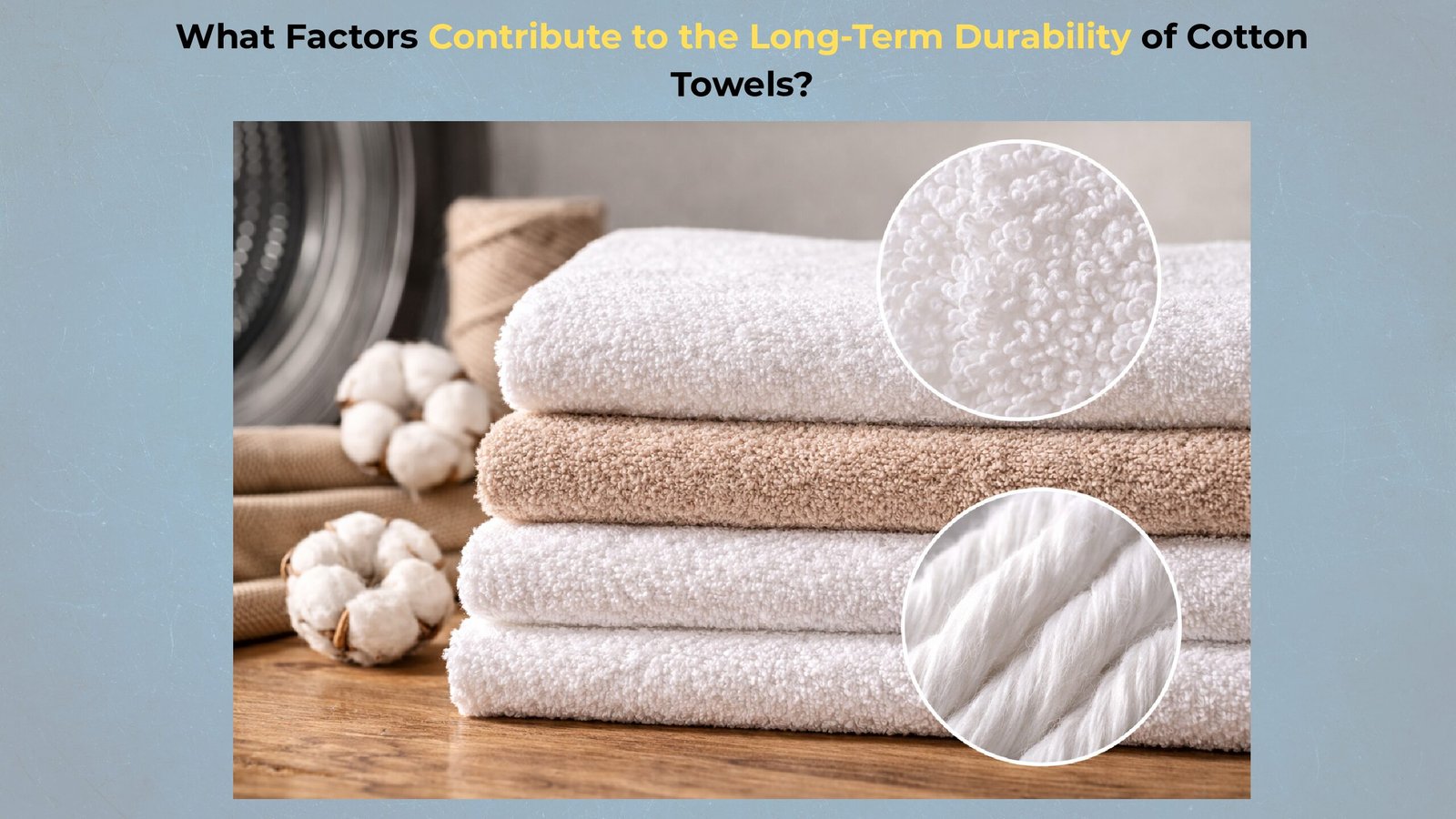
What Factors Contribute to the Long-Term Durability of Cotton Towels?
Cotton towel durability defines the cotton towel long-term value of home linens because the mechanical relationship between fiber staple length and seam reinforcement determines the textile’s resistance to structural thinning and edge fraying.
Task Fulfillment Statement
This guide audits the technical specifications of fiber morphology and construction to maximize cotton towel durability and minimize replacement overhead.
Textile engineers differentiate tensile strength from abrasion resistance. Tensile strength measures the force required to pull the fabric apart, whereas abrasion resistance defines how the surface loops withstand the friction of skin contact and mechanical laundering. Extended textile lifespans drive long-term household costs.
Why Does Cotton Towel Durability Reduce Long-Term Household Costs?
Cotton towel durability directly reduces long-term household costs because increasing the wash-cycle denominator lowers the cumulative expense of inventory replacement and waste management. Maintaining a high cotton towel long-term value ensures that initial capital expenditures are protected against rapid mechanical degradation.
How Do You Identify the Economic ROI of Cotton Towel Durability?
Cotton towel durability dictates the economic return on investment by establishing a high-cycle lifespan that offsets the initial capital allocation for premium fibers. Standard Upland towels fail at 30-50 washes, while ELS towels sustain 100-200 cycles. Procurement officers frequently utilize a towel lifespan calculator to forecast the amortized cost per cycle and optimize inventory turnover. The “cheapest” towel often generates the highest cost-per-use due to rapid thinning and loss of absorbency. High-cycle endurance lowers replacement frequency and optimizes the cost-per-use of cotton towel durability.
What Is the Environmental Impact of Cotton Towel Durability?
Cotton towel durability supports ecological sustainability goals because extending the functional lifespan of a textile reduces the frequency of landfill contributions and the resource load of replacement manufacturing. Industrialized nations generate millions of tons of textile waste annually due to premature fiber failure. These economic and environmental gains depend on the physical properties and raw material factors of the fiber.
What Physical Properties Define the Factors of Cotton Towel Durability?
Physical properties define the factors of cotton towel durability by establishing the mechanical limits of tensile strength and the molecular stability of the cellulose polymer.
Why Is Fiber Staple Length a Driver of Cotton Towel Durability?
Cotton towel durability results from fiber staple length because longer cellulose filaments (ELS > 1.25″) provide more continuous anchoring points that prevent yarn unraveling and surface pilling. Utilizing Egyptian cotton extra-long staple performance provides the highest tensile strength, American Pima offers superior fraying resistance, and Upland serves as utility-grade material. Extra-long staple (ELS) fibers exhibit 30% higher breaking strength than standard short-staple cotton. Uniformity Index: The HVI measure of fiber length consistency that determines yarn cohesion.
How Does Yarn Twist Alter Cotton Towel Durability?
Cotton towel durability varies with yarn twist levels because high-twist coiling provides the mechanical tension required to resist the shearing forces of high-RPM commercial extractors. High-twist coiling ensures structural strength and longevity, while low-twist yarn prioritizes tactile softness. While zero-twist towels offer elite plushness, they lack the “locked” fiber architecture required for multi-year industrial durability. Fiber physics link directly to manufacturing and construction techniques.
How Do Construction Techniques Influence Cotton Towel Durability?
Construction techniques influence cotton towel durability by reinforcing high-stress zones and stabilizing the ground weave against dimensional shrinkage.
Why Are Double-Stitched Hems Essential for Cotton Towel Durability?
Cotton towel durability persists through repeated laundering because double-needle lockstitching creates a redundant perimeter that prevents the sequential unraveling of side seams. Industrial benchmarks specify 12-14 stitches per inch (SPI) to balance seam strength and fabric flexibility. Double-needle lockstitching isolates thread breaks and prevents longitudinal hem failure in cotton towel durability.
How Does GSM Calibration Impact Cotton Towel Durability?
Cotton towel durability depends on Grams per Square Meter (GSM) because a balanced density (550-650 GSM) prevents the fiber-thinning of lightweight textiles and the internal rot of over-dense fabrics. Analyzing the cotton plush vs. drying trade-offs is critical for selecting a density that balances high-cycle endurance with moisture release speed. Ultra-heavy towels (800+ GSM) often suffer from structural stiffness and mildew, while light towels (< 400 GSM) lack the mass to survive mechanical agitation. Construction integrity remains conditional upon the mechanical stress of laundry cycles.
How Do Repeated Laundry Cycles Compromise Cotton Towel Durability?
Cotton towel durability degrades over repeated laundry cycles because the combination of mechanical friction and thermal energy induces molecular fatigue in the cellulose chains.
How Does Fiber Fatigue Accelerate Reduced Cotton Towel Durability?
Cotton towel durability declines through fiber fatigue as the repeated swelling and contraction of the cellulose during washing leads to “cellulose chain scission” and mass loss. Cellulose Chain Scission: The thermal-chemical breaking of polymer bonds that turns strong fibers into weak lint. Molecular mass decreases from 1,320 kDa to 151 kDa after 50 wash cycles in non-optimized conditions.
Why Does Pile Flattening Signal Compromised Cotton Towel Durability?
Cotton towel durability involves monitoring pile loft because compressed or “matted” loops indicate the collapse of the internal capillary network and a permanent loss of wicking efficiency. Hard water minerals calcify inside loops, making them brittle and prone to snapping during use. Comparison of metrics serves as the basis for variety selection.
How Do You Compare Metrics to Select Maximum Cotton Towel Durability?
Selecting maximum cotton towel durability requires a comparative analysis of staple length and tensile performance ratings across regional cotton varieties.
| Cotton Variety | Staple Classification | Tensile Strength | Lifecycle (Washes) | Durability Rank |
|---|---|---|---|---|
| Egyptian Giza | Extra-Long (ELS) | Highest (> 35 g/tex) | 100+ Cycles | 1 (Elite) |
| Turkish Aegean | Turkish cotton long-staple performance | High (30-31 g/tex) | 80–100 Cycles | 2 (Standard) |
| American Pima | Extra-Long (ELS) | High (32-34 g/tex) | 80–100 Cycles | 3 (High) |
| Standard Upland | Short/Medium | Moderate (< 25 g/tex) | 30–50 Cycles | 4 (Utility) |
Using This Decision Guide to Prioritize Cotton Towel Durability Traits
Utilizing this decision guide matches specific cotton towel durability traits to localized facility stressors and turnover requirements.
| User Priority | Required Durability Factor | Best Technical Choice |
|---|---|---|
| Maximum Lifespan | ELS Fiber + 14 SPI Lockstitch | Heavyweight Egyptian |
| Heat Resistance | High-Twist Yarn + Mid-GSM | Commercial Turkish Terry |
| Pilling Resistance | Combed Long-Staple Fibers | Combed Pima Terry |
Which Myths Compromise Long-Term Cotton Towel Durability?
Cotton towel durability suffers from common maintenance myths that encourage improper laundering temperatures and the application of damaging chemical softeners.
Why Does Heavier Weight Not Always Equal Cotton Towel Durability?
Cotton towel durability declines in over-dense textiles (> 800 GSM) because excessive drying times lead to “thermal over-exposure” and the subsequent baking of the fibers. Medium-Heavy weight (600-650 GSM) represents the peak of durability-to-throughput efficiency.
Why Are Fabric Softeners a “Silent Killer” of Cotton Towel Durability?
Cotton towel durability fails prematurely when treated with liquid softeners because cationic surfactants form a hydrophobic film that traps moisture and facilitates anaerobic rot. Effective cotton mildew prevention relies on maintaining fiber wicking efficiency by avoiding the waxy buildup associated with commercial conditioners. Silicone coatings block the capillary channels, forcing the towel to stay damp longer and breeding odors. Proper selection requires adherence to essential laundry protocols.
Which Laundry Steps Maintain Optimal Cotton Towel Durability?
Maintaining optimal cotton towel durability requires technical adherence to thermal thresholds and the total exclusion of oxidative bleaching agents. Technical care definitions follow the ISO 6330 laundering standard.
How Does Avoiding High-Heat Cycles Protect Cotton Towel Durability?
Cotton towel durability persists through more cycles when utilizing low-heat drying because temperatures exceeding 100°C trigger “hornification” and permanent pore collapse. Hornification: The irreversible loss of fiber swelling capacity caused by excessive mechanical heat. Low-heat drying cycles prevent cellulose hornification and maintain the structural flexibility of cotton towel durability.
Why Must You Eliminate Chlorine Bleach to Preserve Cotton Towel Durability?
Cotton towel durability suffers catastrophic mass loss when exposed to chlorine bleach because oxidative chemicals systematically thin the fiber walls and lead to tearing. Replace chlorine with hydrogen peroxide ($H_2O_2$) or oxygen-based whiteners to preserve the degree of polymerization. Correcting structural wear extends the textile lifecycle.
How Can You Fix Structural Wear to Extend Cotton Towel Durability?
Extending cotton towel durability involves executing proactive repairs and chemical resets to restore fiber elasticity before the textile reaches a terminal failure state.
How Do You Repair Snags to Preserve Cotton Towel Durability?
Cotton towel durability depends on the immediate trimming of snags with sharp shears to prevent “runs” that compromise the ground weave integrity. Long-staple fibers prevent a cut thread from unraveling the entire loop system.
How Do You Strip Mineral Buildup to Restore Cotton Towel Durability?
Cotton towel durability recovers its original flexibility when laundered with acetic acid (vinegar) to dissolve the alkaline mineral films that cause fiber “crunch.” Integrating cotton towel softness maintenance into the standard wash cycle prevents loops from becoming brittle under the weight of detergent deposits. Running a hot cycle with one cup of white distilled vinegar exfoliates the textile surface and neutralizes odors. This process precedes the final durability audit.
Durability Audit Checklist
Inventory Verification Protocol
Frequently Asked Questions
How many wash cycles can a high-quality cotton towel withstand?Cotton towel durability benchmarks for Extra-Long Staple (ELS) fibers like Giza or Pima range between 100 to 200 industrial laundering cycles, whereas standard Upland cotton often fails after 30 to 50 cycles.
Does frequent washing improve or reduce cotton towel durability?Laundering initially improves absorbency by removing wax-based residues, but repeated cycles eventually compromise cotton towel durability through mechanical friction and cellulose chain scission. Professional textile audits typically incorporate towel failure diagnostics to assess the structural integrity of a large inventory.
Can you restore cotton towel durability once it becomes stiff?While molecular damage like hornification is irreversible, you can restore tactile flexibility by stripping mineral buildup with white distilled vinegar to neutralize the alkaline crust on the fibers.
Why is ELS cotton considered the standard for long-term durability?Cotton towel durability results from the high length-to-width ratio of ELS fibers, which allows for deeper anchoring within the yarn twist and significantly higher breaking strength compared to short-staple varieties.