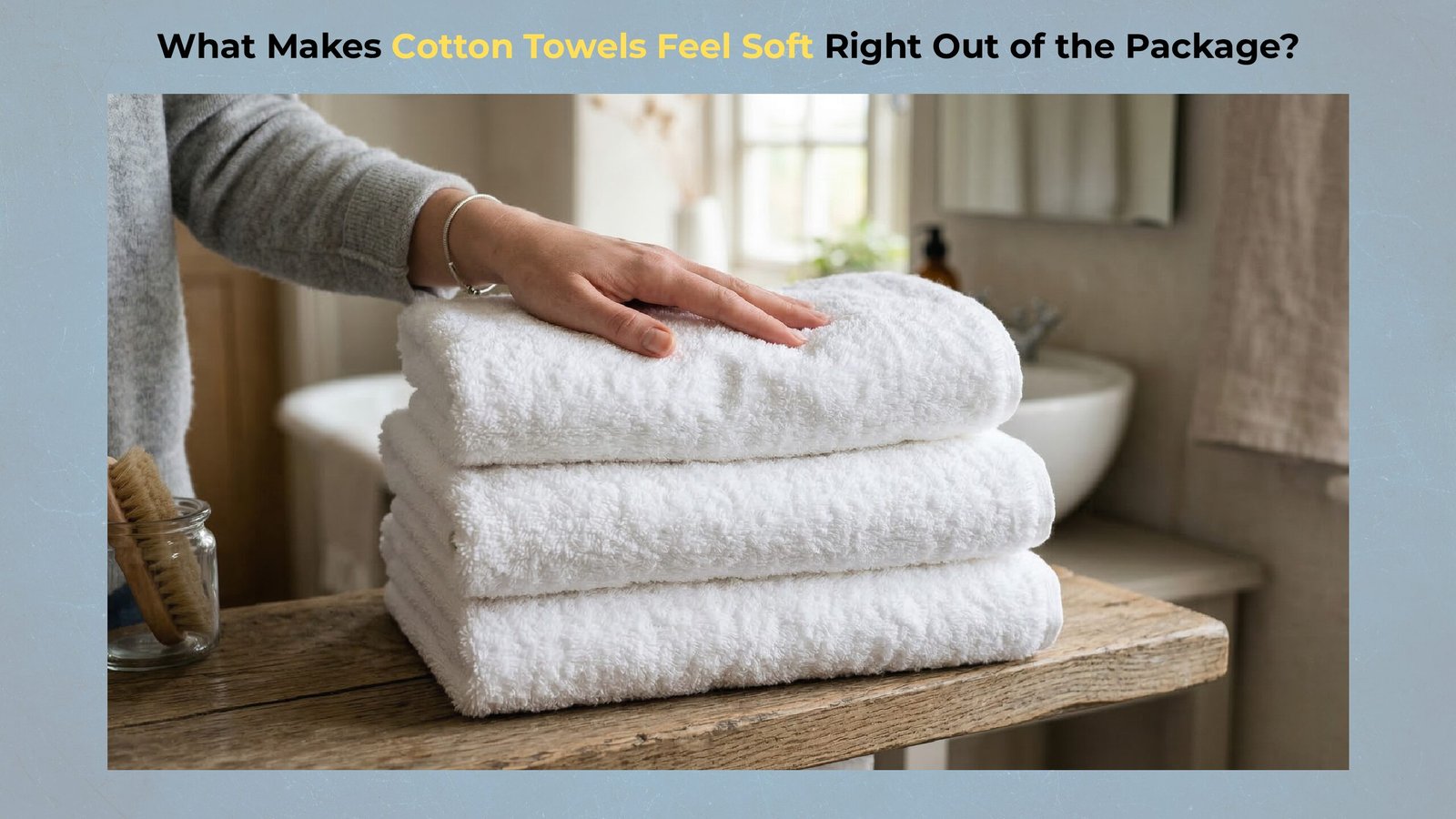
What Makes Cotton Towels Feel Soft Right Out of the Package?
Investigating the chemistry of the “First Touch” vs. the “First Wash.”
The softness of Cotton Towels right out of the package is often an illusion created by temporary chemical finishing agents designed to maximize shelf appeal. Retailers recognize that consumers use tactile sensation as a primary proxy for quality. Chemical Finishes on Cotton Towels lubricates the fibers, which creates a deceptively soft feel that masking the true coarseness of lower-grade cotton. This sensory manipulation relies on water-soluble coatings that eventually dissolve, exposing the material’s actual structural limitations.
Why Do Cotton Towels Lose Softness After the First Wash?
Cotton Towels lose softness after the first wash because the water-soluble chemical finishes are stripped away, revealing the true, underlying fiber quality. Manufacturing processes apply these temporary agents to prevent snagging during high-speed weaving and to enhance display aesthetics. Mechanical agitation and detergent exposure dismantle these lubricating layers. The sudden transition from plush to abrasive indicates that the towel’s initial comfort was a chemical byproduct rather than a structural feature.
Identifying the Role of Sizing Agents in Initial Cotton Towels Softness
Identifying the role of sizing agents shows that residual starch or PVA sizing is applied to Cotton Towels to stabilize them for weaving, not for consumer comfort. PVA (Polyvinyl Alcohol) acts as a high-performance film that protects yarn from the friction of the loom. Residual Starch in Cotton Towels washes away in hot water, which reveals the underlying rough fiber that was previously encapsulated. This “sizing” creates a stiff, smooth barrier that mimics the density of high-quality textiles while concealing short, frayed cotton ends.
Analyzing the Impact of Silicone Finishes on Cotton Towels
Analyzing the impact of Silicone Finishes on Cotton Towels reveals that this temporary lubricant is used to mimic the luxurious drape and plush feel of high-end towels. Silicone emulsions penetrate the outer layer of the cotton loop, providing a silky texture that reduces fiber-to-fiber friction. These waxes provide a hydrophobic barrier that initially prevents the towel from feeling “damp” or “clammy” on the shelf. However, this same coating reduces absorbency, making the towel feel soft but perform poorly during its first few uses.
Correlating Initial Softness with Fiber Quality in Cotton Towels
Correlating initial softness with fiber quality confirms that short-staple Cotton Towels rely most heavily on chemical finishes to compensate for rough, exposed fiber ends. Short-staple cotton consists of numerous small fibers that create “hairy” yarn surfaces. Without chemical intervention, these ends catch the skin, resulting in a scratchy feel. Conversely, long-staple cotton (like Pima or Egyptian) is naturally smooth, requiring minimal processing to achieve a superior hand-feel.
How Do You Compare Immediate Softness vs. Structural Softness in Cotton Towels?
You compare immediate softness (superficial coating) vs. structural softness (fiber integrity) in Cotton Towels to determine the product’s long-term value. This comparison requires looking beyond the initial touch to the density, weight, and construction method. A towel that relies on structure maintains its plushness through hundreds of laundry cycles, whereas a chemically enhanced towel degrades rapidly.
Distinguishing Chemical Softness from Zero-Twist Cotton Towel Softness
Distinguishing chemical softness from Zero-Twist Cotton Towel softness is necessary because Zero-Twist achieves permanent softness structurally (via open fiber) while chemicals achieve temporary softness superficially (via coating). Zero-Twist construction utilizes a water-soluble wrap during spinning which is removed before reaching the shelf, leaving the cotton loops open and airy. This creates a permanent, cloud-like loft that doesn’t wash away. Chemical softness, in contrast, creates a slickness that masks the tight, high-tension twist of low-quality yarn.
Comparison Matrix: Softness Type vs. Longevity
| Softness Source | Mechanism | Longevity | Test for Verification |
|---|---|---|---|
| Chemical Finish (PVA/Silicone) | External Coating | 1 Wash Cycle | Aggressive Chemical Smell |
| Long-Staple Fiber (Egyptian/Pima) | Fiber Integrity | 5+ Years | Sheen and Smoothness |
| Zero-Twist Construction | Low Fiber Tension | 1-2 Years | Physical Pinch Test |
Evaluating the Impact of Mercerization on True Cotton Towels Softness
Evaluating the impact of mercerization on true Cotton Towels softness shows that this chemical process is a positive indicator of quality investment. Mercerization involves treating cotton with sodium hydroxide to swell the fibers, increasing their surface area and luster. This permanent structural change improves dye uptake and fiber strength. Unlike temporary silicone coatings, mercerization is a fundamental refinement of the fiber itself, providing a lasting silk-like finish.
When Should You Be Wary of the Initial Softness of Cotton Towels?
You should be wary of the initial softness of Cotton Towels when the product’s sensory feel conflicts with its structural price point or chemical scent. Market saturation has led to the proliferation of “beauty treatments” for textiles. If a towel feels extraordinarily soft but lacks weight (GSM) or has a synthetic odor, the softness is likely a cosmetic additive rather than a quality trait.
Avoiding Cotton Towels with Aggressive Chemical Scents
Avoiding Cotton Towels with aggressive chemical scents is the simplest way to avoid finishes, as strong odors signal heavy temporary finishing agents. A high-quality cotton towel should smell neutral or slightly like raw plant fiber. A sweet, waxy, or sharp synthetic scent indicates a saturation of silicone softeners or anti-fungal agents used for long-distance shipping.
Matching Towel Price to Expected Cotton Towels Softness
Matching towel price to expected Cotton Towels softness requires knowing that extreme softness at a budget price is mathematically impossible without chemical assistance. Long-staple cotton is an expensive raw material. If a $5 Cotton Towel feels softer than a $25 towel, the cheap towel is relying entirely on temporary fillers. Real quality is priced by weight and fiber origin, not by the initial “fluff” factor.
Prioritizing Structural Integrity Over Initial Cotton Towels Softness
Prioritizing structural integrity over initial Cotton Towels softness is necessary because durability must always be validated before a cosmetic feature that can be faked. Examine the double-stitched hems and the density of the loops. A durable towel with a slightly firmer feel will soften naturally over time, while a flimsy, soft towel will fray and pill within months.
How Can You Eliminate Temporary Softness and Reveal True Cotton Towels Quality?
You can eliminate temporary softness and reveal true Cotton Towels quality by executing a simple, best-practice wash protocol that strips all residual manufacturing agents. New towels must be “broken in” to reach peak absorbency. Until the factory coatings are removed, the cotton cannot effectively interact with water.
Implementing the Vinegar and Baking Soda Strip for Cotton Towels
Implementing the Vinegar and Baking Soda Strip is the best practice for dissolving the complex mix of sizing agents and chemical finishes on new Cotton Towels. Wash the towels once with one cup of white vinegar and once with half a cup of baking soda. Aggressive Stripping of Cotton Towels removes hydrophobic residue, which restores natural absorbency. This protocol effectively “resets” the fiber, revealing its genuine texture.
Data Table: Post-Purchase Indicators of Fake Cotton Towels Softness
| Indicator | Chemical Agent Implied | Long-Term Solution |
|---|---|---|
| Excessive Lint in First Wash | PVA/Sizing Agents | Requires multiple washes to remove all residue |
| Sudden Stiffness Post-Dry | Silicone Wax Residue | Vinegar Strip and Tumble Low |
| Water Beading | Hydrophobic Finishes | Use hot water to dissolve coatings |
Best Practices for Drying Cotton Towels to Maintain Loft
Best practices for drying Cotton Towels focus on utilizing low heat and dryer balls to maintain the structural plushness provided by the pile. High heat damages cotton fibers, making them brittle and rough. Tumble-drying on low heat with wool dryer balls physically beats the air back into the loops, providing a natural loft that doesn’t rely on chemical slickness.
How Do You Validate Long-Term Cotton Towels Softness Before Buying?
You validate long-term Cotton Towels softness before buying by executing a physical audit that verifies the structural integrity of the fiber. Don’t just brush your palm over the top; engage with the fabric’s core.
Executing a 4-Step Cotton Towels Softness Audit
This 4-step Cotton Towels softness audit is a “Softness Integrity Test” box designed to spot low-quality construction.
- [ ] The Pinch Test: Pinch the fabric. Does it feel substantial (high GSM)? Cotton Towels must have density to maintain softness.
- [ ] The Scent Check: Does the Cotton Towel have a strong chemical scent? (Indicates fake softness/filler).
- [ ] The Sheen Test: Does the Cotton Towel have a slight, high-quality sheen? (Indicates mercerization/good fiber).
- [ ] The Staple Check: Look for “Long-Staple,” “Pima,” or “Egyptian” on the label. (Verifies the structural basis for softness).
Frequently Asked Questions About Cotton Towel Softness
This is due to the removal of “sizing agents” and silicone finishes. Manufacturers coat fibers with these water-soluble lubricants to improve “hand-feel” for sales purposes. The first wash strips these away, revealing the true quality of the cotton underneath.
Check for an oily or slick residue when you rub the fabric. Also, sniff the towel; high concentrations of chemical finishers often leave a sweet or synthetic scent. Finally, look for water beading on the surface—structural softness is hydrophilic, while chemical finishes are often hydrophobic.
Actually, the opposite is true. Fabric softeners coat fibers in a waxy film that builds up over time, eventually making towels stiff, greasy, and significantly less absorbent. We recommend using white vinegar in the rinse cycle instead.
Perform a “towel strip” using one cup of white vinegar followed by a second wash with half a cup of baking soda. This breaks down detergent and mineral buildup. Always finish by tumble drying on low heat with wool dryer balls to manually fluff the loops.
Conclusion: How Does Knowing the Source of Cotton Towels Softness Affect Your Purchase?
Knowing the source of Cotton Towels softness affects your purchase by changing your focus from temporary feel to verifiable, structural quality. A consumer who understands textile chemistry is no longer susceptible to the “softness trap” of big-box retail. Focusing on GSM and fiber origin ensures comfort that improves with age rather than disappearing in the wash.
Recap: Summarizing the Difference Between Fake and True Cotton Towels Softness
Summarizing the difference confirms that softness “out of the package” is a sales tactic; long-term softness is structural and requires specific material selection. Chemical softness is a coating; structural softness is a construction. Always choose the latter to avoid the “sandpaper effect” after the third wash.
Final Verdict: Prioritizing Fiber Integrity Over Initial Cotton Towels Feel
The final verdict is that prioritizing fiber integrity over initial Cotton Towels feel ensures a high return on your comfort investment. Never buy a Cotton Towel based solely on how soft it feels in the store—verify the GSM and staple length first. The softness that lasts is the softness that is earned, not sprayed on.
Technical & Educational Disclaimer
The investigative content provided on Toweldaily.com regarding textile chemistry (PVA sizing, silicone finishers) and maintenance protocols is intended for educational purposes only. While our team strives for scientific precision, individual results from “stripping” or “vinegar rinses” may vary depending on local water hardness, detergent formulations, and specific garment manufacturing standards. Toweldaily.com does not guarantee a specific softness outcome and is not responsible for damage resulting from improper laundry techniques. Always consult the specific care label attached to your Cotton Towels before attempting advanced chemical stripping.
UNRAVELING THE SCIENCE AND ART OF TOWELS, DAILY • TOWELDAILY.COM