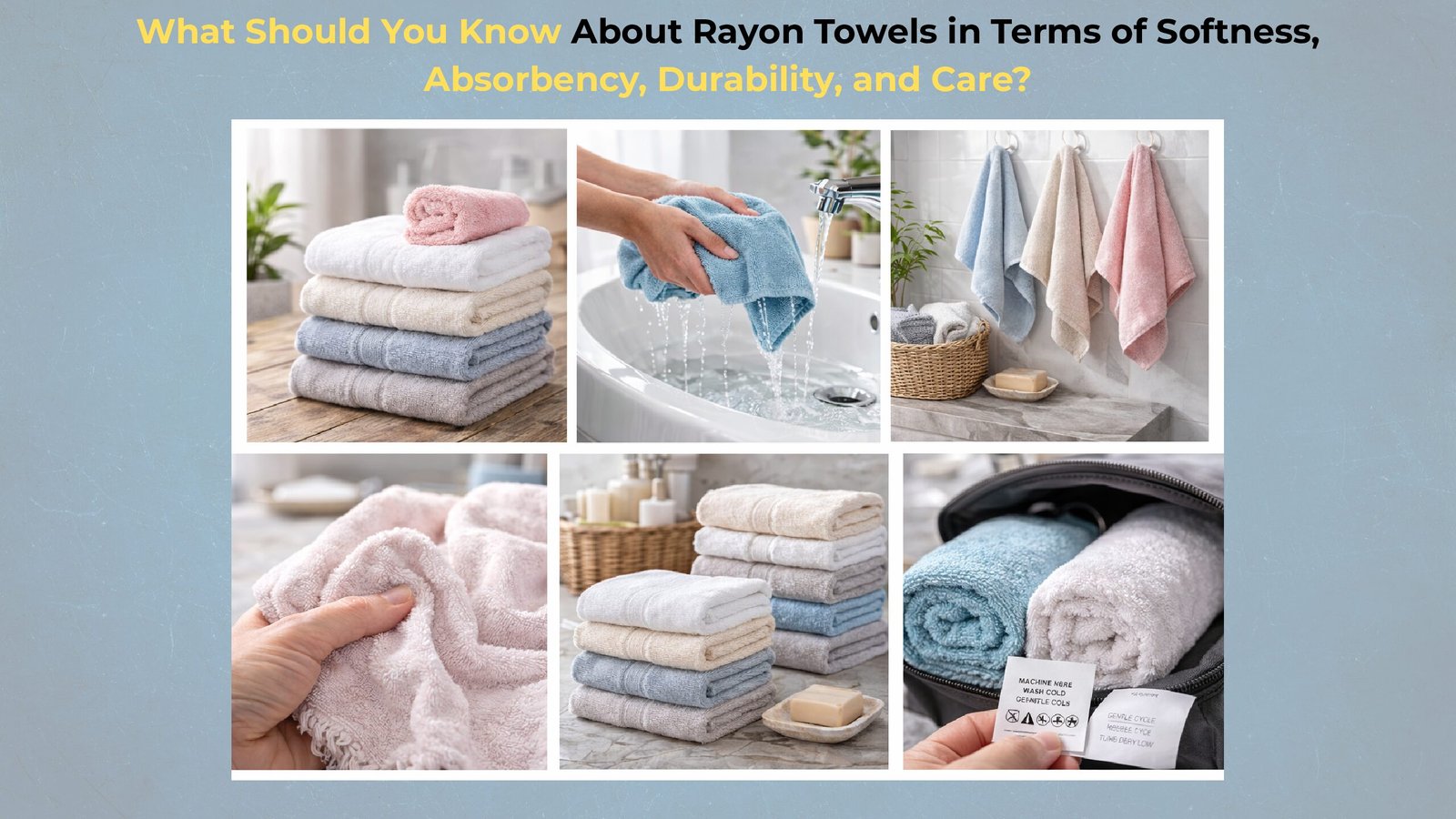
What Should You Know About Rayon Towels in Terms of Softness, Absorbency, Durability, and Care?
Rayon Towels are highly versatile due to their Regenerated Cellulose structure, but they require unique chemical and thermal care due to their delicate nature.
Rayon Towels are defined as regenerated cellulose fibers derived from plant pulp, frequently sourced from bamboo or wood. Their characteristic softness is a direct result of the smooth, round filament produced during extrusion. This often leads to a close Bamboo Towels Softness & Absorbency Comparison when consumers seek eco-friendly alternatives. Unlike cotton’s natural, slightly irregular structure, Rayon is engineered for uniformity.
The longevity and softness of a Rayon Towel depend entirely on the manufacturing process (closed-loop Lyocell is superior). Understanding the distinction between basic viscose and advanced lyocell is crucial for both consumer satisfaction and environmental sustainability.
[Smooth Cellulose Structure of Rayon Towels] → [minimizes Fiber Abrasion] → [creates superior, long-lasting softness].
Why is Rayon Towel Softness and Absorbency Often Misunderstood?
Rayon Towel softness and absorbency are often misunderstood because the fiber’s high moisture content makes it susceptible to degradation if mismanaged. Establish the value of this softness for sensitive skin while recognizing structural limitations that dictate specific laundry protocols.
Identifying the Source of Exceptional Softness in Rayon Towels
Identifying the source of exceptional softness in Rayon Towels reveals that the smooth, round filament of the fiber prevents the friction that causes itching. Rayon Towels’ fibers are naturally long and round, preventing the microscopic sharp ends that cause friction in traditional cotton weaves. For a deeper look at natural fiber alternatives, see the Cotton Towels Comfort & Absorbency Guide. [Naturally Round Filaments of Rayon Towels] → [reduce surface friction] → [prevent skin irritation].
Evaluating the Wicking Speed of Rayon Towels vs. Capacity
Evaluating the wicking speed of Rayon Towels proves they are optimized for fast drying due to high surface area, rather than deep saturation capacity. Rayon Towels (especially Modal) wick moisture quickly, facilitating fast drying. This performance is often contrasted with the rapid evaporation found in synthetic options, as noted in the Microfiber Towels Fast-Drying Performance analysis. However, they typically possess a slightly lower saturation capacity than high-GSM cotton counterparts.
Analyzing the Vulnerability of Rayon Towels to Stiffening
Analyzing the vulnerability of Rayon Towels to stiffening is critical because the soft fiber structure is easily damaged by high heat and Chlorine. The soft fiber structure is easily compromised by High Heat and Chlorine, which causes the smooth texture to degrade into a stiff and brittle state.
How Do You Differentiate Types of Rayon Towels (Viscose, Modal, Lyocell)?
You differentiate types of Rayon Towels by understanding that each category (Viscose, Modal, Lyocell) reflects a different chemical process and resulting sustainability profile.
Distinguishing Between Viscose and Lyocell Processing for Rayon Towels
Distinguishing between Viscose and Lyocell Processing is essential for Rayon Towels because Lyocell offers superior sustainability and durability. Prioritize Lyocell Rayon Towels (such as Tencel) because they utilize a non-toxic, “closed-loop” solvent that is significantly safer for the user, as detailed in our study on Tencel (Lyocell) Moisture Absorption & Sustainability.
Comparison Matrix: Rayon Towels by Manufacturing Type
This comparison matrix maps the different Rayon Towels manufacturing types to their sustainability profile and core benefit.
| Rayon Towels Type | Chemical Process | Sustainability Profile | Core Benefit |
|---|---|---|---|
| Viscose | Open-Loop (Carbon Disulfide) | Low (Chemical Waste) | Low Cost, High Absorbency |
| Modal | Open-Loop Variation | Medium | High Strength, Silky Feel |
| Lyocell (Tencel) | Closed-Loop (Recycled Solvent) | Highest | Superior Durability, Chemical Safety |
Assessing the Impact of Wet Strength on Rayon Towels Durability
Assessing the impact of Wet Strength on Rayon Towels durability is necessary because the smooth fibers lose strength when saturated. Modal and Lyocell Rayon Towels have significantly improved Wet Strength compared to traditional Viscose, making them less prone to tearing or thinning when wet—a key finding in our Modal Towels Durability Analysis.
When Do the Durability Limitations of Rayon Towels Affect Usage?
The durability limitations of Rayon Towels affect usage in environments that rely on aggressive sanitization and high-heat thermal cycles.
Avoiding High-Heat Contexts
Avoiding Rayon Towels for high-heat sanitization contexts is crucial because excessive heat can cause irreversible stiffening and fiber deformation. Advise against using Rayon Towels in commercial settings that rely on industrial dryers to kill germs. For heavy-duty industrial needs, many facilities look toward a Polyester Towels Durability & Drying Speed profile instead.
Prioritizing Lyocell
Prioritizing Lyocell Rayon Towels is essential for sensitive skin users because the Closed-Loop process guarantees minimal chemical residue. Recommended for those with hypersensitivity to ensure minimal chemical residue contact.
Matching Rayon Towels to damp environments for hygiene
Matching Rayon Towels to damp environments for hygiene leverages their superior wicking speed to combat moisture retention. Leverage the fast-drying speed of Rayon Towels (especially Modal) to prevent mildew growth in poor airflow bathrooms.
How Can You Ensure Rayon Towels Retain Their Softness and Integrity?
You can ensure Rayon Towels retain their softness and integrity by strictly controlling the thermal and chemical agents used in the laundry process.
Avoiding High Temperatures and Chlorine That Damage Rayon Towels
Avoiding high temperatures and Chlorine is mandatory because these agents permanently damage the smooth Cellulose structure of Rayon Towels. Excessive heat can effectively melt or permanently stiffen the fibers of Rayon Towels.
Data Table: Essential Care Rules for Rayon Towels
This data table details essential care rules for Rayon Towels, providing solutions for chemical and heat risks.
| Violation | Impact on Rayon Towels | Recommended Care Instruction |
|---|---|---|
| High Heat Drying (Above 140°F) | Causes irreversible stiffness | Tumble Dry Low / Air Dry |
| Chlorine Bleach | Damages natural color and bonds | Use Oxygen Bleach Only |
| Harsh Detergent | Weaves down pile, reducing loft | Use Gentle, pH-Neutral Detergent |
Best Practices for Drying to Maintain Softness in Rayon Towels
Best practices for drying Rayon Towels involve utilizing air drying or very low tumble drying to prevent fiber breakdown. Utilize air drying or very low tumble drying to maintain the smooth structure and prevent breakdown.
[Gentle Washing of Rayon Towels] → [preserves Cellulose structure] → [maintains silky feel and drape].
How Do You Validate Quality and Authenticity in Rayon Towels?
You validate quality and authenticity in Rayon Towels by executing a 4-step audit focused on verifying the manufacturing type and structural integrity.
Executing a 4-Step Rayon Towels Audit
This 4-step Rayon Towels audit is a “Fiber Integrity Test” box you can use to verify quality.
Is the Rayon Towel labeled Viscose, Modal, or Lyocell? (Prioritize Lyocell).
Does the Rayon Towel feel silky, cool, and smooth? (Verifies high quality processing).
Gently tug the Rayon Towel when damp. Does it feel fragile? (Indicates low Wet Strength/Viscose Processing).
Is there an Oeko-Tex or GOTS certification visible? (Verifies chemical safety).
Conclusion: Are Rayon Towels the Best Balance of Comfort and Durability?
Rayon Towels are the best balance of comfort and durability only when the manufacturing process (Lyocell) and the consumer’s care routine align perfectly.
Recap: Summarizing the Key Trade-Offs of Rayon Towels
Summarizing the key trade-offs confirms that Rayon Towels offer superior softness and wicking speed but demand strict adherence to low-heat, gentle care routines. Reiterate that while softness is superior, the user must comply with maintenance standards. To contextualize these fibers against all available options, consult our Complete Towel Materials Guide.
Final Verdict: Prioritizing Lyocell Rayon Towels for Longevity
The final verdict is that prioritizing Lyocell Rayon Towels provides the best balance of softness and long-term durability within the regenerated fiber category. When buying Rayon Towels, prioritize the Lyocell process for the best results.
“The future of fabric is regenerated, but its longevity is up to your care.”
Disclaimer: The information provided in this guide is based on bio-textile research and is intended for educational purposes. Actual towel performance and longevity are subject to specific manufacturing variables, including GSM, weave pattern, and blend percentages. Always prioritize the instructions found on the physical care label of your product.