Industrial Performance Guide
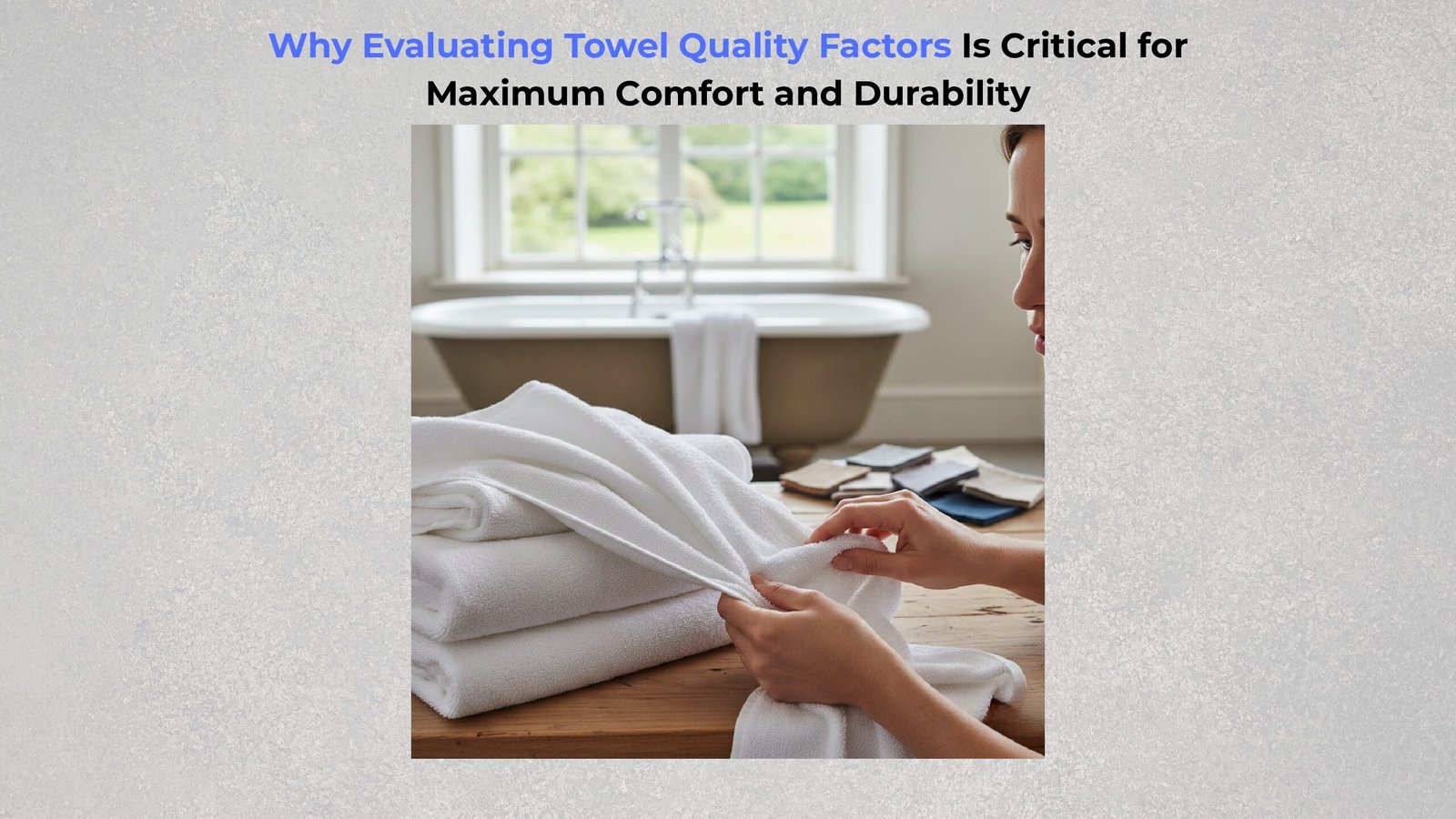
Why Evaluating Towel Quality Factors Is Critical for Maximum Comfort and Durability
Evaluating Towel Quality Factors is critical when buying towels because industrial textile construction and spinning methods heavily influence the long-term sensory comfort and high-cycle durability of the fabric.
In the modern marketplace, surface-level softness is often a chemical illusion achieved through silicone-based softeners. However, true quality is anchored in textile physics—friction, absorption, and tensile strength. By shifting perspective from subjective aesthetics to objective engineering, consumers can audit fabrics based on fiber architecture and mechanical alignment.
Before analyzing construction details, it helps to review the broader guide on what are the 16 factors to consider before buying a towel, since quality connects directly to material, durability, weight, and overall value.
Why Towel Quality Factors Directly Influence Long-Term Skin Health and Sensory Comfort
Towel Quality Factors directly influence long-term skin health and sensory comfort because optimal pile height and loop density mechanically mitigate epidermal micro-abrasions.
Softness and Comfort: Comfort is often the first thing people notice. However, softness should remain even after multiple washes. To better understand this balance, read why soft towels are worth considering before you buy when evaluating premium quality options.
Towel Quality Factors Comfort-to-Durability Risk Matrix
| Quality Indicator | Low-Spec Result | High-Spec Result | Impact on User Experience |
|---|---|---|---|
| Fiber Staple | Fraying & Pilling | Smooth Surface | High tactile comfort |
| Loop Integrity | Rapid Flattening | Resilience/Loft | Sustained capillary absorption |
| Chemical Finish | Synthetic Coatings | Natural Purity | Reduced risk of allergic reactivity |
Executing a Towel Quality Factors Sensory Audit on Premium Towels
Executing a Towel Quality Factors sensory audit protects buyers from abrasive textiles and chemical irritants hidden beneath synthetic softeners.
According to the American Academy of Dermatology (AAD), minimizing skin friction is essential for sensitive or eczematous skin. While high-quality textiles mitigate mechanical friction, individual skin conditions create varying baselines for “comfort.” High-grade construction reduces irritation but cannot cure underlying dermatological sensitivities.
Sensory Quality Audit Checklist
- ☐The Friction Test: Drag a towel across a sensitive area (inner arm) to detect “catch” or abrasive fibers.
- ☐The “Weight-to-Loft” Ratio: Measure the towel’s thickness when folded to assess air-trapping potential.
- ☐The Scent Check: Detect chemical/petroleum odors that signal low-tier manufacturing SOPs.
What Technical Specifications Constitute High-Performance Towel Quality Factors
Technical specifications constitute high-performance Towel Quality Factors by providing measurable benchmarks for fiber selection, spinning methodology, and fabric weight. To understand how these physical properties compare across different fabric categories, review our comprehensive Textile Care Protocols.
Construction and Thickness: The way a towel is woven affects how dense, plush, and durable it feels. Higher pile construction often signals better performance. To see how structure impacts function, explore how towel thickness impacts its performance before you purchase it when evaluating quality.
How Towel Quality Factors Dictate the Selection of Combed vs. Carded Yarns
Towel Quality Factors dictate the selection of combed versus carded yarns by determining the acceptable threshold for short, weak staples that cause linting.
Fiber Strength and Material Composition: One of the most important quality indicators is the type and strength of fibers used. Long-staple cotton, for example, typically produces smoother and more resilient towels. Understanding what makes towel material essential to evaluate before buying allows you to better assess whether a towel’s quality matches its claims.
As defined by Cotton Incorporated, the combing process removes “noil”—short fibers usually in the low-to-mid teens. Carded cotton retains these, which leads to increased surface fuzz and pilling during repeated laundering.
What Spinning Methods Define Towel Quality Factors Softness and Strength
Specific spinning methods define Towel Quality Factors softness and strength by manipulating the twist and alignment of the cotton yarns. Ring-Spun yarns offer higher tensile strength, while Zero-Twist constructions rely on structural binding for plushness.
Technical Definition: Twist Multiple (TM). The factor used to calculate yarn twist levels. Low TM yields maximum plushness, whereas high TM yields industrial longevity.
Quantifying Towel Quality Factors Absorbency via GSM Analysis
Quantifying Towel Quality Factors absorbency via GSM (Grams per Square Meter) analysis provides an objective measurement of the textile’s total water capacity. Standardized by ASTM D3776, luxury towels typically exceed 600 GSM.
Weight and Density (GSM): Quality towels often have an appropriate balance of weight and density, typically measured in GSM (grams per square meter). Heavier towels may feel more luxurious, but balance matters. Learn why towel weight is important to consider before you buy to understand how it reflects quality standards.
Absorbency Performance: A towel’s primary job is to absorb moisture efficiently. High-quality fibers improve drying performance without becoming stiff over time. Discover why towel absorbency is important to consider before you buy when judging overall quality.
Technical Spinning Methods Comparison Matrix
| Spinning Type | Best For | Technical Advantage |
|---|---|---|
| Ring-Spun | Longevity/Hotels | Higher tensile durability under repeated laundering |
| Zero-Twist | Luxury/Home | Untwisted fibers provide “cloud-like” feel |
| Open-End | Budget/Utility | Cost-effective but prone to rapid thinning |
How to Contextualize Towel Quality Factors Benchmarks Across Different Usage Environments
Contextualizing Towel Quality Factors benchmarks ensures that the fabric’s physical properties align with specific atmospheric and mechanical stresses.
Environmental Calibration: Spa vs. Gym
Under AATCC 199 testing, lower-GSM, open-loop constructions demonstrate significantly faster drying times, essential for high-humidity coastal or spa environments where mildew is a primary risk.
Professional-Grade Towel Quality Factors: Vat-Dyeing Standards
Professional-grade Towel Quality Factors require specific vat-dyeing standards to ensure the fabric withstands repeated exposure to harsh bleaching chemicals without significant color loss.
Environment-Specific Selection Table
| Environment | Primary Metric | Recommended Construction |
|---|---|---|
| Master Suite | Softness (Micron level) | ELS Egyptian Cotton / 700 GSM |
| Gym/Sport | Dry-Time (AATCC 199) | Polyamide Blend / 300 GSM |
| Hospitality | Durability (ASTM D5034) | Combed Ring-Spun / 550 GSM |
How to Inspect and Preserve Selected Towel Quality Factors
Inspecting and preserving selected Towel Quality Factors requires strict adherence to physical construction audits and pH-balanced laundering protocols.
Verifying Construction via SPI Counts
Verifying Towel Quality Factors construction via physical Stitch-Per-Inch (SPI) counts immediately reveals manufacturing investment. Commercial-grade hems require 12–14 SPI to prevent edge fraying.
Total Cost of Ownership (TCO) Procurement Strategy
Operationalizing long-term value requires shifting from upfront cost to total cost of ownership.
Durability Over Time: True quality reveals itself after months of use. Towels that resist fraying, thinning, and color fading usually reflect better manufacturing standards. Reviewing how evaluating durability helps you choose a better towel can help you identify products built to last.
Price vs. Quality Balance: Higher quality sometimes comes at a higher cost, but price alone doesn’t guarantee excellence. Before investing, consider why you should consider towel cost before buying to ensure the quality aligns with your budget expectations.
Value Efficiency Formula
(Purchase Price + Total Laundering Energy) / Total Wash Cycles = Value Efficiency
Towel Quality Factors Benchmarks Master Reference
| Quality Grade | Fiber Origin | Performance Expectation |
|---|---|---|
| Grade A (Elite) | Giza 45 / Suvin | 300+ Wash Cycles; Supreme Loft |
| Grade B (Standard) | Pima / Turkish | 150+ Wash Cycles; High Absorbency |
| Grade C (Utility) | Carded Upland | <50 Wash Cycles; Prone to Fraying |
Final Execution Checklist
- 1 Select brands using Ring-Spun, ELS (Extra-Long Staple) fibers.
- 2 Perform a 60°C wash trial to check for dimensional stability.
- 3 Verify Standard 100 by OEKO-TEX bio-safety requirement.
- 4 Audit construction for a minimum of 12-14 Stitches Per Inch.
Brand Reputation and Manufacturing Standards: Quality is often supported by reputable manufacturers that follow strict production guidelines. That’s why it’s helpful to examine why choosing the right brand is essential when buying towels as part of your quality evaluation process.