
TowelDaily · Textile Engineering Guide
The useful difference comes from the assigned task and verified finished performance—not the product name alone.
Dish towels and kitchen towels cannot be separated reliably by name alone because retailers, households, and regions use the terms differently. A better comparison starts with the intended task, then checks the finished towel for visible lint, streaks, water pickup, capacity, handling, drying, and compatibility with its care instructions.
That approach prevents two common errors: assuming every flat cloth is lint-free and assuming every terry or waffle towel absorbs more water. Fiber content, yarn structure, weave or pile, finishes, hems, labels, wear, soil, and laundering history can all change the result. A towel that succeeds on a spill may still leave fibers or residue on a wine glass.
What actually distinguishes a dish towel from a kitchen towel?
The defensible distinction is functional: a dish towel is assigned primarily to drying or handling dishes, while “kitchen towel” is a broader label that may cover dishes, hands, counters, or spills. Neither name guarantees a specific fiber, weave, pile, size, absorbency level, or lint result.
Flat-woven cotton or linen cloths are commonly sold for dishes and glassware; terry and waffle constructions are commonly sold for hands and general kitchen work. Those are market patterns, not technical definitions. A smooth face can still shed from cut fibers, hems, or a label, while a well-made pile fabric may meet a particular household’s tolerance after laundering.
Since “kitchen towel” can describe several household textile formats, the defining features and uses of kitchen towels help clarify why the label alone does not identify a glass-drying or dish-specific construction.
Assigning towels by task is also easier to manage hygienically. One cloth can be reserved for clean dishes, another for hands, and another for work surfaces. A product may perform more than one job, but its clean-task status ends when it contacts raw-food juices, floor soil, cleaning chemicals, or another incompatible source.
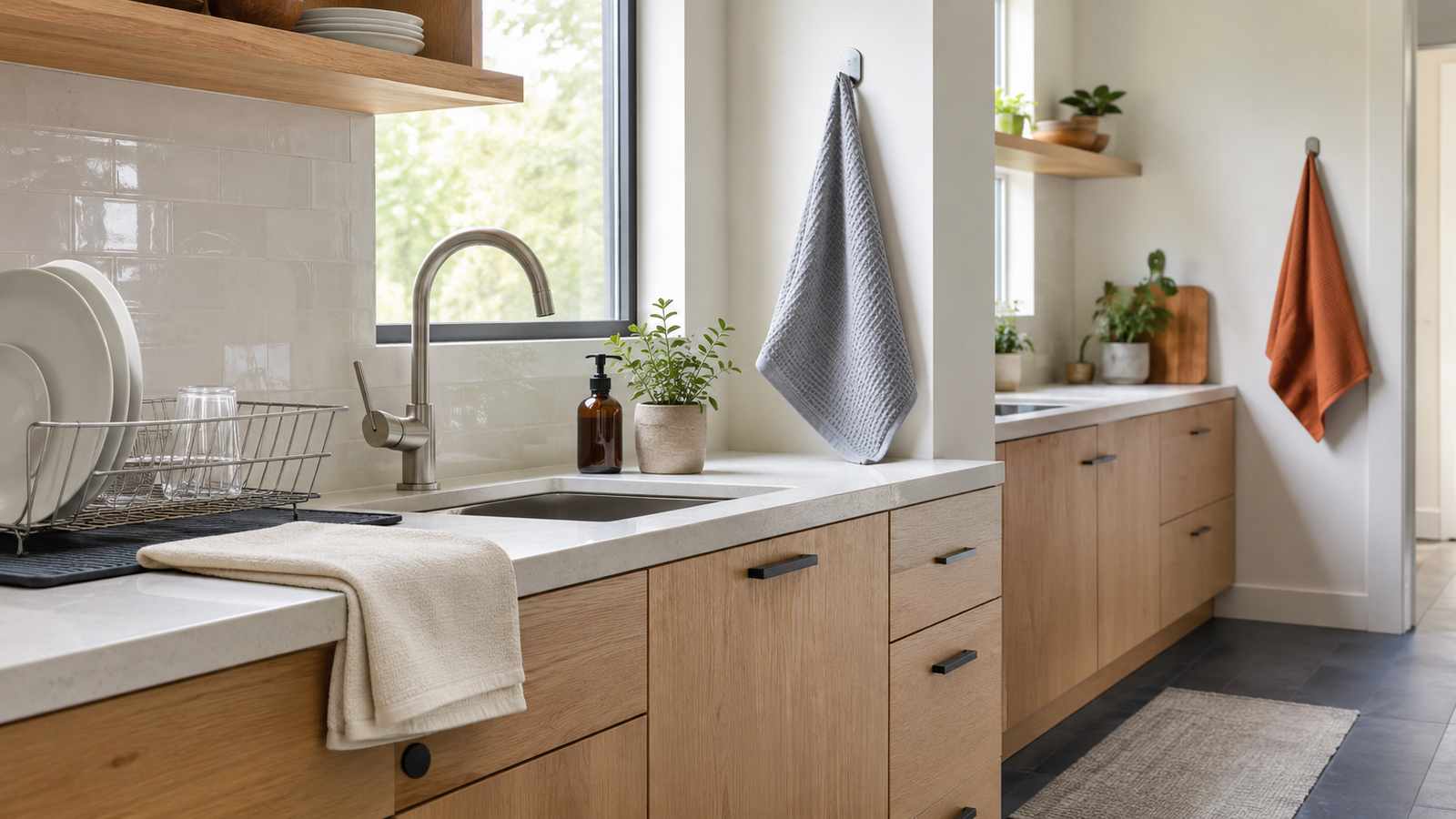
Which construction features influence visible lint from dish towels and kitchen towels?
Visible lint depends on the complete construction and condition, including fiber length distribution, yarn twist, fabric structure, pile, finishing, edges, labels, abrasion, and laundering. Flat weave and terry describe geometry; they do not independently predict how many fibers a finished towel will leave on glass.
Which methods can measure fiber release from a towel?
Fiber release can be measured only after the method and endpoint are defined. AATCC TM212 measures the mass of fiber fragments released during accelerated laundering, but AATCC states that exact correlation with full-scale home laundering has not been established.
That method answers a laundering-release question; it does not directly count fibers left on a drinking glass during wiping. IEST-RP-CC004.4 includes tests for wipers used in cleanrooms and controlled environments, but its scope is not ordinary kitchen towels. A household or purchasing test therefore needs a transparent service protocol rather than an invented universal lint limit.
If visible fibers remain on dishes or glassware, what causes lint from dish towels helps separate face shedding from damaged hems, loose labels, abrasion, trapped debris, and laundry-related fiber release.
How should dish towels and kitchen towels be compared by task?
Compare each towel against the failure that matters for the task. Glassware emphasizes visible lint, streaks, residue, and safe handling; hands emphasize pickup, comfort, and clean assignment; spills emphasize capacity and control; counters add surface compatibility and hygiene.
Once the task has been defined, how specialized dish towels differ by intended use becomes important when assigning separate textiles to glassware, dishes, hands, spills, or work surfaces.
| Kitchen task | Primary checks | Important limitation |
|---|---|---|
| Drying glassware | Visible fibers, streaks, residue, grip, and complete moisture removal under directional light. | A “lint-free” label does not prove a mark-free finish after actual laundering. |
| Drying dishes | Surface pickup, usable dry area, wet handling, seam contact, and finish. | Rapid wetting does not establish total capacity or drying speed. |
| Drying hands | Pickup at realistic pressure, comfort, hanging fit, and between-use drying. | A towel that remains damp may need more airflow, rotation, or capacity. |
| Managing spills | Pickup, capacity, re-deposition, wringing, and compatibility with the spilled material. | Do not return a soiled spill towel to clean-dish or hand service. |
| Wiping work surfaces | Surface instructions, soil removal, residue, hygiene assignment, and laundering. | Food-service wiping-cloth rules may differ from household practice. |
| Handling hot cookware | Use only a dry product specifically intended and approved for heat handling. | A damp towel can transfer heat; a dish towel is not automatically a potholder. |
A product can pass one row and fail another. For example, a towel may absorb a spill well but leave residue on polished glass, or it may produce a clean glass finish yet offer too little usable capacity for repeated dishes. Keep the trial tied to the intended job.
How should dish-towel low-lint performance be tested on glassware?
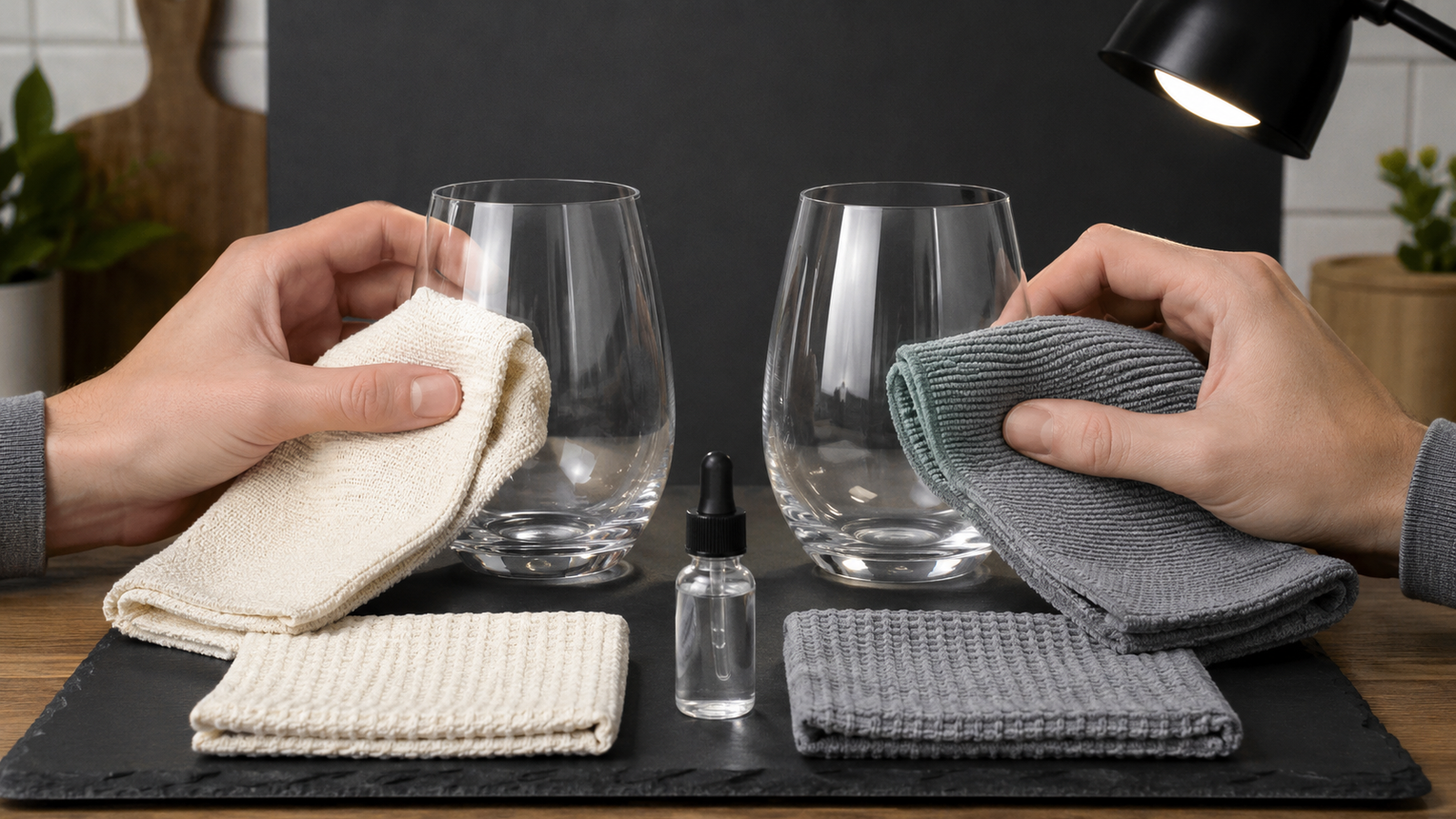
Test low-lint performance with identical clean glass, towel preparation, water load, wiping pattern, pressure, lighting, and inspection criteria. Record visible fibers separately from streaks and residue because a surface can be lint-free but still look marked.
- Confirm the glass manufacturer’s cleaning instructions and remove rings, hard trim, labels, or other objects that could contact the surface.
- Use comparable new samples, then launder and dry each sample exactly as its care label and the appliance instructions permit. Record the number of cycles.
- Clean loose soil from the glass before wiping. Guidance from glass manufacturer Viracon emphasizes a clean, grit-free cloth and avoiding trapped abrasive particles; its document concerns architectural glass, so verify requirements for the glassware being tested.
- Apply the same measured water amount to each glass, expose the same towel area, and use a defined number of strokes with controlled contact pressure.
- Inspect under the same directional light and background. Count visible fibers, then score streaks, residue, water spots, grip, and handling as separate endpoints.
- Repeat with multiple specimens. A single towel or single pass cannot establish a general product claim.
Set the acceptance rule before seeing the results. A household may accept an occasional fiber, while a restaurant, tasting room, laboratory, or controlled environment may use a different method and threshold. Report the exact conditions instead of translating one local result into “zero lint” for every use.
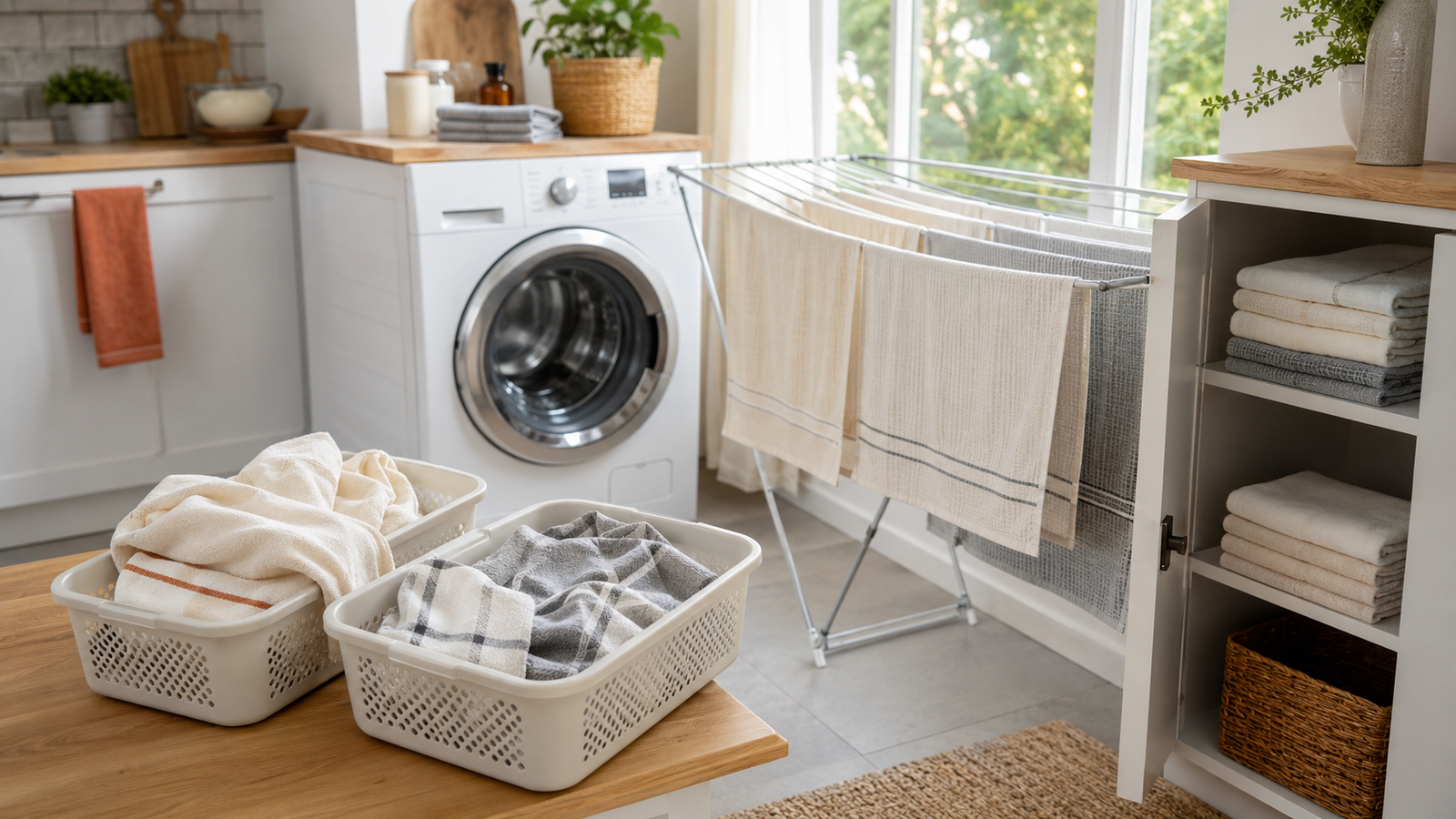
Which moisture properties matter for dish towels and kitchen towels?
Wetting, surface pickup, wicking, total capacity, moisture release, and drying time are different properties. A towel can wet quickly but fill quickly, hold substantial water but feel difficult to wring, or release moisture slowly after use.
Material names become useful only when considered alongside how absorbent materials perform in finished dish towels under the same wetting, pickup, capacity, contact, and laundering conditions.
- Wetting describes how readily liquid enters or spreads on the surface under stated conditions.
- Surface pickup describes water transferred from a wet surface into the towel during contact.
- Wicking describes liquid movement through or along the textile after contact.
- Capacity describes how much liquid a specimen retains under a defined loading and drainage procedure.
- Drying time depends on water load, exposed area, airflow, temperature, humidity, construction, and how the towel is hung.
After moisture enters the textile, how dish-towel construction affects drying performance becomes the next question because weave, fabric mass, water load, airflow, and hanging geometry interact.
Which textile tests distinguish towel moisture properties?
Different methods answer different questions. The AATCC test-method catalog lists separate methods for absorbency, liquid moisture management, wicking, and drying behavior. Results are meaningful only when the specimen preparation and method scope match the comparison.
ASTM D4772-26 measures rapid surface water absorption and retention by terry fabrics. Its scope specifically excludes non-terry constructions such as waffle weave, huck towel, and flour-sack towel, and ASTM notes that surface absorption is only one performance characteristic. It cannot rank every kitchen cloth on every moisture task.
For broader kitchen use, how kitchen towels balance absorbency with drying time helps explain why greater retained capacity does not automatically produce better between-use performance.
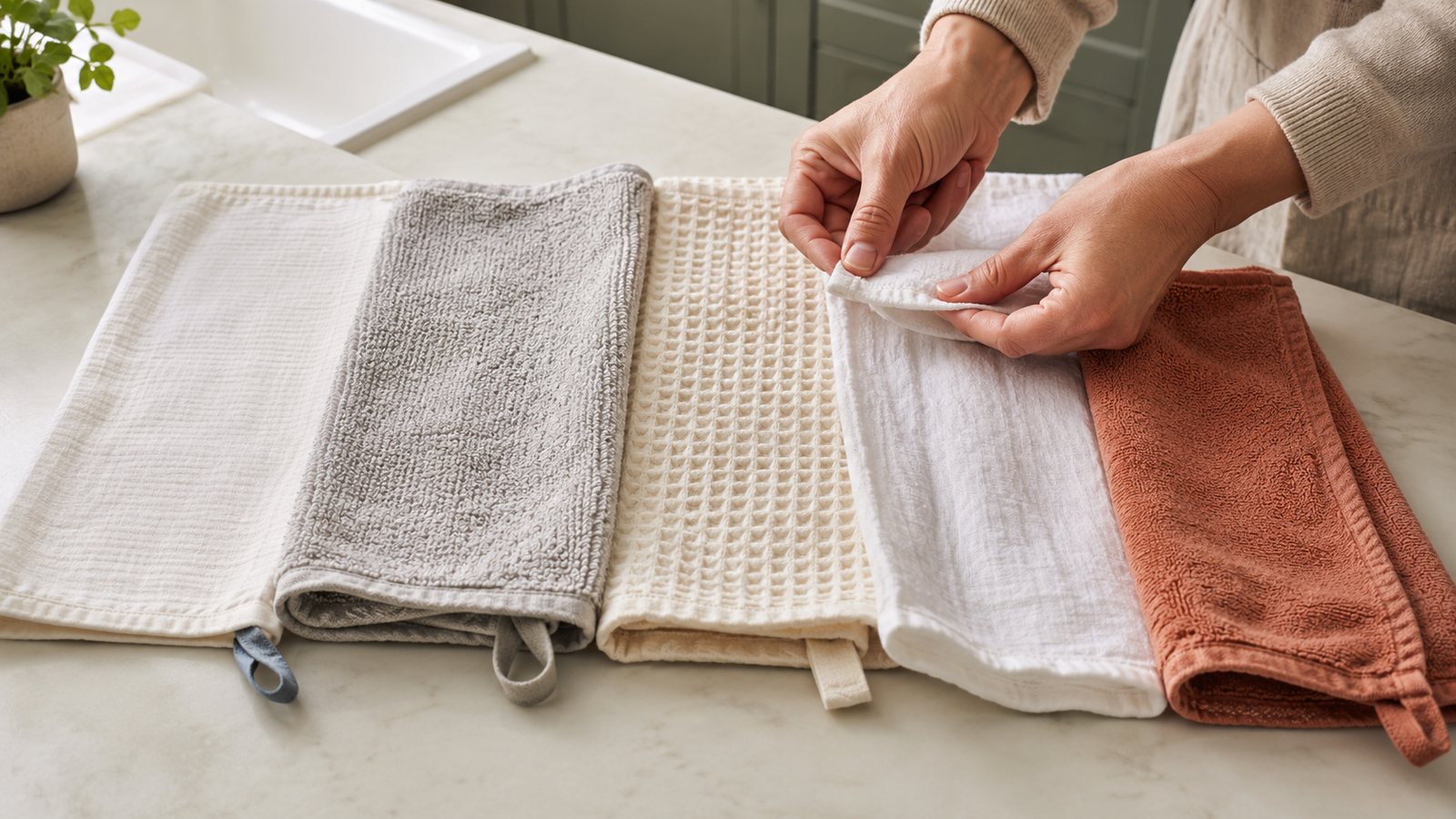
How do flat weave, terry, waffle, flour-sack, and microfiber towels compare?
These construction labels identify useful features, but none is an automatic winner. Compare finished products under the same task because yarn, density, finishes, edges, dimensions, mass, and laundering can outweigh the broad category name.
| Construction label | What the label suggests | What still requires verification |
|---|---|---|
| Flat weave | A low-profile face without terry pile. | Visible lint, stiffness, pickup, capacity, hems, labels, and finish after laundering. |
| Terry | Raised loops that increase the available contact surface. | Loop stability, lint, wet feel, pickup, retained water, drying, and snagging. |
| Waffle | A cellular relief pattern rather than a smooth plane. | Cell stability, surface contact, lint, wetting, capacity, shrinkage, and drying geometry. |
| Flour-sack style | A lightweight flat cloth, often with a large usable area. | Consistency, edge quality, show-through, pickup, capacity, lint, and distortion. |
| Microfiber | A product made with fine manufactured fibers, often polyester and polyamide. | Exact composition, split or unsplit structure, finish, care limits, lint, residue, and surface approval. |
Construction also creates interacting trade-offs. A 2025 study of four woven terry specimens measuring 75 × 75 centimeters found that increasing thread density improved several strength and dimensional outcomes while reducing absorbency, overall moisture-management capacity, drape, softness, and smoothness. The study does not establish a kitchen-towel ranking, but it shows why one variable cannot predict the whole fabric.
How should a dish towel or kitchen towel be selected?
Select the towel by converting the intended job into measurable pass criteria, then trialing representative finished samples. Do not approve a bulk purchase from fiber percentage, weave name, hand feel, or an unverified “lint-free” claim alone.
- ☐ Define the task: glassware, general dishes, hands, spills, work surfaces, or another named use.
- ☐ Confirm dimensions, hanging method, seams, labels, and usable contact area fit the kitchen and user.
- ☐ Record fiber content, construction, finish, care label, country of origin, and supplier lot.
- ☐ Launder representative samples according to the label before the final service evaluation.
- ☐ Test lint, streaks, residue, wetting, pickup, capacity, wet handling, and drying only where relevant.
- ☐ Include multiple samples and repeat trials so one unusually good or bad specimen does not decide the purchase.
- ☐ Set acceptance limits before comparing products and retain a reference sample from the approved lot.
- ☐ Recheck after representative use and laundering for shrinkage, distortion, seam damage, lint, odor, or declining performance.
For one-towel kitchens, prioritize the most frequent task and accept the documented trade-off. A multipurpose towel still needs clean-task rules: once it handles a greasy spill or contaminated surface, it should not return to dish drying until appropriately laundered and completely dried.
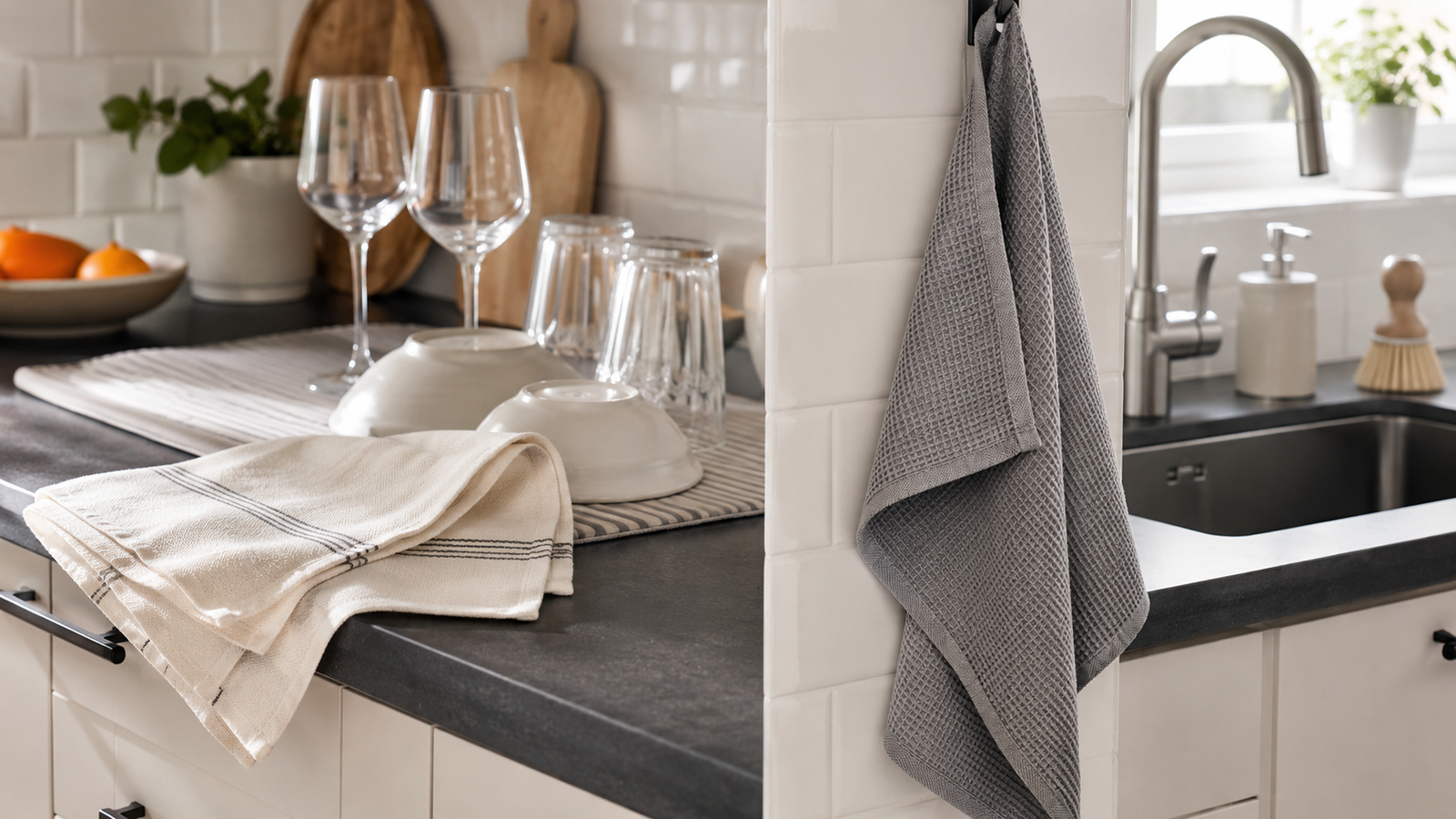
How should kitchen towels be assigned and used hygienically?
Kitchen towels should be assigned to compatible contact zones, changed when soiled or saturated, kept away from raw-food contamination, laundered appropriately, dried completely, and stored clean. Separation reduces transfer opportunities but does not sterilize a textile.
Because towels can contact hands, food-related soil, dishes, and work surfaces, how task assignment supports kitchen-towel hygiene should guide separation, personal handling, laundering frequency, and clean storage.
In a home, use a clear system such as different colors, patterns, hooks, or storage locations for clean dishes, hands, and surface work. Do not use a cloth exposed to raw meat, poultry, seafood, dirty floors, waste, or cleaning chemicals on hands, ready-to-eat food areas, or clean dishes. The FDA advises against drying hands with a towel previously used to clean raw-food juices.
Retail and food-service operations must follow their adopted code and local regulator. The 2022 FDA Food Code is model guidance, not a universal household rule. Its wiping-cloth provisions distinguish uses and include conditions for wet wiping cloths, sanitizer storage, and separation of cloths used with raw animal foods.
How should dish towels and kitchen towels be washed and dried?
Wash and dry each towel according to its care label, the laundry appliance instructions, the detergent directions, the soil type, and any applicable food-service rule. There is no single temperature, detergent form, bleach policy, softener policy, or cycle count that fits every fiber and construction.
- Separate towels by incompatible soil, color, lint transfer, and care requirements. Handle raw-food or heavily soiled cloths according to local procedures.
- Use the detergent amount and cycle permitted by the product and washer instructions. More detergent is not automatically cleaner and may leave residue if the process cannot rinse it adequately.
- Use the warmest appropriate water setting allowed by the item and appliance. CDC household guidance likewise directs users to follow manufacturer instructions, use the recommended water temperature, and dry items completely.
- Use bleach or another laundry additive only when the textile label, appliance manual, product directions, and soil-management plan permit it. Never improvise chemical combinations.
- Remove the towel promptly and expose it fully to the approved drying process. A folded or crowded damp cloth dries differently from one spread with airflow.
- After drying, check odor, residue, surface feel, wetting, lint, seams, and stains before returning the towel to its assigned clean task.
When washing is intended to correct lint or residue, how washing practices and vinegar can affect dish-towel lint should be checked before adding treatments that the textile, appliance, or product instructions do not permit.
How can fabric softener change kitchen-towel performance?
Fabric softener can change surface feel and water interaction, but the effect depends on formulation, dose, fiber, construction, and laundering. A 2021 controlled study on cotton fabric reported a softness–absorbency trade-off with conventional softener; that scoped result does not prove every product causes the same change.
If the towel or appliance guidance permits softener, verify the finished towel after the actual process. Compare wetting, pickup, residue, glass finish, and drying with an otherwise matched control. If performance declines, adjust within the manufacturers’ instructions or omit the product rather than applying a universal rule to every towel.
What causes lint, streaks, residue, odor, or slow drying in kitchen towels?
Most failures come from an interaction among construction, condition, soil, laundry chemistry, water load, use technique, and drying environment. Diagnose the visible symptom first, then change one controlled variable at a time.
| Symptom | Check first | Controlled response |
|---|---|---|
| Visible fibers on glass | Towel face, damaged hems, labels, transferred lint, laundering history, and inspection method. | Clean the glass, use a grit-free sample, repeat the defined trial, then reassign or reject persistent shedders. |
| Streaks without lint | Detergent or softener residue, water minerals, soil re-deposition, saturation, and glass-cleaning method. | Follow glass and laundry instructions; use a clean section sooner and compare a properly rinsed control. |
| Slow initial wetting | Finishes, laundry residue, oil, soil, water conditions, and the selected method. | Launder as directed and retest; do not confuse wetting speed with capacity. |
| Low usable capacity | Specimen size, fabric mass, drainage method, saturation point, and pressure during use. | Compare equal-size specimens with a defined load or increase rotation for the task. |
| Persistent odor | Delayed laundering, retained soil, incomplete drying, crowded storage, and washer cleanliness. | Correct the handling and care process within product instructions; retire cloths that remain unsuitable. |
| Slow between-use drying | Starting water load, folds, hook area, airflow, humidity, temperature, and towel dimensions. | Expose more area, improve safe airflow, reduce crowding, or rotate a second clean towel. |
| Surface scratches or marks | Grit, hard debris, decorations, damaged glass, and incompatibility with the surface instructions. | Stop wiping, rinse loose soil away, inspect both surfaces, and use an approved clean cloth. |
Do not solve one problem by creating another. Extra chemical may leave residue, aggressive rubbing may redistribute grit, and higher drying heat may violate the care label. The most useful correction is the smallest documented change that restores the required task result.
What are the most common dish-towel and kitchen-towel questions?
The most common questions concern naming, new-towel lint, glass safety, softener, and the best construction. Each answer depends on the finished towel and its use conditions rather than a universal material rule.
Are dish towels and kitchen towels the same thing?
The labels often overlap, so the name alone does not establish construction or performance. A seller may call a flat cloth, waffle towel, or terry towel a kitchen towel. Compare the intended task, finished surface, dimensions, moisture behavior, lint result, and care instructions instead.
Why does a new dish towel leave lint?
Loose fibers, cut edges, labels, manufacturing debris, or transfer from another laundry item can create visible lint. Launder the towel according to its label, dry it completely, and repeat a controlled glass test. Replace or reassign it if shedding remains unacceptable.
Can a kitchen towel scratch glass?
A towel should not be treated as harmless merely because its fiber feels soft. Grit, hard particles, damaged decorations, or debris trapped in the cloth can abrade a surface. Rinse loose soil away and use a clean, grit-free towel approved for the glass.
Does fabric softener always reduce towel performance?
No universal result applies to every softener, dose, fiber, construction, and laundry process. A controlled cotton-fabric study found a softness–absorbency trade-off with conventional softener. Follow the towel, washer, and product instructions, then verify wetting and pickup after laundering.
Which towel is best for dishes and glassware?
Choose the finished towel that passes the actual task trial. For glassware, inspect lint, streaks, residue, and handling under consistent light. For general dishes, also measure surface pickup, usable capacity, wet feel, and drying time; no weave name guarantees every result.
What is the best dish-towel versus kitchen-towel decision?
The best decision is to assign each towel a clear task and approve it through a representative service and laundry trial. Use names and construction as screening clues, then let documented lint, finish, moisture, hygiene, handling, and drying results determine whether the towel is accepted, reassigned, or rejected.