Kitchen Textiles & Towel Care
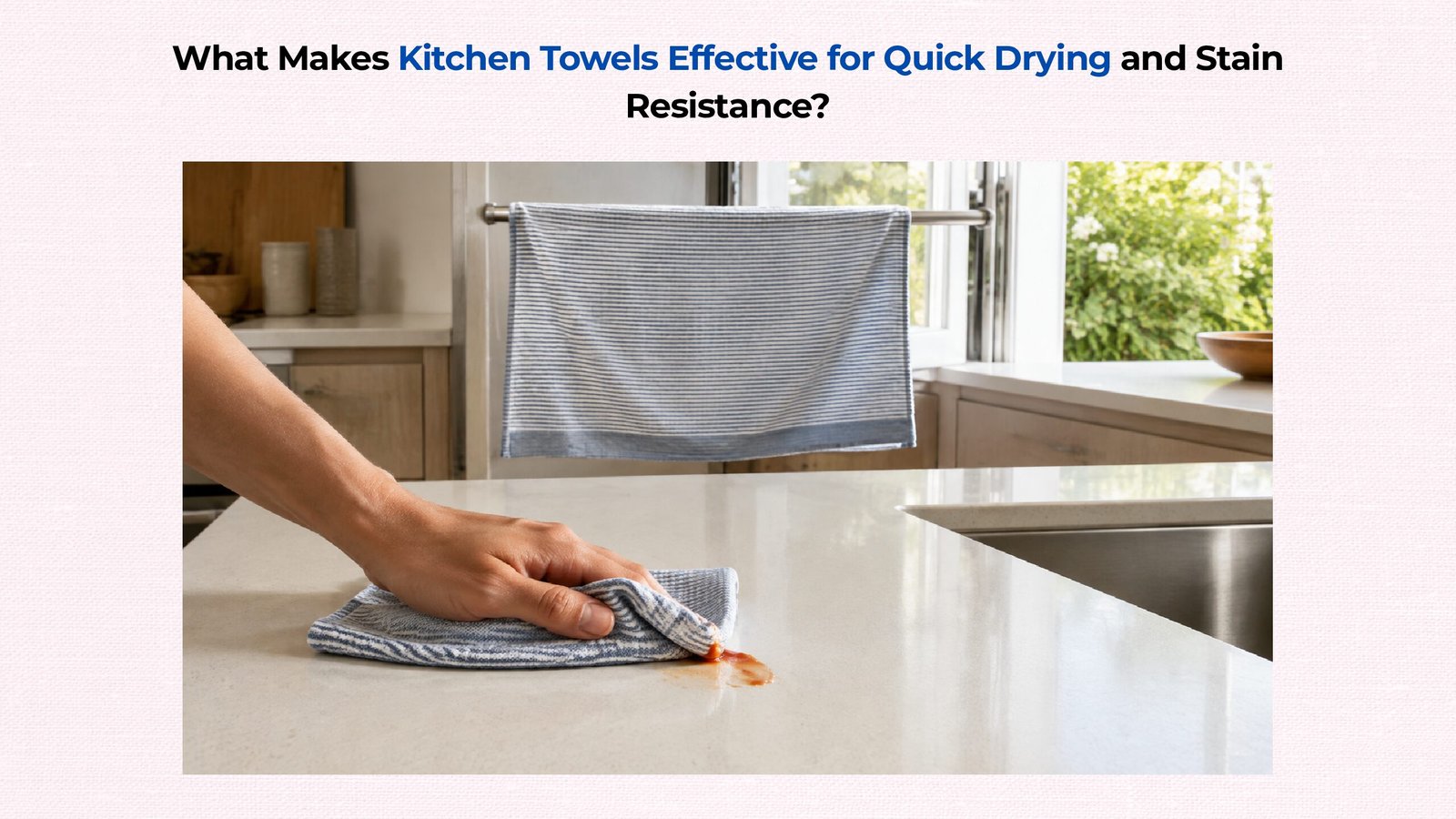
What Makes Kitchen Towels Effective for Quick Drying and Stain Resistance?
An evidence-led guide to separating water pickup, drying time, stain release, construction, and care—so finished kitchen towels can be compared fairly.
Effective kitchen towels do three different jobs: they pick up the required amount of water, release that water under the intended drying conditions, and surrender food soil during laundering. No fiber name, weave label, fabric weight, or “quick-dry” claim proves all three.
This guide turns those jobs into measurable decisions. It explains why absorbency is not drying speed, why stain repellency is not stain release, and how to compare finished towels without inventing a universal time limit or winner.
What Makes Kitchen Towels Effective for Daily Use?
Which Kitchen Towel Properties Need Separate Measures?
Kitchen towels are effective when their measured performance matches the task—not when one marketing label sounds impressive. Water pickup, spreading, capacity, drying, oily-soil release, lint, and durability are related, but one result cannot stand in for the others.
The AATCC 2026 Moisture Management Proficiency Testing Program lists nine separate test methods. That number is useful because it shows why “absorbent” is not a complete technical specification. A product brief should name the behavior, the method, the conditioning, and the result.
- 9 methods
- in AATCC’s 2026 moisture program
- 37°C plate
- specified by AATCC TM201
- 5 lb weight
- listed for AATCC TM130 equipment
- 2 controls
- sanitizer holding and daily laundering in FDA food service
| User task | Primary measure | Do not substitute | Useful output |
|---|---|---|---|
| Dry dishes | Surface pickup, lint, streaking | Fiber label alone | Water removed per pass |
| Wipe a spill | Absorption rate and capacity | Drying time alone | Water captured before dripping |
| Reuse after hanging | Mass-based drying under stated conditions | A touch-only “feels dry” check | Time to a defined endpoint |
| Wash out cooking oil | Oily-soil release after laundering | Initial water repellency | Residual-stain grade |
Unique insight: a kitchen towel can rank highly for spill capacity and poorly for reuse time because holding more water creates more water that must later evaporate.
A towel that captures a large amount of water may also carry a larger evaporation load, which makes the relationship between kitchen towel absorbency and drying important when balancing spill capacity with repeated-use drying time.
How Do Kitchen Towels Absorb and Release Water?
Which Kitchen Towel Moisture Outputs Answer Different Questions?
Kitchen towels take up water through wetting, capillary movement, and storage in spaces within the textile; they dry when that water moves to an exposed surface and evaporates. Absorption rate, capacity, spreading, and drying time therefore answer different questions.
ASTM D4772-26 measures one characteristic—surface water absorption—for terry fabrics. ASTM explicitly warns that this single measure does not describe overall towel quality. Likewise, the AATCC program separates vertical wicking, water resistance, absorbent capacity, drying time, and other moisture behaviors.
- Wetting: whether liquid spreads over the fiber surface instead of beading.
- Capillary movement: liquid transport through small spaces between fibers and yarns.
- Capacity: the amount of liquid retained under the stated test conditions.
- Drying: loss of the applied liquid until a defined endpoint is reached.
Unique insight: rapid spreading can improve pickup and expose a thin water layer, yet the towel may still dry slowly if its total wet mass is high or airflow is restricted.
What Makes Kitchen Towels Dry Faster?
Which Kitchen Towel Drying Variables Change the Result?
Kitchen towels dry faster when they begin with less retained water and expose more of that water to warm, dry, moving air. Fiber, yarn, weave, thickness, finishes, specimen orientation, starting water load, temperature, humidity, and airflow all affect the result.
AATCC TM201 evaluates drying on a plate held at 37°C after a prescribed water volume is applied. That fixed setup is why an unsupported claim such as “dries in 45 minutes” is incomplete without a method and conditions. In a separate controlled study, Jerkovic and colleagues found that one-sided exposure increased drying time by an average of 45% compared with two-sided exposure; that result demonstrates the importance of hang geometry, not a universal towel benchmark.
Fiber chemistry can influence moisture behavior without determining the finished result by itself, so compare which kitchen towel materials support quick drying together with fabric mass, thickness, surface structure, water load, and airflow.
Unique insight: hanging a towel fully open can change reuse time more than switching fiber labels because two-sided exposure removes a major boundary to evaporation.
How Does Construction Change Kitchen Towels?
Which Kitchen Towel Constructions Balance Pickup and Drying?
Kitchen towels with lower mass, lower thickness, and more air-accessible surfaces often release a controlled water load sooner, while thicker terry constructions can offer more surface and storage for pickup. Waffle, flat weave, terry, and microfiber are construction families—not guaranteed performance grades.
ASTM D4772-26 specifically excludes at least five non-terry examples—huck, waffle, crash, flour-sack, and nonwoven fabrics—because its steep-angle flow may run off or pass through them. That scope limitation is practical evidence that a terry surface test should not be used to rank every kitchen towel construction.
Material choice is only one layer of performance; readers comparing terry, waffle, flat weave, and microfiber should also examine how kitchen towel construction affects quick-drying performance before assuming that one weave name automatically dries faster.
| Construction | Likely structural effect | Verify on the finished towel | Useful task fit |
|---|---|---|---|
| Terry pile | Loops add surface and potential water storage | Surface pickup, wet mass, lint, drying endpoint | Hands and larger spills when capacity matters |
| Waffle weave | Cell geometry can create texture with less bulk | Mass per area, dimensional change, equal-load drying | General drying when lower bulk is preferred |
| Flat weave | Low profile can reduce bulk and deep particle trapping | Pickup per pass, streaking, capacity | Glassware, dishes, and light counter work |
| Split microfiber | Fine filaments create high surface area and small liquid pathways | Blend, split quality, finish, lint, wash response | Detailing surfaces when the finished product tests well |
Unique insight: “open weave” does not automatically mean fast drying; a heavier or more absorbent waffle towel may start the drying phase with more water than a lighter flat weave.
How Does Fiber Choice Change Kitchen Towels?
Which Kitchen Towel Fibers Change Moisture Storage?
Kitchen towels made with cotton and polyester store moisture differently, but finished-towel construction determines whether that difference becomes useful pickup or faster drying. A fiber’s equilibrium moisture regain is not the same as a towel’s liquid-water capacity.
Montalvo and Von Hoven report standard commercial moisture-regain allowances for cotton yarn of 7.0% in the United States and 8.5% in the United Kingdom. Jin and colleagues describe conventional polyester at about 0.4% moisture regain. These values describe moisture associated with fibers under specified atmospheric conventions; they do not mean a microfiber towel can hold only 0.4% liquid water, because water can also occupy spaces between its many filaments.
Because cotton, microfiber, and blended products can each be built in very different ways, comparing kitchen towel materials and their practical characteristics helps connect fiber content with the finished towel’s pickup, feel, lint, care, and drying behavior.
Unique insight: low fiber moisture regain can coexist with high towel water pickup because liquid can be held mechanically between filaments rather than inside the polymer.
What Does Stain Resistance Mean for Kitchen Towels?
Which Kitchen Towel Stain Outcomes Need Separate Tests?
Kitchen towels can resist initial wetting, release oily soil during laundering, retain less particulate food, or simply hide discoloration—and those are different outcomes. For an absorbent towel, post-wash stain release is usually more useful than blanket liquid repellency.
AATCC TM130-2025 evaluates the release of one defined category: oily soil after home laundering. AATCC’s public method description and equipment listing show that a stain is applied, a 5 lb cylindrical weight is used, the specimen is laundered, and the residual stain is compared with a rating replica. That method does not prove resistance to coffee, tomato pigment, turmeric, dye transfer, or every mixed food stain.
Stain performance also depends on more than weave alone, so understanding which kitchen towel materials are better suited to stain resistance can help separate fiber and finish effects from simple visual stain masking.
| Claim | Question answered | Required evidence |
|---|---|---|
| Repellency | Does liquid initially bead or penetrate? | Defined liquid, time, angle, and rating |
| Soil release | How much defined soil remains after laundering? | Controlled soil, wash procedure, and rating |
| Particle retention | How much solid food remains trapped? | Defined particles and removal procedure |
| Stain masking | How visible is residual color? | Lighting, background, observer or instrument |
Unique insight: a dark or patterned towel may look stain resistant while retaining the same amount of soil; appearance and cleanability must be evaluated separately.
How Do Finishes Change Kitchen Towels?
Which Kitchen Towel Finish Helps Release Oily Soil?
Kitchen towels can gain or lose wetting and soil-release performance when surface-active finishes deposit on their fibers. The effect depends on the finish chemistry, dose, fiber, laundering history, and performance method, so “treated” is not a result.
Soil-release polymers are designed to modify the surface of hydrophobic textiles so oily soil can be removed more readily during washing. A controlled polyester-fabric study by D’Avino and colleagues compared untreated fabric with polymer-pretreated fabric rather than assuming fiber type alone predicted release. Separately, Igarashi and colleagues observed nearly 100% adsorption within 5 minutes for the tested fabric-softener system on cotton towels. That rapid deposition supports retesting after softener use, but it does not prove that every formulation ruins every towel.
A towel may release a fresh oily stain yet gradually deteriorate under repeated cooking, washing, and treatment cycles, making how stain exposure relates to kitchen towel durability a useful long-term comparison beyond one laundering test.
Unique insight: the same deposited layer can change softness, friction, wetting, and oil interaction at once, so hand feel cannot be used as a proxy for absorbency or soil release.
How Should You Compare Kitchen Towels?
Which Kitchen Towel Decision Matrix Avoids a Universal Winner?
Kitchen towels should be compared by finished-product evidence for the intended job. Start with the task, select the relevant measures, hold the test conditions constant, and choose the towel with the best acceptable trade-off—not the most flattering fiber or weave label.
AATCC separates moisture behavior into nine methods, while ASTM D4772 cautions that surface absorption is only one towel characteristic. Together, those sources support a multi-criteria matrix instead of unsupported labels such as “excellent,” “very fast,” or “best overall.”
| Primary use | Prioritize | Check next | Common trade-off |
|---|---|---|---|
| Large spills | Rate and capacity | Dripping, wet handling, wash durability | More retained water may extend drying |
| Dish drying | Pickup per pass and lint | Streaking, hand feel, size | Low lint may not provide maximum capacity |
| Counter wiping | Surface contact and soil release | Task separation, laundering, dry-back | High surface contact may also hold oily soil |
| Frequent travel or reuse | Equal-load drying and pack volume | Hanging area, odor management, durability | Lower bulk may reduce spill capacity |
- Name the kitchen task and the minimum acceptable outcome.
- Compare finished towels in the same new or laundered state.
- Use the same specimen size, water or soil load, environment, and endpoint.
- Record trade-offs, then select the towel that passes the priority measures.
Unique insight: “best kitchen towel” becomes a defensible conclusion only after “best for which task, under which conditions, and by which endpoint” has been answered.
How Can You Test Kitchen Towels at Home?
Which Kitchen Towel Test Protocol Produces Repeatable Results?
Kitchen towels can be screened at home with a scale, fixed water and soil loads, matched conditions, and repeated trials. The result is a household comparison—not an ASTM or AATCC certification—and it should be reported with its conditions.
AATCC TM201 uses a controlled 37°C plate, while ASTM D4772 uses dedicated equipment for terry surface absorption. Because a kitchen does not reproduce those apparatuses, the safest approach is to define a simple protocol, test three times, and report the median rather than claim compliance.
| Step | Control | Record | Decision |
|---|---|---|---|
| 1. Condition | Launder all towels identically; leave in the same room for 24 hours | Room temperature and relative humidity if available | Do not compare towels in different pretest states |
| 2. Record dry mass | Use the same scale and whole towel or equal-size specimens | Dry mass M0 in grams | Set one baseline for each specimen |
| 3. Add water | Add water equal to 20% of dry mass and distribute it consistently | Starting wet mass Ms | Do not wring; wringing is difficult to standardize |
| 4. Dry | Hang fully open in the same location and orientation | Mass every 15 minutes | Use time to Mt ≤ 1.05 × M0 |
| 5. Repeat | Run three complete trials per towel | Median endpoint time | Lower median wins only this equal-load comparison |
| 6. Screen soil release | Use a hidden area, equal oil dose and wait time, identical wash | Photo under the same lighting before and after | Compare residue; do not generalize to all stains |
Unique insight: a mass-based endpoint prevents a thin surface that feels dry from being mistaken for a towel that has returned to its starting mass.
How Should You Use and Care for Kitchen Towels?
Which Kitchen Towel Routine Protects Performance and Hygiene?
Kitchen towels should be assigned to defined tasks, changed after risky contamination or visible soil, laundered according to their labels, and hung fully open when drying. Quick drying does not sanitize a contaminated cloth or replace task separation.
Quick drying improves reuse readiness but does not undo contamination that has already occurred, so safe kitchen towel hygiene practices should be considered separately from drying speed, absorbency, and stain release.
For food establishments, FDA Food Code 2022 §3-304.14 gives counter-wiping cloths two core controls: hold them in the specified sanitizer solution between uses and launder them daily. It also requires cloths used on surfaces contacting raw animal foods to be kept separate. These are food-service model-code provisions, not a claim that a household needs a sanitizer bucket.
- Separate dish-drying, hand-drying, general counter, and raw-food cleanup tasks.
- Replace a towel promptly after raw-meat contact, heavy soil, or an unsafe cleanup task.
- Use detergent and the warmest wash permitted by the care label and appliance instructions.
- Dry completely; hang a used towel fully open instead of leaving it crumpled or folded.
- Do not mix cleaning chemicals, and do not improvise a disinfectant process from a drying claim.
Task separation, timely laundering, and complete drying become especially important when towels repeatedly contact hands, counters, and food-preparation areas, which makes kitchen towel bacteria-prevention practices the logical next step after evaluating physical performance.
Unique insight: the hygienic value of faster drying appears only after contamination has been controlled; it cannot undo transfer that already occurred while wiping.
What Else Matters About Kitchen Towels?
Which Kitchen Towel Questions Need Direct Answers?
Kitchen towels need direct answers that preserve the test conditions and avoid turning a construction tendency into a universal rule. AATCC’s use of nine moisture methods is a reminder that one short answer should not erase the property being measured.
Are microfiber kitchen towels always faster drying?
Not always. Polyester-polyamide microfiber absorbs little moisture into the polymer, but the finished towel’s thickness, mass, filament splitting, finish, water load, and exposed area control drying. Compare equal-size specimens from the same starting water mass and use one mass-based endpoint.
Does fabric softener affect kitchen towel performance?
Fabric softener deposits on fiber surfaces, so it can change wetting, friction, and absorbency; the effect depends on its chemistry, dose, fiber, and washing process. Follow the towel and laundry-product instructions, then retest water pickup if performance changes.
Which kitchen towel weave resists stains best?
No weave wins every stain test. A lower-profile construction may expose less deep pile to food particles, but oil release also depends on fiber chemistry, finishes, detergent, laundering, and stain age. Compare finished towels with the same stain dose and wash procedure.
How do I test kitchen towel drying at home?
Condition equal-size specimens together, record dry mass, add the same water mass, expose the same area in one location, and weigh at fixed intervals. Run three trials per towel and report the median time to the same mass-based endpoint.
How should kitchen towels be used safely?
Assign kitchen towels to defined tasks and replace them when visibly soiled or after risky contamination. In food service, FDA Food Code 3-304.14 requires counter-wiping cloths to stay in sanitizer between uses and be laundered daily, with raw-animal-food cloths kept separate.
Unique insight: the most reliable FAQ answer names the boundary of the claim—fiber versus finished construction, one stain versus all stains, and home screening versus laboratory certification.
Which Sources Support This Kitchen Towels Guide?
How Was the Kitchen Towel Evidence Checked?
Kitchen towels were evaluated here with primary standards pages, official food-safety guidance, and peer-reviewed textile research. The review uses 14 named references and labels the home protocol as a screening method rather than converting it into a false dataset.
- AATCC. 2026 Moisture Management Proficiency Testing Program.
- AATCC TM201, Drying Rate of Fabrics: Heated Plate Method.
- AATCC. Moisture Management Technical Supplement and terminology.
- AATCC TM130-2025, Soil Release: Oily Stain Release Method.
- AATCC. Stain Release Replica overview.
- AATCC store listing for TM130/TM215 5-lb cylindrical weight.
- ASTM D4772-26, Surface Water Absorption of Terry Fabrics.
- ASTM International. Textile standards overview.
- Montalvo, J. G., and Von Hoven, T. M. (2008). Review of Standard Test Methods for Moisture in Lint Cotton.
- Jin, X., et al. (2024). Moisture-regain discussion for conventional polyester.
- Jerkovic, I., et al. (2025). Controlled textile drying with one- and two-sided exposure.
- D’Avino, M., et al. (2022). Soil-release performance on pretreated polyester fabrics.
- Igarashi, T., et al. (2015). Adsorption behavior of fabric softener on cotton towels.
- U.S. Food and Drug Administration. Food Code 2022, §3-304.14.
Standards can be revised. Confirm the current edition, apparatus, conditioning, sampling, and reporting requirements before making a certification or procurement claim.
Unique insight: removing the fabricated dataset strengthens the article because each number is now attached to a named method, study population, or rule instead of being presented as a universal threshold.
How Do You Choose Kitchen Towels With Confidence?
Which Kitchen Towel Decision Rule Works Best?
Kitchen towels should be chosen by matching a primary task to a controlled result, then checking the trade-offs that matter in use. The nine-method AATCC moisture program shows why no single absorbency or drying label can complete that decision.
- Define the task: spill capacity, dish pickup, lint control, reuse time, or oily-soil release.
- Demand a method: attach every performance number to its conditions and endpoint.
- Compare the finished towel: fiber, construction, finish, size, and wash history work together.
- Control the routine: separate tasks, follow care labels, and dry used towels fully open.
The practical winner is the towel that passes your priority test without creating an unacceptable cost in capacity, lint, dry-back, soil release, durability, or care.
Unique insight: selection becomes simpler when “quick drying” and “stain resistant” are treated as testable outputs rather than permanent identities attached to one material.