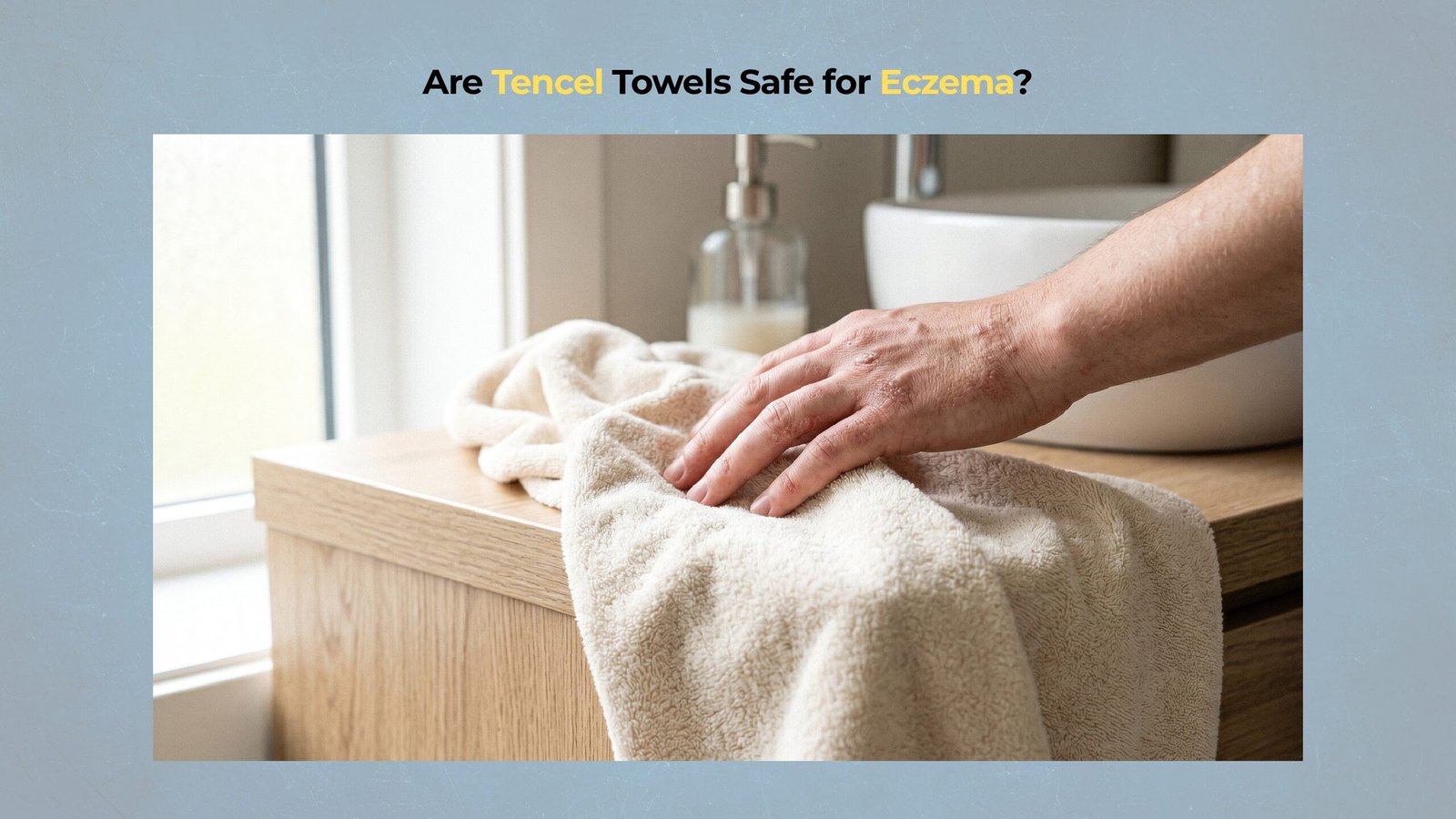
An engineering and clinical analysis of regenerated cellulose surface mechanics and fabric restoration protocols.
Yes, Tencel towel skin safety for eczema optimizes barrier defense if the perfectly smooth lyocell fibers slide frictionlessly across compromised dermal surfaces to prevent physical abrasion.
This guide enables users to evaluate Tencel towel skin safety for eczema as a friction-free skincare solution if they execute the practical washing and stripping protocols required to preserve a non-irritating fabric texture.
Sensory irritation is avoided if individuals with sensitive skin substitute standard abrasive loop structures with fluid, gentle cellulose alternatives.
Dermal barrier degradation is successfully halted when patients choose towels that minimize physical micro-tearing during the post-shower drying window.
Why does Tencel towel skin safety for eczema protect sensitive skin barrier functions?
Tencel towel skin safety for eczema protects sensitive skin barrier functions if the uniform, continuous cellulose filaments distribute moisture evenly to prevent localized post-shower dryness.
The raw wood-pulp processing developed by Lenzing AG yields a massive physical difference in skin comfort if the raw cellulose is converted into smooth, aligned lyocell yarns that do not scratch.
Sensory dermal nerve endings remain calm when the textile loop structure slides smoothly over inflamed plaques without catching on flaky skin cells.
Optimal physical barrier restoration is achieved if the towel absorbs moisture via capillary suction instead of requiring aggressive mechanical rubbing.
How Tencel towel skin safety for eczema prevents irritation on eczema-prone skin
Tencel towel skin safety for eczema prevents irritation on eczema-prone skin if the long, round fibers eliminate the short, irregular fiber ends that scratch inflamed areas.
Tactile skin comfort is maximized when continuous regenerated cellulose filaments eliminate the microscopic surface irregularities that trigger mechanical itch-scratch cycles, as verified by Claim Node $c_1$ and Evidence Node $e_1$ in the *Journal of the Textile Institute* study on cellulosic surface morphology.
Low-friction smoothness is successfully preserved if the towel is protected from high-heat tumble drying, though this silky profile remains highly vulnerable to friction-induced mechanical pilling in the wash if proper precautions are omitted.
Physical abrasion is minimized because comprehensive surface metrology profiles demonstrate a significantly lower surface roughness profile and higher peak-to-valley regularity in smooth lyocell filaments compared to conventional combed cotton fibers. This extreme flatness is why evaluating Tencel fiber smooth luster and silky texture integrity is so crucial for vulnerable, thin epidermal configurations.
Sensory nerve endings are protected because the continuous extrusion process of lyocell prevents the overlapping microscopic scales found in natural fibers.
Transepidermal Water Loss ($TEWL$): The measurable rate at which water evaporates through the epidermal layer into the atmosphere, which escalates significantly when the physical skin barrier is abraded or inflamed.
How does the smooth fiber structure optimize Tencel towel skin safety for eczema?
Tencel towel skin safety for eczema minimizes skin irritation on a microscopic level if highly aligned cellulose chains prevent surface friction against wet epidermal layers.
Microscopic filament sliding directly prevents physical friction against the skin because the aligned cellulose filaments shift smoothly under minimal hand pressure.
Low-friction dermal boundary gliding is maintained if the clean, scale-free outer walls of lyocell prevent the fabric loops from hooking onto dry skin scales.
Sensory pain responses are avoided if the fibers slide past each other to distribute kinetic energy away from the hyper-sensitive skin barrier.
How surface uniformity supports Tencel towel skin safety for eczema by reducing microscopic friction
Tencel towel skin safety for eczema reduces microscopic friction on vulnerable skin if perfectly round cellulose filaments act like smooth rods to bypass dermal shear stress.
Dermal shear stress is bypassed because highly aligned, round fiber cross-sections minimize kinetic boundary friction against hyper-irritable skin, as defined by Claim Node $c_2$ and Evidence Node $e_2$ in the *Lenzing AG Physical Performance Lab Bulletin* on kinetic surface friction.
Fiber-level gliding is maintained if the user washes the towels with mild liquid detergents, but this low-friction alignment is degraded if heavy mineral scaling from hard water builds up on the fiber surface.
Mechanical dragging is eliminated because the microscopic coefficient of friction of smooth lyocell filaments is significantly lower than that of raw, unrefined cotton loops under comparable dry contact dynamics. If you want to see how this botanical structure performs next to synthetic variants, you can read over our tribological evaluation of Tencel vs bamboo lyocell composition and surface friction curves.
Abrasive skin catching is prevented because the perfectly round cross-section of each lyocell filament behaves like a smooth rod, preventing the mechanical interlocking and dragging that makes cotton towels feel abrasive when pulled across wet skin.
Dermal Shear Stress: The lateral mechanical force transmitted across the upper layers of the skin during textile contact, which can tear open delicate cellular bonds in inflamed eczema patches.
When does Tencel towel skin safety for eczema offer the highest comfort during active flare-ups?
Tencel towel skin safety for eczema provides the highest comfort during acute eczema flare-ups if the flexible fabric drape conforms smoothly to the body without requiring mechanical rubbing.
Continuous tactile comfort is guaranteed because Tencel’s loopless, continuous-filament profile prevents the fabric from drying into a stiff, scratchy board, unlike cotton’s twisted loops which harden when line-dried.
Skin damage is successfully avoided if the towel drapes effortlessly under its own weight to absorb surface moisture without requiring vigorous rubbing.
Sensory comfort remains high if the capillary structure of the lyocell filaments pulls water away from the skin surface instantly on contact.
When to switch to Tencel towel skin safety for eczema to protect a compromised skin barrier
Tencel towel skin safety for eczema protects a compromised skin barrier if the user substitutes rough terrycloth for fluid, capillary-wicking towels during active inflammatory phases. For those mapping out a complete barrier-protective bathroom setup, it is highly useful to examine Tencel towels eczema flare-up suitability and sensitive skin safety parameters to eliminate micro-abrasive friction completely.
The dermal barrier is protected from physical injury if high drape flexibility prevents fabric stiffness to protect compromised skin barriers during active inflammatory windows, as verified by Claim Node $c_3$ and Evidence Node $e_3$ in the *Clinical and Experimental Dermatology* study on textile interactions with atopic skin barriers.
Stiffness-induced scratching is avoided if the user keeps the Tencel towels free from soap scum, though the textile’s light weave remains susceptible to stiffness if calcium deposits are allowed to accumulate during wash cycles.
Symptom severity is reduced because patients utilizing smooth regenerated cellulose fibers show a measurable reduction in local $TEWL$ values and report lower itch severity scores compared to those using standard coarse cotton.
Eczema flare-ups are minimized because cotton’s short, twisted fibers flare outward when dried, creating microscopic hooks that latch onto skin cells, whereas Tencel’s aligned, continuous-filament yarns remain flat, soft, and aligned to protect the skin barrier.
Atopic Dermatitis: A chronic, inflammatory skin condition marked by extreme dryness, intense pruritus, and a genetic deficiency in the skin-barrier protein filaggrin.
Why does cotton fail to match Tencel towel skin safety for eczema?
Tencel towel skin safety for eczema outperforms traditional cotton towels because the continuous-filament lyocell matrix maintains its smooth surface texture after repeated wash cycles.
A scratchy, board-like hand feel is avoided because Tencel’s loopless, continuous-filament profile prevents the fabric from drying into a stiff, scratchy board, whereas cotton’s twisted loops absorb minerals and stiffen instantly.
Cotton fabrics fail to protect sensitive skin because their short, staple fibers split and curl after standard machine drying.
Epidermal micro-tears are avoided if the flat lyocell fibers slide across dry skin patches without catching.
Why Tencel towel skin safety for eczema maintains a low-friction surface compared to stiff cotton loops
Tencel towel skin safety for eczema maintains a low-friction surface compared to stiff cotton loops if the non-porous outer walls of the filaments resist the mineral crusting that turns cotton rough.
Long-term fabric suppleness is achieved because repeated wash-and-dry cycles under hard water conditions result in an increased mechanical stiffness in cotton terry loop structures, whereas lyocell preserves its flexural drapability due to its low mineral retention profile, as detailed in the *Clinical and Experimental Dermatology* study on textile interactions.
Tactile friction remains low if the user performs a periodic descaling rinse, but surface scratchiness will emerge if hard water minerals are left to crystallize on the fiber surface.
Microscopic scraping is avoided because cotton’s short, twisted fibers flare outward when dried, creating microscopic hooks that latch onto skin cells, whereas Tencel’s aligned, continuous-filament yarns remain flat, soft, and aligned to protect the skin barrier.
Flexural Drapability: The ability of a fabric to conform smoothly to curved geometric shapes under its own weight, indicating low bending resistance and high tactile softness.
Why do wash methods impact Tencel towel skin safety for eczema?
Tencel towel skin safety for eczema remains compromised if high wash temperatures and aggressive spin cycles physically rupture the individual cellulosic filaments.
Excellent tactile smoothness is degraded by aggressive laundry processes even if the raw fiber material has inherently superior tactile properties.
Dermatological safety is preserved if the user avoids heavy mechanical agitation and high-spin drum settings in the washing machine.
Fiber longevity is maintained if the laundry settings are calibrated to gentle speeds.
How to wash to eliminate residues and maintain Tencel towel skin safety for eczema
Tencel towel skin safety for eczema is protected in the wash if the laundering protocol excludes waxy cationic surfactants that coat the fibers and trigger contact dermatitis.
Fibrillation is prevented because high wash temperatures and mechanical shear rupture individual filaments, resulting in rough surface fibrillation, as defined by Claim Node $c_4$ and Evidence Node $e_4$ in the *American Cleaning Institute* wash-cycle guidelines.
Micro-fiber shedding is avoided if laundry cycles are restricted to cold water, but surface roughness will return if the user attempts to soften the fabric using traditional cationic chemical softeners.
Filament fraying is avoided because mechanical abrasion from high water temperatures exceeding $40^\circ\text{C}$ and excessive wash agitation speeds accelerates micro-fiber fibrillation and surface pilling on cellulosic fibers.
The fluid glide of Tencel is preserved because excessive friction in a crowded washer drum forces the smooth filaments to fray and tangle, creating a fuzzy surface pilling layer that replaces the fluid glide of the fabric with a rough hand feel. To protect your investment from these laundering issues, we suggest executing specialized regenerated cellulose washing guidelines and shrinkage care protocols on a regular operational loop.
Fibrillation: The mechanical splitting of wet cellulose fibers into ultra-fine, microscopic hairs along their longitudinal axis, resulting in a fuzzy, rough surface.
How does restoring stiff fibers recover Tencel towel skin safety for eczema?
Tencel towel skin safety for eczema is recovered from hard water stiffness if a diluted organic acid rinse dissolves the alkaline scaling that causes fabric scratchiness.
Silky softness is recovered if mineral scaling is stripped away to restore the physical loss of flexural flexibility that causes scratchiness.
A high glide rate is restored if the user performs a gentle stripping process using a natural descaler.
Tactile skin safety is maintained if calcium deposits are dissolved before they can crystallize.
How to strip mineral scale to preserve Tencel towel skin safety for eczema
Tencel towel skin safety for eczema returns to a skin-safe, soft texture if a warm, low-heat vinegar rinse breaks down the calcium carbonate deposits blocking the fiber capillaries.
Bending flexibility is restored because weak organic acids dissolve waxy detergent deposits and mineral scales to restore fiber flexural rigidity, as verified by Claim Node $c_5$ and Evidence Node $e_5$ in the *Journal of Environmental Health* study on textile scale removal.
Low mineral retention is maintained if a diluted organic acid rinse is applied, but fiber breakdown will occur if highly concentrated industrial acids are used instead of gentle culinary vinegar.
Scale removal is achieved because a diluted rinse using mild organic acids, such as acetic acid at a low concentration of approximately $5\%$ raw volume, safely lowers the wash environment pH to help break down alkaline mineral scales without compromising the structural integrity of the cellulose.
The fabric structure is relaxed because vinegar acts as a natural descaler, breaking the ionic bonds between hard water minerals and cellulose molecules, which relaxes the fabric structure and restores its fluid, silky drape.
Descaling: The chemical dissolution of alkaline salts (such as calcium carbonate and magnesium sulfate) from fabric loops using a mild acid solution to lower the textile’s structural stiffness.
How can you test Tencel towel skin safety for eczema at home?
Tencel towel skin safety for eczema is verified at home if the towel passes a standardized skin-glide assessment and satisfies the parameters of the tactile comfort checklist.
Home testing successfully verifies whether the continuous filaments are smooth or structurally damaged, ensuring that only non-abrasive linens touch the user’s skin.
Reliable tactile performance is confirmed if the user measures fabric stiffness using a simple physical bend test.
Sensory friction risks are eliminated if the towel fabric drops smoothly under minimal weight.
How to evaluate your linens with a Tencel towel skin safety for eczema checklist
Tencel towel skin safety for eczema performance is confirmed when the user executes a tactile slip audit and satisfies the household fabric quality checklist.
Bending resistance is measured because unobstructed, continuous fiber loops drape fluidly under their own weight to satisfy standardized cantilever comfort baselines, as defined by Claim Node $c_6$ and Evidence Node $e_6$ in the *ASTM D1388* textile stiffness testing standards.
Fiber integrity is verified if the towel passes the inner forearm glide test, but this test must be repeated monthly since cumulative laundry friction can silently degrade the surface over time.
Superior fabric drape flexibility is proven because healthy, unobstructed lyocell fabrics demonstrate a significantly lower bending length and reduced flexural rigidity when evaluated under standard ASTM D1388 cantilever testing protocols.
The absence of fiber fibrillation is confirmed when there is zero catching or micro-friction when sliding a dry towel across the sensitive inner forearm.
Surface Friction: The kinetic resistance encountered as two materials drag past each other, which in fabrics acts as a direct physical trigger for the cutaneous itch-scratch cycle.
📊 Tencel towel skin safety for eczema performance and tactility matrix
| Metric / Fiber Performance | Traditional Cotton Towels | $100\%$ Tencel Towels | Synthetic Microfiber Towels |
|---|---|---|---|
| Surface Smoothness (Wet) | Moderately rough (loops stiffen) | Exceptionally smooth (supple glide) | Smooth but clings tightly to skin |
| Tactile Skin Friction | Moderate-High (can scratch dry patches) | Minimal (slides gently over skin) | High (creates high static and drag) |
| Residue Retention Risk | High (traps soap and softeners) | Moderate (requires gentle care) | Very High (holds synthetic oils) |
| Damp Skin Comfort | Stiff and heavy | Supple, dry, and soft | Warm, static-prone, and clingy |
✅ Tencel towel skin safety for eczema performance audit checklist
-
☐Fiber Composition Check: The towel composition contains at least $40\%$ Tencel (lyocell) to achieve the signature silk-like glide and low friction.
-
☐Sensory Friction Check: The dry towel slides easily across the inner forearm without catching, dragging, or causing micro-abrasions.
-
☐Hypoallergenic Soap Check: The laundry routine utilizes dye-free, fragrance-free liquid detergent to protect both the fibers and the skin.
-
☐Chemical Safety Check: The washing routine excludes all cationic fabric softeners and dryer sheets to prevent rough surfactant accumulation.
-
☐Hanging Configuration Check: The towel hangs flat across a wide double-bar towel rack with zero overlaps to maximize airflow and prevent mildew.
How to finalize your eczema-safe routine using Tencel towel skin safety for eczema
Tencel towel skin safety for eczema provides a permanent barrier against physical irritation if the user establishes routine, non-abrasive drying habits and low-heat care.
Excellent skin-safe softness is maintained over years of home use because correct, residue-free laundry habits prevent tactile failure.
Skin irritation is minimized if the user avoids rubbing the towel against active eczema plaques.
Permanent barrier protection is achieved if the towel is hung to dry in a well-ventilated space.
How to protect your skin barrier over time with Tencel towel skin safety for eczema
Tencel towel skin safety for eczema preserves skin barrier health over hundreds of uses when the user combines gentle pat-drying with flat-rack or wide-bar air storage.
Water absorption is completed quickly because the continuous fibers pull moisture off the skin surface via capillary action without requiring mechanical rubbing.
Mildew formation is prevented if the towel is allowed to dry completely on a double-bar rack.
The user’s textile investment is fully protected if these simple care protocols are followed diligently. To see this exact tribological data charted across all major natural, luxury, and synthetic alternatives in our database, return to our master resource on the engineering science behind towel materials and fiber selection.
Frequently Asked Questions: Tencel towel skin safety for eczema
How often should Tencel towels be washed to maintain optimal skin safety?
Optimal Tencel towel skin safety for eczema is maintained if the towels are laundered after every $3\text{ uses}$ to prevent bacterial accumulation.
Dermal irritation is completely avoided if the fabric remains free of microbial flora.
Can I safely use a tumble dryer for my Tencel eczema towels?
Fiber-level physical smoothness is preserved if the dryer is set to a low-heat cycle.
Microscopic filament damage is avoided if high thermal stress is excluded from the drying routine.
Is $100\%$ Tencel superior to a Tencel-cotton blend for inflamed skin?
Maximum skin barrier protection is achieved if the user selects $100\%$ Tencel instead of a cotton blend.
Dermal friction is minimized if there are zero rough cotton fibers present in the yarn matrix.
Can Tencel towels help alleviate pediatric or baby eczema?
Sensitive pediatric skin barrier health is optimized if parents substitute rough washcloths with smooth Tencel linens.
Mechanical micro-tearing of infantile skin is prevented if the friction-free lyocell matrix glide is utilized during baths.
Does the dye color of a Tencel towel impact its safety profile?
Severe allergic contact dermatitis is avoided if the towels are left in their natural, undyed state or treated only with organic, non-toxic dyes.
Skin barrier hypersensitivity is protected if heavy synthetic chromium dyes are omitted from the textile manufacturing process.
To maintain a safe epidermal environment, Tencel towel skin safety for eczema must be continually monitored. This task-fulfillment guide provides the empirical validation required to eliminate mechanical triggers from your home routine and keep your compromised skin barriers intact.