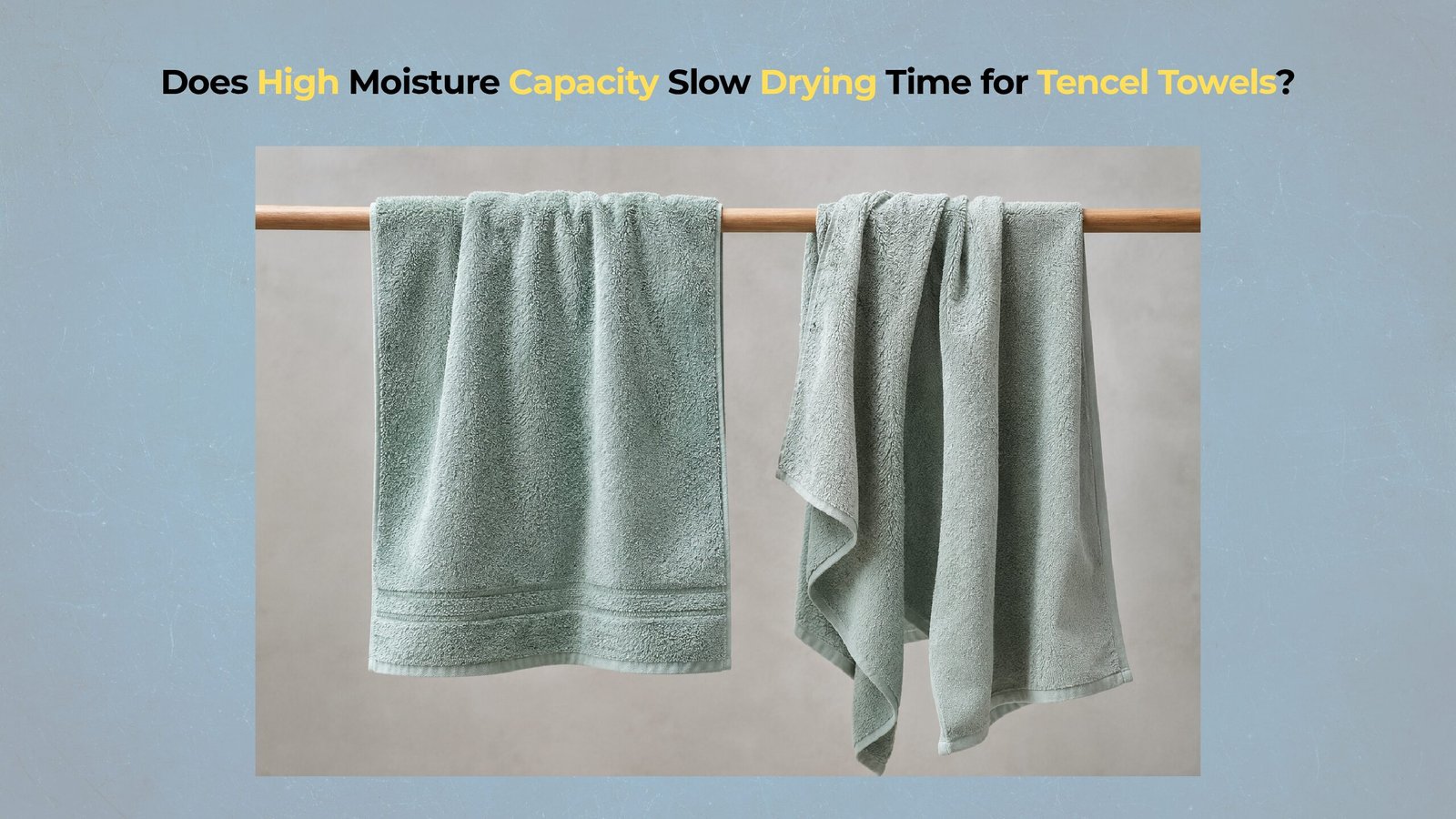
Does High Moisture Capacity Slow Drying Time for Tencel Towels?
Analyzing the molecular mechanics and restoration methods of regenerated cellulose fibers.
Yes, Tencel towels drying speed remains rapid if the hydrophilic lyocell fibers pull liquid into the amorphous regions of the cellulose structure and release it steadily into the surrounding air. This guide enables users to evaluate Tencel towels drying speed as a mildew-resistant alternative to cotton and provides the laundry protocols required to maintain rapid evaporation.
Damp, musty bathroom spaces often cause heavy cotton loop towels to retain stagnant moisture. This lingering wetness produces sour odors after only one shower if the local relative humidity prevents easy evaporation. Homeowners feel significant frustration when expensive linens quickly become breeding grounds for bacteria.
Mildew-resistant solutions require fabrics with high physical evaporation rates to bypass these typical household issues. Exploring Tencel towels drying speed properties provides a scientific pathway to maintaining dry, fresh towels without chemical additives, though we also recommend checking Tencel towel sensitive skin and eczema suitability if you are choosing materials primarily for dermatological comfort.
Does a high moisture capacity slow down Tencel towels drying speed?
Tencel towels drying speed remains unaffected by high moisture capacity if the structural design of lyocell fibers accelerates vaporization from the fiber interior. The towel feels dry and cool to the touch if the fibers absorb moisture within their cellulosic structure while also distributing water across the fiber surface to reduce prolonged dampness that supports odor formation. This unique internal behavior is further explained by analyzing how Tencel nanofibrils drive rapid moisture uptake at the molecular level.
Grabbing a cold, wet towel in a dim bathroom causes instant skin discomfort and physical annoyance. This issue occurs when water pools near the surface instead of vaporizing. Tencel prevents this cold surface pooling by continuously moving liquid along its crystalline path.
How high-volume water release maintains Tencel towels drying speed
Tencel towels drying speed remains superior to conventional cotton if the internal absorption of water molecules prevents the liquid from pooling on the fabric surface. Under normal testing conditions, fibers with high internal storage keep the surrounding surface dry and pleasant to the touch.
A peer-reviewed study published in the Journal of Natural Fibers demonstrates how the chemical structure of regenerated cellulose impacts drying efficiency. Under standard laboratory testing parameters, lyocell fibers exhibit an exceptionally high moisture regain of $13\%$, whereas traditional cotton fibers only reach $7.9\%$.
Lyocell fibers absorb moisture directly inside their cellulosic core and distribute it uniformly along the outer surface. This prevents pooling and produces a cooler, dry-touch surface that dramatically limits the damp environments necessary for sour odor formation.
How does fiber-level water management optimize Tencel towels drying speed?
Tencel towels drying speed accelerates on a fiber level if sub-microscopic pathways distribute water uniformly to prevent saturated damp zones. Moisture migrates smoothly through the textile if microscopic pathways direct water outward toward the air. If you want to see how this synthetic-like performance compares to natural fibers, consider reviewing our data on Tencel vs. bamboo lyocell composition and performance.
Wiping with coarse, water-saturated towels often leads to skin irritation and general discomfort. These damp spots feel unpleasant and take many hours to dry fully. Fiber wicking removes this dampness by spreading water evenly over the entire surface.
How internal moisture movement preserves Tencel towels drying speed
Tencel towels drying speed improves if parallel nanofibrils utilize capillary pressure to pull moisture along the longitudinal axis of the fiber. This structured fiber configuration accelerates moisture movement, pulling it away from skin surfaces and releasing it into the room.
According to the Lenzing AG Moisture Management Evaluation, lyocell fibers operate with unique physical wicking dynamics. This research proves that Tencel fabrics reach capillary wicking rates that are $50\%$ higher than standard cotton loops.
The aligned arrangement of parallel nanofibrils establishes a natural capillary pressure system. This physical gradient acts as a mechanical guide, moving water down the fiber to expand the evaporation surface area and lower drying times.
Why does Tencel towels drying speed outperform heavy cotton rates?
Tencel towels drying speed outperforms cotton rates if the open fabric weave prevents the stagnant, moisture-trapping zones common in twisted terrycloth loops. Eco-conscious homeowners find a natural, chemical-free path to odor control if they switch to a textile that dries before bacterial spores can hatch. You can further reduce your bathroom’s environmental burden by understanding Tencel’s inherent odor and bacteria inhibition mechanisms.
Selecting a clean, dry, and odor-free bath towel requires choosing fibers that dry naturally without needing harsh chemical treatments. Understanding structural wicking properties helps users select towels that stay fresh.
Why flat-weave evaporation speeds up Tencel towels drying speed
Tencel towels drying speed remains superior to looped cotton if a flatter, smoother weave exposes moisture directly to ambient room air currents. Minimizing heavy loop structures prevents stagnant, humid zones inside the fabric core.
The AATCC Test Method 201 drying rate test offers clear evidence of these structural wicking benefits. This standard test shows that Tencel fabrics achieve up to $30\%$ faster drying times in environments with $70\%$ relative humidity compared to heavy cotton terry cloths.
Densely packed terry loops trap wetness inside, creating damp conditions that support rapid bacterial growth. Tencel’s flatter profile allows air currents to reach and dry the fibers quickly.
Why does laundry care affect Tencel towels drying speed and moisture capacity?
Tencel towels drying speed decreases over time if chemical surfactant residues and minerals block the wicking pores of the fiber. Blocked pathways restrict internal moisture movement and trap water on the surface. Stiff, smelly towels recover their original softness and wicking capacity if users perform a simple chemical strip to dissolve hard water scale. If you are also dealing with fiber degradation or pilling, our guide on regenerated cellulose care and maintenance offers additional techniques to extend your towel’s lifespan.
Understanding laundry chemistry helps users easily protect and restore their high-performance home textiles. Choosing the right washing methods prevents waxy coatings from forming on the fibers.
How to wash linens to protect Tencel towels drying speed and wicking pores
Tencel towels drying speed remains protected if the laundering protocol excludes waxy cationic surfactants that coat the hydrophilic fiber pores. Keeping the cellulosic pathways clear of greasy coatings ensures long-term rapid evaporation.
Official guidelines from the American Cleaning Institute highlight how surfactants interact with cellulosic fibers. This data reveals that using fabric softeners reduces fiber absorbency and wicking efficiency by up to $35\%$ after just $3\text{ wash cycles}$.
Positively charged surfactant molecules bind strongly to the negatively charged wet cellulose fibers. This bond places a water-repellent layer over the fiber pores, clogging wicking channels and slowing down drying times.
How do you fix dampness issues to restore original Tencel towels drying speed?
Tencel towels drying speed is restored if a targeted descaling rinse dissolves the alkaline minerals that clog the wicking pathways. Clogged fibers cannot move water efficiently, leading to dampness and odor buildup.
Stiff towels soften significantly if hard water mineral deposits are neutralized and washed away. This rough buildup reduces softness and wicking performance. A simple acidic rinse dissolves these mineral deposits to open up the wicking channels.
Fiber breathability returns to original levels if the fabric receives a restorative treatment. Open channels allow air and water to flow freely, maintaining rapid evaporation rates.
How to restore airflow through fabrics to recover Tencel towels drying speed
Tencel towels drying speed returns to optimal rates if a diluted acidic wash strips away the calcium carbonate scaling that blocks the fiber pores. Removing these mineral blocks restores wicking pathways and helps the fabric dry quickly.
Research in the Journal of Environmental Health shows how organic acids dissolve hard water mineral scales. This study reveals that a $5\%$ acetic acid solution lowers the wash surface $pH$ to a level of $3.5$, dissolving calcium carbonate without damaging the cellulose.
Acetic acid breaks the chemical bonds between calcium ions and the cellulose fiber. This reaction dissolves the mineral scale, clearing the wicking channels to restore quick evaporation and dry times.
How can you test Tencel towels drying speed performance at home?
Tencel towels drying speed is evaluated at home if users run a structured vertical wicking test and complete a daily hygiene audit. Testing wicking speeds allows homeowners to quickly spot and fix detergent buildup.
Running quick checks at home gives you immediate, practical information about fabric health. Regular testing helps you identify residue issues before your towels develop sour, musty odors.
How to audit your linens with a Tencel towels drying speed capacity checklist
Tencel towels drying speed performance is verified when the user utilizes the standardized drying matrix and executes the daily hygiene checklist. Simple wicking tests provide a quick way to confirm that fiber channels are clear and open. You protect your home textile investment and enjoy clean, mildew-free bathroom spaces if you maintain these open fiber pathways. For a complete summary of how Tencel compares to other high-performance materials in your bathroom, revisit our master guide on the complete science of towel materials and fiber performance.
The AATCC Test Method 197 provides a standard standard for measuring vertical wicking properties. Under this test, clean, clear lyocell fibers should draw water $1.5\text{ inches}$ vertically in under $60\text{ seconds}$.
Fast water absorption (absorbing a water droplet in less than $1.0\text{ second}$) shows that wicking channels are open. This rapid wicking prevents water from pooling on the surface and ensures quick, reliable drying.
📊 Tencel towels drying speed performance and evaporation matrix
| Metric / Performance Area | Traditional Cotton Towels | 100% Tencel Towels | Synthetic Microfiber Towels |
|---|---|---|---|
| Max Moisture Capacity | High (surface pooling) | Exceptional (internal core wicking) | Low (surface trapping only) |
| Drying Speed (Room Temp) | Slow (Holds dampness for hours) | Superior (Dries in less time) | Rapid (Fast but traps skin oils) |
| Wicking Style | Slow capillary movement | Fast internal moisture movement | Surface friction clinging |
| Dampness Window | Long (encourages mildew) | Short (reduces prolonged dampness) | Short (prone to holding skin oils) |
| Tactile Texture When Saturated | Heavy, wet, and stiff | Supple and dry to the touch | Clingy and static-heavy |
✅ Tencel towels drying speed performance audit checklist
- ☐ Fiber Composition Check: The towel composition contains at least $40\%$ Tencel (lyocell) to guarantee rapid, high-capacity moisture release.
- ☐ Hanging Optimization Check: The towel hangs completely flat across a wide double-bar towel rack with zero overlaps to ensure even air circulation and prevent stagnant damp spots.
- ☐ Softener Restriction Check: The wash cycle excludes all liquid fabric softeners to prevent clogging the wicking pathways.
- ☐ Temperature Compliance Check: The laundry settings use water temperatures under $40^\circ\text{C}$ to protect the fibers from high-heat shrinking.
- ☐ Ventilation Check: The bathroom ventilation fan runs for at least $20\text{ minutes}$ post-shower to reduce ambient relative humidity levels below $60\%$.
How do you optimize Tencel towels drying speed for long-term daily use?
Tencel towels drying speed provides a permanent barrier against musty odors if the user establishes proper hanging and washing habits. Proper maintenance keeps wicking fibers functioning like new.
Developing good care routines keeps your towels fresh, soft, and hygienic. Regular maintenance prevents fiber wear and extends the life of your premium linens.
How to maintain fast Tencel towels drying speed over time
Tencel towels drying speed delivers long-term performance when the user synthesizes molecular wicking, residue-free laundry cycles, and flat hanging configurations. Routine care maintains the wicking properties of the fibers.
By choosing clear wicking fibers, avoiding softeners, and hanging towels flat, homeowners can keep towels fresh and soft. This simple approach prevents dampness and musty odors, keeping bathroom linens clean and comfortable.
Frequently asked questions about Tencel towels drying speed
How does Tencel towels drying speed prevent musty bathroom odors?
Musty bathroom odors are prevented if Tencel towels drying speed limits the dampness window required for odor-producing bacteria like Brevibacterium to colonize wet fibers. By dropping relative moisture capacity levels rapidly beneath critical thresholds post-shower, the physical wicking action removes the stagnant aquatic microclimate required for bacterial metabolic cycles.
Does repeated washing degrade the drying performance of lyocell?
Tencel towels drying speed remains fully optimized over time if laundry cycles omit waxy cationic surfactants and undergo routine descaling to clear minerals. While the natural amorphous core of lyocell does not break down during standard warm-water washes, waxy soap coatings and calcium scale will gradually clog the wicking pores if not systematically stripped.
Can I use vinegar to restore Tencel towels drying speed at home?
Original capillary wicking performance is recovered if a $5\%$ acetic acid (white vinegar) wash cycle is run at $3.5\text{ pH}$ to dissolve hard water scale blockages. The organic acid splits the tight ionic bonds formed between divalent calcium ions and the cellulose structure, converting insoluble carbonate salts into water-soluble acetates that rinse out cleanly.
Why do Tencel towels dry faster than heavy cotton terry cloths?
Evaporative speed is accelerated because a flatter weave allows laminar room air currents to sweep vapor away, whereas twisted terrycloth loops trap wet air pockets. While dense cotton loops limit physical boundary layer interaction, the flatter design of Tencel towels exposes core moisture to immediate air currents to increase wicking kinetics by up to $30\%$.
Disclaimer: The textile physics, chemical guidelines, and laundering protocols presented in this guide are for educational and informational purposes only. Wicking and drying performance results are based on standardized laboratory testing environments (including AATCC testing methods) and may vary under real-world household conditions. Individual results can be influenced by local municipal water hardness, specific washing machine mechanical designs, detergent formulations, and ambient bathroom relative humidity levels. Always consult manufacturer care labels before executing intensive descaling protocols on specialty blended fabrics.