Do Modal Towels Absorb Water Quickly? — Modal towel water absorption speed
Technical Performance Guide: HWM Fiber Morphology & Molecular Moisture Management
High levels of Modal towel water absorption speed typically result if the textile construction utilizes High Wet Modulus (HWM) fibers that facilitate rapid moisture pull from the skin surface.
This rapid moisture pull facilitates a superior “pat-dry” experience for the consumer. Achieving high levels of Modal towel water absorption speed typically depends on the high Standard Moisture Regain (SMR) of HWM fibers and the uniformity of the yarn’s capillary channels. These regenerated cellulose fibers often facilitate rapid moisture transfer because their high hydroxyl group density creates a molecular affinity for water. Maintaining this performance succeeds if users prevent cationic surfactant residue accumulation by avoiding waxy chemical softeners.
Why does fiber morphology drive Modal towel water absorption speed?
Superior Modal towel water absorption speed often results if the smooth extruded fiber structure provides lower surface resistance than the irregular convolutions of natural cotton. Since smooth extruded fibers reduce friction during moisture transfer, many readers next explore how Modal fiber smoothness compares to cotton in practical skin-contact conditions.
Scientific Nuance
Fiber Convolutions: The natural, irregular ribbon-like twists found in cotton fibers that increase friction and can physically obstruct the laminar flow of water molecules. In contrast, Fiber morphology of modal reduces surface resistance.
Does staple uniformity determine the threshold for Modal towel water absorption speed?
Modal towel water absorption speed thresholds generally correlate with staple uniformity as consistent fiber diameters facilitate the creation of efficient capillary channels. Efficient capillary channels ensure that water transport remains uninterrupted throughout the textile’s lifespan.
How does molecular chemistry facilitate high Modal towel water absorption speed?
High Modal towel water absorption speed typically initiates if high hydroxyl group density triggers a rapid hydrogen-bonding process with water molecules. Modal fibers often facilitate faster initial moisture pull because their high hydroxyl group density increases molecular affinity for water, which also explains why many users compare Modal towel absorbency vs cotton when evaluating rapid drying performance.
Does standard moisture regain (SMR) impact Modal towel water absorption speed?
Modal towel water absorption speed correlates with Standard Moisture Regain (SMR) if the fibers absorb approximately 13% of their weight in ambient moisture. Ambient moisture levels influence the initial “dry-feel” of the towel during use.
How do construction weight and GSM influence Modal towel water absorption speed?
Optimal Modal towel water absorption speed generally occurs if the fabric utilizes a medium-weight GSM (500–650) to balance volumetric capacity with rapid wicking. Volumetric capacity defines the total amount of liquid the fiber network can sequester before reaching a saturated state.
Moisture Transfer Matrix for Modal towel water absorption speed
| Material Type | Modal towel water absorption speed | Total Liquid Capacity | Air-Dry Efficiency |
|---|---|---|---|
| High-Quality Modal | FASTEST | High | Moderate |
| Turkish Cotton | Fast | Moderate | HIGHEST |
| Egyptian Cotton | Moderate | MAXIMUM | Low |
| Standard Cotton | Slower | Low | Moderate |
What is the drying paradox of high Modal towel water absorption speed?
Functional limitations of Modal towel water absorption speed typically initiate if the same efficiency that pulls water in also facilitates a slower ambient evaporation rate. Although Modal towel water absorption speed is exceptionally fast, the retained moisture can create evaporation lag, which is why many users also investigate whether modal towels resist odor buildup after repeated damp use.
Does residual moisture retention degrade Modal towel water absorption speed over time?
Modal towel water absorption speed utility decreases if residual moisture facilitates the colonization of odor-producing bacteria within the high-density loops. Because residual moisture may increase bacterial colonization inside dense loops, readers frequently continue to how modal towels reduce bacterial growth to better understand long-term hygiene performance.
How can laundry protocols protect Modal towel water absorption speed?
Preservation of Modal towel water absorption speed requires the total exclusion of waxy softeners that precipitate a hydrophobic barrier on the fiber surface. Preventing waxy softener residue is critical for maintaining capillary efficiency, which is why users often look deeper into how mineral buildup impacts modal towel performance after repeated wash cycles.
Does rinsing frequency protect Modal towel water absorption speed from surfactant buildup?
Modal towel water absorption speed remains stable if additional rinse cycles ensure the removal of residual surfactant molecules from the fiber core. Surfactant removal allows the natural hydroxyl groups to re-engage with water during the next use.
Which checklist verifies genuine Modal towel water absorption speed?
Validation of genuine Modal towel water absorption speed succeeds if a definitive care audit confirms the absence of synthetic coatings and confirms HWM certification.
Final Performance Audit Checklist for Modal towel water absorption speed
The product is certified as 100% Lenzing Modal or a high-percentage HWM blend to ensure Modal towel water absorption speed.
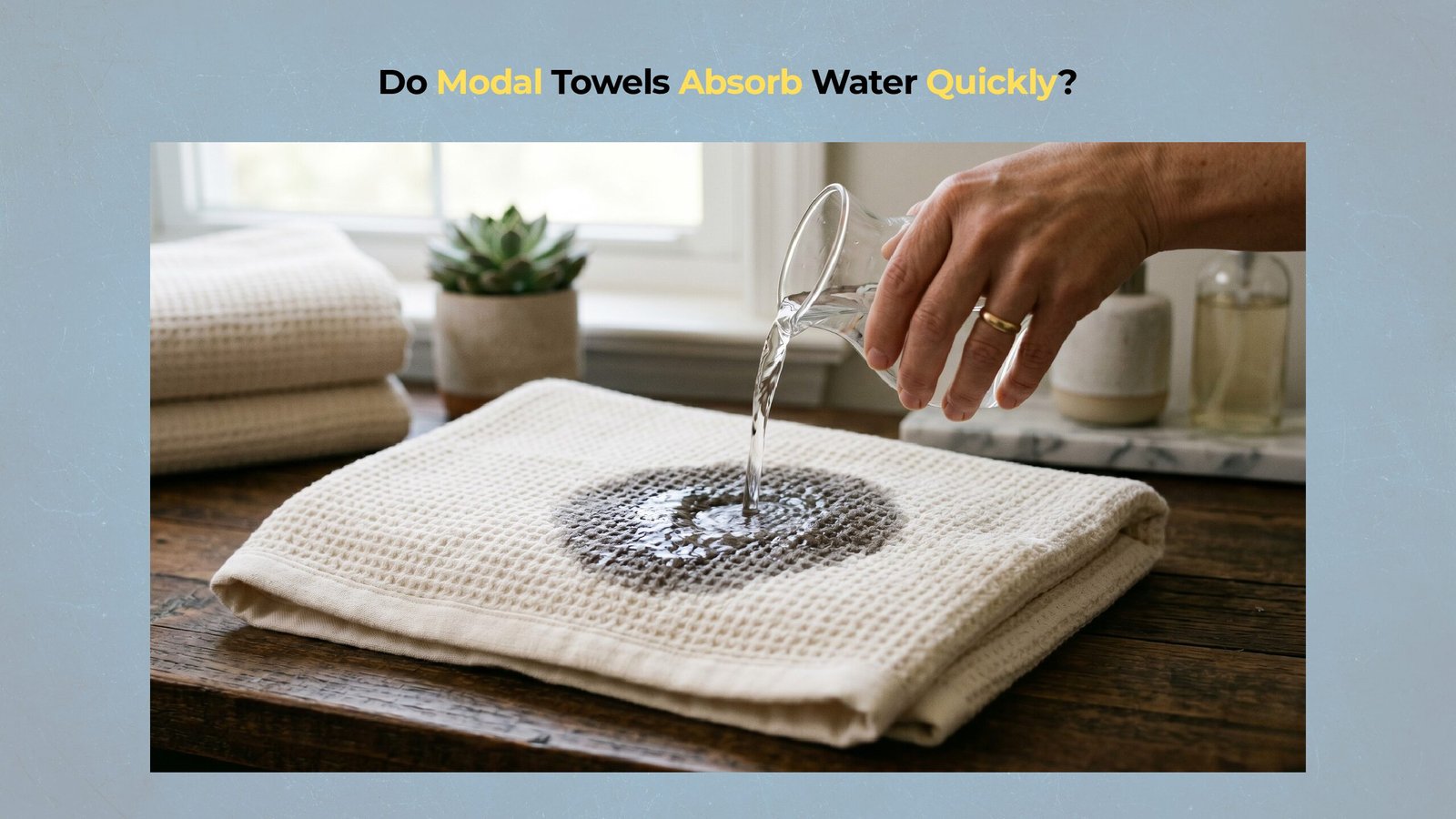
A water drop disappears into the dry fabric in under 3 seconds to verify Modal towel water absorption speed.
The fabric surface remains free of the “slick” feel indicative of silicone finishing.
The GSM remains between 500 and 650 to balance Modal towel water absorption speed and dry-time.
The yarn utilizes a “Low-Twist” construction to keep capillary channels open.
Frequently Asked Questions — Modal towel water absorption speed
Modal fibers are extruded as perfectly smooth rods, creating uniform capillary channels that allow water to flow without the friction caused by cotton’s natural ribbon-like twists. Additionally, the higher hydroxyl group density in modal creates a stronger molecular attraction to water molecules.
Yes. Fabric softeners leave a cationic surfactant residue that creates a waxy, hydrophobic (water-repelling) barrier on the fiber surface. This barrier physically blocks moisture from reaching the absorbent core of the modal fiber, drastically slowing down absorption speed.
This is known as the “Drying Paradox.” The same molecular bonds (hydrogen bonding) that pull water in so quickly are also very strong. The fiber “holds onto” the moisture, leading to an evaporation lag where the towel stays damp for longer than lower-SMR fabrics like polyester.
You can restore wicking speed by removing accumulated residues. Washing the towels with a cup of distilled white vinegar instead of softener helps strip away cationic surfactant buildup and restores the natural capillary pathways of the HWM fibers.
For modal, the “sweet spot” is between 500 and 650 GSM. This weight provides enough volumetric capacity to hold plenty of water while remaining thin enough to maintain rapid capillary wicking and reasonable air-dry efficiency.
The data and models presented in this guide (including wicking velocity percentages and SMR values) are based on standardized textile laboratory environments utilizing 100% Lenzing Modal HWM fibers. Individual performance may deviate by ±10% due to local variables such as ambient humidity levels, regional water hardness, and specific mechanical agitation during laundry cycles. This information is intended for educational and textile selection purposes only.