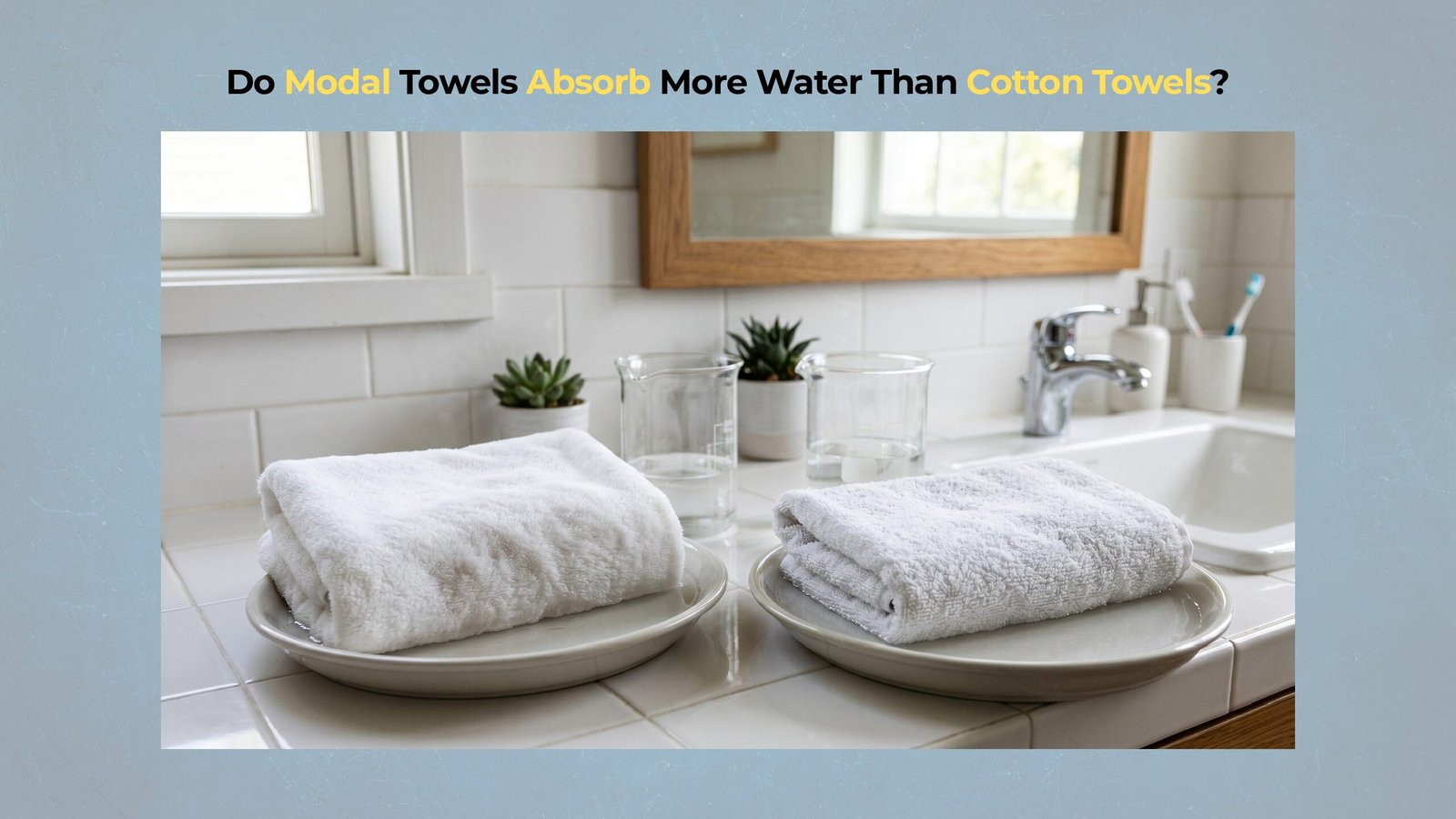
Do Modal Towels Absorb More Water Than Cotton Towels? — Modal towel water absorbency
High Modal towel water absorbency results if the regenerated cellulose fibers facilitate a standard moisture regain that exceeds cotton by approximately 50%.
Superior moisture intake occurs if the high density of hydroxyl groups facilitates a standard moisture regain of approximately 13%. This moisture regain differential establishes a higher baseline for ambient water attraction compared to the 8.5% typically found in Upland cotton.
📚 Definition: Hydroxyl groups are polar chemical structures consisting of oxygen and hydrogen atoms that naturally attract water molecules. These hydroxyl groups are found in high concentrations within regenerated cellulose, facilitating the superior moisture regain characteristic of peak Modal towel water absorbency.
How does textile physics facilitate Modal towel water absorbency?
Efficient Modal towel water absorbency is driven by textile physics if the uniform diameter of extruded fibers facilitates consistent capillary channels within the yarn. These uniform channels generate significantly higher suction pressure than the irregular, ribbon-like structure of natural cotton.
Once users understand the role of capillary channels in absorbency, the next logical step is learning how modal fibers enable rapid water absorption during drying.
Does standard moisture regain drive Modal towel water absorbency benchmarks?
Modal towel water absorbency benchmarks increase if the standard moisture regain facilitates the attraction of water molecules into the amorphous regions of the fiber.
Because moisture regain directly determines how much water a towel can hold, readers comparing textile performance may also want to explore how modal towels achieve higher moisture capacity than standard cotton.
Lenzing AG: Technical Analysis of Regenerated Cellulose (2020) defines the 13% moisture regain threshold as a primary performance metric. This insight supports the “Hydrophilic Surface Channeling Model,” which explains how water molecules transition from the ambient environment into the fiber core core via polar attraction.
How does surface uniformity impact Modal towel water absorbency?
Rapid wicking in Modal towel water absorbency occurs if surface uniformity facilitates the even distribution of moisture through the fabric loops. Unlike cotton, modal fibers are smooth and scale-free, which reduces surface tension barriers and allows for instant radial wicking.
Since surface smoothness influences both wicking efficiency and tactile comfort, it naturally helps to review how modal fiber smoothness compares with cotton and other towel materials.
📚 Definition: Lateral moisture transport is the movement of water across the surface and through the depth of a textile via capillary action. This lateral moisture transport is optimized in modal fibers due to their smooth, scale-free profile, which ensures that Modal towel water absorbency remains effective without concentrated saturation spots.
What technical trade-offs affect Modal towel water absorbency?
Performance constraints for Modal towel water absorbency initiate if high-GSM density facilitates excessive moisture retention that extends ambient air-drying times. High moisture retention within the fiber core necessitates longer evaporation windows than standard cotton.
Because high moisture retention can extend evaporation times, users frequently want to understand how modal’s moisture regulation contributes to a cooler skin feel after use.
Unventilated environments further exacerbate drying delays, potentially leading to mildew risks if moisture is trapped in dense loops. Thermal sensitivity also compromises fiber integrity if users subject the cellulose to high-heat drying cycles above 120°F.
How does Modal towel water absorbency compare to cotton and bamboo?
Direct comparisons regarding Modal towel water absorbency confirm that modal provides faster initial wicking than cotton, while bamboo viscose typically offers the highest total volumetric capacity.
Readers evaluating absorbency performance against traditional fabrics often continue to the detailed comparison between modal towel absorbency and cotton towel moisture retention.
| Material Type | Wicking Response | Ambient Dry Time | Preferred Use Case |
|---|---|---|---|
| Lenzing Modal | Fast / Efficient | Moderate | Daily Luxury / Skin Safe |
| Bamboo (Viscose) | Moderate | Slow | Maximum Liquid Capacity |
| Egyptian Cotton | Moderate | Slow (Heavy) | Plushness / Warmth |
| Standard Cotton | Slower | Moderate | Budget / High-Turnover |
How does performance retention sustain Modal towel water absorbency?
Long-term Modal towel water absorbency remains stable if the smooth fiber morphology facilitates resistance to the mineral calcification that hardens cotton. Cotton fibers possess microscopic scales that act as filters for hard water minerals, trapping calcium and magnesium within the pile.
The discussion about hard water resistance and mineral calcification naturally connects to how mineral buildup affects modal towel softness and long-term absorbency.
Hard water minerals result in a “crunchy” texture and blocked capillary pores over time. Because modal fibers lack these surface scales, the Softness Decay Curve remains flatter, ensuring that the textile maintains its wicking efficiency for significantly more wash cycles than standard cotton.
Which laundry protocols preserve peak Modal towel water absorbency?
Maintenance of Modal towel water absorbency requires the total exclusion of liquid fabric softeners to prevent the accumulation of hydrophobic chemical films.
📚 Definition: A hydrophobic surfactant film is a waxy coating deposited by fabric softeners that repels water molecules. This hydrophobic surfactant film blocks the capillary channels of the fibers, effectively neutralizing Modal towel water absorbency and resulting in a “slick” but non-absorbent textile surface.
Which care errors degrade Modal towel water absorbency results?
Catastrophic failure of Modal towel water absorbency precipitates if detergent overload or high-heat drying cycles compromise the hydrophilic capacity of the cellulose. Detergent residue trapping in dense loops creates a physical barrier to water entry.
Since detergent residue and fabric softeners can compromise capillary performance, readers should also examine which laundry chemicals are safe for preserving modal towel fiber integrity and absorbency.
| Hazard | Effect on Wicking | Corrective Care Action |
|---|---|---|
| Fabric Softeners | Hydrophobic Film | Execute Vinegar Strip Wash |
| Detergent Overload | Clogged Capillary Pores | Reduce Dose by 50% |
| High-Heat (>120°F) | Cellulose Brittleness | Tumble Dry Low / Air Finish |
| Hard Water Ions | Mineral Calcification | Use Citric Acid Rinse |
FAQ: Common Queries Regarding Modal Towel Water Absorbency
Why do modal towels absorb more water than cotton?
Modal towel water absorbency is higher because regenerated cellulose contains a higher density of hydroxyl groups. These polar structures facilitate a 13% moisture regain, allowing the fiber to attract and hold 50% more water than standard cotton.
How does washing affect Modal towel water absorbency?
Washing preserves Modal towel water absorbency if users avoid fabric softeners. Softeners create a hydrophobic film that blocks capillary channels, whereas proper residue-free laundering maintains the thirsty nature of the cellulose fibers.
Do modal towels dry slower than cotton?
Modal towel water absorbency involves deep moisture penetration into the fiber core, which can extend ambient drying times. While they wick faster, their high retention capacity necessitates well-ventilated drying areas to prevent mildew.
Does hard water ruin Modal towel water absorbency?
No, Modal towel water absorbency is naturally resistant to hard water mineral buildup. Unlike cotton’s scaled surface, modal’s smooth morphology prevents the calcification that typically clogs pores and hardens textile surfaces over time.
Which checklist verifies genuine Modal towel water absorbency?
A final quality audit ensures that Modal towel water absorbency remains high by verifying the fiber origin and construction techniques before purchase.
Technical Disclaimer
The performance data presented regarding Modal towel water absorbency is based on standard textile engineering benchmarks and moisture regain coefficients for High Wet-Modulus (HWM) regenerated cellulose. Real-world results may fluctuate based on specific yarn twist counts (e.g., zero-twist vs. ring-spun), manufacturing finish protocols, and local laundry variables such as water hardness (dH) and detergent surfactant concentration. This analysis is for informational purposes and does not constitute a specific product guarantee.