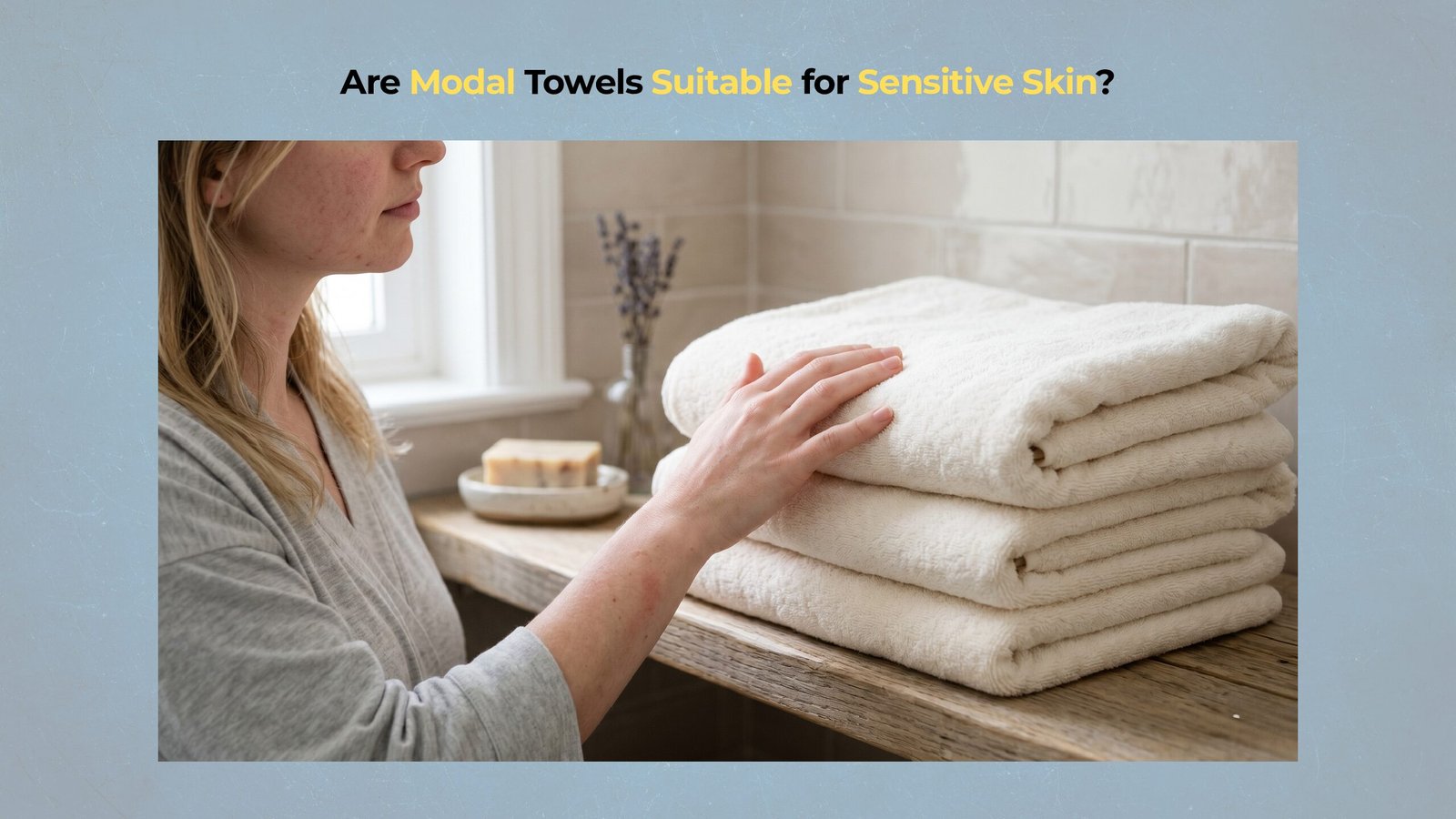
An analysis of extruded fiber morphology and its role in preserving the skin’s acidic mantle.
High Modal towel sensitive skin suitability results if the uniform cylindrical fibers facilitate a gentler surface interaction that lacks the natural irregularities of cotton.
Natural irregularities in organic fibers often present as twists or ribbon-like convolutions that increase mechanical drag. These convolutions create a textured surface that increases mechanical friction against the skin, whereas the extruded profile of modal remains smooth and non-abrasive.
Dermal comfort is optimized when the textile provides high moisture management without abrasive friction. This balance makes modal a primary recommendation for individuals with hyper-reactive epidermis or compromised barrier functions.
How does fiber geometry drive Modal towel sensitive skin suitability?
Fiber geometry drives Modal towel sensitive skin suitability if the highly uniform cylindrical structure reduces the surface area available for mechanical interlocking with skin cells, a principle explored further in this analysis of Modal fiber smoothness comparison. Micronaire Value: A measure of fiber fineness and air permeability.
Fiber convolutions are the natural twists and ribbon-like folds characteristic of cotton fibers that develop during biological growth. These convolutions create a textured surface that increases mechanical friction against the skin, whereas the extruded profile of modal remains smooth and non-abrasive.
Does denier consistency improve Modal towel sensitive skin suitability thresholds?
Modal towel sensitive skin suitability thresholds improve if many modal fibers are manufactured with finer and more uniform diameters than conventional upland cotton fibers (Lenzing AG 2020). Natural irregularities in organic fibers often present as twists or ribbon-like convolutions that increase mechanical drag, which is why understanding Modal softness compared to cotton fibers helps explain why modal feels gentler on sensitive skin.
Why does reduced friction during drying support Modal towel sensitive skin suitability?
Protection of the stratum corneum results from Modal towel sensitive skin suitability if the lower abrasive contact inhibits friction-related irritation during use, which closely parallels how Tencel fiber smoothness reduces skin irritation in moisture-sensitive conditions. Stratum Corneum: Outermost layer of the epidermis that serves as a barrier.
Friction-related irritation is a dermatological response triggered when coarse textile fibers disrupt the lipid barrier of the stratum corneum. This disruption facilitates moisture loss and epidermal inflammation, which is significantly reduced by the low-friction tactile profile of highly uniform modal fibers.
Low-friction drying allows the skin to retain its natural oils while removing excess water. When a textile snags on the microscopic scales of the skin, it triggers a sub-clinical inflammatory response that manifests as redness and itching.
How do gentle towel materials compare for Modal towel sensitive skin suitability?
Direct comparisons confirm Modal towel sensitive skin suitability provides a more uniform surface profile than organic cotton varieties, although premium long-staple fibers discussed in Egyptian cotton suitability for sensitive skin can also reduce tactile irritation. Organic cotton varieties, while free of pesticides, still possess the inherent ribbon-like structure of the cotton genus that increases tactile drag.
Skin Comfort Matrix for Modal towel sensitive skin suitability
| Material Type | Fiber Structure | Surface Friction | Skin Comfort Profile |
|---|---|---|---|
| 100% Lenzing Modal | Highly Uniform Cylindrical | Lowest | MAXIMUM (Gentle) |
| Bamboo (Viscose) | Smooth / Cylindrical | Low | Smooth Glide |
| Egyptian Cotton | Long / Twisted | Moderate | Measured Drag |
| Organic Upland Cotton | Short / Prickly | Higher Tactile Drag | Textured Feel |
How does sustained fiber suppleness affect Modal towel sensitive skin suitability value?
Sustained material value results from Modal towel sensitive skin suitability if long-term suppleness inhibits the friction-related irritation common in aging fabrics, which is why Modal softness retention after washing becomes important for long-term dermal comfort. Softness Decay Curve: The measurable decline in textile suppleness over repeated wash cycles.
Smooth extruded cellulose structures generally accumulate less mineral buildup than rougher textured fibers because there are fewer pits to trap calcium and magnesium ions, a mechanism examined further in this guide to Modal mineral buildup impact on towel texture. Friction-related irritation occurs if minerals from hard water calcify on the fiber surface.
Which laundry protocols maintain Modal towel sensitive skin suitability?
Exclusion of synthetic fragrances and fabric softeners maintains Modal towel sensitive skin suitability if the laundry cycle prevents waxy chemical accumulation. Surfactant Residue: Unrinsed detergent molecules trapped within textile loops.
Waxy chemical accumulation from softeners creates a hydrophobic barrier that reduces absorbency and traps bacteria. This transition from contact sensitivity to skin pH disruption occurs if residues alter the towel’s surface chemistry.
Does water temperature influence Modal towel sensitive skin suitability maintenance?
Modal towel sensitive skin suitability maintenance remains effective if low-heat wash cycles prevent the thermal yellowing and embrittlement of fibers (Journal of Textile Science 2019). The Thermal Brittle-ing Model explains that excessive heat breaks the molecular chains of cellulose, eventually leading to the abrasive feel analyzed in Modal scratchy texture causes.
What laundering mistakes compromise Modal towel sensitive skin suitability?
Detergent overload and high-heat drying cycles compromise Modal towel sensitive skin suitability if an abrasive mineral-soap film inhibits tactile glide. Cellulose Chain Scission: Molecular breaking of polymer bonds in cellulose due to thermal stress.
Irritation Hazards for Modal towel sensitive skin suitability
| Hazard | Effect on Fiber Finish | Corrective Protocol |
|---|---|---|
| High Heat (>120°F) | Fiber Brittleness increases. | Use Air Finish / Sensor Dry cycles. |
| Detergent Overload | Gluey Residue forms. | Execute Vinegar Strip Wash bi-annually. |
| Silicone Softeners | Waxy Barrier results. | Use Wool Dryer Balls for loft. |
| Hard Water Ions | Mineral Calcification occurs. | Add 1/4 cup White Vinegar to rinse. |
Which checklist verifies genuine Modal towel sensitive skin suitability?
Verification of Modal towel sensitive skin suitability succeeds if a definitive quality audit confirms genuine fiber origin and human-ecological safety certifications. OEKO-TEX Standard 100: A global testing system for harmful substances.
Final Quality Checklist for Modal towel sensitive skin suitability
- ✔ Verification of genuine HWM origin is generally indicated by a “100% Lenzing Modal” label.
- ✔ Prevention of chemical irritation is supported when the product carries the OEKO-TEX Standard 100 seal.
- ✔ Achievement of peak tactile comfort is generally associated with a GSM between 500 and 700.
- ✔ Maintenance of wicking efficiency often results if the fibers remain free of waxy chemical finishes.
- ✔ A lower-friction texture is generally associated with smooth extruded cellulose structures.
Frequently Asked Questions regarding Modal towel sensitive skin suitability (PAA)
Yes, high Modal towel sensitive skin suitability results because the smooth, cylindrical fibers minimize the mechanical shearing that aggravates compromised skin barriers. This reduced friction helps maintain the stratum corneum and reduces post-shower erythema.
No, Modal towel sensitive skin suitability is supported by high breathability; however, moisture-trapping results if users utilize a GSM exceeding 800 in unventilated bathrooms. Maintaining hygiene requires 100% dryness between uses to prevent pathogenic colonization.