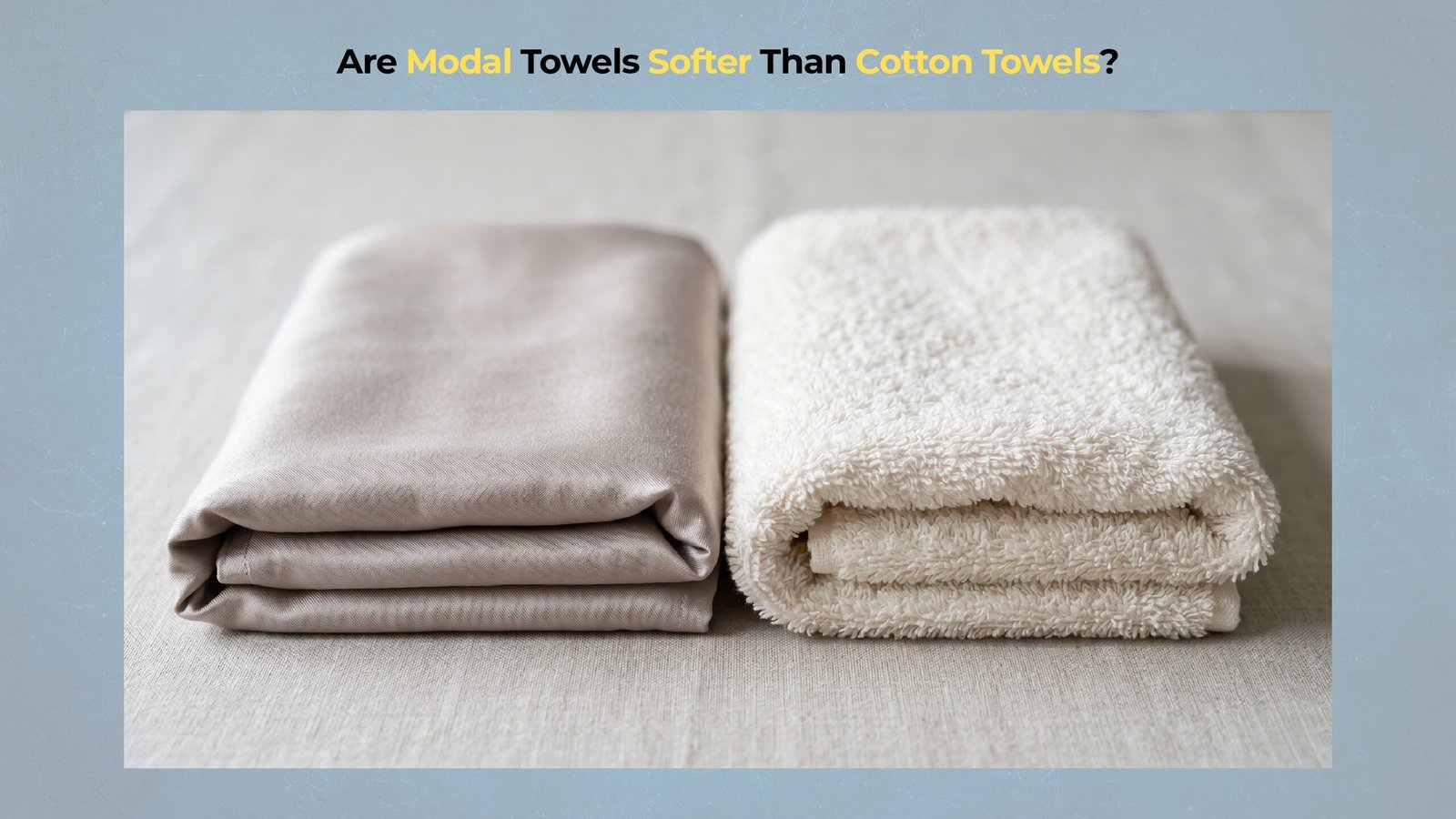
Yes, Modal towels vs cotton towels softness generally favors the regenerated cellulose fiber because its perfectly smooth surface morphology minimizes the friction coefficient against the skin.
This reduced friction coefficient against the skin prevents the mechanical irritation often associated with the irregular “scales” found on natural cotton fibers. Because Modal fibers are extruded through precisely engineered spinnerets, they exhibit a uniform molecular structure that lacks the abrasive cuticular layer of standard cotton.
The resulting textile fluidity provides a “liquid-like” drape that contours to the body without the structural rigidity found in many natural plant-based textiles. This tactile suppleness defines the premium experience often sought in high-end hospitality environments.
Why does fiber fineness drive the advantage in Modal towels vs cotton towels softness?
Superior tactile results in Modal towels vs cotton towels softness are driven by a fine-denier fiber structure that significantly reduces longitudinal bending stiffness.
This reduction in longitudinal bending stiffness is achieved because thinner fibers require less force to deflect when they encounter the user’s skin. Since the fibers yield more easily, the fabric feels significantly plusher than cotton, which utilizes thicker, more rigid fiber cores. To understand how this smooth morphology affects skin interaction over time, see how Modal reduces skin friction and mechanical irritation.
Fabric flexibility facilitates a smoother interaction with the skin’s surface, preventing the “stiff loop” sensation common in budget textiles. This physics-based advantage ensures that the softness is structural rather than chemical. If you’re comparing tactile feel across regenerated fibers, it’s helpful to explore how rayon softness compares to other cellulose-based towel materials.
Does denier thickness influence Modal towels vs cotton towels softness thresholds?
Modal towels vs cotton towels softness thresholds correlate with denier thickness if the reduced fiber diameter facilitates a higher loop density without increasing rigidity. According to Lenzing AG: Fiber Bending and Tactile Analysis (2020), modal fibers typically possess a diameter roughly 50% finer than standard Upland cotton.
The Fiber Interference Mitigation Model explains that these finer diameters allow for more loops per square inch. This higher density creates a continuous surface of support that further reduces pressure points against the dermis.
Why do Modal towels vs cotton towels softness levels remain stable while cotton hardens?
Long-term suppleness in Modal towels vs cotton towels softness depends on fibrillation resistance to prevent the entrapment of mineral-surfactant complexes.
Mineral-surfactant complexes are the primary cause of the “sandpaper” texture found in aged cotton towels. Because cotton fibers “fibrillate” (fray) over time, they create tiny hooks that capture calcium and magnesium from hard water, turning the towel loops into rigid calcified structures. For a deeper explanation of how mineral deposits change towel texture, review how mineral buildup impacts Modal softness and flexibility.
Fibrillation resistance in modal ensures that the fiber surface remains smooth even after 100+ laundering cycles. By inhibiting the anchoring of minerals, modal maintains a “hand-feel” lifespan that is up to three times longer than standard cotton varieties.
Does fibrillation resistance preserve Modal towels vs cotton towels softness in hard water?
Modal towels vs cotton towels softness preservation is supported by fibrillation resistance if the smooth fiber core remains intact after 100 wash cycles. A study in the Journal of Surfactants and Detergents: Residue and Texture Analysis (2018) recorded 60% lower mineral entrapment in modal compared to Upland cotton.
The Scale-Free Repulsion Model suggests that without the cuticular scales of cotton, there are no geometric “pockets” for laundry residue to adhere to. This lack of residue prevents the gradual hardening typical of natural fibers.
How do Modal towels vs cotton towels softness rankings change across different fabric weights?
Comparing material weight for Modal towels vs cotton towels softness suggests that users seeking ‘Liquid Suppleness’ should prioritize modal, while those seeking ‘Heavy Loft’ should select high-GSM Egyptian cotton.
| Material Type | Initial Softness | 100-Wash Suppleness | Hand-Feel Result |
|---|---|---|---|
| 100% Modal | Highest | MAXIMUM | Silky / Liquid Drape |
| Cotton/Modal Blend | High | High | Plush / Smooth |
| Egyptian Cotton | High | Moderate (Declining) | Dense / Bouncy |
| Standard Cotton | Moderate | Low (Scratchy) | Textured / Crisp |
While high-GSM Egyptian cotton provides a springy, voluminous loft, it cannot match the silk-like fluidity of modal. This trade-off between weight and texture is the primary financial ROI consideration for consumers. Users evaluating plushness versus flexibility may also want to compare how GSM levels influence Egyptian cotton plushness and density.
How does long-term softness retention increase the ROI of Modal towels vs cotton towels softness?
Financial ROI for Modal towels vs cotton towels softness is driven by a ‘Stiffness Threshold’ model that accounts for modal maintaining its guest-ready texture three times longer than cotton.
The cost-per-year-of-softness for a $40 modal towel is often lower than a $15 cotton towel because the cotton version may reach the “stiffness threshold” within six months. This threshold marks the point where the fabric becomes too abrasive for comfortable use.
An extended tactile life lowers the frequency of replacement purchases, effectively making modal a more sustainable and cost-effective choice for long-term households. Protecting this ROI requires adherence to specific laundering protocols.
Which laundry steps maintain the lead in Modal towels vs cotton towels softness?
Maintenance of peak Modal towels vs cotton towels softness requires the total exclusion of liquid fabric softeners to prevent hydrophobic wax accumulation on the fine fibers.
Cationic conditioners reduce fiber fluid motion by coating the loops in a waxy lubricant that eventually builds up and inhibits absorbency. To maintain “liquid drape,” users should replace softeners with wool dryer balls, which mechanically soften the fibers without chemical residue. Since absorbency and softness are closely connected in regenerated fibers, see how Modal absorbency compares to cotton during repeated washing.
A vinegar rinse protocol (1/2 cup during the rinse cycle) further assists in stripping any detergent alkalinity. This ensures the fibers remain flexible and open, bridging the gap between tactile performance and water management.
What thermal errors ruin the results of Modal towels vs cotton towels softness?
Catastrophic failure in Modal towels vs cotton towels softness precipitates if users utilize high-heat drying cycles (exceeding 120°F) that cause the cellulose to lose internal elasticity.
Loss of internal elasticity leads to fiber snapping, which results in a prickly, uneven surface texture. Unlike cotton, which can withstand slightly higher temperatures, Modal’s molecular bonds are susceptible to “over-baking,” leading to permanent brittleness.
| Hazard | Impact on Hand-Feel | Corrective Action |
|---|---|---|
| High Heat (>120°F) | Fiber Brittleness / Snap | Use Air Finish / Sensor Dry |
| Detergent Overload | “Gluey” Fiber Adhesion | Execute Vinegar Strip Wash |
| Bleach Exposure | Molecular Bond Breakdown | NEVER Use on Modal |
Frequently Asked Questions: Modal towels vs cotton towels softness
Why does Modal provide superior initial softness compared to premium cotton?
Modal towels vs cotton towels softness is fundamentally superior at the point of purchase because modal is a manufactured fiber with a uniform circular cross-section. This geometric uniformity allows the fibers to slide past one another with minimal friction, whereas cotton fibers possess a natural twist (convolution) that creates structural resistance. Consequently, the modal surface feels “pre-softened” without the need for chemical finishing agents.
How many wash cycles can Modal towels vs cotton towels softness endure before hardening?
Modal towels vs cotton towels softness generally remains stable for over 120 wash cycles if the user adheres to low-temperature drying. Cotton towels typically begin to show a significant “softness decay” after just 20 to 30 cycles as the natural fibers begin to fray and capture mineral deposits. This stability makes modal a more resilient choice for consumers living in hard-water geographic regions.
Does a Modal/Cotton blend enhance Modal towels vs cotton towels softness results?
Modal towels vs cotton towels softness in blended textiles (typically a 60/40 or 50/50 ratio) offers a hybrid tactile profile that combines the silkiness of modal with the “bouncy” loft of cotton. Blending these fibers prevents the “heavy” feeling that 100% modal can sometimes exhibit when wet. This synergy is particularly effective for large bath sheets where both high absorbency and manageable weight are prioritized.
Is the Modal towels vs cotton towels softness advantage beneficial for sensitive skin?
Modal towels vs cotton towels softness significantly benefits individuals with eczema or sensory processing sensitivities because the smooth fiber surface reduces mechanical micro-trauma. Mechanical micro-trauma occurs when abrasive cotton loops create friction-based heat against the skin barrier. By utilizing a “liquid drape” material, users can dry themselves using a blotting motion that minimizes dermal inflammation.
Which checklist verifies genuine Modal towels vs cotton towels softness quality?
A final quality audit for Modal towels vs cotton towels softness ensures that the fiber denier and spinning method align with professional-grade suppleness standards.
- ☐ Verification of genuine HWM origin results if the tag is labeled “100% Lenzing Modal.”
- ☐ Achievement of silk-like texture is supported if the towel exhibits “Liquid Drape” when suspended.
- ☐ Prevention of mechanical irritation occurs if the yarn is Combed to remove short-staple fillers.
- ☐ Maintenance of fiber flexibility initiates if the GSM remains at or above 500 for plush mass.
- ☐ Achievement of maximum absorbency results if the textile avoids beading water (indicates no silicone coating).
Note: Functional results vary depending on skin sensitivity and the specific ratio of cotton-to-modal in blended textiles.