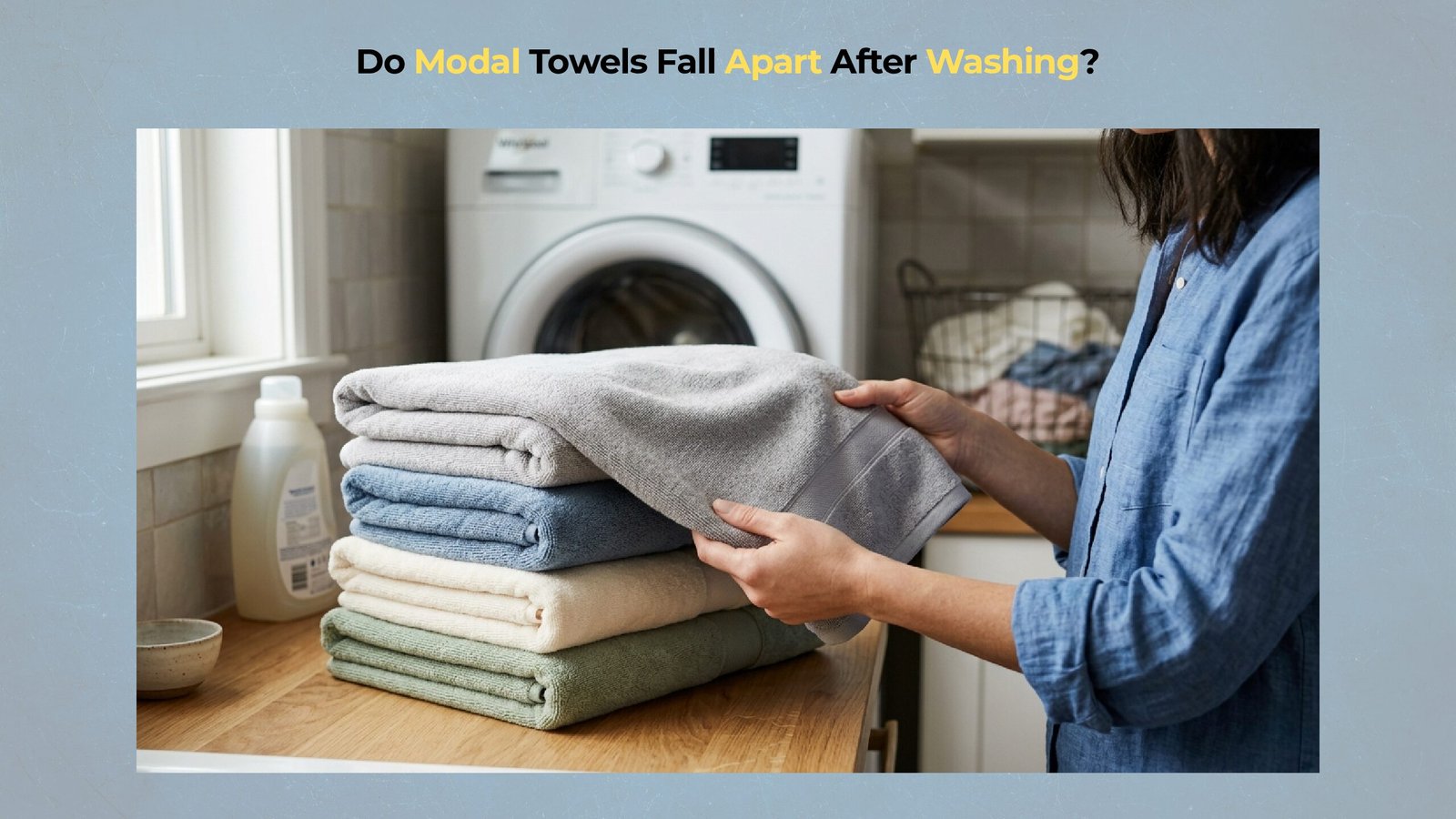
Do Modal Towels Fall Apart After Washing? — Modal towel wash durability
Textile Lifecycle Analysis & Domestic Engineering Protocols
No, Modal towel wash durability is exceptionally high because the High Wet-Modulus (HWM) fibers are specifically engineered to maintain structural integrity during intense mechanical agitation. Mechanical agitation in modern laundry systems exerts centrifugal forces that typically shear standard viscose fibers; however, Modal’s molecular structure is optimized to resist this disintegration. Beyond structural strength, consumers often notice a brief shedding period during the initial break-in phase, which is a normal clearing of unbonded surface cellulose and does not signal fiber failure.
Why is Modal towel wash durability superior for long-term softness?
Long-term tactile softness is influenced by Modal towel wash durability because the smooth fiber surface naturally resists the mineral accumulation that makes cotton towels feel crunchy. Mineral accumulation typically occurs when calcium and magnesium ions from hard water bond with detergent surfactants to create an abrasive crust. Because Modal fibers are hydrophobic in their non-crystalline regions, they prevent these deposits from embedding deeply into the yarn. This mechanism is central to how mineral buildup affects towel texture and performance.
This lack of buildup allows towels to reach their peak plushness around the 5–10 wash milestone, whereas cotton begins its descent into roughness. This contrast highlights how modal compares to cotton in softness retention and transitions logically from the sensory experience into the underlying molecular physics that govern wet-state performance.
Does HWM technology drive Modal towel wash durability during saturation?
Modal towel wash durability during saturation is driven by High Wet-Modulus (HWM) technology which ensures that the regenerated cellulose fibers remain stable in water. According to a Lenzing AG Technical Study (2020), HWM fibers exhibit a wet-strength benchmark 50–100% higher than standard rayon durability under washing stress. This performance is codified in the Molecular Bond Stabilization Model, which explains how the high degree of polymerization in Modal preserves dimensional stability when the fiber is at its most vulnerable state: fully saturated.
How does fiber wet-strength facilitate Modal towel wash durability?
Enhanced Modal towel wash durability is facilitated by fiber wet-strength that prevents the ‘loop snapping’ associated with lower-grade cellulose expansion. High Wet-Modulus fibers inhibit structural thinning by preventing the yarn from over-extending when heavy with water, showcasing how modal fibers are engineered for durability. Furthermore, the fiber’s intrinsic fibrillation resistance ensures that the yarn does not split into microscopic fibrils that cause pilling. This mechanical stability ensures that the towel maintains its original dimensional borders after 100+ cycles.
By preventing these micro-structural failures, the material naturally transitions to a discussion on aesthetic longevity and color, focusing on how modal towels resist structural damage during washing.
Why does Modal towel wash durability outperform 100% cotton in color retention?
Superior color retention is driven by Modal towel wash durability because the fibers absorb dye deeply and resist the surface fraying that makes cotton appear faded. Surface fraying on cotton towels creates a “white noise” effect where light reflects off broken fibers, masking the true pigment. Because Modal fibers remain cylindrical and smooth, they preserve a high-definition light reflection that keeps colors looking “newly dyed.” This smooth surface profile explains how modal resists color fading over time.
This aesthetic performance isn’t just about beauty; it represents a significant financial justification for the initial purchase price of high-end linens.
| Metric | 100% Upland Cotton | 100% Modal / Blend | Durability Result |
|---|---|---|---|
| Color Vibrancy | Significant Fading | MAXIMUM Retention | Modal is superior |
| Fiber Softness | Becomes “Crunchy” | Stays Silky/Plush | Modal is superior |
| Tensile Strength | High (Dry) / Med (Wet) | High (Dry) / HIGH (Wet) | HWM Advantage |
| Heat Tolerance | MAXIMUM | Low (Thermal Risk) | Cotton Advantage |
How does functional lifespan increase the ROI of Modal towel wash durability?
Financial ROI for Modal towel wash durability is driven by a functional lifespan model that accounts for a 40% increase in service life compared to standard cotton. Extended service life reduces the total cost-per-wash (CPW) because the replacement cycle is deferred by several years. Analyzing these replacement cycles shows how towel durability affects long-term value, as the stiffness threshold is reached significantly later in Modal’s lifecycle.
Protecting this long-term financial asset requires a transition from understanding physics to executing proper technical maintenance protocols.
Which laundry settings preserve Modal towel wash durability from thermal stress?
Preservation of Modal towel wash durability requires utilizing cool or warm water settings (max 105°F) to prevent the thermal yellowing of the cellulose fibers. Controlled thermal settings preserve cellulose molecular bonds, which can become brittle if exposed to boiling-point temperatures. An “extra rinse” protocol is vital to ensure zero chemical carryover, while mesh bags safeguard the long terry loops from mechanical snagging on other garments. Implementing these towel care instructions directly influence lifespan and performance.
Does detergent pH influence Modal towel wash durability and wicking?
Modal towel wash durability remains optimal if pH-neutral detergents prevent the alkaline-induced brittleness that compromises fiber flexibility. According to the Journal of Textile Science & Engineering (2019), a pH threshold of 7.0 (neutral) is the ideal environment. The Alkaline Swelling Mitigation Model notes that high-alkaline soaps cause excessive fiber swelling, which leads to permanent structural hardening once the water evaporates.
What chemical errors destroy Modal towel wash durability?
Catastrophic failure of Modal towel wash durability precipitates if users apply chlorine bleach, which dissolves the molecular bonds of regenerated cellulose. Regenerated cellulose is an organic polymer that reacts aggressively with oxidizing agents; bleach essentially “eats” the fiber structure. Microscopic observation confirms how chlorine bleach damages modal fibers at a molecular level. Additionally, fabric softener buildup creates a waxy coating that traps moisture, while over-drying causes “fiber snap,” making the towel permanently stiff.
| Harmful Habit | Resulting Fiber Damage | Corrective Care |
|---|---|---|
| Chlorine Bleach | Fiber Dissolution / Holes | Use Oxygen Whiteners |
| High-Heat Drying | Fiber Brittleness / Snap | Tumble Dry Low / Air |
| Over-drying | Permanent Creasing | Remove while 10% Damp |
| Rough Contact | Snagging / Pulls | Wash in Dedicated Loads |
Which checklist verifies genuine Modal towel wash durability?
A final quality audit of Modal towel wash durability ensures that the GSM weight and fiber certification align with professional structural standards. Professional structural standards, such as Lock-Stitched reinforcement at the hems, are the primary markers of a towel that will not unravel. Verification of these standards is the final hurdle between a low-quality textile and a durable household asset.
Final Quality Checklist
- ✓Verification of genuine HWM origin results if the tag is labeled “100% Lenzing Modal.”
- ✓Prevention of premature unraveling occurs if hems feature industrial Lock-Stitched reinforcement.
- ✓Maintenance of moisture transport is supported if the GSM remains between 500 and 700.
- ✓Achievement of maximum smoothness results if the fabric avoids pilling during a “Rub Test.”
- ✓Optimization of fiber stability initiates if the manufacturer confirms “Double-Singtoned” surface processing.
FAQ: Common questions regarding Modal towel wash durability?
Does Modal towel wash durability prevent pilling?
Yes, Modal towel wash durability prevents pilling because High Wet-Modulus (HWM) fibers possess superior fibrillation resistance. Fibrillation resistance inhibits the micro-tearing of fibers that creates the “pills” common on standard cotton after multiple washes.
Can mixing fabrics affect Modal towel wash durability?
Modal towel wash durability remains highest when washed in dedicated loads, as friction with rougher fibers like heavy denim can cause surface snags.
Disclaimer: Performance Variability
Actual Modal towel wash durability may vary depending on local water hardness, the specific chemical composition of household detergents, and the mechanical efficiency of individual laundering equipment.