TowelDaily Science
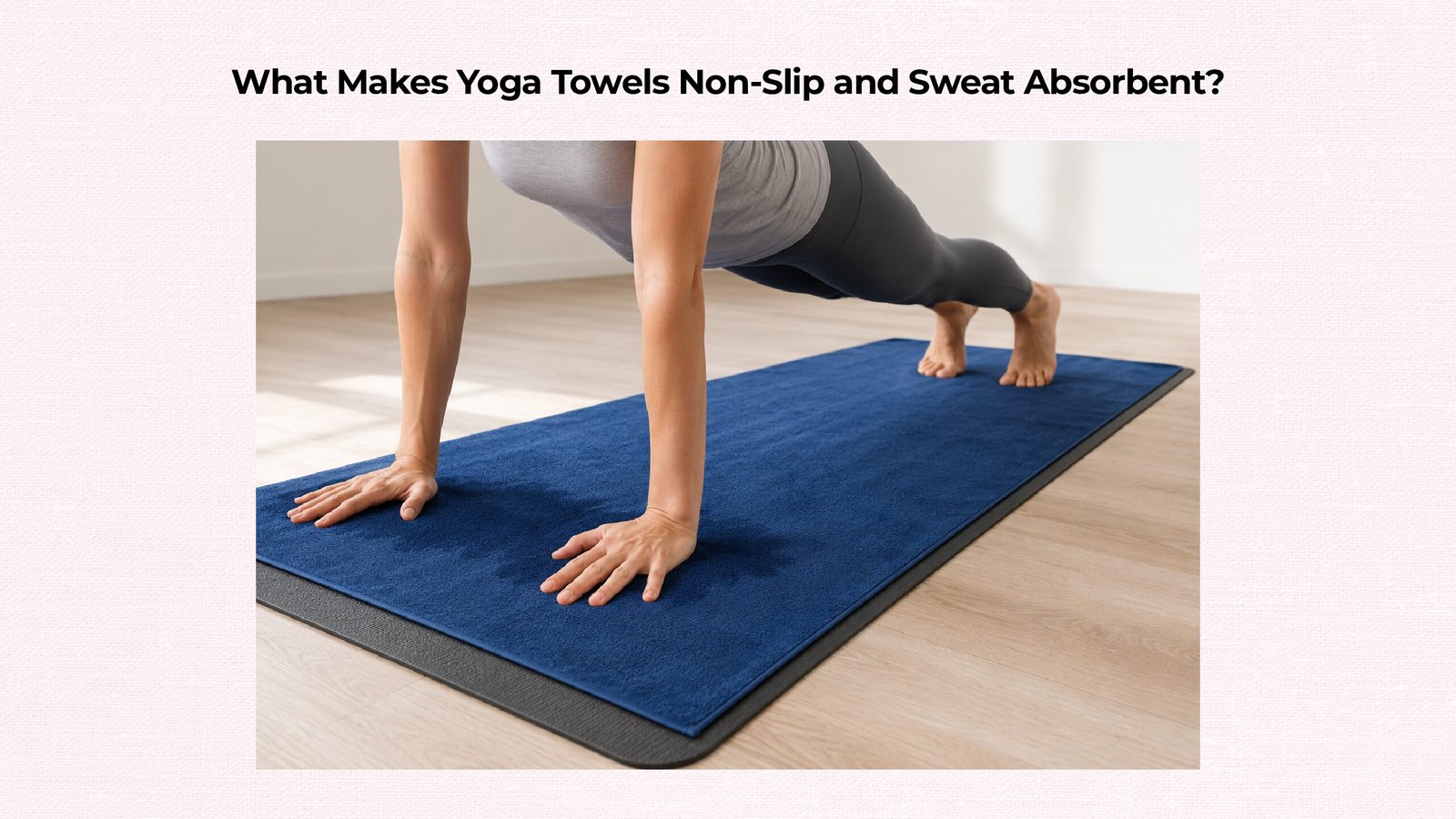
A yoga towel performs well when its finished face manages the expected sweat, its top surface supports hand and foot traction, its underside remains compatible with the specific yoga mat, and its dimensions stay flat during movement. These are separate properties. Microfiber, cotton, silicone nubs, textured fabric, or moisture activation may contribute, but no material name or backing pattern guarantees the complete result.
What makes a yoga towel absorbent and non-slip as a system?
A yoga towel works as a layered system with at least four interfaces: skin to towel, sweat within the textile, towel to mat, and mat to floor. A design succeeds only when moisture handling and stability remain acceptable at every interface through the movements, pressures, and wetness levels of the intended practice.
“Absorbent” can mean fast initial wetting, lateral spreading, water storage, surface pickup, or retention under pressure. “Non-slip” can refer to a hand staying on the towel, a towel staying on a mat, or a mat staying on the floor. Improving one result does not automatically improve another. A towel may absorb sweat yet bunch, or anchor to a mat while its top face feels slick.
The practice changes the specification. A small hand towel targets localized palm or foot moisture. A full-length towel adds alignment, edge, and bunching requirements. A low-sweat restorative session, repeated vinyasa transitions, and a saturated hot-yoga class impose different moisture loads and shear directions. Define that use before comparing products.
Once the towel’s purpose is established, the features that influence yoga-towel performance help connect fabric construction, backing design, dimensions, seams, and drying behavior.
How should yoga-towel sweat handling be evaluated?
Evaluate yoga-towel sweat handling by separating wetting, spreading, capacity, pickup, retention, and drying. Use the same specimen area, water composition, liquid volume, conditioning, pressure, temperature, airflow, and endpoint for every candidate, then repeat the checks after representative laundering.
For practices involving sustained heat and heavier perspiration, how yoga towels perform during hot yoga should be considered under realistic moisture accumulation, saturation, and drying conditions.
Which textile methods apply to yoga-towel moisture performance?
No single method proves the full task. AATCC’s current moisture-management program lists nine separate methods: TM79, TM195, TM197, TM198, TM199, TM200, TM201, TM204, and TM213. They address different properties, including absorbency, liquid movement, wicking, drying, and vapor transmission.
Request the exact method edition, specimen orientation, pretreatment, sample count, mean, variation, units, and pass criterion. A fast droplet result does not prove useful sweat capacity. A drying-time result does not establish skin traction. A supplier claim based on fabric yardage may also exclude the finished towel’s backing, print, seams, or laundering history.
| Property | Controlled question | Record | What it does not prove |
|---|---|---|---|
| Initial wetting | Does a defined droplet enter or spread on the conditioned face? | Time, face, volume, water, conditioning, and spread. | Capacity, grip, or drying. |
| Spreading or wicking | How far and how evenly does liquid move from the application point? | Distance or area, time, direction, and specimen orientation. | Retention under body pressure. |
| Useful capacity | How much water can the towel hold before pooling, transfer, or unacceptable slickness? | Dry mass, wet mass, loading procedure, pressure, and failure point. | Towel–mat stability. |
| Drying | How long does the defined wet load take to reach the chosen dry endpoint? | Starting load, mass loss, airflow, humidity, temperature, and hanging method. | Hygienic cleanliness or safe reuse. |
How should non-slip yoga-towel grip be evaluated?
Evaluate non-slip performance at both the skin–towel and towel–mat interfaces using the actual mat, defined moisture states, realistic loading, and movements in more than one direction. Record initial movement, continuous sliding, bunching, edge lift, backing transfer, and the moisture level at which behavior changes.
Since traction can change with direction, pressure, moisture, and surface condition, the factors that control yoga-towel grip should be tested under the movements and sweat load expected during practice.
Why is a generic coefficient of friction insufficient for yoga towels?
Friction values are method- and interface-specific. ASTM D1894-24 measures starting and sliding friction of plastic film and sheeting at specified conditions; it is not a complete yoga-towel test. ASTM also states that D1894 is not equivalent to ISO 8295 and that results cannot be compared directly between them.
A meaningful supplier report should identify the contact pair, mat brand or material, towel face or backing, sled or load, contact area, dwell time, pulling speed, direction, temperature, humidity, and dry or wet preparation. A silicone, rubber, TPE, or textured-fabric label cannot predict every yoga-mat surface, detergent residue level, or movement pattern.
Grip testing also leads to what makes a yoga towel non-slip because skin-to-towel traction and towel-to-mat stability can fail independently.
Which yoga-towel face constructions fit different practices?
The best face construction is the finished surface that matches the user’s sweat load, touch preference, movement, laundry process, and mat. Polyester, nylon or polyamide, cotton, blends, split fibers, brushed faces, and woven textures are construction clues—not guarantees of capacity, traction, softness, or quick drying.
| Construction clue | Potential role | Trade-off to inspect | Required verification |
|---|---|---|---|
| Low-profile synthetic face | May support compact packing and a broad contact area. | Can feel slick when dry or saturated, depending on finish and texture. | Dry, damp, and high-load skin traction plus drying. |
| Textured or brushed microfiber | May change surface contact and liquid spreading. | Texture may flatten, retain residue, or change after laundering. | Before-and-after wetting, hand feel, and abrasion. |
| Cotton or cotton-rich fabric | May provide familiar hand and useful water storage. | Bulk, saturation behavior, drying time, shrinkage, and bunching vary. | Finished capacity, stability, dimensions, and care. |
| Blended or zoned construction | May place different yarns or textures where contact changes. | Fiber percentages do not reveal placement or surface exposure. | Face mapping, seam behavior, wear, and complete-towel tests. |

Which backing designs can stabilize a yoga towel on a mat?
Silicone nubs, printed elastomer patterns, textured fabric, and unbacked designs can stabilize a yoga towel only when they are compatible with the chosen mat and moisture state. Pattern name, dot size, and backing material do not establish traction without a defined interface test.
When a backing or textured underside is used, how a yoga towel and mat interact during non-slip use becomes more useful than judging the towel on a bare floor or incompatible surface.
Discrete nubs may anchor selected contact points while leaving much of the fabric flexible. A continuous or dense print may increase contact area but can change drape, drying, mass, residue sensitivity, and wash behavior. An unbacked towel may rely more on its fabric texture, full coverage, body pressure, and moisture activation. Edge binding and size also influence bunching.
Product differences are real even within one brand. Manduka’s current help center describes Yogitoes as a woven towel with 100% silicone nubs, while eQua uses an 80% polyester and 20% nylon microfiber without that nub construction. Their listed standard dimensions also differ. This product-specific example should not be generalized to all yoga towels.
How should a yoga towel be chosen for a specific practice?
Choose a yoga towel by matching its size, face traction, backing compatibility, sweat capacity, drying, and care requirements to the user, mat, studio, movement, and laundry routine. Test a representative towel before purchasing several because fit and interface failures are difficult to infer from labels.
Because the correct design depends on practice style, mat size, movement, and sweat load, the main factors for selecting a yoga towel should guide comparisons before material labels or marketing claims.
- ☐ Define full-mat or localized coverage, mat dimensions, practice style, usual sweat load, and movement directions.
- ☐ Confirm which side faces the body, whether a backing exists, and which mat surfaces the manufacturer approves.
- ☐ Inspect dimensions, edge binding, labels, seams, texture, drape, color-transfer warnings, and care instructions.
- ☐ Test skin traction and towel–mat movement when dry, lightly damp, and at the expected high moisture load.
- ☐ Launder the sample as directed, dry it completely, then repeat wetting, traction, bunching, and backing inspections.
- ☐ Reject a product that shifts, wrinkles, lifts, transfers residue, remains slick, retains odor, or exceeds the available drying time.

How should a yoga towel be used without creating new slip points?
Use a yoga towel on the surface and orientation approved by its manufacturer, align it fully, remove folds, and test stability with light pressure before dynamic movement. Stop and reset the system when an edge lifts, the towel rotates, water pools, the face becomes slick, or the mat itself moves.
After selecting a compatible product, how to use a yoga towel correctly helps prevent misaligned edges, wrinkles, bunching, and unexpected changes in traction.
- ☐ Inspect the mat and towel for damage, residue, debris, damp storage odor, peeling, or distorted edges.
- ☐ Place the designated backing or grip side against the compatible mat; do not assume it is approved for bare flooring.
- ☐ Match the towel edges to the mat and smooth from the center outward without stretched corners or rolled hems.
- ☐ Apply light hand and foot pressure in forward, backward, and sideways directions before weight-bearing transitions.
- ☐ Add moisture only if the product instructions require it, then repeat the stability check.
- ☐ During practice, pause if the towel bunches, slides, saturates, transfers dye, or changes traction unexpectedly.
- ☐ After use, separate the towel from the mat promptly and follow each product’s cleaning and drying directions.
When should a yoga towel be dampened before practice?
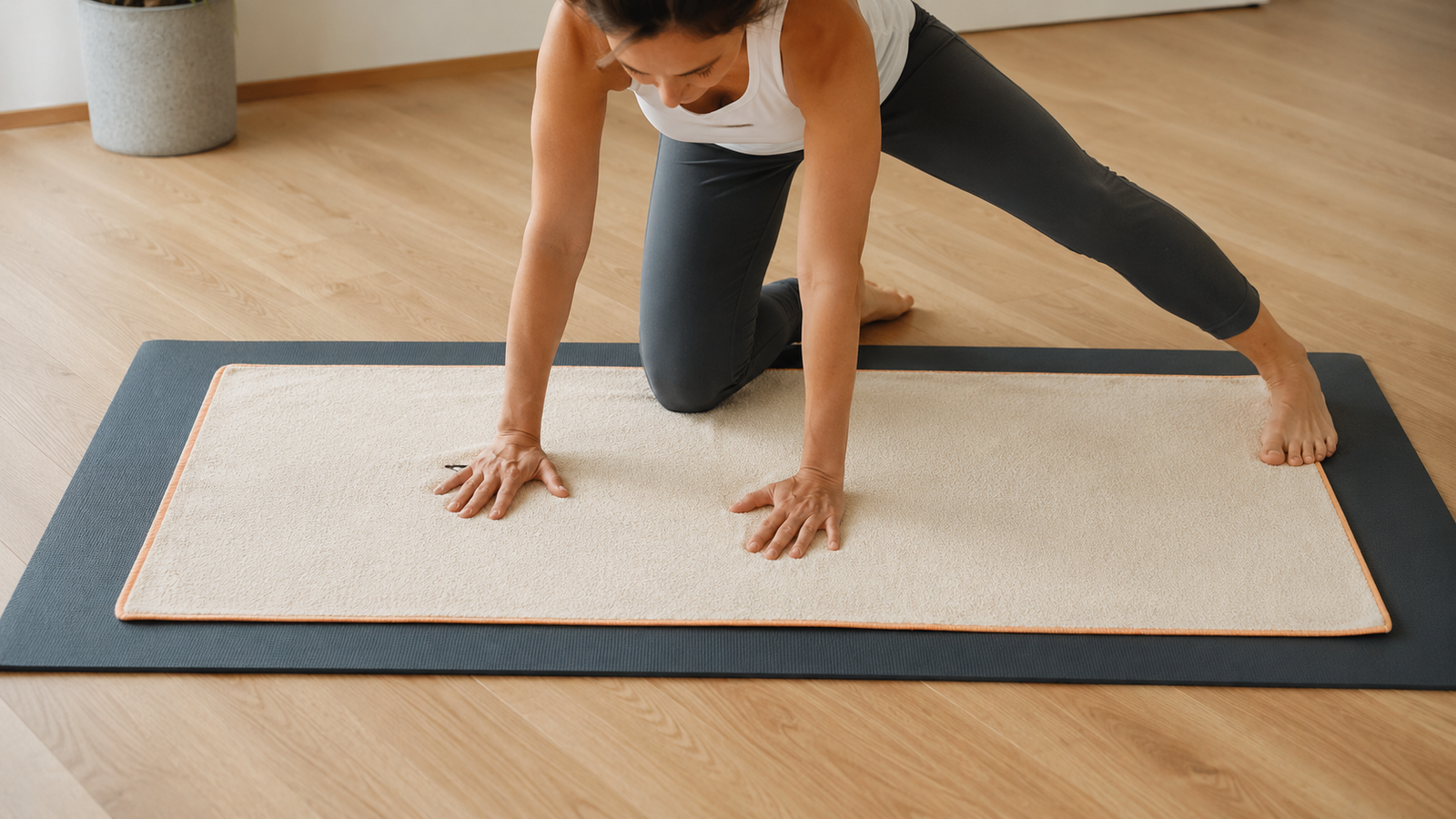
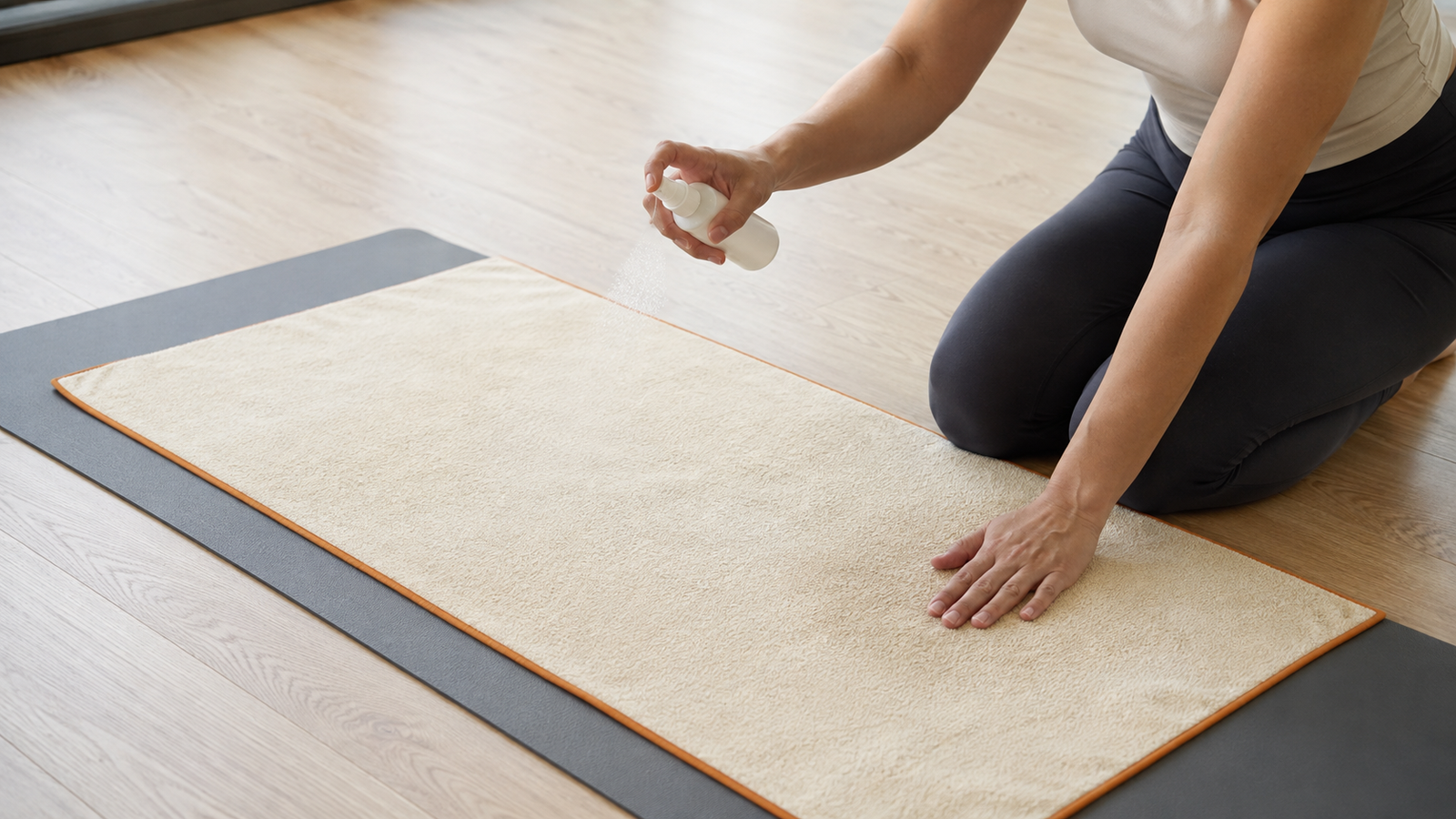
Dampen a yoga towel only when its manufacturer describes moisture activation and identifies where to mist. Manduka’s current Yogitoes guidance says to lightly mist the top side, while its eQua guidance describes lightly misting both sides. These are product instructions, not a universal rule for every towel or mat.
More water is not automatically safer. Excess liquid can pool, migrate to the mat, change the skin interface, or create uneven traction. Use the stated amount, distribute it evenly, and recheck the complete system. If dry hands slip immediately, the correct response may be another towel, mat cleaning, or a different compatible setup—not uncontrolled wetting.
How should yoga towels be washed, dried, and stored?
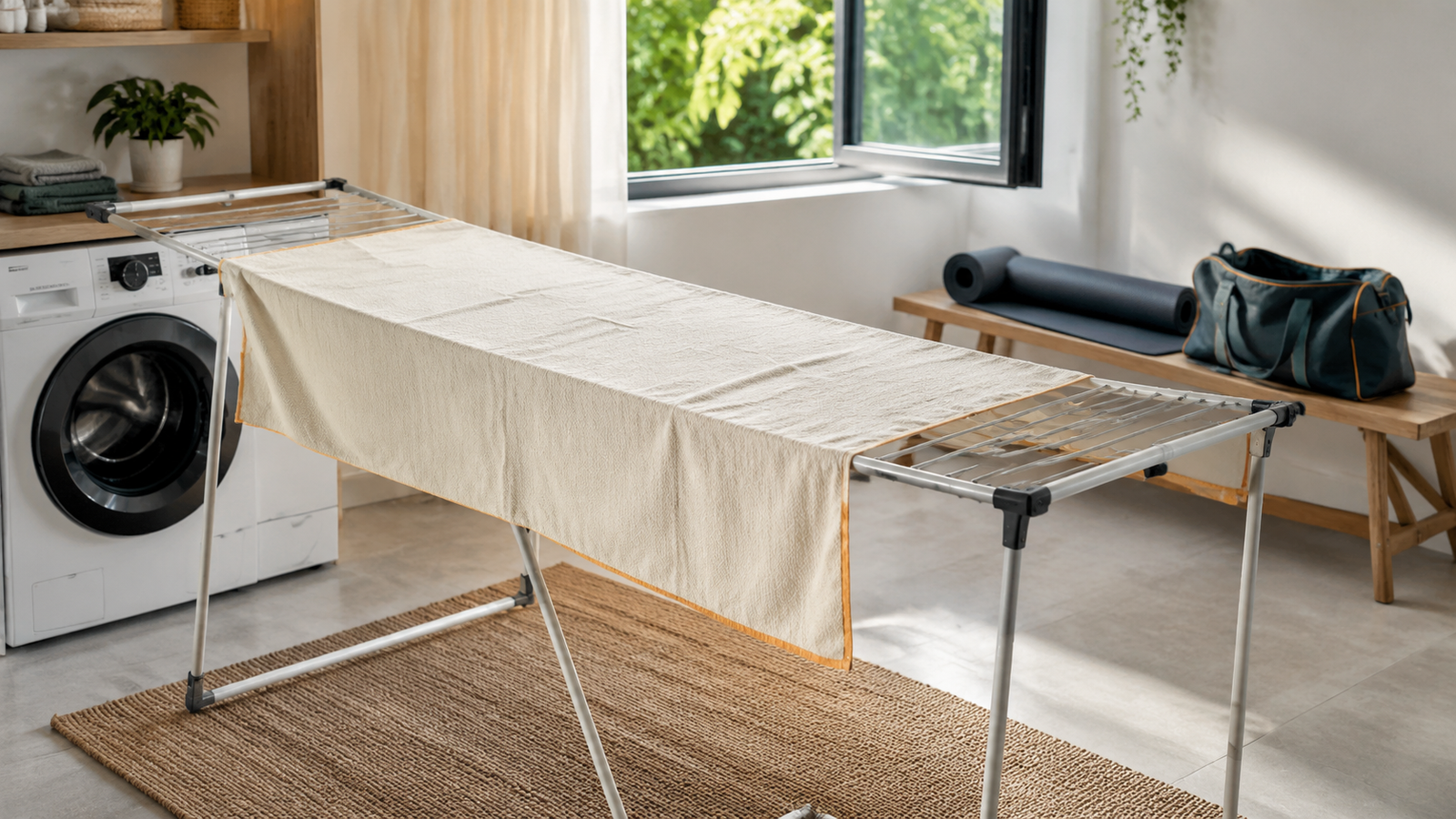
Wash, dry, and store a yoga towel according to its own care instructions, using compatible laundry products and complete drying before storage. Backings, prints, dyes, fibers, and edge constructions differ, so one water temperature, dryer setting, softener policy, vinegar quantity, or stripping schedule cannot apply to the category.
Since residue, softener, incomplete rinsing, and damaged backing can reduce performance, the correct instructions for washing a yoga towel should be followed before its wetting and grip are tested again.
Manufacturer directions can be precise. Manduka’s current towel care page recommends cold washing with like colors for Yogitoes and eQua, low tumble drying or hang drying, no bleach, and no softener or dryer sheets. That guidance applies to those named products and should not be copied to an unrelated towel without checking its label.
Do not rely on a fixed vinegar rinse or periodic “strip.” Acids, alkalies, oxidizers, solvents, heat, and concentrated products can affect fibers, dyes, prints, adhesives, elastomers, and machines differently. If performance falls, first review product instructions, laundry dosing, rinsing, load contamination, drying, mat cleanliness, and physical damage.
Hygiene adds a separate condition. CDC guidance for athletes advises not sharing personal towels, laundering and completely drying towels after use, and following the clothing label. Keep damp yoga towels out of closed bags and rolled mats, wash hands after handling soiled textiles, and seek medical guidance for concerning skin symptoms rather than treating a towel adjustment as care.
What causes a yoga towel to slip, wet slowly, smell, bunch, or peel?
Yoga-towel problems usually come from interface mismatch, moisture outside the working range, residue, insufficient coverage, dimensional change, damaged backing, inadequate cleaning or drying, or a change in mat condition. Diagnose the symptom under controlled conditions before changing several variables at once.
| Symptom | Check first | Controlled next action | Stop or replace when |
|---|---|---|---|
| Towel slides on mat | Side orientation, mat compatibility, mat residue, backing wear, and moisture state. | Clean as directed, align flat, and repeat a low-load multidirectional test. | Movement persists or backing peels, cracks, or transfers. |
| Hands slide on towel | Face orientation, dry versus damp design, skin products, saturation, and residue. | Follow the activation instructions and compare with a correctly cared-for reference towel. | Traction remains unpredictable in the intended moisture range. |
| Sweat beads or pools | New-product finish, laundry products, saturation, surface damage, and expected load. | Launder as labeled, dry fully, and repeat the same droplet and capacity checks. | Pickup remains below the defined requirement. |
| Towel bunches or edges lift | Size mismatch, shrinkage, backing distribution, drape, and movement direction. | Realign without stretching and test a size or construction matched to the mat. | Wrinkles return under normal transitions. |
| Odor persists | Delayed washing, incomplete drying, load contamination, storage, and care compliance. | Correct the wash-and-dry process without adding unapproved chemicals. | Odor remains after correct laundering and complete drying. |
| Dots, print, or coating peel | Heat, chemistry, abrasion, age, folding, and manufacturer warranty. | Stop use and document the damage; contact the seller or manufacturer. | Loose material or uneven grip affects stability. |
What should buyers verify before ordering yoga towels in bulk?
Bulk buyers should translate practice conditions into measurable acceptance criteria, approve representative production samples after laundering, and require notification when face fabric, backing, dimensions, finishing, dyeing, edge construction, or manufacturing location changes.
Request fiber percentages, finished dimensions and tolerances, dry mass, face and backing descriptions, side orientation, compatible mat guidance, care instructions, color-transfer warnings, dimensional-change results, and the exact methods behind moisture or friction claims. Ask whether the reported test used the complete towel or only unbacked fabric.
Define pass criteria for dry, lightly damp, and high-moisture use; initial and continuous sliding; bunching and edge lift; useful capacity; drying in the real room; odor after care; color transfer; shrinkage; and backing integrity after representative cycles. Retain an approved sample for lot comparison and repeat testing after any material or process change.
What are the most common questions about non-slip yoga towels?
The most reliable answers keep product instructions, finished-towel tests, mat compatibility, moisture state, and care history visible. They avoid turning one brand’s construction or activation method into a universal yoga-towel rule.
Do non-slip yoga towels work without a yoga mat?
Use a yoga towel without a mat only when its manufacturer expressly approves that surface and setup. A backing designed to engage a yoga mat may shift on wood, tile, carpet, or studio flooring. Test placement at low load before beginning movement.
Is split microfiber always the most absorbent yoga-towel material?
No. A split-fiber claim does not establish initial wetting, sweat capacity, spreading, drying rate, or retention after laundering. Compare finished towels with named methods or an identical use trial. Fiber percentages and filament descriptions help identify construction, but they do not replace performance results.
Should a yoga towel be dampened before practice?
Dampen a yoga towel only when the product instructions recommend moisture activation. Apply the stated amount and location, spread the towel flat, and test hands and feet with light pressure. Too much water or the wrong mat–towel combination can reduce stability instead.
Why does a yoga towel become slippery after washing?
Possible causes include residue, an incompatible laundry product, damaged texture or backing, incomplete rinsing, or use on a different mat. Review every care label, repeat a controlled dry-and-damp trial, and retire the towel if shifting, peeling, or slickness persists.
How often should a yoga towel be washed?
Wash a sweat-soaked yoga towel after use according to its care instructions, then dry it completely before storage. Do not share personal towels. Frequency may increase with heavy soil, shared facilities, skin concerns, or manufacturer directions, but no universal temperature or chemical formula fits every construction.
What defines a high-performing non-slip yoga towel?
A high-performing yoga towel is the finished product that manages the intended sweat load, supports predictable skin traction, remains stable on the chosen mat, fits without bunching, survives its labeled care, and dries completely within the available routine. Those outcomes must be verified together.
Material and design claims still help shortlist candidates, but they need scope. Split fibers do not prove capacity, silicone does not prove mat compatibility, moisture activation does not justify uncontrolled wetting, and “quick dry” requires stated conditions. Choose, use, troubleshoot, and replace the towel through repeatable finished-product checks.