Towel Engineering · Sports Textiles
A finished-product guide to moisture pickup, dry-zone control, match use, care, and verification.
A tennis towel manages on-court sweat when it removes surface moisture quickly, keeps enough usable dry area for later wipes, remains comfortable under pressure, and can be cleaned and dried before reuse. Fiber content, terry loops, microfiber labels, GSM, and size are clues, but none independently proves match performance.
How does a tennis towel manage sweat during play?
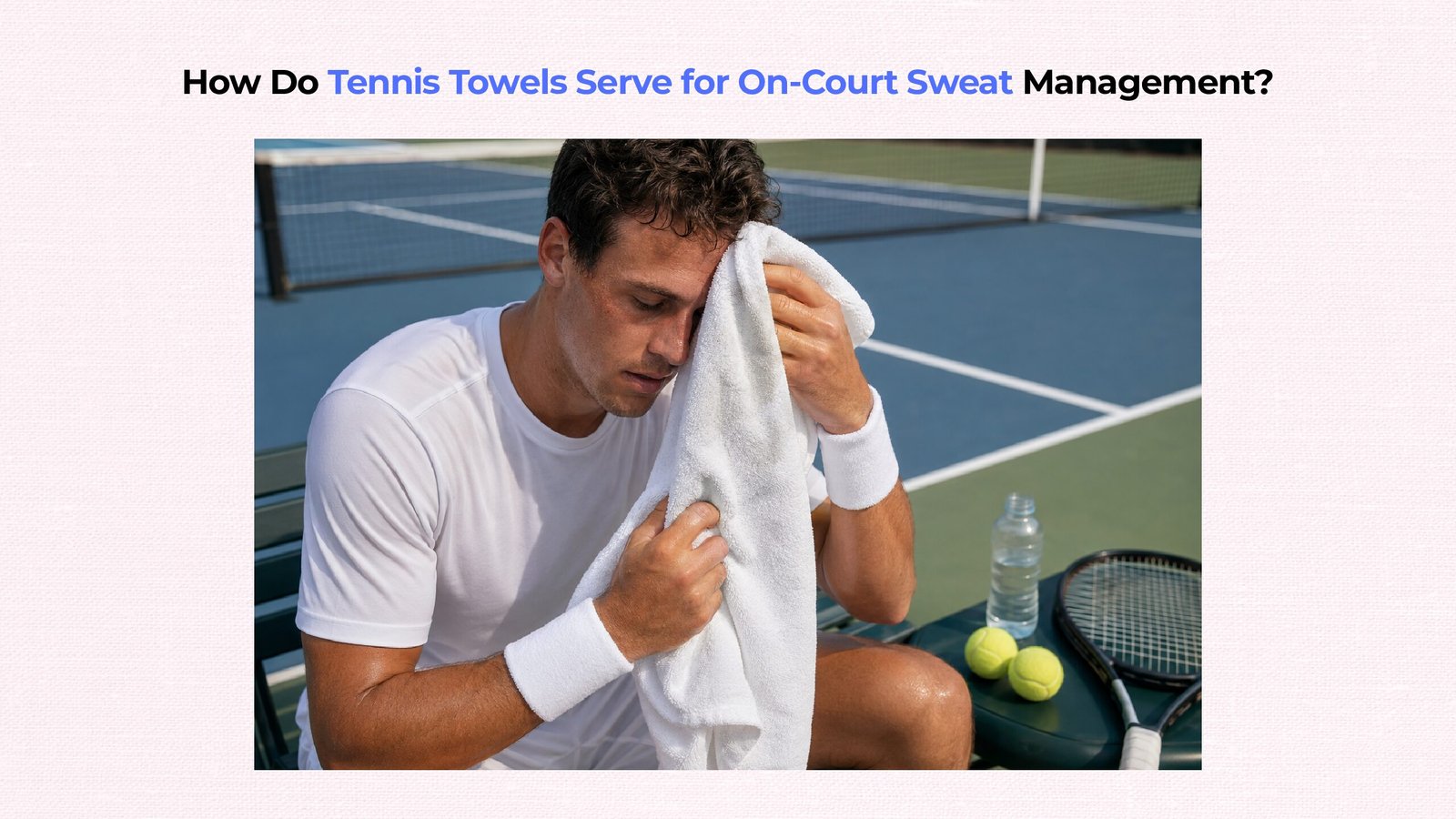
A tennis towel manages sweat by transferring liquid from the face, neck, hands, or another approved contact area into a textile during a short pause. The towel must provide surface pickup without immediately returning moisture, transferring residue, shedding fibers, irritating skin, or becoming too saturated for the next use.
This is a local moisture-control task rather than whole-body hydration or cooling. A dry towel can remove sweat that might reach the eyes or contaminate a hand-to-grip interface, but it cannot replace fluids, electrolytes, shade, a heat policy, or medical action. The CDC’s current athlete heat guidance says a person who feels faint or weak should stop activity and move to a cool place.
The working system includes the player, sweat and skin products, the towel face, the folded dry zones, the storage location, and the laundry process. A towel can perform well for a light indoor session yet fail during a long outdoor match because the moisture load, contamination, access, and drying conditions have changed.
Since the face and eye area require controlled contact, how tennis towels support facial sweat control should be considered alongside texture, residue transfer, and blotting technique.
How variable are sweat rates in tennis?
Tennis sweat rates vary too widely to define one universal towel capacity. A 2006 practical review reported approximately 0.5–3.0 L/hour across male and female tennis players, depending on environment, intensity, and individual physiology. The review concerns whole-body fluid balance—not the amount a court towel must absorb from selected skin areas.
Use the range as evidence that players need individualized planning, not as a purchasing threshold. The towel receives only part of total sweat, and that share changes with clothing, evaporation, toweling frequency, sunscreen, humidity, and match access. Read the original scope in Kovacs’ 2006 tennis hydration review before applying its numbers.
For longer matches or warmer conditions, which tennis-towel materials suit heavy sweating should be evaluated through usable capacity, wet feel, moisture release, and between-use drying.
Which moisture properties determine tennis-towel performance?
Tennis-towel performance depends on initial wetting, surface pickup, spreading, usable capacity, retention under pressure, damp-surface feel, and drying time. These properties interact, but they are not interchangeable. A towel that wets quickly can still saturate early, dry slowly, or release moisture when squeezed.
“Absorbency” therefore needs a named endpoint. Wetting asks whether liquid enters the surface. Pickup asks how much leaves the skin or test plate. Capacity measures a retained mass under stated conditions. Wicking describes movement away from the contact point. Drying measures water loss over time under controlled airflow, temperature, humidity, orientation, and starting load.
Which test methods apply to tennis towels?
No single laboratory method proves on-court performance. The AATCC moisture-management program currently lists nine separate methods, including TM79 for absorbency, TM195 for liquid moisture management, TM197 and TM213 for vertical wicking, TM198 for horizontal wicking, and TM199–201 for different drying conditions.
ASTM D4772-26 measures rapid surface-water absorption by terry fabric. Its scope does not make it a universal test for waffle, huck, nonwoven, or every low-profile microfiber construction. A supplier report should identify the method edition, specimen face, pretreatment, conditioning, sample count, units, variation, and acceptance rule.

| Property | Controlled question | Record | What it does not prove |
|---|---|---|---|
| Initial wetting | Does a defined droplet enter or spread on the intended face? | Water, volume, face, time, and laundering state. | Capacity, pickup, or match duration. |
| Surface pickup | How much liquid leaves a defined surface after controlled contact? | Starting liquid, contact pressure, motion, and residual mass. | Drying speed or skin comfort. |
| Usable capacity | How much water remains in the towel before wiping quality fails? | Dry mass, wet mass, folding pattern, and failure endpoint. | Fast wetting or residue resistance. |
| Drying | How long does a stated water load take to reach the dry endpoint? | Load, temperature, humidity, airflow, orientation, and time. | Pickup, grip protection, or hygiene by itself. |
How does construction influence tennis-towel performance?
Construction influences performance through the exposed face, yarn geometry, pile or texture, ground structure, finishing, edge design, dimensions, and total mass. A tennis towel may use terry loops, a waffle texture, a low-profile microfiber face, or another structure; terry is one option rather than the category definition.
Raised pile can increase contact area and cushioning, while a lower profile can reduce bulk and expose a broad wiping surface. Denser construction may improve some strength measures yet slow liquid entry or increase stiffness. Taller or looser loops may increase accessible surface but can snag, flatten, or change after laundering. The finished balance matters more than one isolated specification.
What does woven-terry research show about trade-offs?
A 2025 Scientific Reports study produced four 75 × 75 cm cotton terry sample designs and evaluated shrinkage, strength, absorbency, moisture management, drape, softness, smoothness, and resilience. In those samples, greater thread density improved strength-related performance but reduced several absorbency and comfort outcomes.
The result demonstrates an interacting trade-off, not a tennis-towel recipe. The study used specified cotton yarn counts, 3-pick terry bodies, selected decorative weaves, and loom conditions. It did not establish that every low-density towel is better, nor did it test sunscreen, racket grips, on-court folding, synthetic microfiber, or match-duration saturation.
How should tennis-towel materials be compared?
Compare tennis-towel materials as finished constructions under the same moisture load and care history. Cotton, polyester, polyamide or nylon, blends, and split microfiber describe fiber composition or geometry; they do not reveal exposed-face placement, finish chemistry, yarn structure, pile profile, fabric mass, seams, or actual drying conditions.
Fiber labels become useful only when compared with how absorbent materials perform in tennis towels under the same water load, contact pressure, dimensions, and laundering history.
Cotton-rich terry may offer a familiar hand and useful pressure pickup, but capacity, drying, lint, and wet weight vary. Low-profile synthetic microfiber may be compact and spread liquid efficiently, but untreated polyester is not automatically wettable and a microfiber label does not confirm splitting, finish durability, or face direction. Blends may distribute functions across different yarns, yet a percentage label cannot show where each fiber is exposed.
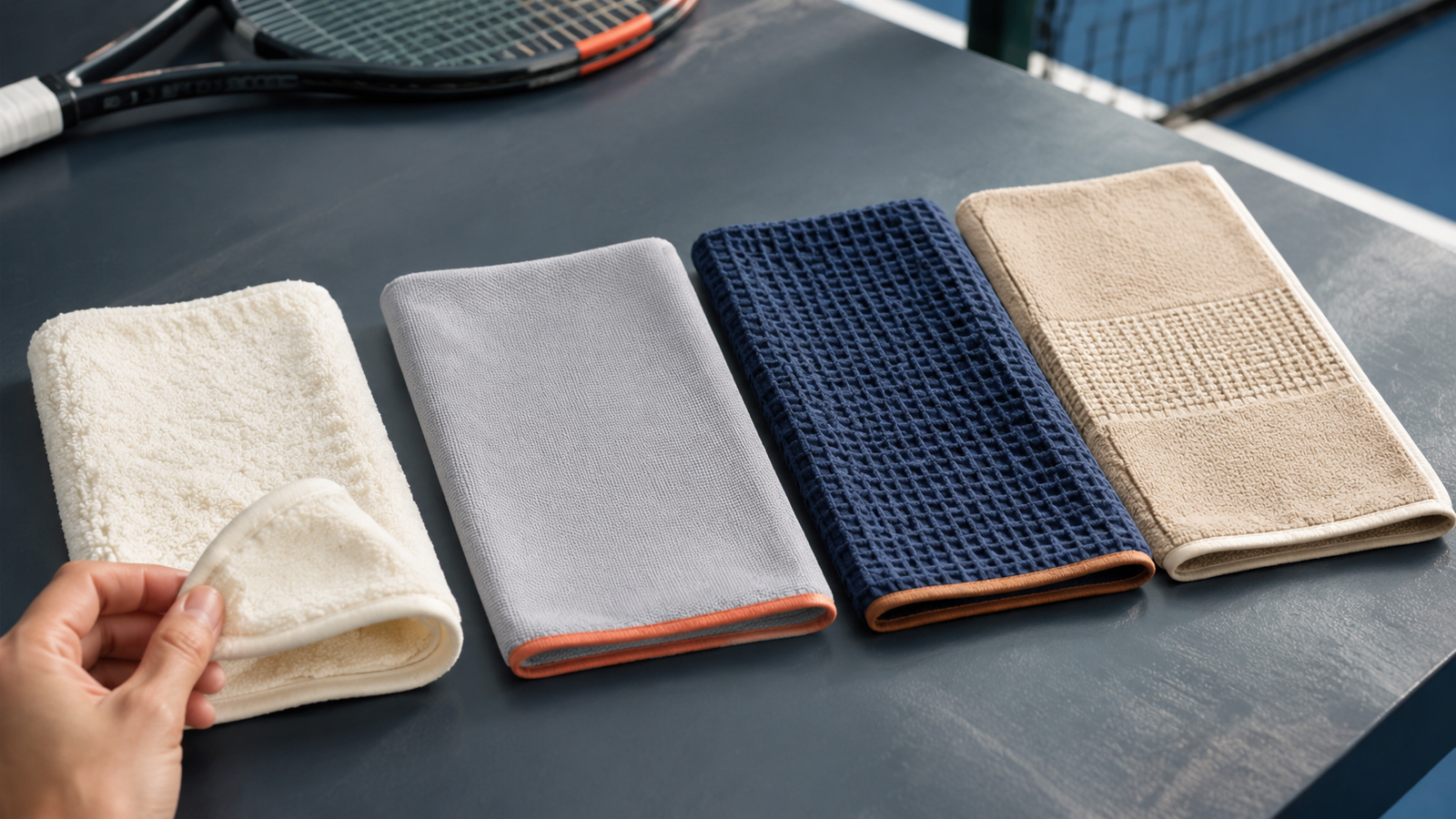
| Construction clue | Potential role | Trade-off to inspect | Required verification |
|---|---|---|---|
| Cotton-rich terry | Raised contact surface and familiar pressure feel. | Wet mass, drying time, loop snagging, lint, and shrinkage. | Pickup, capacity, dry time, and repeated-laundering trial. |
| Low-profile synthetic microfiber | Compact format with broad surface contact. | Finish loss, damp slickness, edge curl, and heat sensitivity. | Wetting and pickup before and after approved care. |
| Waffle or textured weave | Lower bulk and structured channels or pockets. | Surface pickup can differ from pile; edges may distort. | Task-level wipe, capacity, dimensional, and drying checks. |
| Blended or zoned construction | Different fibers or textures may serve different zones. | Percentage labels hide placement and exposed surface. | Face mapping, seam inspection, and complete-towel test. |
How is a tennis towel different from bath and cooling towels?
A tennis towel is defined by its on-court task, not by a universal size or GSM range. It must fit the player’s permitted access and storage, expose repeatable dry zones, and remain usable after intermittent sweat pickup. Bath towels and cooling towels can overlap in material, but their primary working conditions differ.
A bath towel usually handles a larger post-wash water load in a controlled environment. A sweat-management tennis towel handles smaller, repeated contacts while sunscreen, skin oil, clay, bag surfaces, and grip residue may be present. A cooling towel is commonly wetted intentionally for skin-cooling use; that wet starting state conflicts with the need for dry surface pickup unless a separate dry towel is available.
Do not classify a product solely from marketing names. A compact bath hand towel may pass a tennis trial, while a branded “court towel” may fail because it saturates, sheds, remains damp in the bag, or does not fit the player’s routine. Evaluate the role, interface, and care path.
How should a tennis towel be selected for match conditions?
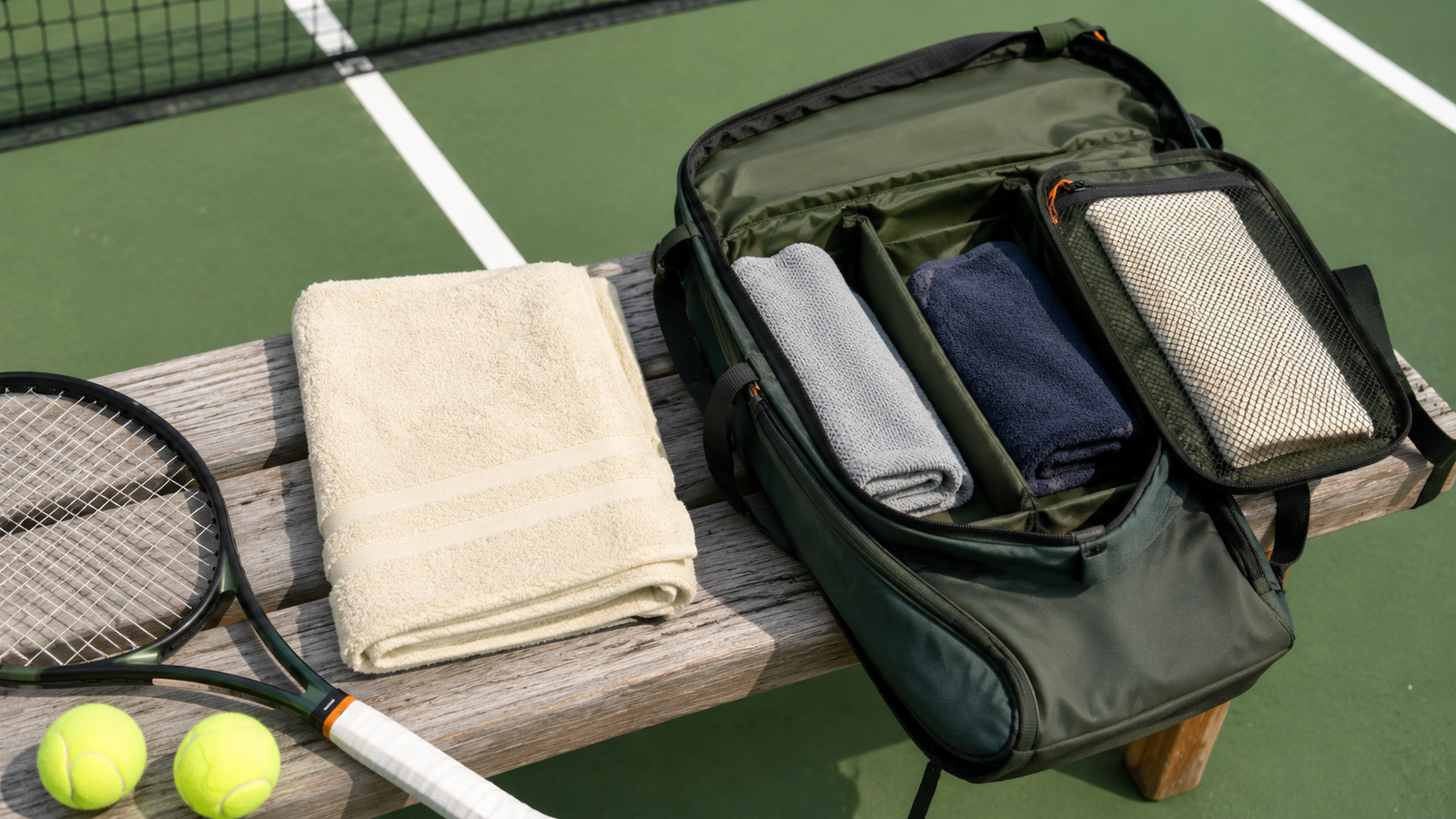
Select a tennis towel by matching its working area, pickup, capacity, drying, hand feel, residue control, and care requirements to the player’s sweat pattern, climate, match length, bag space, skin products, and access to replacements. Test one representative towel before buying several or relying on it in competition.
Because court conditions and player routines differ, how to select a tennis towel for reliable performance should account for match length, climate, toweling frequency, storage access, and replacement availability.
- ☐ Define the intended contacts: face, neck, hands, equipment, or separate towels for different zones.
- ☐ Record the longest expected session, climate, typical toweling frequency, storage point, and replacement access.
- ☐ Inspect dimensions, wet weight, edge binding, labels, seams, texture, drape, shedding, and care instructions.
- ☐ Compare wetting, controlled surface pickup, usable capacity, and drying under identical conditions.
- ☐ Apply the player’s sunscreen or grip-related residues to a separate test area and check transfer or staining.
- ☐ Launder the sample as directed, dry it completely, then repeat moisture, feel, size, color, and seam checks.
- ☐ Reject a towel that scratches, transfers dye, retains odor, sheds excessively, distorts, or cannot dry in the available time.
When one towel cannot provide enough clean surface for the expected session, how many tennis towels are needed for competition use becomes more important than relying on an unsupported universal quantity.
How can a tennis towel be tested before a match?
Test a tennis towel with a repeatable home or club screening that mimics its actual contacts without pretending to be a laboratory standard. Use equal specimens or complete towels, the same water, mass, fold, pressure, contact count, room conditions, and care history, then record results rather than relying on touch alone.
- Condition each clean, dry towel in the same room and record its dry mass, dimensions, face, and laundering history.
- Apply the same measured water mass to identical nonabsorbent test surfaces; keep sunscreen and grip-residue trials separate.
- Press each folded towel with the same flat load for the same time; do not change rubbing motion between candidates.
- Weigh the towel and remaining surface water, then record pickup, visible transfer, damp feel, and any release under light pressure.
- Repeat on fresh zones until the defined failure point, such as smearing, release, uncomfortable saturation, or no clean area.
- Dry each towel in the planned orientation and environment; record the time to the same dry-mass or practical-dry endpoint.
- Repeat after representative laundering and compare change, not just the best first-use result.
Report the screening as a comparison under stated conditions. It does not generate an ASTM or AATCC result, predict hygiene, or prove safety. If procurement or product claims require formal evidence, use an accredited laboratory and a method whose scope matches the towel construction and performance question.
How should a tennis towel be used on court?
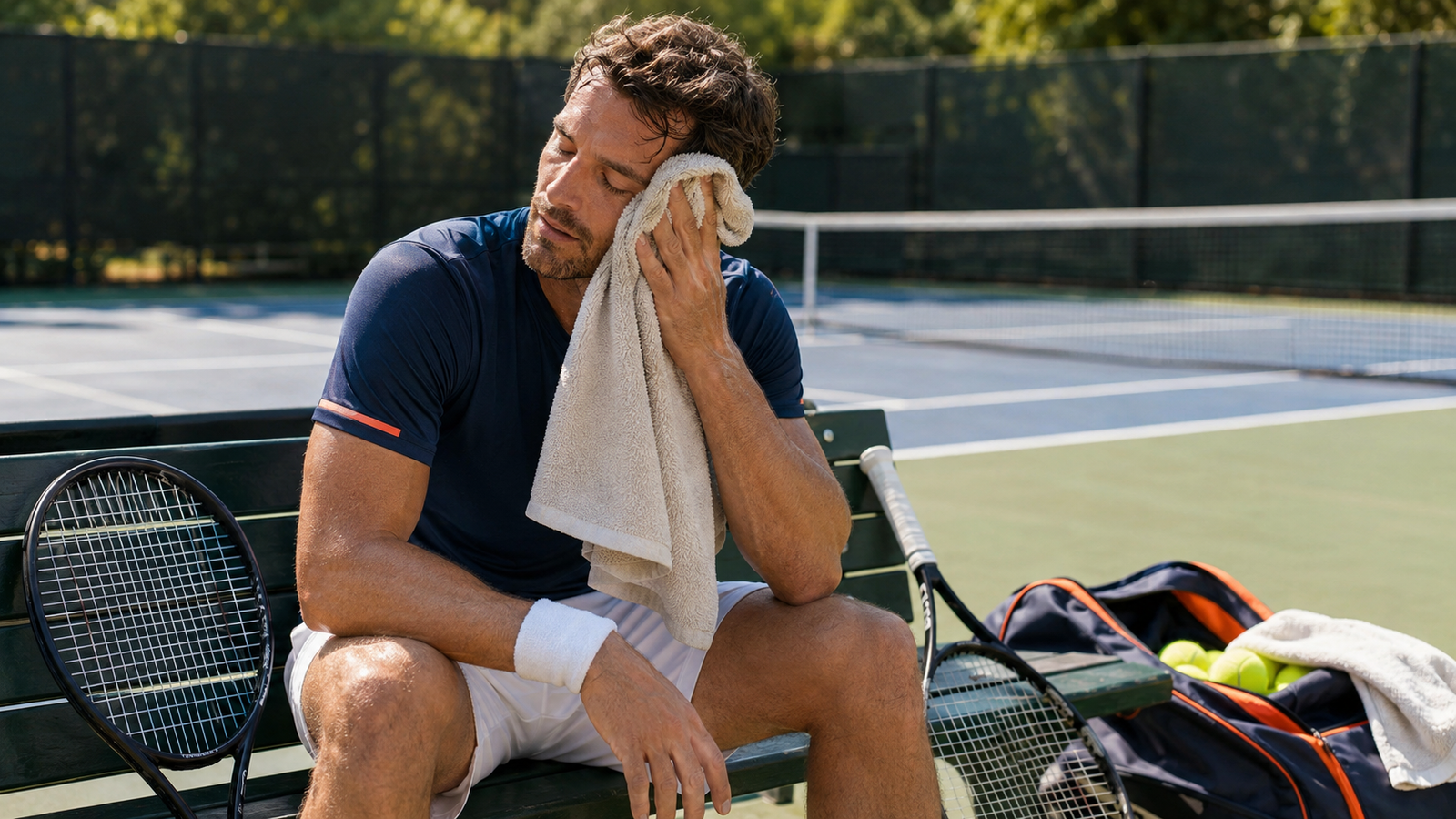
Use a tennis towel by assigning clean contact zones, pressing or wiping only as much as needed, rotating to a dry area, and replacing the towel when surface pickup fails. Keep it off contaminated floors and shared surfaces, follow event rules, and separate personal skin use from equipment cleaning when residue transfer matters.
Once moisture properties are understood, how to use a tennis towel for sweat management becomes the next practical question because clean zones must be rotated before saturation causes smearing.
- ☐ Begin with a clean, fully dry towel and a dry backup when conditions or match length justify one.
- ☐ Assign a face-and-neck side and a hand or equipment side, or use two clearly separated towels.
- ☐ Fold the towel into repeatable zones and rotate before a used zone begins to smear or release moisture.
- ☐ Blot near the eyes and irritated skin rather than rubbing aggressively; stop if the textile causes discomfort.
- ☐ Keep clay, sunscreen, grip residue, floor contact, and shared-chair contamination away from clean facial zones.
- ☐ Replace rather than wring a sweat towel when wringing cannot restore a genuinely clean, effective surface.
- ☐ After play, isolate the damp towel from clean gear and begin the approved care process promptly.
A second towel is useful when it creates functional separation, not simply because two is a universal rule. Heavy sweaters may need additional dry capacity. Players using sunscreen may benefit from keeping facial residue away from the hand-and-grip towel. A compact session may require only one towel with clearly managed zones.
How should tennis towels be washed, dried, and stored?
Wash, dry, and store a tennis towel according to its care label and compatible laundry-product instructions, then verify that it is completely dry before reuse or closed storage. Fiber blends, dyes, prints, hydrophilic finishes, seams, and microfiber structures differ, so one temperature, detergent fraction, dryer setting, acid rinse, or stripping schedule cannot fit every towel.
After play, sunscreen, sweat, skin oils, and grip residue make the correct way to wash tennis towels important for restoring clean wetting and preventing persistent odor.
Hygiene and textile performance are related but separate. CDC athlete guidance says not to share personal towels, to wash and completely dry towels after each use, to follow label instructions, and to clean hands after touching dirty laundry. Apply those principles without overriding product-specific chemical or heat limits.
Keep hook-and-loop fasteners, open zippers, clay-heavy garments, and color-transfer risks away when their instructions or the towel’s construction make damage likely. Dose detergent for the machine, load, water conditions, and product label. More detergent does not guarantee better removal and may leave residue when the process is overloaded or poorly rinsed.
Once laundering is complete, how proper drying supports effective tennis-towel use helps prevent damp storage and prepares a completely dry towel for the next match.
Can fabric softener change tennis-towel wetting?
Some softener systems can reduce rapid water uptake, but the effect depends on formulation, dose, fabric, and test. A 2021 cotton-fabric study tested softener at 0.05% and 0.1% on fabric weight and described the established softness–absorbency trade-off; it also investigated a special hydrophilic-particle treatment intended to improve wetting.
The study does not prove that every conditioner ruins every tennis towel, and its experimental treatment is not a household remedy. Follow both labels. When pickup declines, compare an otherwise identical sample without softener and inspect detergent dosing, rinsing, body-oil removal, heat exposure, finish damage, and fabric wear before assigning one cause.
What causes a tennis towel to smear, smell, shed, or dry slowly?
Tennis-towel failures usually come from saturation, residue, an unsuitable construction, contamination, incomplete cleaning or drying, damaged fibers, distorted seams, or a mismatch between towel format and match conditions. Diagnose one symptom under controlled conditions before changing detergent, heat, folding, and product type together.
| Symptom | Likely checks | Controlled action | Retire or escalate when |
|---|---|---|---|
| Smears sweat | Saturation, used zone, surface finish, residue, or insufficient pressure pickup. | Try a clean dry zone, then repeat a measured pickup comparison after approved washing. | The clean towel still releases or cannot meet the required load. |
| Wets slowly | New finish, softener, detergent residue, face orientation, or fiber damage. | Confirm the correct face and repeat wetting after label-compliant laundering. | Performance remains unsuitable or the maker’s claim cannot be reproduced. |
| Retains odor | Delayed washing, closed damp storage, overload, incomplete cleaning, or incomplete drying. | Correct the care process within label limits and dry completely before storage. | Odor persists, visible growth appears, or skin symptoms occur. |
| Sheds or scratches | Loose fibers, loop damage, rough edges, incompatible laundry contact, or wear. | Inspect dry and damp faces, hems, labels, and laundering partners. | Fibers transfer near eyes, edges abrade skin, or damage progresses. |
| Dries too slowly | High water load, low airflow, folded hanging, humidity, excess bulk, or load crowding. | Standardize starting mass and expose the full area under approved conditions. | The towel cannot dry completely within the available hygiene cycle. |
What do players ask about tennis towels?
Players most often ask about purpose, material, towel quantity, softener, and washing frequency. The concise answers below preserve the same evidence limits used throughout the article and distinguish a textile choice from hydration, heat-safety, hygiene, or medical decisions.
Why do tennis players use towels between points?
Tennis players use towels to remove surface sweat from the face, neck, hands, and sometimes equipment during permitted pauses. The wipe can improve immediate comfort and reduce moisture transfer, but it does not replace hydration, cooling procedures, grip replacement, or appropriate action for heat-illness symptoms.
What is the best material for a tennis towel?
No fiber name is universally best. Compare the finished towel’s pickup, usable capacity, damp feel, drying time, lint, size, seam quality, and laundering response. Cotton terry, synthetic microfiber, waffle fabric, and blends can each work when the tested construction matches the player’s conditions.
Should a player carry one tennis towel or two?
Two towels can separate face and neck residue from hands or equipment and provide a dry backup during heavy sweating. One towel can still work if it has enough clean zones and remains effective. The decision depends on moisture load, bag space, match length, and replacement access.
Can fabric softener reduce tennis-towel performance?
Some softener treatments can reduce the rapid water pickup of cotton fabrics, although formulations and doses differ. Follow the towel and laundry-product instructions. If wetting worsens after laundering, compare a controlled sample washed without softener before blaming fiber content or using an unsupervised stripping recipe.
How often should a tennis towel be washed?
Wash and completely dry a tennis towel after use when it has contacted sweat, skin, sunscreen, or shared surfaces, while following its care label. Do not share personal towels. Replace or professionally assess a towel that retains odor, transfers color, sheds, damages skin, or no longer dries fully.
What is the best tennis-towel decision?
The best tennis-towel decision is the finished product that passes the player’s actual moisture, contact, access, care, and drying trial. Start with the task, compare separate performance properties, control residue transfer, verify results after laundering, and carry enough clean dry area for the expected session without treating a material or marketing label as proof.