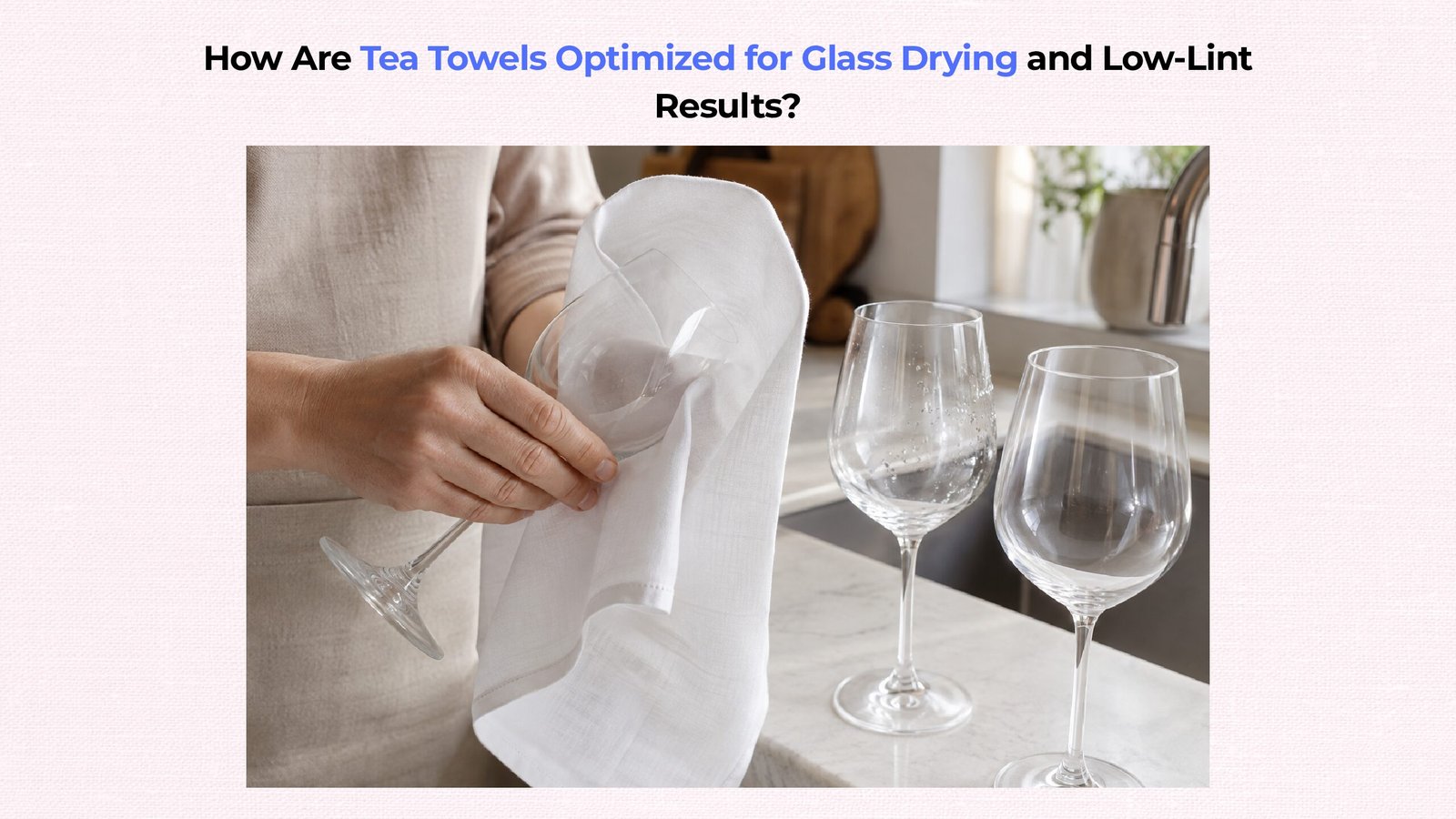
A finished-product method for comparing water pickup, visible shedding, streaks, drying, and safe glass contact.
A tea towel is optimized for household glass drying when the finished product picks up the remaining water film, leaves no unacceptable visible particles or streaks under the chosen inspection light, contacts the glass without damaging force, and dries fully between uses. Flat construction, fiber content, yarn preparation, and finishing can influence those outcomes, but none guarantees them. The reliable approach is to define each task, test representative towels under the same conditions, and follow the care label after selection.
Once the general purpose is established, how tea towels perform when cleaning and drying glass becomes the next question because moisture removal and visible finish must be assessed separately.
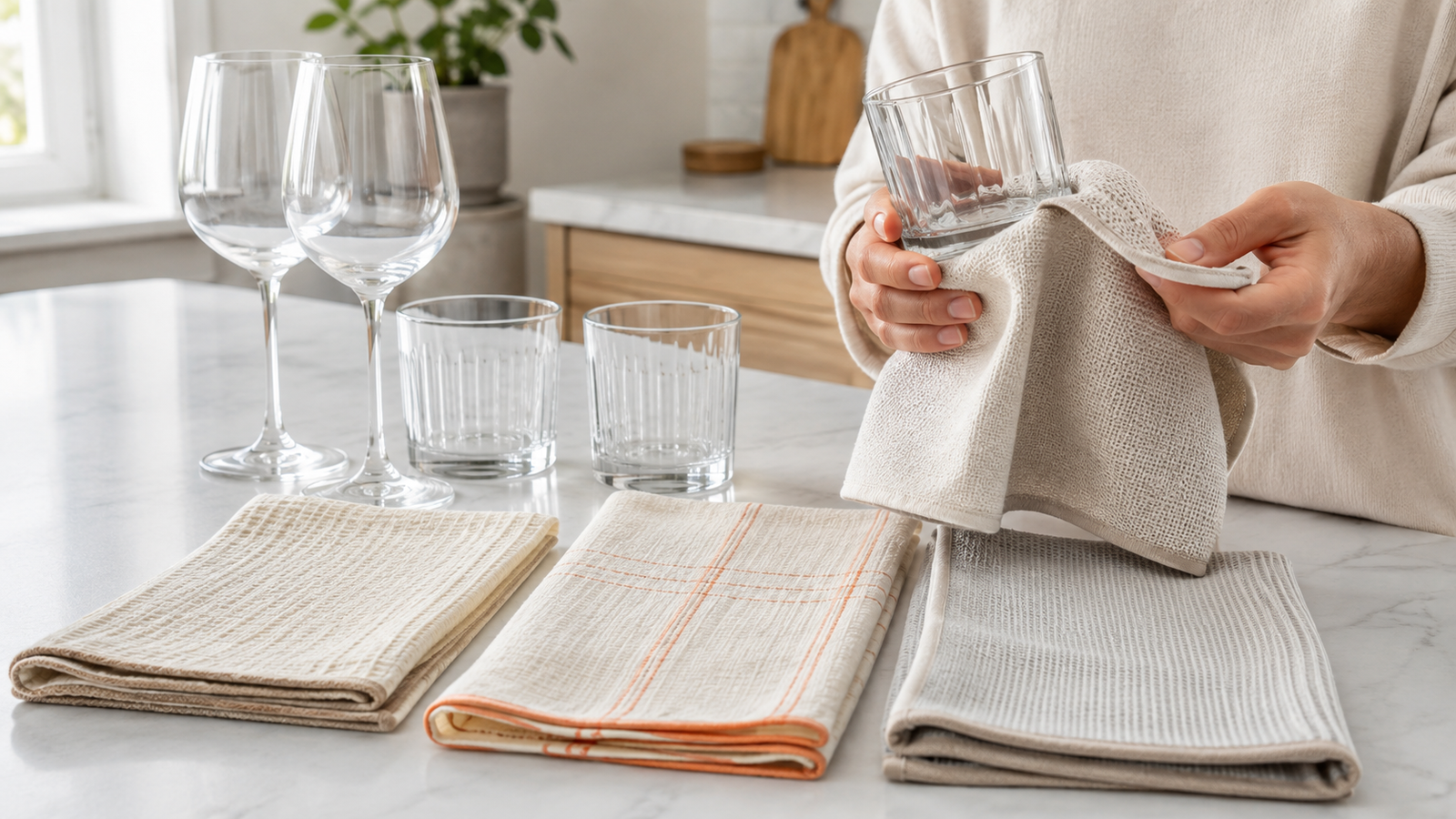
What must a tea towel do to dry glass with low visible lint?
A useful glass-drying tea towel must perform four separate jobs: begin wetting, remove a practical water load, avoid transferring visible particles or residue, and remain controllable on fragile shapes. Calling a towel “lint-free” should therefore mean that it meets a stated inspection criterion, not that it can never release a fiber.
Wetting describes how readily water enters or spreads through a textile surface. Water pickup describes how much of a defined surface film the towel removes. Capacity describes how much water the towel can retain before it stops working effectively. Drying rate describes water loss under stated air, temperature, humidity, and specimen conditions. These properties interact, but they are not interchangeable.
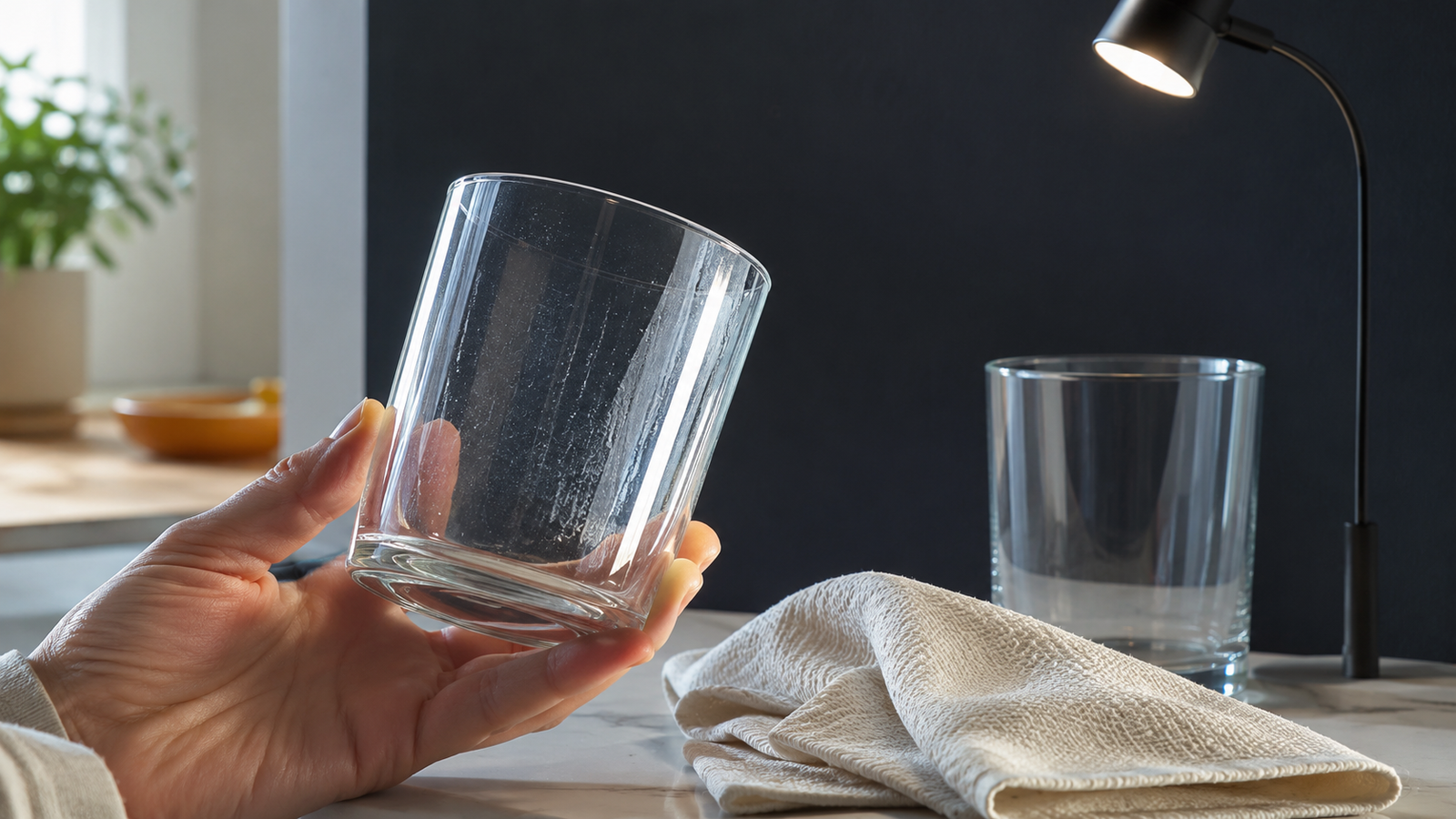
Visible lint is also task-specific. A towel may pass an ordinary daylight inspection yet fail under directional light on dark glass. Loose material can come from the fabric face, hems, labels, damaged yarns, or contamination from another laundry load. Record the inspection distance, lighting, glass type, and acceptance limit so supplier comparisons use the same definition.
Wetting
Does a controlled droplet enter the conditioned fabric instead of remaining on top?
Transfer
Does one defined wipe leave visible fiber, haze, or residue on the glass?
Recovery
Does the towel dry completely under the actual hanging and ventilation conditions?
How should tea-towel wetting, pickup, drying, lint, and streaks be tested?
Test each property with a separate, repeatable procedure because a towel can wet quickly yet hold too little water, absorb well yet shed visibly, or dry quickly yet smear residue. Condition every candidate the same way, use equal specimens or complete towels, and document water, glass, load, motion, lighting, and laundering.
Which textile test methods apply to tea towels, and where do they stop?
No single cited method proves complete glass-drying performance. AATCC’s moisture-management program lists nine separate methods covering absorbency, liquid movement, wicking, drying, and vapor transmission. ASTM D4772 measures rapid surface-water absorption by terry fabrics but expressly excludes non-terry products such as huck and flour-sack towels, so it cannot validate a flat tea towel.
A supplier should name the exact method, edition, specimen conditioning, result units, sample count, and variation. “Tested for absorbency” is incomplete without that information. A laboratory method answers only its defined property; it does not automatically predict visible lint, streak transfer, stemware safety, or drying in a particular kitchen.
| Property | Controlled check | Record | What it does not prove |
|---|---|---|---|
| Initial wetting | Place the same water volume on conditioned specimens without pressure. | Time, spread, penetration, face tested, and water conditions. | Total capacity or lint transfer. |
| Surface pickup | Apply a repeatable water film to identical glass and make one defined pass. | Water removed, passes required, pressure, motion, and glass type. | Between-use drying or long-term durability. |
| Visible transfer | Inspect the glass before and after wiping under the same directional light. | Particle count or grade, haze, streaks, seam contact, and inspector. | Microscopic or microbiological cleanliness. |
| Drying | Wet to the same load, hang the same way, and weigh or assess at set intervals. | Time, airflow, humidity, temperature, wet mass, and dry criterion. | Wetting speed on the next use. |
How can a household comparison become a useful verification trial?
A household trial becomes useful when it controls variables and sets a pass criterion before comparison. Buy at least two representative towels per candidate if possible, mark them, launder them identically according to their labels, and repeat each check rather than accepting one favorable result.
- ☐ Use the same clean glass shape, water source, water volume, fold, hand motion, and number of passes.
- ☐ Inspect against both a light and dark background under the same directional light.
- ☐ Separate face shedding from hem, label, and damaged-edge shedding.
- ☐ Repeat the test when new, after initial care, and after representative use-and-laundry cycles.
- ☐ Record smearing, snagging, slow wetting, saturation, odor, shrinkage, and distorted hems.
Which tea-towel constructions support controlled glass contact?
Smooth, stable, low-profile constructions often support broad contact and easy particle inspection, but “flat weave” is a category rather than a performance certificate. Plain, huck, damask, and other low-pile constructions can differ in yarn size, density, finish, hems, stiffness, and water capacity.
A fabric with little pile may glide evenly around a bowl and make loose particles easier to see. A more open structure may dry efficiently in one environment yet distort, snag, or hold too little water in another. A dense structure may feel stable but become stiff, heavy, or slow to dry when saturated. GSM reports mass per area; it does not identify weave, thickness, pore structure, wetting, shedding, or useful capacity by itself.
Terry is not automatically unsuitable. Its loops can provide useful surface-water pickup, but pile height and loose fiber ends may complicate fine polishing or visual particle control. Compare the finished product instead of assuming every low-pile towel beats every terry towel. Pay special attention to hems and decorative bands because they may behave differently from the main fabric.
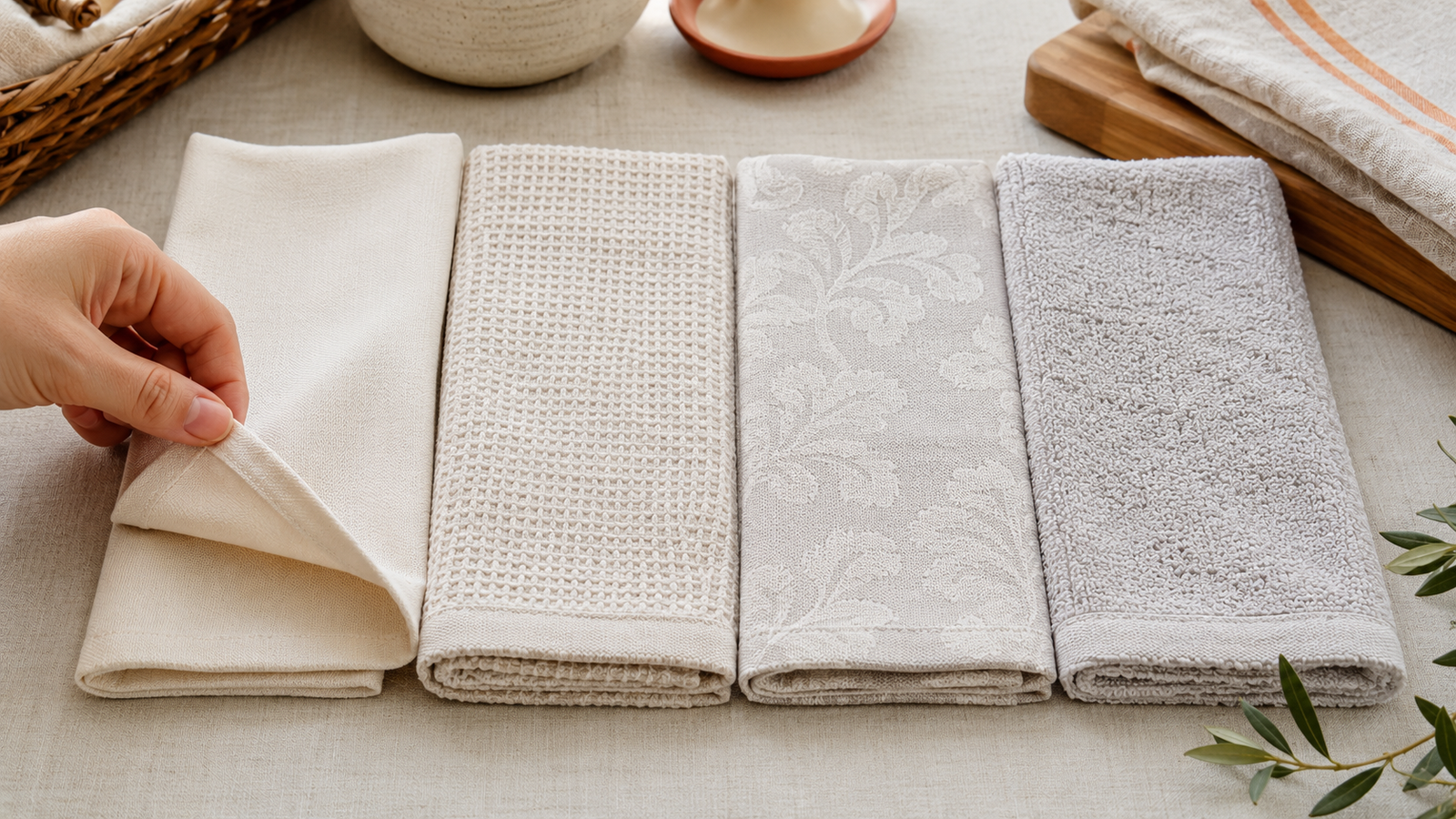
What do fiber and yarn labels reveal about glass-drying tea towels?
Fiber and yarn labels identify inputs or manufacturing claims, not the finished towel’s complete behavior. Cotton, linen, blends, and manufactured fibers can each succeed or fail depending on yarn construction, fabric geometry, finishing, contamination, edge quality, and laundering.
Fiber percentages become more meaningful when considered alongside how tea-towel materials and blends affect glass cleaning and drying rather than being treated as finished-performance guarantees.
| Label or claim | Potential relevance | Verification still required |
|---|---|---|
| Cotton | Cellulosic fiber that can support useful wetting and water storage after suitable processing. | Finished wetting, pickup, residue, shedding, shrinkage, and drying. |
| Linen | Bast-fiber construction often chosen for crisp, low-profile household textiles. | Surface comfort, stiffness, creasing, seam behavior, pickup, and visible transfer. |
| Blend | May combine properties, but percentage alone does not show fiber placement or yarn construction. | All task-level performance on the finished towel. |
| Long-staple or combed cotton | May indicate an attempt to remove short fibers or produce a smoother yarn. | Claim documentation and shedding after cutting, hemming, washing, and abrasion. |
| Compact-spun yarn | May reduce yarn hairiness under defined spinning conditions. | Surface hair, lint transfer, durability, and whether the claim applies to the whole product. |
How can singeing, biopolishing, and prewashing change tea-towel performance?
Singeing, enzyme treatment, and prewashing can alter surface hair, loose-fiber release, hand, wetting, shrinkage, or appearance, but the result depends on the process and textile. These terms should narrow the questions asked of a supplier; they should not be converted into “zero-lint” guarantees.
Singeing exposes protruding fibers to a controlled heat source to reduce surface hair. Biopolishing commonly uses enzymes to modify accessible cellulosic fibrils under controlled conditions. Prewashing may remove some processing residues or loose material and reveal dimensional change. Excessive or poorly controlled processing can also affect strength, shade, hand, or later durability.
Ask whether the process was applied to yarn, fabric, or finished towel; what measurable before-and-after property changed; and whether the hems and labels were evaluated. If a supplier cannot provide that scope, treat the term as descriptive. Confirm the final towel through the same transfer and laundering trial used for unclaimed products.
Material choice is only one variable, making what helps a tea towel produce low-lint results important when comparing yarn structure, weave, finishing, hems, and surface condition.
How should tea towels be selected for a specific glass-drying task?
Select tea towels by matching finished performance to the glass type, water load, inspection standard, laundry process, and drying space. Begin with supplier documentation, then run a small wash-and-use trial before buying a large set.
Delicate stemware may prioritize low bulk, smooth hems, and precise control. Large tumblers may require more useful water capacity. A humid kitchen with little hanging space may make complete between-use drying a limiting factor. Dark or high-gloss glass can make particles and streaks more visible than ordinary clear tumblers.
For glassware inspected under directional light, which tea-towel materials support low-lint performance should be evaluated through controlled use and laundering trials.
- ☐ Define the glasses, usual remaining water, daily volume, inspection light, and acceptable transfer grade.
- ☐ Confirm fiber content, dimensions, care instructions, hems, labels, shrinkage information, and test-method references.
- ☐ Compare new and conditioned samples for wetting, pickup, streaking, shedding, hand control, and drying.
- ☐ Reject towels that snag, twist fragile glass, transfer odor or residue, remain damp, or lose stable edges.
- ☐ Retain one approved reference towel and repeat the trial if supplier construction or laundry chemistry changes.
How should a tea towel be used on household glassware?
Use a clean, dry, undamaged tea towel with light controlled contact, support the glass near the area being polished, and stop when the towel becomes too damp to remove the remaining film. The objective is stable pickup without twisting, high pressure, repeated dirty passes, or contact from a contaminated edge.
Once the towel has accumulated moisture, the factors that determine tea-towel drying time become important for deciding when to expose a clean section or replace the damp towel.
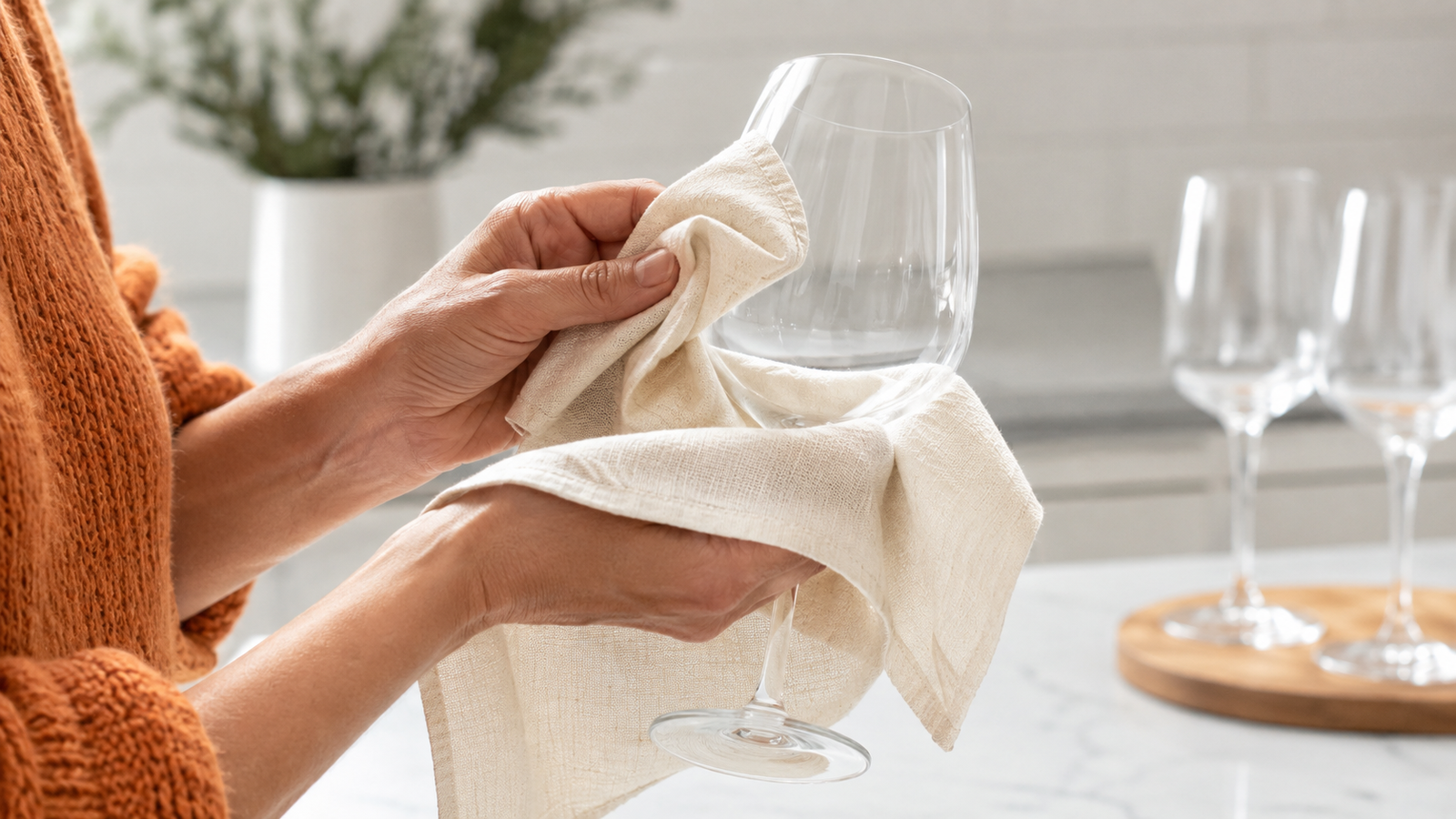
What glass-polishing sequence limits twisting and re-deposition?
A safe sequence separates clean towel surfaces and supports delicate glass components. Riedel’s published care guidance recommends using two cloths, holding a wine glass at the bottom of the bowl while cleaning the bowl, and holding the base while cleaning the base and stem. It warns against holding the base and bowl simultaneously because twisting can break the stem.
- Inspect the glass for chips or cracks and follow the manufacturer’s washing and handling instructions.
- Wash hands and choose a towel section free of labels, damaged hems, odor, oil, and visible debris.
- Support the glass near the area being dried; avoid applying opposing torque through a stem.
- Use light passes and expose a clean towel area as water accumulates.
- Inspect under consistent light. Rewash rather than polishing over grease, detergent film, or adhered debris.
- Retire the towel from glass use when it becomes damp, contaminated, damaged, or visibly shedding.
Why is foodservice glass drying a separate compliance question?
Foodservice rules can prohibit the household drying method. Section 4-901.11 of the FDA Food Code 2022 says cleaned and sanitized equipment and utensils must be air-dried or used after adequate draining and may not be cloth dried. It allows already air-dried utensils to be polished with cloths maintained clean and dry.
The Food Code is a model that jurisdictions may adopt or modify, so an operator must follow the applicable local code and approved establishment procedure. A tea towel selected for home drying is not automatically a compliant foodservice polishing cloth, and a polishing step does not replace cleaning, sanitizing, adequate draining, air-drying, or protected storage.
How should glass-drying tea towels be washed, dried, and stored?
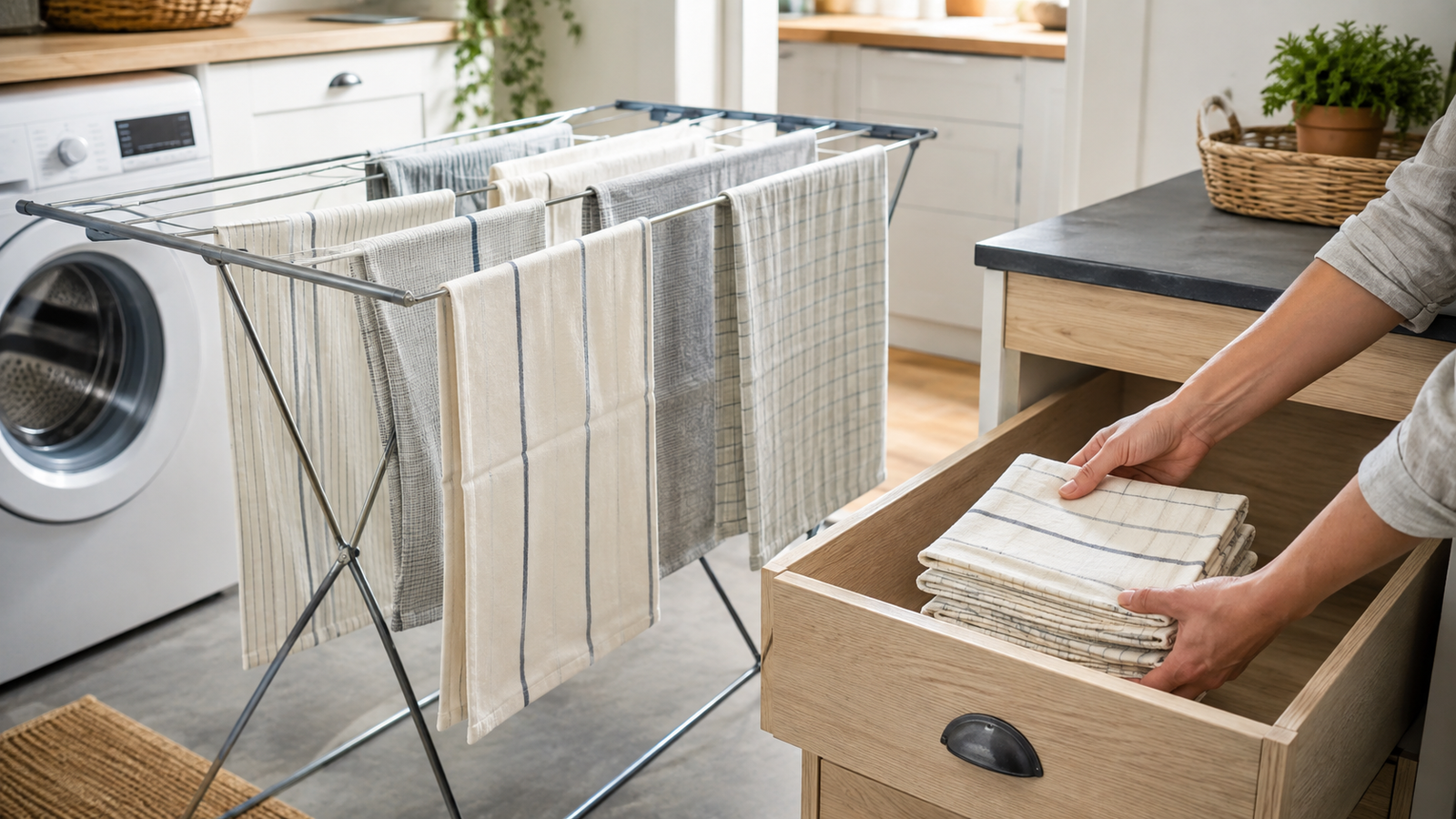
Wash, dry, and store glass-drying tea towels according to the textile care label and the washer, detergent, and dryer instructions. Keep them away from greasy textiles and products that can transfer fragrance, coating, dye, debris, or cleaning residue, then dry them completely before clean storage.
Because detergent residue, softener, incomplete rinsing, and damaged fibers can alter performance, how to wash tea towels without reducing their effectiveness should guide the care process between glass-drying tasks.
There is no universal requirement for three pre-washes, a fixed detergent volume, one wash temperature, or a maximum dryer temperature. Load size, water hardness, machine design, soil, textile construction, chemistry, and care labeling all change the appropriate process. More detergent is not always better, but an arbitrary reduced dose can also clean inadequately; use the labeled amount for the actual conditions.
If softener use coincides with slower wetting or new smearing, compare one affected towel with an otherwise equivalent towel laundered without softener, while following product directions. Do not prescribe vinegar, citric acid, bleach, or improvised “stripping” as a universal recovery method. Mixing incompatible laundry chemicals can create hazards and may damage the textile, machine, or glass-contact performance.
Hang or tumble the towel as permitted until fully dry, then store it in a clean, dry place protected from splash, dust, cooking aerosol, and cleaning chemicals. Retire towels from glass duty when hems unravel, fabric becomes stiff or distorted, odor persists after correct washing, visible transfer exceeds the acceptance limit, or water pickup no longer supports the task.
What causes lint, streaks, odor, or poor water pickup from a tea towel?
Tea-towel failures usually come from the finished construction, contamination, an unsuitable laundry process, inadequate drying, damage, or a mismatch between towel capacity and the task. Diagnose one variable at a time instead of assuming the fiber label identifies the cause.
If visible fibers remain on the glass, what causes tea-towel lint during use helps separate face shedding from damaged hems, labels, abrasion, and laundry-related damage.
| Symptom | Check first | Controlled next action | Retire or escalate when |
|---|---|---|---|
| Water is pushed around | Face tested, new-product finish, contamination, saturation, and care history. | Launder exactly as labeled, dry fully, and repeat the same droplet and pickup checks. | Wetting or pickup remains below the defined pass criterion. |
| Visible lint appears | Whether material comes from face, hem, label, damage, or mixed laundry. | Inspect before wiping, isolate the towel load, and repeat under identical light. | Transfer persists after correct care or edges continue to unravel. |
| Glass shows streaks or haze | Glass cleanliness, rinse quality, hand oil, towel residue, and towel dampness. | Rewash the glass, use a verified clean dry towel, and compare one controlled pass. | Residue persists across clean glass and a verified reference towel. |
| Towel develops odor | Time left damp, airflow, storage, soil level, and laundry directions. | Correct drying and storage conditions, then launder according to all labels. | Odor persists after correct cleaning and complete drying. |
| Towel becomes stiff or distorted | Heat exposure, chemistry, residue, shrinkage, and damaged seams. | Review care compliance and compare with an unused retained sample. | Stiffness impairs control or deformation creates snag and breakage risk. |
A towel can leave a glass free of lint yet still produce marks, so examining why tea towels leave streaks on glassware is the next step when residue, saturation, or re-deposition affects the finish.
What should buyers ask before ordering glass-drying tea towels in bulk?
Buyers should request traceable construction, care, test, and change-control information, then approve a representative production sample after laundering and use. A marketing phrase such as “professional,” “lint-free,” or “glass cloth” is not a measurable purchase specification.
Ask for fiber percentages, yarn and weave description, finished dimensions and tolerances, mass-per-area method, hem and label construction, finishing processes, dimensional-change data, colorfastness scope, and the exact methods behind wetting or drying claims. Require lot identification and notification when fiber, yarn, mill, finish, dimensions, or care instructions change.
Translate the intended use into acceptance criteria: maximum acceptable visible transfer under defined light, minimum pickup during a stated pass, acceptable drying time in the actual environment, edge stability after a representative laundry sequence, and safe handling on the target glass. Keep an approved reference sample so later deliveries can be compared consistently.
What are the most common questions about glass-drying tea towels?
The most useful answers separate fiber and finish claims from verified finished-product behavior. They also distinguish household drying from regulated foodservice handling and avoid universal recovery recipes that ignore textile, appliance, and chemical instructions.
Are linen tea towels always better than cotton for glass drying?
No. Fiber content alone does not establish wetting speed, water capacity, visible shedding, stiffness, or drying rate. Compare finished linen, cotton, and blended towels after equivalent laundering, using the same glass, water volume, wiping pattern, inspection light, and between-use drying conditions.
Why does a new tea towel push water instead of absorbing it?
A new towel may wet slowly because of removable finishing material, packaging contamination, or its finished construction. Wash it exactly as its care label directs, dry it fully, and repeat the same droplet check. Reject it if pickup remains poor or residue appears on glass.
Does singeing make a tea towel lint-free?
No. Singeing can reduce exposed surface fibers, but it does not prove zero shedding after cutting, hemming, laundering, or abrasion. Treat the finish as a supplier claim, inspect seam and face shedding separately, and confirm performance after representative wash-and-dry cycles.
Should fabric softener be used on glass-drying tea towels?
Follow both the towel and laundry-product instructions. If a towel begins wetting slowly, smearing glass, or transferring residue after softener use, compare it with an otherwise identical towel washed without softener. Do not use improvised stripping chemicals or combine incompatible laundry products.
Can foodservice glassware be dried with a tea towel?
In the FDA Food Code model, cleaned and sanitized utensils must air-dry or drain adequately before use; cloth drying is not allowed. Utensils that have already air-dried may be polished with clean, dry cloths. Local rules and the establishment’s approved procedure still govern.
What defines a well-optimized glass-drying tea towel?
A well-optimized tea towel is the finished product that passes the user’s defined wetting, pickup, visible-transfer, streak, control, durability, and drying checks after representative care. Flat construction, cotton, linen, long-staple yarn, compact spinning, singeing, biopolishing, and prewashing may guide candidate selection, but none replaces task-specific verification.
For household use, pair the verified towel with clean glass, light pressure, supported handling, dry towel sections, complete between-use drying, and label-compliant laundering. For foodservice, start with the applicable code and approved procedure: the FDA model requires air-drying or adequate draining and permits clean, dry cloth polishing only after the utensil has air-dried.