Toweldaily.com · Laundry & Towel Care
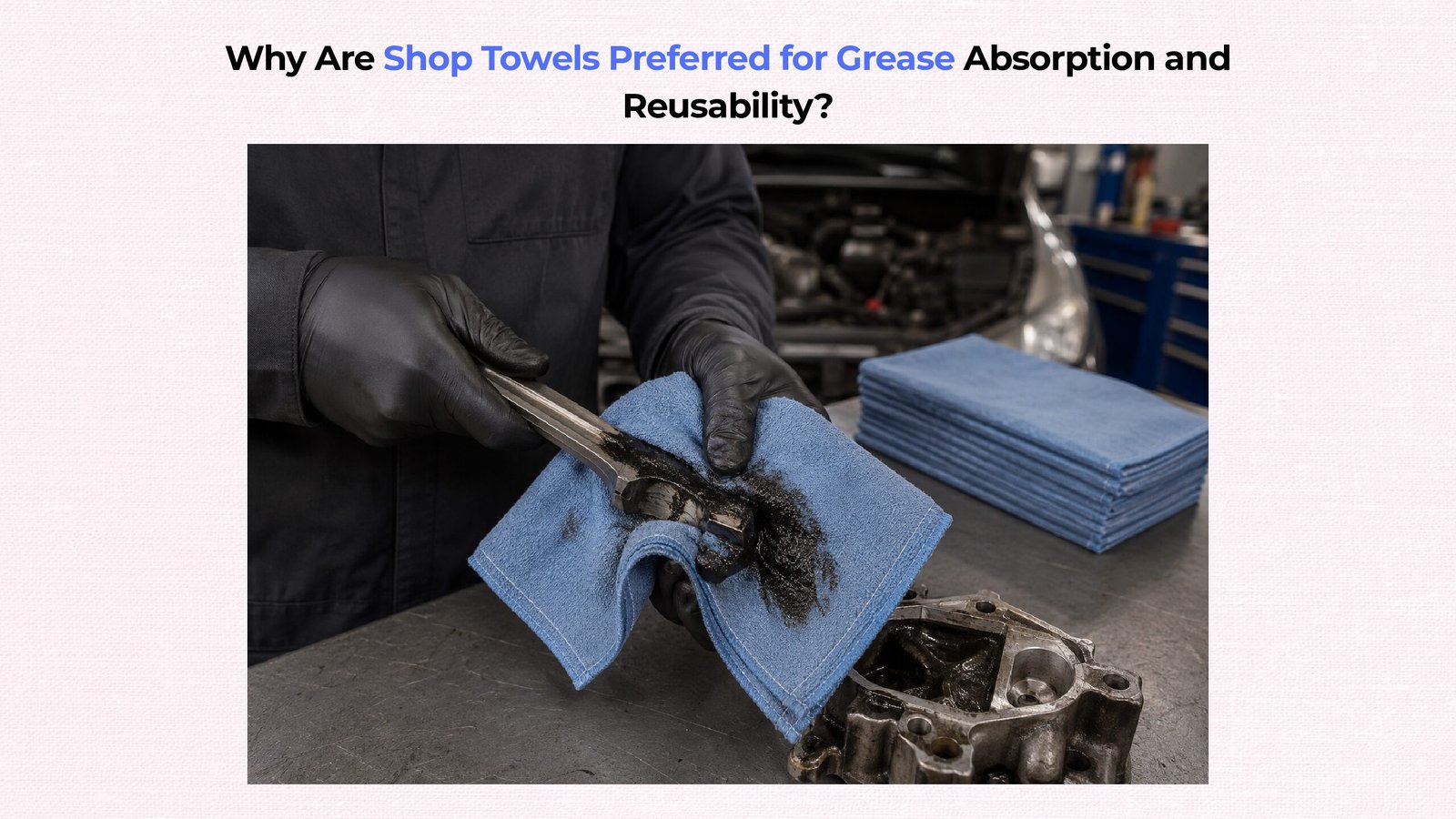
Reusable shop towels are often preferred when a facility needs a conformable wipe that remains intact through repeated contact, can be collected under a controlled system, and can be cleaned and inspected for another approved use. That preference is conditional: the contaminant, surface, task, fire controls, waste rules, and laundry process all matter.
“Grease absorption” is useful everyday language, but a wipe may remove grease through surface wetting, adhesion, mechanical displacement, storage in yarn and fabric voids, and retention during lifting. A towel that picks up oil quickly may still smear at saturation, release residue, shed lint, damage a sensitive surface, or become unsafe to launder.
Why are reusable shop towels used for grease-wiping tasks?
Reusable shop towels can suit grease wiping because a flexible textile provides repeated contact, usable internal volume, and mechanical integrity after becoming wet or oily. They are preferred only when the finished product passes the task and the facility can manage the contaminated towel safely.
Once a reusable format is being considered, what determines whether a shop towel can be safely reused becomes more important than assuming every grease-soiled textile can enter the same laundry process.
The term “shop towel” is not one standardized construction. Products include woven cotton or cotton-rich fabrics, knitted wipes, microfiber constructions, reclaimed textiles, and disposable nonwovens. Terry, huck, waffle, jersey, and flat weaves create different contact surfaces, but the category name does not guarantee oil capacity, lint, strength, chemical compatibility, or wash life.
A reusable format can reduce repeated purchasing and solid-waste volume in some systems, but laundering, collection, transport, rejected inventory, wastewater controls, loss, and final disposal remain part of the lifecycle. Cost and environmental claims require facility-specific accounting rather than a reusable-equals-better assumption.
Which shop-towel construction features affect grease pickup and retention?
Grease pickup and retention depend on fiber surface, yarn structure, fabric geometry, mass, thickness, finishes, edges, dimensions, compression, contaminant viscosity, temperature, and use technique. No single loop, fiber, or GSM value predicts the finished result.
- Contact geometry controls how much of the wipe conforms to peaks, recesses, edges, and tool shapes under the applied pressure.
- Void volume creates potential storage space, but only voids reached by the contaminant under the test conditions contribute to usable capacity.
- Wet or oily strength affects whether the towel remains intact during dragging, twisting, wrapping, and repeated passes.
- Surface finish and laundry residue can alter wetting, friction, transfer, and the visible finish left on the workpiece.
- Edges, seams, labels, and embedded debris may create lint, snags, scratches, or contamination even when the main fabric performs well.
Because oily strength affects whether a wipe tears or leaves fragments, the factors that determine paper-towel strength should be checked under the contaminant and handling conditions expected in service.
How should grease pickup by a shop towel be measured?
Measure grease pickup with a protocol that fixes the contaminant, starting mass, surface, applied amount, temperature, contact pressure, stroke pattern, dwell, drainage time, and endpoint. Use at least three conditioned specimens per product and report retained contaminant in grams per gram of dry wipe together with smear, lint, and release results.
ASTM F726-17(2024) is a scientific counterpart for sorbent-performance testing, but its scope covers adsorbents removing crude oils and other floating immiscible liquids from water. It is not a shop-surface wiping method, so its result should not be presented as direct proof of workshop performance.
How do reusable shop towels compare with paper wipers and microfiber?
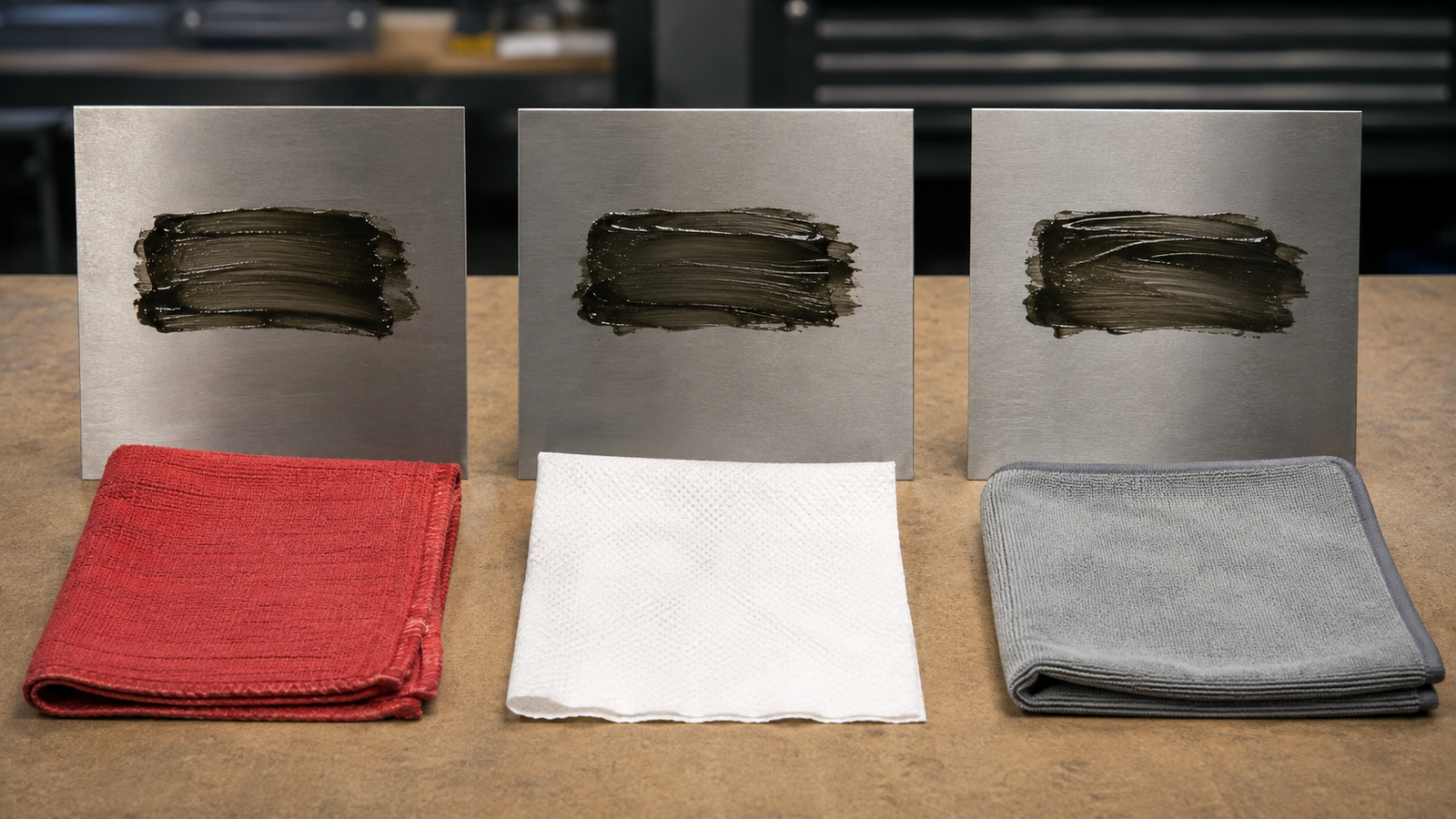
Reusable shop towels, disposable paper or nonwoven wipers, and microfiber should be compared under the same contaminant and task. None is universally strongest, lowest-lint, most absorbent, safest, cheapest, or most sustainable.
Facilities comparing reusable textiles with disposable alternatives should also examine the practical benefits and limitations of blue paper shop towels under the same contaminant, surface, wiping pattern, and acceptance criteria.
| Decision factor | Reusable woven shop towel | Disposable paper or nonwoven wiper | Microfiber wipe |
|---|---|---|---|
| Contact and strength | May provide conformability and repeated passes; test oily strength and seams. | Strength varies widely by grade and binder; test when loaded. | Construction varies; test snagging, drag, and oily strength. |
| Pickup and retention | Verify capacity, saturation behavior, and release under lifting. | Verify pickup before structural failure or smear. | Verify compatibility with the grease and any prior finish or residue. |
| Lint and surface finish | Check face, hems, labels, wear, and embedded debris. | Check fiber or binder transfer under realistic pressure. | Check edge construction, particle retention, and finish on the workpiece. |
| Contamination control | Requires assignment, closed collection where applicable, cleaning, and inspection. | May simplify one-use segregation, but disposal rules still apply. | Requires strict separation and compatible cleaning to prevent transfer. |
| Lifecycle decision | Include rental or purchase, collection, laundry, loss, rejects, and final disposal. | Include purchase, inventory, handling, disposal, and required waste treatment. | Include purchase, specialized care if required, loss, rejects, and disposal. |
For demanding wiping tasks, how paper towels perform during heavy-duty cleaning provides a useful comparison with reusable shop towels when smear, residue, lint, breakage, and consumption are recorded.
Use the smallest format that completes the task without unsafe saturation or excessive replacement. A disposable wiper may be preferable for strict one-use segregation or a contaminant rejected by the laundry, while a reusable towel may be preferable for repeated mechanical wiping within an approved collection system.
How should contaminant hazards change shop-towel selection?
Contaminant hazards must be identified before choosing a shop towel because a material that is effective to wipe can still create exposure, ignition, incompatibility, transport, or waste problems. The wipe never replaces engineering controls, spill procedures, personal protective equipment, or chemical-specific training.
When wipes may approach food-handling or food-storage areas, the food-safety limits of shop-towel use help explain why chemical-contaminated towels require controlled separation, containment, cleaning, and storage.
| Contaminant situation | Control question | Reuse boundary |
|---|---|---|
| Known lubricating oil or grease | Does the SDS and facility procedure permit textile wiping and the planned container? | Reuse only if the laundry accepts the exact soil and inspection confirms serviceability. |
| Flammable solvent or coating | What ignition, ventilation, container, labeling, and waste controls apply? | Follow the applicable solvent-wipe rule and local adoption; do not improvise ordinary laundry. |
| Unknown mixture | Can every component and reaction hazard be identified? | Stop and use the facility’s unknown-material procedure before selecting or collecting a wipe. |
| Lead, asbestos, pesticides, or other toxic material | What exposure and take-home controls apply? | Do not home-launder; use the employer’s contaminant-specific system and authorized provider. |
| Abrasive particles or metal chips | Can the towel trap hard debris and later scratch a surface or injure a handler? | Segregate and retire according to procedure when embedded debris cannot be removed reliably. |
Which safety-data-sheet sections control shop-towel handling?
Use the chemical label, safety data sheet, and facility procedure before wiping. OSHA’s 16-section SDS format places hazard identification in Section 2, accidental-release controls in Section 6, handling and storage in Section 7, exposure controls and PPE in Section 8, and stability and incompatibility information in Section 10.
OSHA’s Hazard Communication Standard requires chemical-specific information to be available through labels and safety data sheets and requires effective worker information and training. Section 13 disposal information may appear on an SDS, but applicable federal, state, and local rules still govern the actual decision.
When can a grease-soiled shop towel be reused?
A grease-soiled shop towel can be reused only when the contaminant is eligible for the planned cleaning route, the towel is collected and transported correctly, the laundry accepts it, the cleaning process removes soil to the required level, and inspection confirms that the towel remains safe for its assigned task.
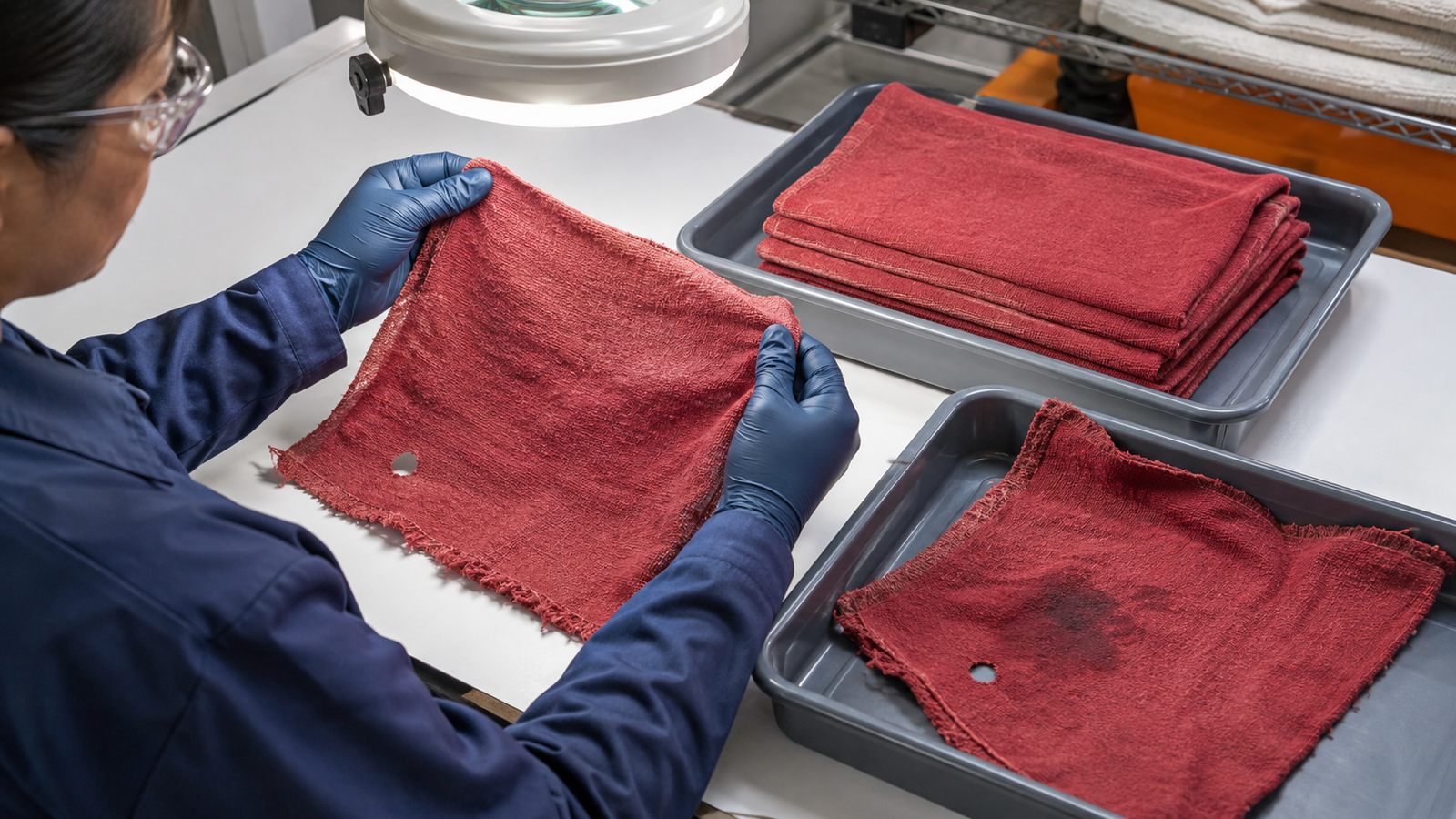
Laundering does not make every towel “clean as new.” Stains can mask new contamination, fibers can retain particles, hems can fail, and residual oil or detergent can change pickup and transfer. Return-to-service criteria should address odor, free liquid, visible debris, residue, holes, thinning, lint, dimensions, and task performance.
What does EPA require for qualifying solvent-contaminated reusable wipes?
Under the U.S. federal reusable-wipes exclusion at 40 CFR 261.4(a)(26), qualifying solvent-contaminated wipes sent for cleaning must meet conditions that include recordkeeping, closed containers, labeling, no more than 180 days of accumulation, and no free liquids when sent for cleaning.
The EPA’s current implementation FAQ explains that the exclusion is conditional and does not cover wipes made hazardous by non-solvent contaminants through toxicity, corrosivity, or reactivity. State adoption can differ, so the facility must confirm applicable requirements with its regulator.
How should used shop towels be contained before cleaning or disposal?
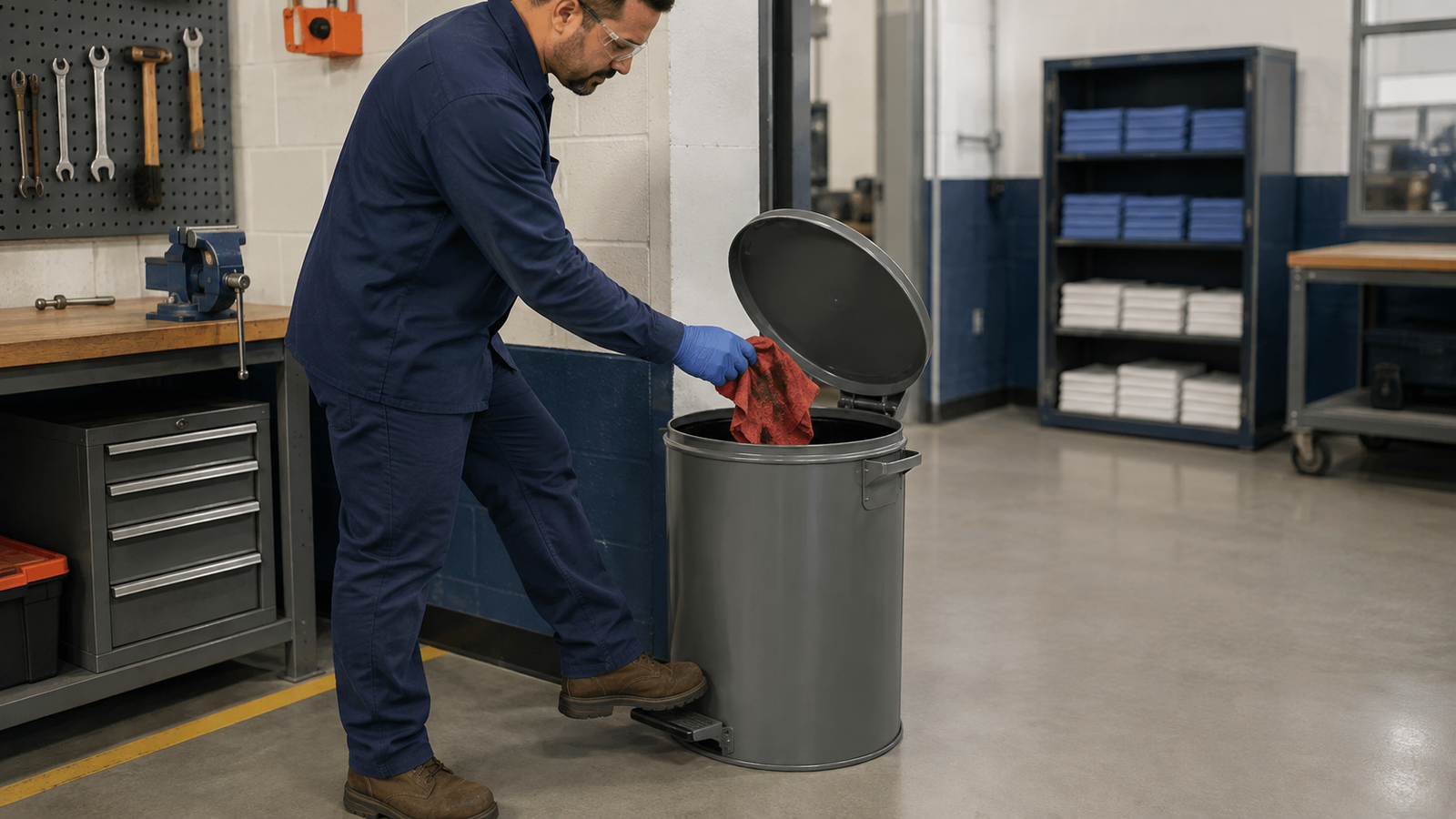
Used shop towels should enter the facility’s designated, compatible, labeled, closed collection system immediately after use. Container material, closure, location, segregation, removal frequency, and emergency controls must match the contaminant and applicable rule.
- ☐ Identify the contaminant and confirm the correct collection stream before placing the towel in a container.
- ☐ Keep incompatible chemicals, abrasive chips, unknown mixtures, and other restricted soils out of the reusable-wipe stream.
- ☐ Use the required compatible container and keep it closed except when adding or removing wipes, where the governing rule permits.
- ☐ Apply the required label and record the accumulation start or other tracking information specified by the facility procedure.
- ☐ Keep the container away from ignition sources, vehicle traffic, drains, food areas, and unauthorized access as required.
- ☐ Manage separated free liquid through the approved waste route; do not pour it into a sink, floor drain, soil, or ordinary trash.
OSHA 29 CFR 1910.106(e)(9)(iii) requires combustible waste material and residues in operating areas to be kept to a minimum, stored in covered metal receptacles, and disposed of daily. OSHA has clarified that “disposed of daily” can mean transfer into a suitable covered receptacle at or near the point of generation, not necessarily final off-site disposal that day.
How should reusable shop towels be laundered safely?
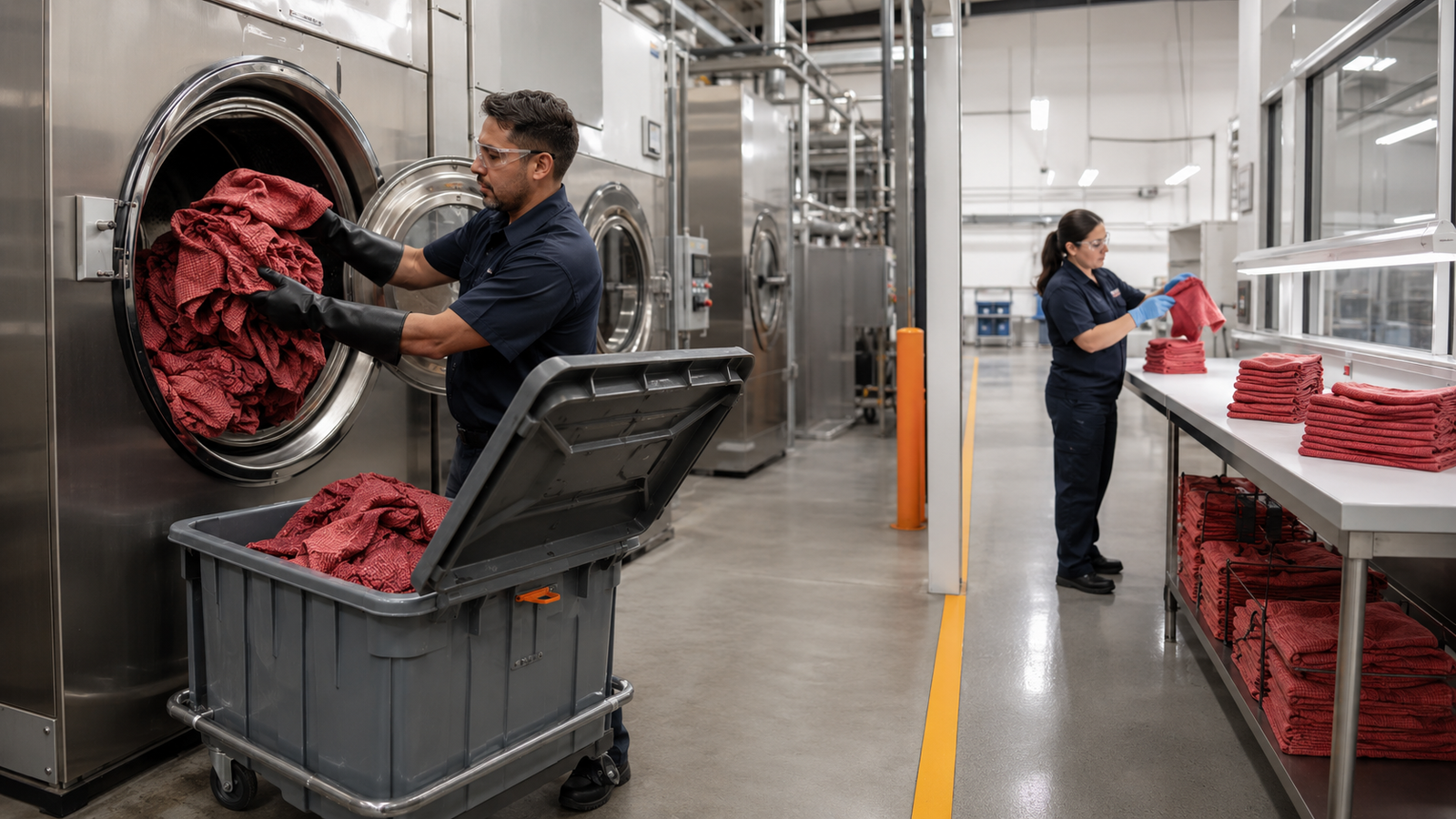
Reusable shop towels should be cleaned only through a process approved for the identified contaminant, towel construction, equipment, wastewater route, and jurisdiction. There is no universal 60°C temperature, alkaline dose, rinse count, extraction setting, or dryer temperature.
An industrial laundry may use temperature, chemistry, time, mechanical action, rinsing, extraction, and drying as an integrated formula. The formula must remove the accepted soil without creating incompatible reactions, uncontrolled emissions, unsafe residues, or textile damage. “Hotter” and “more detergent” are not independent guarantees of cleanliness.
Do not bring industrial towels home merely because they look washable. NIOSH take-home-exposure guidance identifies substances such as lead, pesticides, beryllium, and asbestos and emphasizes preventing workplace chemicals from leaving the workplace. Contaminant-specific employer procedures take priority over domestic towel-care advice.
- Confirm in writing that the laundry accepts every contaminant assigned to the load.
- Preserve segregation and container controls during collection, transport, loading, and unloading.
- Follow the textile supplier, chemical supplier, equipment manufacturer, laundry provider, and regulator instructions together.
- Validate the process with residue, odor, performance, and damage criteria appropriate to the next use.
- Keep rejected towels out of clean inventory and route them for recleaning or approved disposal.
How should a facility select and validate reusable shop towels?
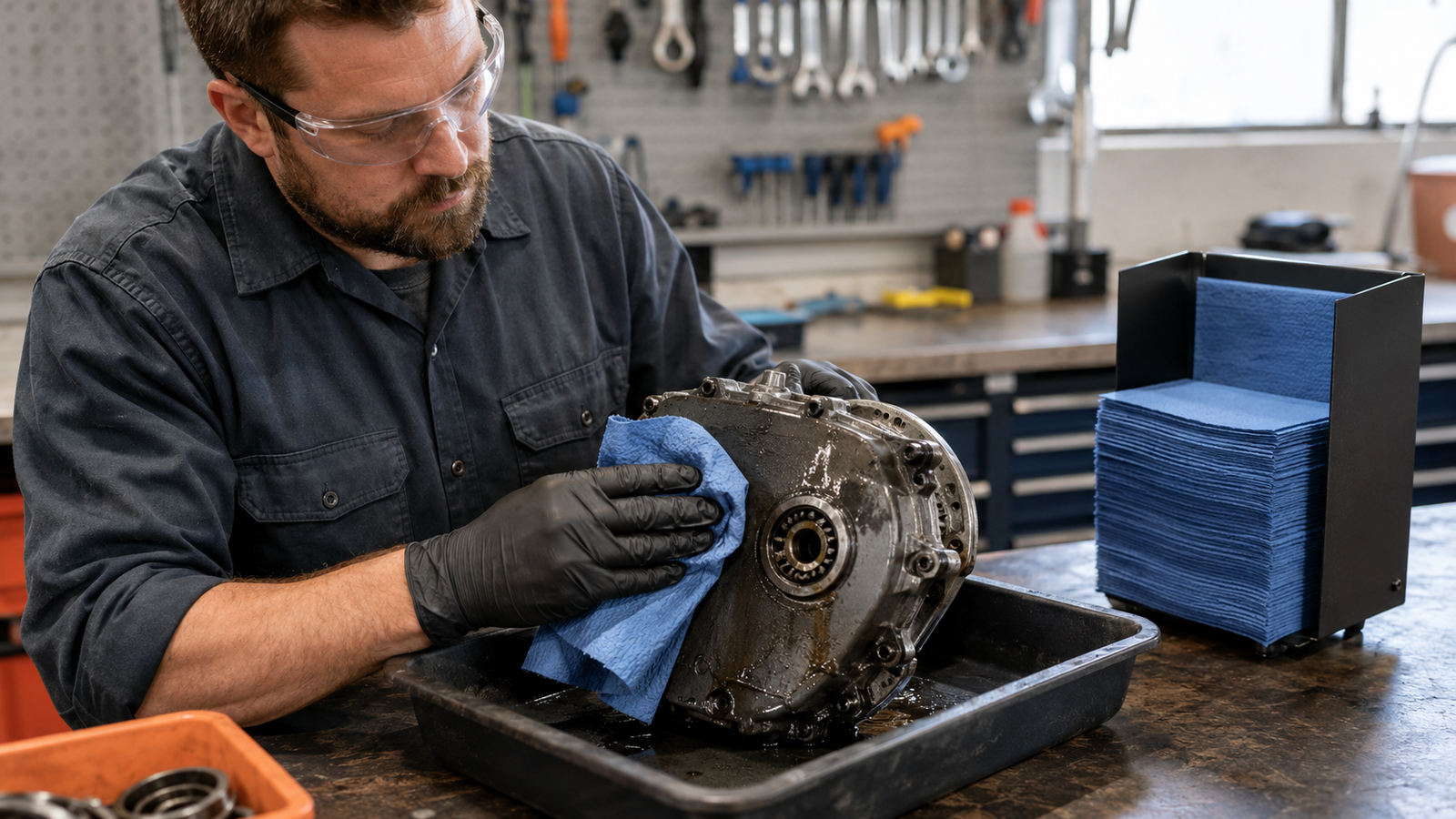
A facility should select shop towels through a representative trial that starts with the contaminant and surface, then evaluates pickup, retention, smear, lint, strength, ergonomics, containment, cleaning acceptance, post-laundry performance, and total cost.
Since a disposable wipe must remain intact during pressure, dragging, and repeated passes, what determines paper shop-towel durability should be evaluated separately from absorption capacity.
- Define the task. Record the chemical or grease, surface material, temperature, area, pressure, wiping pattern, cleanliness target, and replacement trigger.
- Screen hazards. Review the label, SDS, facility procedure, ignition controls, waste classification, and laundry acceptance before touching a sample to the contaminant.
- Choose candidates. Compare finished sizes, constructions, edges, colors, traceability, supplier consistency, and required collection systems.
- Run matched trials. Use at least three conditioned specimens per candidate with the same contaminant mass, surface, contact sequence, and endpoint.
- Measure the complete result. Record grams retained, number of controlled passes, smear, lint, residue, damage, saturation behavior, handling, and towels consumed.
- Validate the reuse loop. Send trial towels through the intended collection and cleaning system, then repeat the relevant performance and safety checks.
- Calculate accepted-use cost. Include purchase or rental, dispensing, collection, laundry, transport, losses, rejects, waste treatment, labor, and final disposal.
Set pass limits before comparing results. Keep an approved reference sample and periodically audit returned inventory. A change in supplier lot, contaminant, chemical process, laundry provider, washer formula, or workpiece can invalidate the earlier approval.
What causes shop towels to smear, shed lint, retain odor, or lose pickup?
Shop-towel failures usually come from saturation, an incompatible contaminant, embedded debris, structural wear, transferred soil, laundry residue, incomplete cleaning, or a mismatch between the towel and the surface. Diagnose the symptom before changing chemistry or temperature.
Pickup alone does not establish a clean finished surface, making how paper towels perform during surface cleaning relevant when comparing retained grease, smearing, lint, scratches, and visible residue.
| Observed failure | Check first | Controlled response |
|---|---|---|
| Grease smears | Saturation, exposed clean area, pressure, grease viscosity, and towel-to-surface compatibility. | Rotate or replace at a defined load; compare capacity and release under the same protocol. |
| Oil beads on the face | Surface finish, laundry residue, prior contaminant, temperature, and wetting method. | Quarantine the lot and compare a correctly processed control; do not prescribe an unapproved strip wash. |
| Visible lint | Worn face, cut edges, seams, labels, abrasive contact, and transferred lint from laundering. | Trace the source, inspect multiple samples, and reassign or retire failures. |
| Persistent odor or oily feel | Accepted-soil limit, load segregation, cleaning formula, rinsing, drying, and clean-storage conditions. | Keep the towel out of service and use the provider’s reclean or rejection route. |
| Scratches or embedded chips | Hard debris, workpiece cleanliness, collection segregation, and towel inspection. | Stop use on sensitive surfaces; segregate debris-bearing towels and correct the source. |
| Early holes or thinning | Sharp edges, mechanical load, chemical compatibility, heat, and laundering abrasion. | Map failure location, test a compatible construction, and define an earlier retirement criterion. |
Never use odor, color, or hand feel alone to prove that a towel is safe or clean. When the contaminant or reaction is uncertain, isolate the towel and follow the facility’s hazardous-material procedure.
What are the most common questions about reusable shop towels?
The most common questions concern grease performance, safe reuse, fabric softener, lifespan, and alternatives. Each answer depends on the contaminant and controlled service system rather than the towel label alone.
Why can a shop towel work well for grease wiping?
A finished shop towel can provide conformable surface contact, internal void volume, mechanical strength, and enough usable area for repeated passes. Performance still depends on the grease, surface, pressure, towel construction, finish, previous laundering, saturation point, and acceptance criteria.
Can every grease-soiled shop towel be laundered and reused?
No. Reuse depends on the contaminant, safety data sheet, applicable law, collection method, laundry acceptance, cleaning result, and inspection. Towels containing incompatible, toxic, reactive, or unapproved material may require specialized management rather than ordinary laundering or return to service.
Should fabric softener be used on reusable shop towels?
Do not apply a universal rule without the towel, chemical-product, appliance, and service-provider instructions. A laundry additive can change wetting, residue, surface feel, or pickup. If permitted, compare treated and untreated samples under the same grease load before approving the process.
How long does a reusable shop towel last?
There is no universal cycle count. Usable life ends when holes, thinning, damaged edges, embedded debris, staining that masks hazards, unacceptable lint, odor, residue, poor pickup, or contaminant restrictions prevent safe service. Track inspection failures and cost per accepted use.
Are reusable shop towels always better than disposable wipers?
No. The better format depends on contaminant hazards, required cleanliness, surface sensitivity, pickup and retention, cross-contamination controls, collection, laundry availability, waste rules, transport, and total cost. Run a representative trial and include both rejected wipes and cleaning operations in the comparison.
What is the best shop-towel decision for grease absorption and reusability?
The best decision is the towel and service system that safely completes the defined grease-wiping task, meets surface and cleanliness limits, controls the contaminated wipe, passes approved cleaning and inspection, and delivers acceptable cost per verified use.